
Shopify Plus starts at $2,300 per month on a three-year term or $2,500 per month on a one-year term in the United States. Treat that as the floor, not the total, because above roughly $800,000 in monthly GMV, Plus can shift to a revenue-tied platform fee.
That's the counterintuitive answer to how much is Shopify Plus per month. The published subscription is easy to quote, but it's rarely the number that decides whether upgrading makes financial sense. Term length, expansion stores, local pricing, payment processing, apps, integrations, and GMV-based fees can all change the monthly bill.
The right question is not, “Can we afford $2,300?” It's, “Will the processing savings and additional revenue enabled by Plus exceed the subscription and operating-cost increase?” Shopify's official pricing page is the starting point, but serious merchants need crossover math before they sign.
The Sticker Price Is the Floor, Not the Answer
For a US merchant, Shopify Plus has two published entry points: $2,300 per month with a three-year commitment and $2,500 per month with a one-year commitment. Shopify also presents the Plus tier as from $2,300 per month, which makes the lower figure useful for initial budgeting, not for calculating total ownership cost.
The three-year option totals $27,600 annually, while the one-year option totals $30,000 annually, based on Shopify's published Plus pricing structure at Shopify. The one-year commitment therefore costs $200 more per month, or $2,400 more over a full year.
That difference is only the first lever. Your real cost can move because of:
- Term length: A longer commitment lowers the published monthly subscription.
- Expansion stores: Shopify states that additional stores can cost $300 per month per store, increasing the headline fee for multi-store operations.
- Country pricing: Shopify publishes different local-currency prices across supported markets.
- GMV pricing: At higher volume, Plus can move beyond a flat subscription into a fee tied to gross merchandise volume.
| Term Length | Monthly Fee, USD | GMV Threshold |
|---|---|---|
| Three-year term | $2,300 | Revenue-based pricing may apply at high monthly GMV |
| One-year term | $2,500 | Revenue-based pricing may apply at high monthly GMV |
The GMV threshold matters because two merchants paying for the same Shopify tier can have very different bills. A smaller Plus merchant may remain near the published subscription, while a large merchant can pay a variable platform fee that rises with volume.
For operators comparing platform options, a practical Shopify solutions guide can help frame the broader technology decision. But don't let platform features distract from the financial test.
Operator rule: Evaluate Plus as processing savings plus incremental contribution margin, minus the subscription delta and operating costs. The list price alone tells you almost nothing about payback.
Term Lengths, Multi-Store Fees, and Country Pricing
Shopify Plus pricing changes before you add payment volume or software. The first decision is the contract term. A three-year commitment carries the lower published US monthly rate, while a one-year commitment offers more flexibility at a higher monthly price.
That trade-off is straightforward. If your business is already committed to Shopify and expects to stay on the platform, the longer term is usually the better economic anchor. If your platform strategy is uncertain, paying more for a shorter commitment can be rational, but you should value that flexibility explicitly rather than treating it as free.
Multi-store operations create another layer. Shopify states that additional stores can cost $300 per month per store, so an international structure, separate B2B storefront, or regional catalog can push the subscription above the primary license. Confirm whether the stores you need are included in your commercial package and document every add-on in the order form.
Local currency changes the comparison
The US entry price isn't a universal global price. Shopify's Help Center lists the following published monthly amounts for one-year and three-year terms:
| Country | 1-Year Term | 3-Year Term | Multi-Store Add-On |
|---|---|---|---|
| United States | $2,500 | $2,300 | $300 USD per additional store |
| Canada | CAD $3,650 | CAD $3,400 | Confirm local equivalent |
| European Union | €2,250 | €2,100 | Confirm local equivalent |
| United Kingdom | £1,950 | £1,800 | Confirm local equivalent |
| Japan | ¥398,000 | ¥368,000 | Confirm local equivalent |
| Australia | AUD $4,000 | AUD $3,700 | Confirm local equivalent |
| India | ₹190,000 | ₹175,000 | Confirm local equivalent |
These figures come from Shopify's Plus plan pricing and features. They show why “starting at $2,300” should be read as a US-specific entry point, not a globally fixed subscription.
Tax, payment settlement, entity structure, and local operational needs can also affect the practical budget. Merchants selling across borders should separate platform pricing from their wider compliance and tax workflow. Resources covering how helps Shopify merchants can be useful when mapping those regional requirements.
Treat term, store count, and currency as negotiation anchors, not immutable assumptions. Ask for the complete commercial package, including the primary subscription, expansion stores, payment rates, renewal terms, and any launch support.
The Crossover Math Between Advanced and Plus
Shopify Plus isn't automatically cheaper because it offers lower payment processing rates. The upgrade works when the savings generated by your actual payment volume outweigh the difference between your current plan and the Plus subscription.
For the comparison requested by many merchants, Shopify Advanced costs $399 per month, while the published Shopify Plus entry prices are $2,300 per month on a three-year term or $2,500 per month on a one-year term. The subscription gap is therefore roughly $1,901 per month on the three-year entry price, before considering apps, services, store expansion, or negotiated terms.
Use the formula, not a sales slogan
The core calculation is:
Annual processing savings = eligible annual payment volume × rate reduction
Then compare that result with:
Annual subscription delta = annual Plus subscription minus annual Advanced subscription
A Plus upgrade becomes financially attractive from processing alone when annual processing savings exceed the annual subscription delta. Add the value of checkout customization, B2B capabilities, automation, expansion stores, and support only after you've calculated the payment difference.
| Cost Component | Shopify Advanced | Shopify Plus |
|---|---|---|
| Published monthly subscription | $399 | $2,300 on a three-year term, $2,500 on a one-year term |
| Shopify Payments processing | Plan-specific card rates | Lower rates may be negotiated |
| Third-party gateway treatment | Additional transaction economics may apply | Commercial terms can differ |
| Checkout and B2B capability | More limited | More advanced Plus capabilities |
| Contract structure | Standard plan | Contract-based and negotiable |
Worked example
Worked example: A merchant processes $2 million in annual GMV and currently pays an additional 0.5% transaction fee on Advanced. That fee equals roughly $10,000 per year in extra transaction costs.
That saving closes only part of the approximately $22,812 annual subscription difference between Advanced at $399 per month and Plus at $2,300 per month. It doesn't justify the upgrade on processing savings alone. The merchant would need additional savings, negotiated payment rates, or incremental gross profit from Plus-specific capabilities to close the remaining gap.
The crossover will vary with payment mix, average order value, card share, geography, and gateway selection. Regional payment methods can override the assumptions used in a US calculation, so use your actual payment report and order form rather than a generic calculator.
For merchants below the crossover, staying on Advanced isn't failure. It's disciplined capital allocation. Fix the conversion layer, improve merchandising, and reduce operational friction before paying for enterprise features you won't monetize.
When Shopify Plus Stops Being a Flat Fee
At roughly $800,000 in monthly GMV, Shopify Plus can move from a flat subscription into a variable platform-fee structure. Shopify's public Help Center confirms that Plus pricing is country- and currency-specific, while independent pricing coverage describes the high-volume model as a fee tied to GMV. The exact threshold, percentage, and cap must be confirmed in the merchant's order form.
That change makes the question “how much is Shopify Plus per month” much more serious. A merchant that grows rapidly may no longer be comparing $2,300 with $399. It may be comparing a negotiated platform fee, a GMV-based charge, payment processing, and the cost of supporting a more complex operation.
The available independent analyses don't present one consistent variable-fee figure. One analysis describes about 0.35% of revenue with a monthly cap around $40,000, while another describes approximately 0.25% of GMV capped at $40,000 per month. Because those sources disagree, don't use either figure as a guaranteed Shopify rate. Use them only as a warning that the commercial model can change.
Why the cap matters
A monthly cap on the revenue-tied portion limits how far that specific fee can rise. It doesn't make the entire platform inexpensive, because payment processing, applications, agencies, ERP work, and additional stores remain separate costs.
The practical evaluation is:
- Confirm the GMV trigger in writing.
- Confirm whether the variable fee replaces or supplements the base subscription.
- Confirm the percentage and the cap.
- Model low, expected, and high monthly GMV.
- Compare the result with Advanced and with your negotiated Plus offer.
| Monthly GMV | Advanced, blended | Plus, flat tier | Plus, variable tier, illustrative |
|---|---|---|---|
| $1 million | Depends on payment mix and plan terms | May no longer apply after the GMV trigger | Apply the contracted GMV percentage |
| $3 million | Depends on payment mix and plan terms | May no longer apply after the GMV trigger | Apply the contracted GMV percentage, subject to the cap |
| $8 million | Depends on payment mix and plan terms | May no longer apply after the GMV trigger | Apply the contracted GMV percentage, subject to the cap |
For a broader explanation of the economics behind Shopify transaction costs, see how much Shopify takes per sale. The main point is simple: at scale, Plus becomes a margin and forecasting decision, not a software-seat decision.
The Add-On Stack That Quietly Doubles the Bill
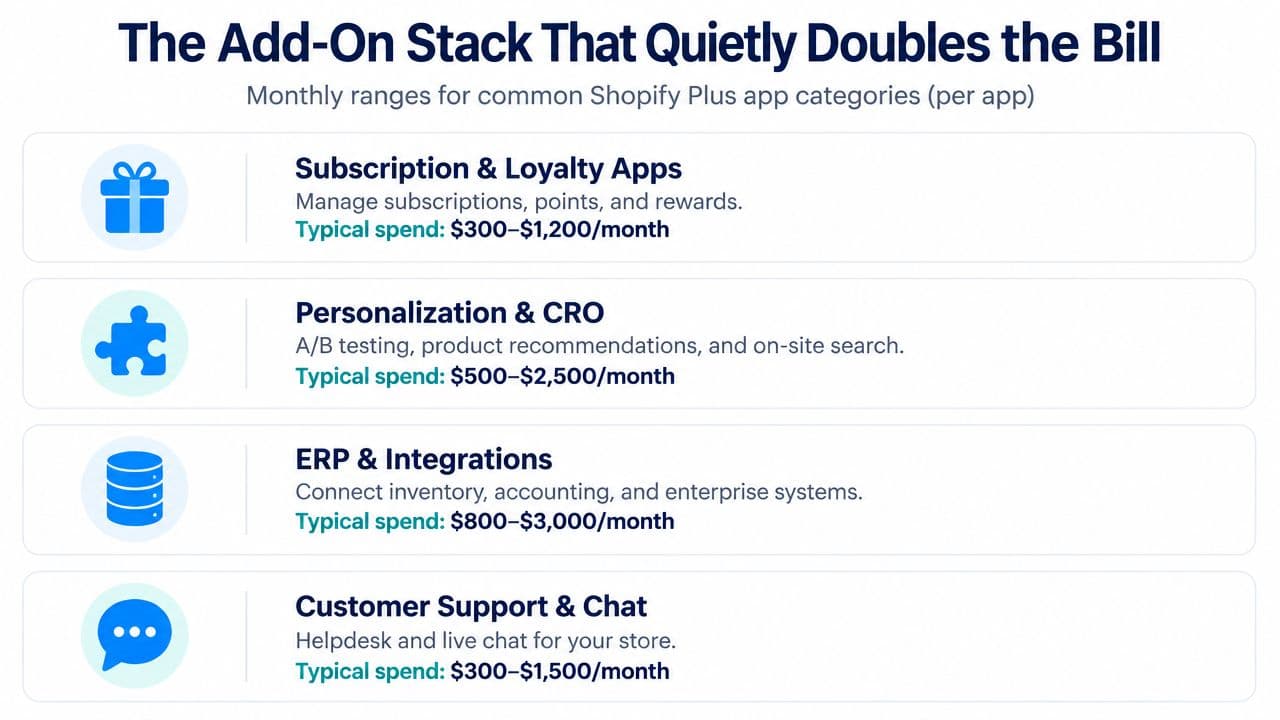
The Plus subscription is rarely the whole bill. Growing stores commonly pay for reviews, email and SMS, support tooling, search, conversion tools, ERP connectors, and development work. The mistake is to approve every tool because its monthly price looks small in isolation.
Audit the stack by revenue contribution and operational necessity, not by subscription cost alone. A low-cost app that creates no attributable revenue is expensive. A higher-cost tool that improves profitable orders or prevents manual work may be worth keeping.
Typical categories include:
- Subscription and loyalty apps: Monthly costs can range from $100 to $1,000, depending on program depth and customer volume.
- Reviews and UGC: Common spend ranges from $50 to $300 per month.
- Search and merchandising: Enterprise search and merchandising tools can range from $200 to $1,500 monthly.
- ERP and OMS connectors: Integration software can range from $500 to $5,000 per month.
- Email and SMS: Klaviyo or an equivalent platform can cost $400 to $2,000 monthly at larger list sizes.
- Theme and headless work: Custom implementation is usually a project cost, then becomes an ongoing maintenance obligation.
Services create the bigger surprise
A launch or replatform engagement can run from $15,000 to $150,000, followed by $3,000 to $15,000 per month for retained engineering, integrations, conversion-rate optimization, and store changes. Shopify Plus agency work can also carry a 20% to 40% premium over standard Shopify agency rates.
That service layer explains why a quoted $2,300 per month platform fee can become a $6,000 to $12,000 monthly operating reality within the first ninety days for a complex merchant. The platform didn't secretly multiply its rate. The merchant added the operating system required to use the platform effectively.
Budgeting rule: Separate recurring software, variable payment costs, one-time implementation, and retained services. Mixing them into one “Shopify cost” number makes overruns almost guaranteed.
Email, onsite assistance, and conversion tooling deserve attribution at the order level. Carti is one Shopify-focused option that answers catalog and policy questions, recommends relevant products, and supports cart recovery. For merchants investing in discoverability as well as conversion, SEO for Shopify and AI search is another area to evaluate before adding more software.
Realistic Monthly Cost Scenarios by Store Size
Store size changes the answer, but complexity changes it faster. A small Plus merchant may pay close to the platform fee plus a light app stack. An enterprise merchant can spend far more on variable platform charges, multiple stores, headless infrastructure, ERP connections, and engineering.
Use these profiles as budgeting frames, not promises.
| Cost Component | Small Brand, $200K/mo | Mid-Market, $1.5M/mo | Enterprise, $5M-$10M/mo |
|---|---|---|---|
| Platform structure | $2,500 one-year subscription | $2,300 three-year base, variable tier active | Variable Plus model |
| App and integration stack | Light | Standard plus ERP or feed tooling | Headless, ERP, multiple-store stack |
| Agency or development | None assumed | Part-time CRO and feed support | Dedicated development agency |
| Estimated monthly total | $3,200-$4,500 | $8,000-$14,000 | $40,000-$90,000 |
| Main cost risk | Underused Plus features | GMV-based platform fee and services | Variable fee, engineering, and store count |
Small brand
At $200,000 in monthly GMV, the assumed cost is a one-year Plus subscription, a light app stack, and no agency retainer. That produces an estimated $3,200 to $4,500 monthly total.
This is the profile I challenge most often. If the merchant doesn't need Plus-only checkout, B2B, automation, or expansion-store capabilities, the upgrade may be premature. Keep the capital available for conversion work and demand generation.
Mid-market merchant
At $1.5 million in monthly GMV, the model includes the three-year base subscription, standard applications, part-time agency support, and an active variable GMV tier. The estimated total is $8,000 to $14,000 per month.
The range expands because payment terms, integration depth, store count, and agency scope vary sharply. Run the calculation using actual monthly volume, not annual averages.
Enterprise brand
At $5 million to $10 million in monthly GMV, Plus may have fully shifted to variable pricing. A headless storefront, dedicated developers, ERP connections, and multiple stores can produce a $40,000 to $90,000 monthly total, even when the platform cost per dollar improves at scale.
Build your own assumptions with the Carti ROI calculator, then compare the result with contribution margin rather than revenue alone.
How to Request a Quote and Actually Negotiate
Shopify Plus pricing is contract-based, so treating the first quote as fixed is a costly mistake. The commercial process typically begins with an online application, followed by a handoff to a merchant development manager. The discovery conversation focuses on GMV, catalog complexity, operational pain, international needs, B2B requirements, and the limits of the current plan.
The formal quote should be the beginning of the negotiation, not the end. Shopify has more flexibility when you negotiate the full package rather than arguing only over the monthly subscription.
Ask for these items in writing:
- Term trade-off: Request a lower monthly rate in exchange for a longer commitment, then compare the exit risk.
- Payment economics: Negotiate card rates, volume rebates, and gateway treatment alongside the platform fee.
- Launch support: Ask whether migration, implementation, or launch services can be waived, discounted, or expanded.
- Feature bundles: Clarify whether B2B functionality, expansion stores, and support commitments are included.
- Store concessions: Request favorable treatment for additional regional, wholesale, or operational stores.
- Renewal protections: Review renewal caps, notice periods, termination rights, and exit clauses before signing.
Contract rule: If a concession matters to your budget, it belongs in the order form. Verbal assurances don't belong in your financial model.
Payment processing deserves special attention because Plus rates are part of the commercial conversation in a way standard-plan pricing usually isn't. Calculate your expected savings from actual card volume, payment mix, and geography, then ask Shopify to state the assumptions explicitly.
Negotiate the whole package, not the sticker line. A slightly higher subscription can be rational if it comes with materially better payment economics or launch support. A lower subscription can still be a poor deal if the rate card and expansion-store costs erase the apparent savings.
When to Upgrade, When to Stay Put, and What to Fix First
Most smaller stores should stay on Advanced. Paying for Plus because the brand feels “enterprise” is not a strategy, and a bigger plan won't repair weak merchandising, slow support, poor product discovery, or an underperforming checkout.
Merchants below roughly $800,000 in monthly GMV should be especially cautious about upgrading solely for scale economics. If Advanced handles the operation and margins are healthy, invest first in conversion-rate optimization, acquisition efficiency, checkout testing, and customer support.
| Store Profile | GMV Range | Primary Indicator | Recommended Action |
|---|---|---|---|
| Growing Advanced merchant | Below roughly $800K/mo | Current plan meets operational needs | Stay on Advanced and improve conversion |
| Plus candidate | Near or above the GMV trigger | Checkout, B2B, API, or store limitations | Run crossover math and request a quote |
| Established high-volume brand | $2M+ annual volume | Payment savings and operational complexity justify review | Negotiate Plus aggressively |
Upgrade when Plus solves a constraint that costs more than the subscription delta. That might be checkout customization, B2B complexity, multi-store management, higher API capacity, or payment economics. It shouldn't be a vague desire for more status or a sales team's claim that “serious brands use Plus.”
Established brands with $2 million or more in annual volume should request a quote and negotiate hard, particularly when card processing savings are material. But don't buy the plan before fixing the conversion layer. More traffic and more platform capacity won't matter if shoppers can't find the right product or get answers at the moment they're ready to buy.
For a practical framework on reducing waste before adding enterprise software, review how to reduce operational costs. The final decision is marginal economics: does the additional contribution margin created by Plus exceed the subscription, payment, app, and service costs?
Carti helps Shopify merchants answer product and policy questions instantly, recommend relevant products, and recover abandoned buying journeys with an AI shopping assistant. Visit Carti to see whether a five-minute, no-code conversion layer can produce more revenue before you commit to a larger Shopify bill.

Written by
Daniel AndersonFounder of Carti. 10+ years building ecommerce brands in apparel and supplements. Still runs a Shopify store and built Carti to help merchants convert more browsers into buyers.
Ready to boost your store's sales?
Install Carti in 5 minutes and let AI handle customer questions, recommend products, and close sales 24/7.
Start Free Trial14-day free trial