
A shopper lands on your Shopify store from an international ad. They find a product they like, but one question stops the purchase: Will this fit, how long will delivery take, or can I return it after trying it on? The chat bubble is visible, yet every prompt feels English-first. The shopper doesn't ask. They leave.
That silent exit is the problem a multilingual AI assistant should solve. It isn't merely a translation layer placed over an FAQ bot. A useful assistant helps shoppers begin conversations, keeps the language stable, retrieves exact store information, recommends relevant products, and hands off when the request needs a person.
The commercial opportunity is already substantial. One 2024 estimate valued the global multilingual conversational AI platform market at USD 1.39 billion, with projections of USD 1.57 billion in 2025 and USD 3.28 billion by 2034, implying a 13.1% CAGR over that forecast period. The same source cites a 40% increase in customer engagement for companies offering multilingual support, while a 2023 survey reported that 68% of global contact centers deploy multilingual AI chatbots, alongside a reported 40% reduction in average handling time and 92% translation accuracy. These figures come from the multilingual conversational AI market estimate, but the practical lesson is simpler: language access can bring otherwise silent shoppers into the funnel.
This guide focuses on the parts that decide whether that promise survives production: conversation stickiness, catalog grounding, language-specific safety, and reliable action completion. Those are the details that matter for Shopify stores in fashion, beauty, home, wellness, and any category where a question can make or break checkout.
Introduction Why Language Decides Whether Shoppers Ask at All
The first language interaction often happens before the customer says anything. A German shopper sees product copy in English, a Mexican visitor reads a shipping policy they can't comfortably parse, or a Spanish-speaking customer clicks chat and receives a rigid language selector. Each experience adds friction before the assistant has had a chance to sell.
That friction creates a silent segment. The visitor might be interested, but they won't ask whether the linen shirt runs small or whether a skincare product suits sensitive skin. An English-only widget doesn't produce an explicit complaint. It prevents the conversation from starting.
Native-language chat changes that opening moment. One ecommerce implementation summary reported that non-English visitors converted at 0.8% without native-language chat versus 3.5% with it, a 4.4x increase. The source attributes the result to engagement from a previously quiet group, not to multilingual shoppers being better buyers. That distinction matters, and it's reflected in the multilingual customer support discussion.
The conversation is the conversion opportunity
A multilingual assistant gives an international visitor a low-effort way to ask for help at the exact point of uncertainty. It can answer in the shopper's language, suggest an alternative product, explain delivery terms, or recover a cart without forcing the customer to translate their own question first.
The most revealing behavior isn't always a completed purchase. Across stores, shoppers may start in English because they assume that's required, then switch into their own language once the assistant shows it can follow. Spanish is the most common non-English conversation language across the stores described by the content owner, but responsible operators shouldn't publish language leaderboards when individual store samples are too small to support them.
Practical rule: Measure whether shoppers start conversations before you judge whether the assistant speaks enough languages.
A 24/7 multilingual sales associate also expands coverage without requiring a separate support shift for every market. It can handle routine questions consistently while preserving human attention for edge cases, complaints, and policy-sensitive requests. The rest of the implementation challenge is making that interaction feel like one coherent conversation rather than a sequence of translated fragments.
What a Multilingual AI Assistant Really Is
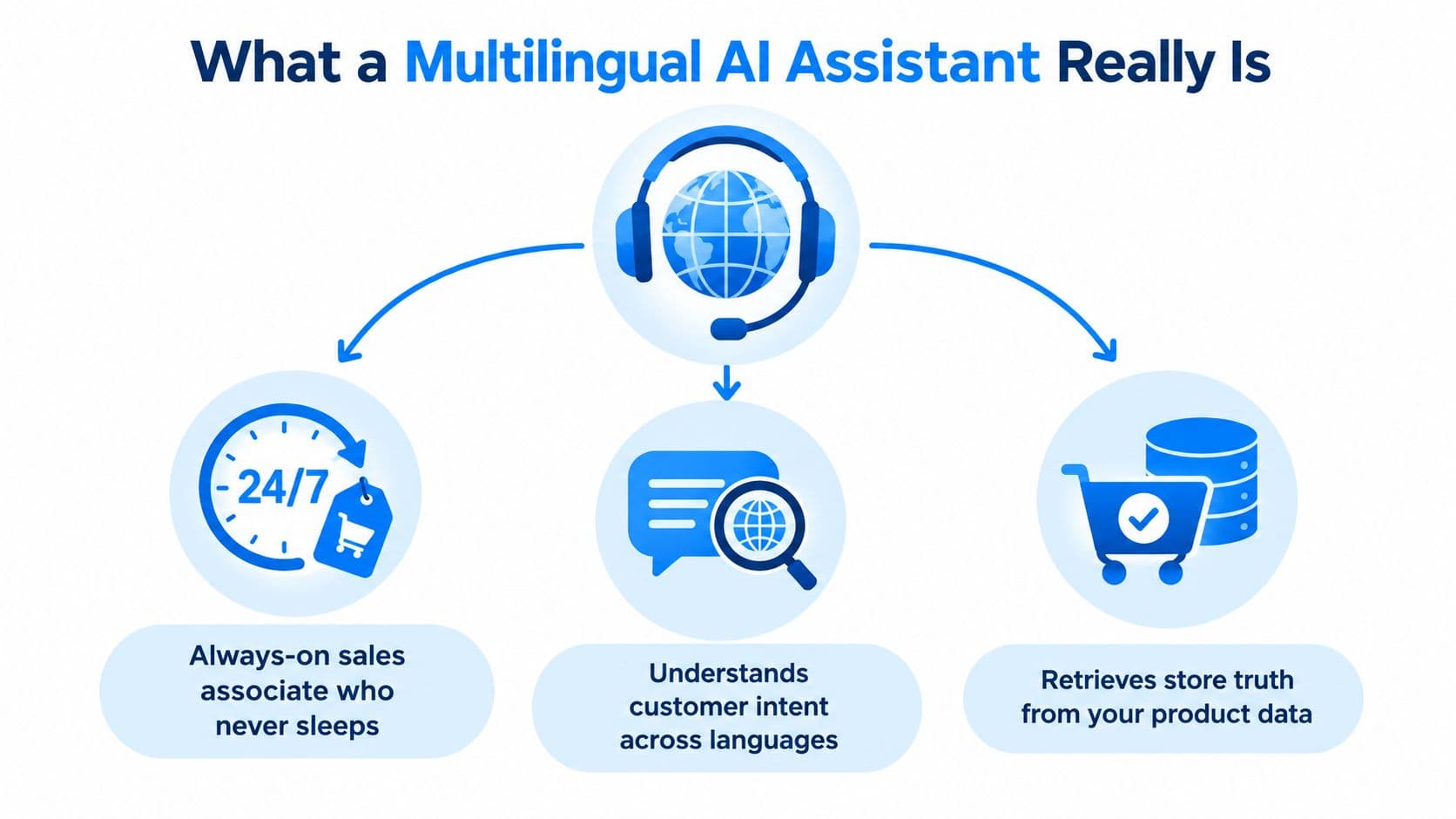
Think of a strong multilingual assistant as a bilingual store associate with instant access to your catalog, policies, FAQs, and product context. The associate doesn't translate a random answer and hope it's accurate. They first understand what the shopper wants, check the store's source information, and then explain the answer naturally in the customer's language.
That work usually combines three layers:
- Intent understanding: Natural language processing interprets messy requests, including slang, incomplete sentences, mixed-language phrases, and product names pasted into another language.
- Store retrieval: The system searches approved catalog content, shipping details, return policies, sizing information, and FAQs.
- Language rendering: The response is phrased in the shopper's language while keeping store facts intact.
Translation alone isn't enough
A keyword FAQ bot with automatic translation can match “return” to a policy page, but it may fail when the customer asks, “I ordered the blue one last week, can I exchange it if the sleeves are too short?” That request includes order context, product attributes, and a policy question. The system needs to identify the underlying intent, retrieve the relevant rules, and avoid inventing an answer.
Catalog grounding protects against the most expensive type of multilingual mistake: a friendly answer that changes the facts. Product names, prices, sizes, delivery windows, ingredients, and policy terms should come from the merchant's source content. Guidance on multilingual ecommerce chat grounding recommends treating the catalog or knowledge base as the source of truth and filtering retrieval by detected language rather than translating store information on the fly under pressure.
The assistant should sell, not just deflect
A store assistant becomes commercially useful when it connects an answer to a next action. For example, it can explain the difference between two moisturizers, recommend a jacket based on a shopper's stated use, or remind a customer about an abandoned cart in the language used during the conversation.
That makes multilingual support part of the sales layer. It still needs restraint. The assistant shouldn't claim a product treats a medical condition, promise an outcome the catalog doesn't support, or convert an ambiguous question into a confident recommendation. A reliable system knows when to answer, when to ask a clarifying question, and when to escalate.
How It Works Under the Hood Without Breaking the Conversation
The hardest technical problem isn't translating the response. It's deciding which language should govern the conversation.
A shopper might type "ok," add "gracias," and paste an English product title into a Spanish sentence. If the system detects only the latest fragment, it can flip from Spanish to English and back again. That behavior feels broken immediately, especially when the shopper hasn't changed languages.
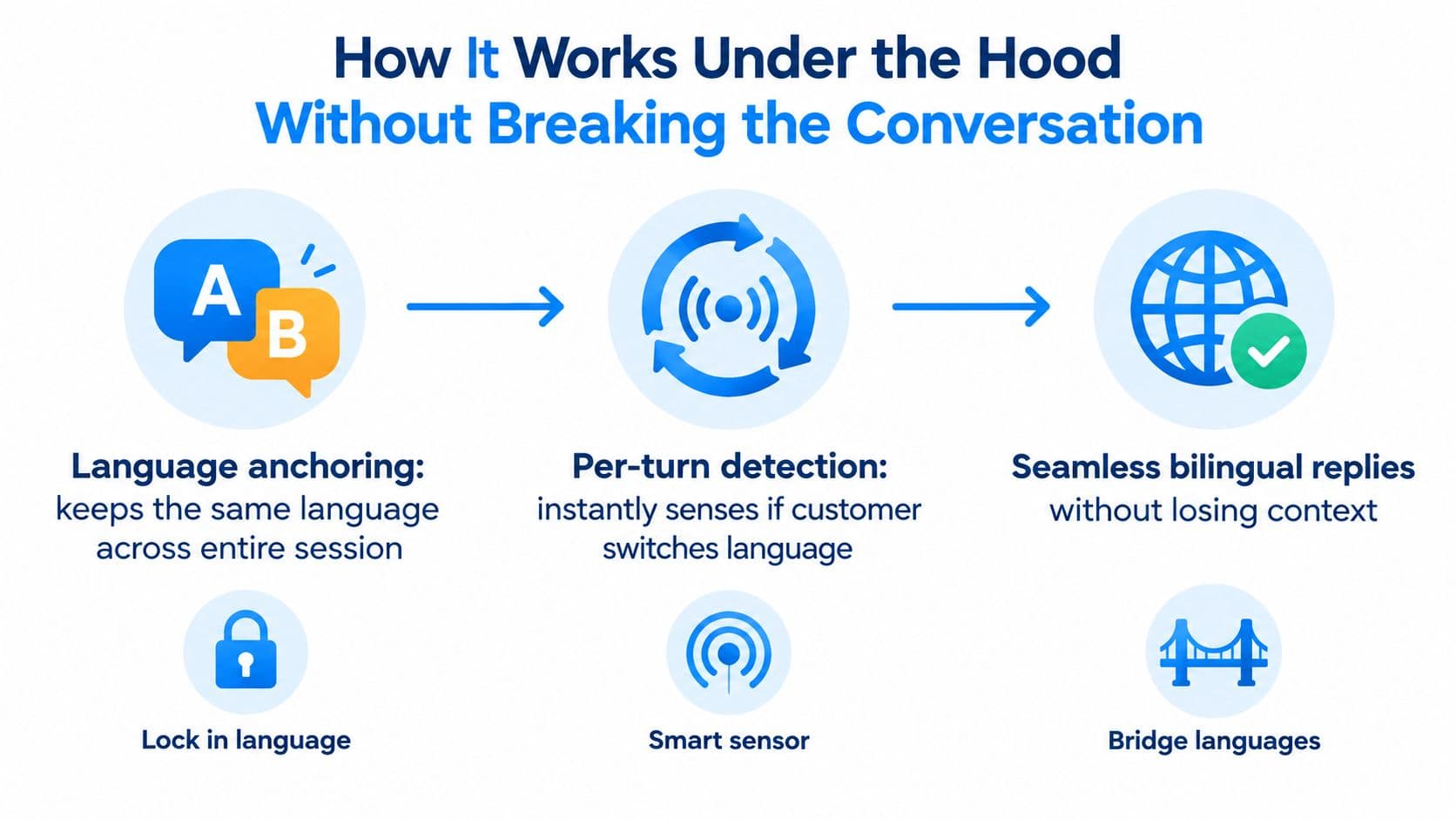
Sticky language beats last-message detection
A production pipeline needs two related controls:
- Session anchoring: Once the system has enough evidence that the shopper prefers Spanish, German, or another language, it keeps that language stable across the session.
- Per-turn detection: Every new message still gets evaluated for a genuine switch, because customers can code-switch within a conversation or even within one utterance.
Research on code-switched language identification uses word-level labels, which reflects how granular the problem can become. A one-time language choice misses the moment when a customer changes language. A last-message rule overreacts to short words, brand names, and copied product text. The practical solution is a sticky default that changes only when the shopper's broader behavior supports a switch.
The same principle applies to context. If the shopper asks about a black dress in English, then asks in Spanish whether “it” ships to Mexico, the assistant must retain the product reference, cart state, and unresolved shipping intent. Industry guidance on code-switching in ecommerce chat emphasizes preserving intent and cart context while detecting language changes.
Catalog first, phrasing second
The response pipeline should retrieve the answer from store content before rendering it in the customer's language. That sequence protects exact information such as size charts, return conditions, product variants, and delivery rules.
It also reduces a common failure mode: a model produces a fluent translation that subtly changes the policy. A merchant should test whether “final sale,” “exchange,” and “store credit” retain their intended meaning in every supported language. Tone can adapt to the shopper's register, but operational facts shouldn't become creative copy.
Latency adds another trade-off. A multilingual conversational system reported median response times of 420 ms for English versus 480 ms for Igbo, with the slower path attributed to diacritic normalization and hybrid embeddings. Both remained under the 500 ms interactive threshold, as documented in the multilingual conversational AI latency study. Low-resource languages may need normalization, subword search, or hybrid retrieval, and those steps can add overhead. Efficient indexing and fallback handling keep the experience responsive enough for sizing questions and checkout assistance.
For adjacent localization work, merchants may also benefit from a practical take on AI dubbing tools, especially when product videos need broader language access. That solves a different layer of the customer journey, but the same principle applies: localization must preserve meaning, not just substitute words.
The broader engineering lesson is covered in this guide to NLP and chatbots. Language detection, retrieval, context memory, and response generation need to work as one pipeline.
Key Capabilities to Evaluate Before You Choose
Language count makes an attractive headline, but it's a weak buying criterion on its own. A vendor can support many languages while producing inconsistent refusals, poor tool calls, or unstable behavior in long conversations.
MMLU-ProX spans 29 languages, while the Artificial Analysis multilingual index aggregates reasoning results across 16 languages, including high-resource and lower-resource markets. Those benchmarks illustrate why average performance can hide language-specific weaknesses. The buyer's task is to test the workflows that matter to the store, not just the languages listed on a product page.
A practical comparison matrix
| Capability | What Good Looks Like | Why It Matters for Conversions |
|---|---|---|
| Language stickiness | The assistant holds the shopper's active language and detects genuine switches | Prevents confusing replies that make shoppers abandon the conversation |
| Catalog and policy grounding | Product, size, price, shipping, and return answers come from approved store content | Protects trust and reduces costly misinformation |
| Tone and register | The assistant mirrors casual or formal language without changing store facts | Makes the exchange feel natural across markets |
| Safety and escalation | Refusals, policy boundaries, and human handoffs are tested by language | Keeps sensitive conversations from turning into unsupported claims |
| Transactional reliability | Recommendations, cart recovery, order workflows, and tool calls work outside English | Converts language support into completed commercial actions |
| Response speed | Normalization and retrieval remain responsive for lower-resource languages | Preserves momentum during product discovery and checkout |
| Reporting | Metrics can be filtered by language, intent, and outcome | Shows which markets need better content or workflow coverage |
Test execution, not fluency
A fluent answer can still fail the job. A 2026 analysis of multilingual tool use reported that the top model averaged 34.05% accuracy across 52 languages, with 57.37% in English and 6.81% in Amharic. The results show why a merchant should test product recommendations, cart actions, order changes, and policy retrieval in each priority language rather than assuming that conversational fluency guarantees reliable execution. The analysis is summarized in this multilingual agentic reliability report.
Safety requires the same discipline. Independent coverage reports a 2026 benchmark in which refusal rates dropped by more than half in some West African languages, alongside persistent imbalance and cross-language alignment problems. Test refunds, medical claims, regulated products, harassment, and escalation behavior by language. A multilingual assistant that answers in 92 languages but applies weaker guardrails in one market increases the risk surface instead of reducing it. The multilingual AI safety gap analysis provides useful context for this evaluation.
For a broader vendor discovery process, a curated AI customer service NZ directory can help you identify options, but shortlist tools based on live store scenarios. Before choosing, ask each vendor to demonstrate a mixed-language conversation, a catalog-grounded policy answer, a failed tool call, and a human handoff.
Finally, review translation accuracy in ecommerce chat as an operational issue rather than a copywriting detail. The answer needs to be accurate, actionable, and connected to the right product or workflow.
Shopify Use Cases That Turn Browsers Into Buyers
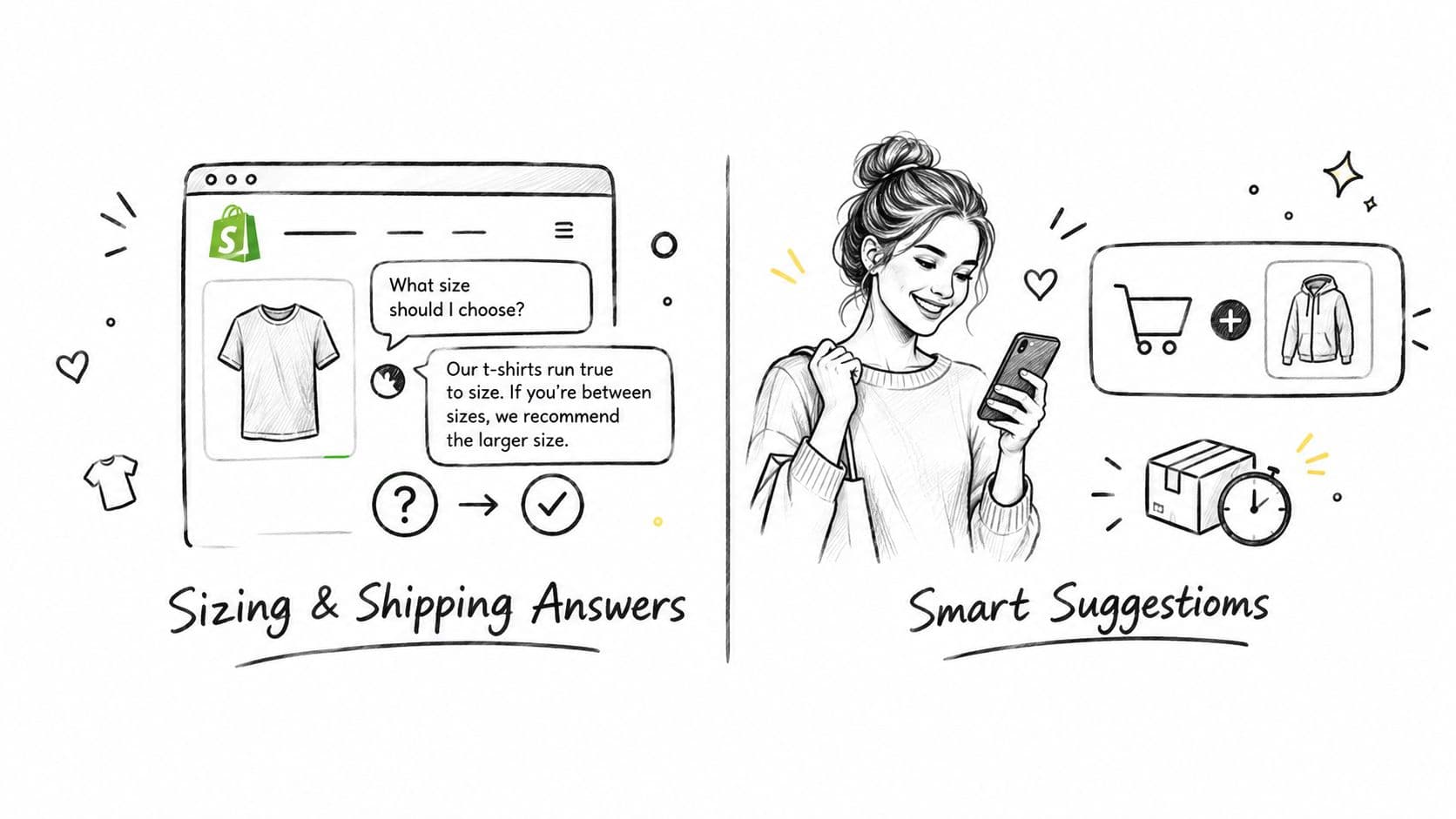
A fashion shopper often doesn't need a long conversation. They need confidence. They might ask whether a coat runs large, whether a trouser leg can be altered, or which size matches a measurement. If the assistant answers in the language they naturally use and grounds the answer in the store's sizing data, it can move the shopper from uncertainty to product selection.
Sizing and product discovery
In beauty, the equivalent question might concern ingredients or routine compatibility. In home, it could involve dimensions, material, or assembly. The assistant should ask for the missing detail, search the relevant product content, and recommend only items supported by the catalog.
Smart suggestions work best when they use behavior and stated intent together. A visitor browsing lightweight jackets who asks about rain protection has given the assistant more useful context than a generic “customers also bought” module. The response can narrow the choice, explain the difference, and present the relevant product without forcing the customer to search through multiple collection pages.
Cart recovery in the shopper's language
A cart reminder is more effective when it continues the customer's existing conversation. If the shopper asked about delivery in Spanish, a recovery message in English breaks continuity. The assistant should retain the product, unresolved question, and language preference, then use a nudge that answers the concern rather than repeating the cart contents.
The strongest recovery flow is often a clarification: “Would you like help choosing the size?” or “Do you want to check delivery to your postcode?” It gives the shopper a reason to reply and creates a path back to checkout.
Social DMs and onsite continuity
International traffic frequently arrives from localized ads and social posts. DMs may come in whatever language the ad reached, while the shopper later visits the storefront and starts a second conversation. Keeping intent and product context aligned across those channels prevents the customer from starting over.
One behavior deserves special attention. Shoppers may begin in English because they expect that's the only supported option, then move into German, Spanish, or another language once the assistant follows them. That switch often signals deeper engagement. Don't treat it as a technical anomaly. Treat it as a prompt to preserve context and continue naturally.
Carti is one Shopify-focused option that automatically detects the shopper's language and supports multi-turn conversations in 92 languages, including product questions, recommendations, and sales interactions. Its feature set includes instant answers, smart suggestions, cart recovery, and an insights dashboard, so merchants can connect language support to specific storefront actions rather than treating it as a translation widget.
ROI and Metrics That Prove Multilingual Is Working
The first metric to watch is not language accuracy. It's conversation start rate by language.
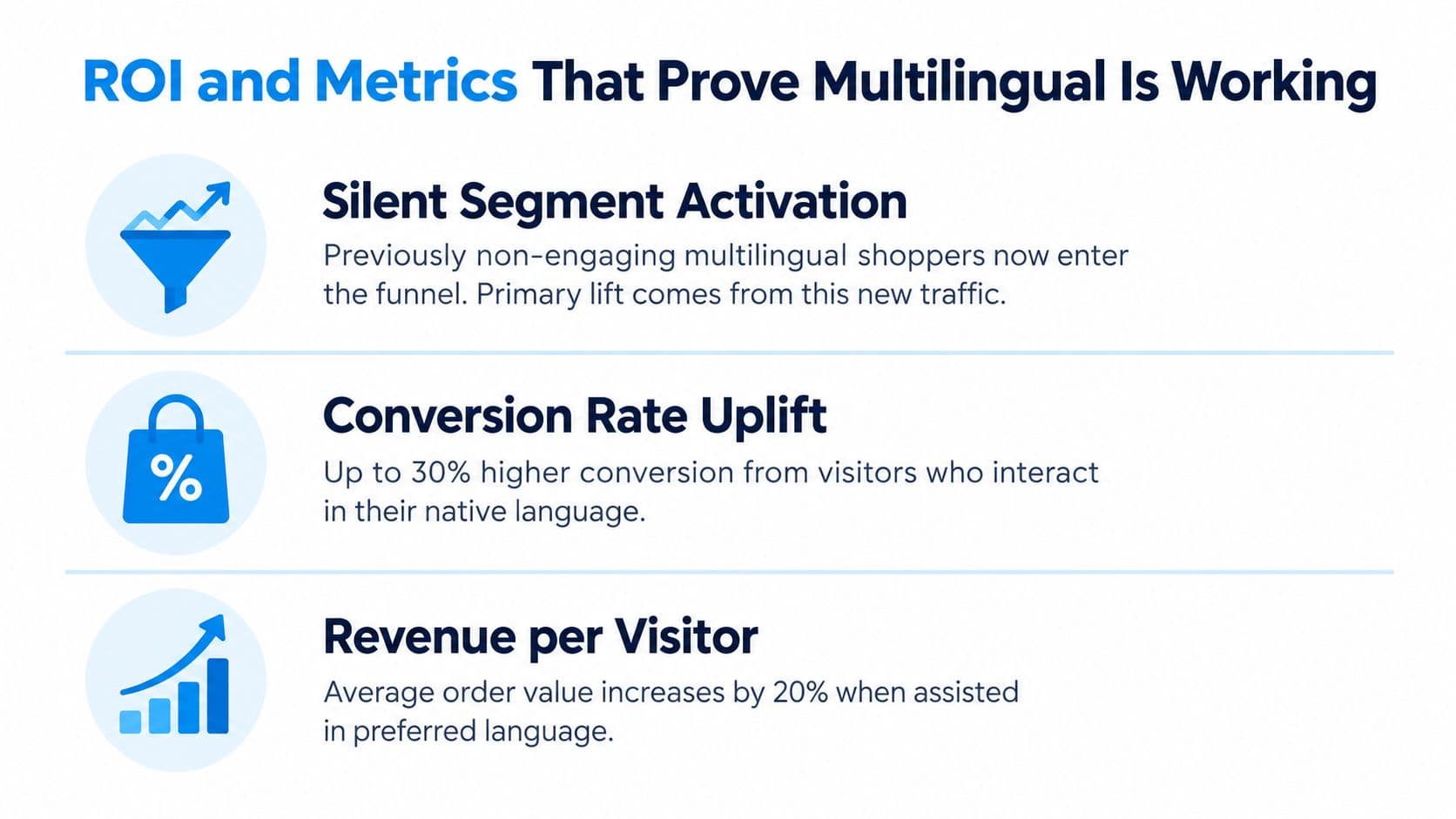
If international visitors were present but rarely opened chat, a successful launch should create measurable activity among that previously silent group. The ecommerce implementation cited earlier recorded non-English visitor conversion moving from 0.8% without native-language chat to 3.5% with it, a 4.4x increase. That result supports a useful interpretation: multilingual support activates demand that was already visiting the store, rather than proving that one language group naturally converts better. See the implementation summary for multilingual ecommerce support for that comparison.
Build a language-level measurement view
Track the funnel by language, but resist ranking languages prematurely. Per-language samples on an individual store can be too small to support responsible conversion claims, especially when traffic is seasonal or campaign-driven.
A practical dashboard should include:
- Conversation starts: Compare the share of visitors who open chat in each language.
- Qualified engagement: Record whether the assistant identifies a product, answers a purchase question, or receives a meaningful reply.
- Assisted conversion: Compare orders after a relevant chat interaction with the store's existing baseline.
- Cart rescue: Track abandoned carts where the assistant answered a concern or prompted a return to checkout.
- Handling time: Review whether multilingual automation reduces repetitive support work without increasing escalations.
- Escalation quality: Measure whether human handoffs include the language, intent, transcript, and unresolved issue.
- Content gaps: Use recurring questions to improve product descriptions, size charts, shipping pages, and FAQs.
The market estimate cited by Intel Market Research links multilingual deployment with a 40% reduction in average handling time and 92% translation accuracy, but merchants should treat those as external reference points, not guaranteed store outcomes. Your own baseline matters more than a vendor's aggregate claim.
Watch the language switch moment
Spanish is the most common non-English conversation language across the stores described by the content owner. The more valuable insight is behavioral: a shopper who starts in English and then relaxes into their preferred language may reveal exactly when trust increases.
Log that transition without overinterpreting it. Look for changes in question depth, product interaction, recommendation clicks, and checkout progression after the switch. Tone can earn attention, but accuracy keeps the sale alive.
Implementation Considerations for a Smooth Launch
A smooth Shopify launch starts with the store's existing truth. The assistant should learn from the catalog, policies, FAQs, and shipping content, then expose unanswered questions and weak product information through ongoing review.
A no-code setup can make deployment fast, but speed shouldn't replace testing. Before launch, run real scenarios in every priority language:
- Ask a sizing question using casual language.
- Mix an English product name into a non-English sentence.
- Switch languages halfway through the conversation.
- Ask about a refund, restricted product, or sensitive claim.
- Request a recommendation and verify the suggested product.
- Trigger a cart recovery flow and inspect the handoff context.
- Ask an ambiguous question and check whether the assistant clarifies instead of guessing.
Support for 92 languages should not require separate configuration for every language, but quality review still needs language-specific coverage. Grade real multilingual conversations weekly. Check whether tone matches the shopper's register, whether product facts remain literal, and whether the same escalation rule applies everywhere.
Launch checklist: Confirm branding and widget placement, choose proactive triggers carefully, define human handoff rules, verify catalog and policy grounding, review language-specific safety behavior, and arrange priority support if your store handles high conversation volume.
The operating principle is straightforward. A casual German shopper should receive casual German, not stiff translated prose. Product names, sizes, prices, and policy terms should stay exact rather than becoming approximate localization. Tone earns trust, but accuracy keeps it.
Carti provides a Shopify chatbot that answers product and policy questions, recommends relevant items, supports cart recovery, and responds in 92 languages without additional language configuration. Visit Carti to launch a multilingual AI sales assistant, test it against your store's real catalog, and turn more international conversations into checkout progress.

Written by
Daniel AndersonFounder of Carti. 10+ years building ecommerce brands in apparel and supplements. Still runs a Shopify store and built Carti to help merchants convert more browsers into buyers.
Ready to boost your store's sales?
Install Carti in 5 minutes and let AI handle customer questions, recommend products, and close sales 24/7.
Start Free Trial14-day free trial