
“Hi Sarah, we picked these for you” is not ecommerce personalization. It's a name placed in a template.
Useful personalization starts with the shopper's current mission. Someone asking whether a jacket runs small needs an answer based on the product, reviews, fit concern, and return policy. Someone with a tent in the cart needs sleeping-pad guidance, not another tent. Someone browsing from another country may need the same recommendation in their own language.
That distinction matters because ecommerce personalization has moved from early experimentation into a formal software category. A 2025 industry summary reported that 41% of retail executives considered their ecommerce platform only “somewhat personalized,” while 13% said it delivered a fully customized experience. The same summary cited a forecast for personalization software to rise from $263 million in 2023 to $2.4 billion by 2033, a projected 24.8% CAGR. Contentful's ecommerce personalization summary captures the gap between investment and execution.
The seven ecommerce personalization examples below are organized by shopper mission and lifecycle moment, from discovery and product consideration to cart, checkout, and retention. Measure each one by joining personalized interactions to orders, then compare conversion rate, add-to-cart rate, revenue per visitor, average order value, assisted revenue, and support workload against a baseline.
1. Carti
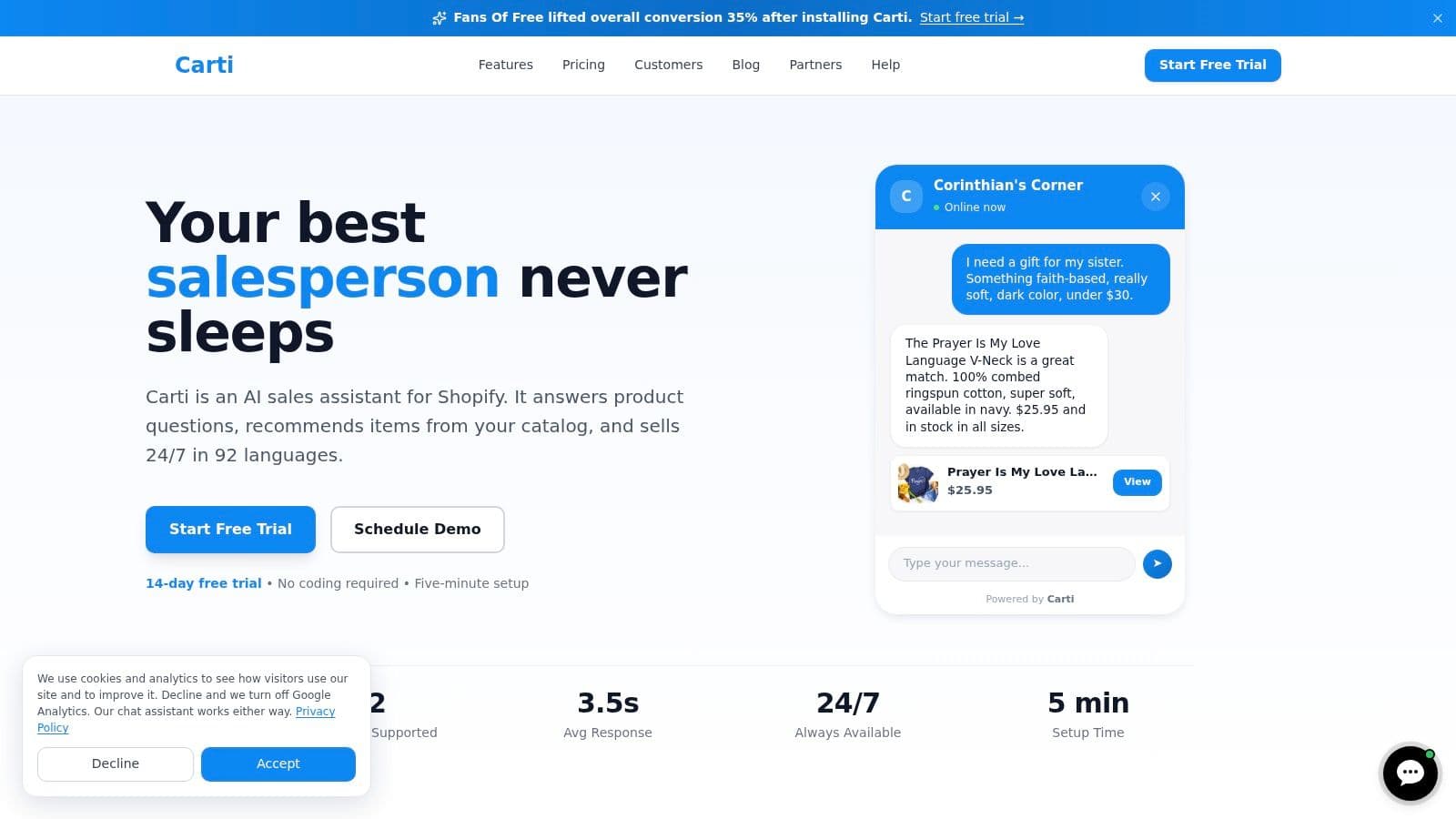
The highest-intent personalization moment is often a conversation that happens while the shopper is deciding. A visitor asks about a product, mentions a budget, explains a size concern, names a skin type or dog breed, and expects the store to use that information immediately.
Carti is built for that moment on Shopify. It reads a store's catalog, policies, pages, and reviews, then answers product, sizing, shipping, and return questions while recommending relevant products. Its Smart Suggestions can use the current product, browsing behavior, cart contents, and the constraint the shopper just mentioned. That's more useful than a homepage grid based on old clicks.
A practical example is a shopper who says they usually wear medium, but reviews suggest the brand runs small. The assistant can recommend large, then address the return-policy concern before the shopper has to ask. That feels memorable because the store responded to the shopper's actual uncertainty, not because it used a first name.
Where Carti fits best
Carti supports Instant Answers, Smart Suggestions, proactive triggers, cart recovery nudges, and an Insights Dashboard. The dashboard surfaces repeated questions and missing information, giving merchants a direct way to improve product pages, policies, and merchandising.
It also responds in 92 languages and averages approximately 3.5 seconds per reply, according to the product information supplied for this comparison. Setup takes about five minutes without code, and the assistant learns from the store's existing content. Carti's proactive AI assistant guide explains the broader use case for engaging shoppers at moments of hesitation.
Practical rule: Personalize the answer around the shopper's uncertainty, then make one relevant recommendation. Don't turn a useful answer into a carousel of unrelated products.
For measurement, join conversations to orders and compare engaged-shopper conversion, revenue per visitor, add-to-cart rate, assisted revenue, and support workload with the store baseline. The supplied Carti data reports engaged-shopper conversion at roughly 3.5 times store baseline and revenue per visitor at roughly 20% higher across Carti stores, measured by connecting conversations to orders. Those are Carti-reported figures, not a universal benchmark.
Pros include fast no-code setup, multilingual support, catalog-aware answers, proactive selling, cart recovery, and question-level merchandising insight. The trade-off is conversation capacity. Carti's listed plans include a Free tier with 50 AI conversations per month, Starter at $49 per month for 250 conversations, Growth at $99 per month for 600 conversations, and Scale at $249 per month for 1,750 conversations. Paid plans include 14-day trials, while the site advertises a limited-time offer for the first 100 merchants. High-volume stores should model usage before choosing a tier, and every merchant should review the information gaps Carti flags.
2. Shopify
Shopify's enterprise guidance is most useful when a team needs to translate personalization from a broad ambition into funnel-stage actions. Its ecommerce personalization examples cover discovery, search intent, product pages, retargeting, and retention, with patterns that Shopify merchants can adapt to their existing workflows.
The strongest idea to borrow is sequencing. Discovery personalization should help a shopper find a relevant category or product. Consideration personalization should reduce uncertainty through recommendations, comparisons, reviews, and product education. Retention personalization should reflect what the customer already bought instead of repeatedly showing the same acquisition message.
A Shopify-friendly implementation
Start with one behavior and one response. A shopper who searches for waterproof trail shoes could see relevant products, trail-use content, and shipping information for the selected region. A shopper returning to a product page could see recently viewed items, in-stock alternatives, or a comparison prompt.
Use Shopify's storefront data, product tags, customer events, and audience logic to keep recommendations operationally accurate. A recommendation engine that ignores inventory, variant availability, or margin can create more frustration than relevance.
- Discovery signal: Search query, category visit, or campaign landing page.
- Consideration response: Product comparison, review summary, size guidance, or complementary item.
- Retention response: Replenishment reminder, care content, or a product that fits the previous purchase.
The advantage is accessibility. Shopify teams can connect the ideas to familiar storefront, marketing, advertising, and analytics workflows without treating personalization as a separate science project. The limitation is that the article is guidance rather than a filterable use-case database, and some recommendations naturally point toward Shopify's ecosystem.
For measurement, test one stage at a time. Compare add-to-cart rate for personalized product-page modules, revenue per visitor for returning shoppers, and support contacts for questions that the storefront should answer directly. Carti's guide to personalization at scale is a useful companion when the team needs to move from isolated tactics toward a connected operating approach.
3. Shopify Website Personalization
Website personalization works best when it changes the next useful action, not when it decorates the page. A returning shopper who previously viewed running gear should be able to resume that journey. A customer who just purchased a camera should see setup help, compatible accessories, or care information rather than another generic acquisition banner.
Shopify's companion guidance on website personalization strategies and examples focuses on site content, merchandising, post-purchase experiences, tracking pages, retargeting audiences, and Shopify rules. That makes it a practical reference for teams working across the storefront and lifecycle rather than only on product recommendations.
Use context without overfitting
A good rule is to personalize the module that matches the shopper's stage. On a product page, show relevant comparisons or accessories. On a tracking page, show useful post-purchase guidance. In a returning session, restore recently viewed products or the category the shopper was exploring.
A poor implementation changes too much at once. If the hero image, navigation, product order, offer, and message all change together, the team won't know which element helped or hurt. It can also make the site feel unstable, especially when a shopper returns to find familiar products moved.
Shopify Audiences and rules can support audience-driven merchandising and retargeting, but the team still needs clear exclusions. Don't recommend a product that's sold out, an item already in the cart, or a replenishment message immediately after a purchase unless the context supports it.
The best website personalization shortens the path to the shopper's next decision.
Track return-session conversion, product-module clicks, add-to-cart rate, post-purchase engagement, and revenue per visitor. Keep a control group that sees the standard experience. The source is especially useful for merchants already operating inside Shopify, but it's less suitable as a searchable inspiration library and may assume access to Shopify-specific features.
4. Dynamic Yield Inspiration Library
Dynamic Yield's personalization use-case library works well for ideation. It filters examples by page type, strategy, and experience, covering patterns such as dynamic content, recommendations, triggered overlays, and product-page assistance. Teams can also compare patterns in our guide to ecommerce personalization software before choosing a Shopify-friendly implementation path.
The useful question is situational: what is this shopper trying to do now? A visitor who has viewed several products in one category without adding anything may need comparison help, a guided finder, or content that addresses a known concern. A shopper with a full cart may need delivery or compatibility information instead. The signal should determine the response, not a cosmetic name-based greeting.
Turn inspiration into a Shopify test
Use the library to generate a testable hypothesis, then filter each idea through this table:
| Shopper signal | Mission | Response | Exclusion | KPI |
|---|---|---|---|---|
| Recent category views without an add-to-cart | Compare | Show a focused comparison or finder | Exclude shoppers who already purchased the category | Product clicks and add-to-cart rate |
| Cart contains a product with a compatible accessory | Complete the purchase | Recommend the accessory | Exclude items already in the cart or unavailable products | Conversion and revenue per visitor |
| Post-visit return with no purchase | Resume research | Restore viewed products or the explored category | Exclude shoppers with a completed order | Return-session conversion |
A Shopify merchant can build the response with theme sections, an app, a recommendation engine, or an AI assistant. Keep the logic simple when product data, inventory, language, or customer events are incomplete. A reliable signal paired with one useful response is easier to maintain than an enterprise-style experience copied without its supporting data.
The library's strength is breadth and filtering. Its limitation is that deeper examples may assume Dynamic Yield modules, technical resources, and mature experimentation practices. Small teams should start with one signal, one audience rule, and a clear exclusion.
Measure against a control. Track clicks, add-to-cart rate, conversion, average order value, and revenue per visitor. A widget that earns interaction but increases support contacts or fails to improve orders has not proved its value.
5. Optimizely
Optimizely's retail experimentation field notes frame personalization as a testable product decision. That's the right approach for teams that already have ideas but lack confidence about whether a personalized homepage, recommendation module, or behavior-based experience helps.
The platform's examples pair ecommerce personalization with experimentation. A homepage recommendation row might use browsing behavior, category interest, or returning-visitor context. The important question isn't whether the row looks more relevant. It's whether the exposed group adds more products, completes more purchases, or generates more revenue than a comparable control group.
Keep the hypothesis narrow
A strong hypothesis names the behavior and the expected action:
If returning visitors see products connected to their recent category interest, they'll find a relevant item faster than visitors who see the default product row.
That hypothesis can run on Shopify through the tools already used for theme testing, personalization, analytics, or recommendation logic. The implementation doesn't need to copy Optimizely's platform. It needs a clean audience rule, a stable control, and event tracking that connects exposure to downstream orders.
Optimizely is a good fit for teams that want measurement discipline and experimentation language. It's less Shopify-specific than the Shopify references above, and some field notes assume familiarity with Optimizely terminology. Smaller merchants may need to translate the concepts into a lighter testing setup.
Measure the primary outcome first, then inspect guardrails. Primary outcomes may include conversion or revenue per visitor. Guardrails should include page performance, support workload, margin, inventory availability, and returns. A recommendation that drives clicks toward poor-fit products can look successful in an interaction report while creating operational problems later.
6. Bloomreach
Bloomreach's ecommerce personalization strategies for 2026 is useful for teams thinking beyond onsite widgets. Its examples connect web personalization with zero-party data, product discovery, email, SMS, advertising, and AI-assisted shopping.
The strongest pattern is asking shoppers for information when it improves the recommendation. A quiz or product finder can collect a stated preference such as skin type, style goal, use case, or price constraint. That signal is often more valuable than assuming intent from a single page view, provided the question is short and the answer changes what the store recommends.
Use stated intent carefully
Zero-party data becomes useful when the store acts on it immediately. If a shopper says they have sensitive skin, the next response should narrow products, explain relevant ingredients, and avoid recommendations that conflict with the stated need. If the store asks several questions and then returns a generic collection, the interaction feels like work without a payoff.
Bloomreach also provides a broader use-case and case-study perspective across channels. That makes it helpful for omnichannel teams, but the depth varies by example and some pages are marketing-heavy. Merchants should separate the transferable tactic from the platform-specific pitch.
A Shopify implementation can begin with a product finder on a collection or landing page, then pass the answer into recommendation logic, onsite conversation, or lifecycle segmentation. Keep the data policy clear, especially when preferences relate to sensitive personal circumstances. Privacy trust matters because personalization can backfire when shoppers feel watched rather than helped. Recent coverage cited a 2025 Gartner-based finding that personalized marketing created a negative experience for 53% of customers, made them 3.2 times more likely to regret a purchase, and left them 44% less likely to buy again. The cited personalization risk coverage makes the operational warning clear.
Measure finder completion, recommendation engagement, add-to-cart rate, conversion, returns, and support questions. A useful quiz reduces uncertainty. A decorative quiz only adds another step.
7. Emarsys
Emarsys, part of SAP, offers eight ecommerce personalization examples for marketers in a skimmable format. It's aimed at teams that need channel-ready ideas for email, SMS, onsite experiences, advertising audiences, and lifecycle campaigns.
The practical value is speed. A lean Shopify team can take one pattern, adapt it to its existing apps, and run a focused experiment. Examples such as browse recovery, personalized content, targeted retargeting, and post-purchase messaging become more useful when the team ties each one to a specific event instead of building a broad “personalized journey.”
Match the message to the lifecycle moment
Post-visit intent is a strong starting point. A shopper who viewed a product but didn't add it can receive a reminder that restores the product context. A shopper who abandoned a cart should see the items still available, relevant completion help, and accurate shipping or policy information. A recent buyer should receive product care, setup guidance, or a compatible next step.
Email and SMS should not repeat the same message at every stage. If the shopper has already returned and purchased, suppress the recovery sequence. If the product is no longer available, replace the reminder with an in-stock alternative or a clear notification option. Operational awareness matters more than message volume.
The Emarsys roundup is current and easy to translate into experiments, but it offers fewer deep case-study details and includes product-oriented calls to action. It's a useful quick-win source, not a complete implementation architecture.
For measurement, connect exposure to orders and review conversion, revenue per visitor, average order value, repeat purchase behavior, unsubscribe rate, and support workload. Personalization strategies have shown commercial upside over time. A widely cited 2017 Boston Consulting Group analysis found that brands running personalization programs increased revenue by 6% to 10% and grew two to three times faster than brands that didn't personalize. The later ecommerce personalization compilation also reports a 20% sales lift associated with ecommerce personalization strategies, higher conversion rates reported by 65% of ecommerce stores after adoption, and product recommendations accounting for up to 31% of ecommerce revenue. These figures are benchmarks from the cited sources, not guarantees for every Shopify store.
Comparison of 7 Ecommerce Personalization Examples
| Solution | Implementation complexity | Resource requirements | Expected outcomes | Ideal use cases | Key advantages |
|---|---|---|---|---|---|
| Carti | Very low, no-code, 5‑minute install | Minimal internal effort; subscription conversation quotas | Faster responses, cart recovery, measurable conversion lifts (reported +35% / 3.5x) | DTC Shopify stores needing 24/7 multilingual sales assistant and cart recovery | Auto-reads catalog/policies, multilingual (92), proactive triggers, insights dashboard, transparent pricing |
| Shopify, Ecommerce Personalization: 12 Scalable Tactics | Low–medium, guidance with some config/dev per tactic | Marketing/product time; uses Shopify workflows/apps | Actionable personalization across funnel; ready-to-implement tactics | Shopify brands looking for stage-by-stage personalization strategies | Shopify-authored, funnel-mapped, current (2026) guidance |
| Shopify, Website Personalization: Strategies and Examples | Low–medium, leverages Shopify rules & Audiences | Config time; familiarity with Shopify Audiences | Improved on-site personalization and audience targeting | Merchants optimizing on-site content, merchandising and retargeting | Practical, Shopify-specific configuration guidance |
| Dynamic Yield, Inspiration Library | Low for ideation; medium–high to deploy on platform | Time to explore; enterprise dev/ops for full implementation | Broad idea generation and deployable templates (if using platform) | Ideation sprints and teams borrowing patterns for complex experiences | Searchable, filterable example hub with strategy notes and templates |
| Optimizely, Personalization Examples & Field Notes | Medium, experimentation and testing focused | Experimentation resources, analytics and QA | Measured lift from validated tests; testable personalization hypotheses | Teams prioritizing A/B testing and measurement-driven personalization | Experimentation-first playbooks and measurement guidance |
| Bloomreach, 7 Ecommerce Personalization Strategies | Medium, omnichannel and data-driven tactics | Cross-channel resources; data/zero‑party collection and integrations | Omnichannel personalization aligned with privacy changes; case-study outcomes | Brands pursuing omnichannel discovery, intent and zero‑party strategies | Current 2026 context, use-case catalog and case studies |
| Emarsys (SAP), 8 Ecommerce Personalization Examples | Low, concise, marketer-focused tactics | Marketing resources for email/SMS/web experiments | Quick wins in lifecycle and channel personalization | Lean marketing teams seeking fast, skimmable experiments | Skimmable, actionable examples suitable for quick experiments |
Turn These Patterns Into a Personalization Roadmap
Don't launch seven personalization programs at once. Start with the moment where shopper intent is already visible and the cost of being unhelpful is highest, usually a product-page or cart question. A shopper who asks about fit, compatibility, ingredients, shipping, or returns has given the store a strong signal. Answer that question clearly, then offer one relevant next step.
The rollout can follow a practical order:
- Product and cart assistance: Use the current product, cart contents, reviews, and stated constraint to answer questions and recommend a relevant item.
- Contextual prompts: Trigger a question when a shopper lingers, closes the cart drawer, or shows hesitation. Don't use the same announcement for every session.
- Language-aware support: Reply in the shopper's language wherever the store can do so accurately. Language is one of the most overlooked forms of useful personalization for international traffic.
- Recommendation logic: Add complementary products, alternatives, bundles, and in-stock substitutes. Exclude items already in the basket, sold-out products, and irrelevant products from old sessions.
- Post-visit recovery: Restore recently viewed products, recover abandoned carts, and adapt follow-up based on whether the shopper returned, purchased, or moved to another category.
- Post-purchase guidance: Personalize care instructions, setup help, compatible accessories, and replenishment timing around the item the customer bought.
Cart contents deserve special attention. Once a shopper adds an item, the basket often provides enough context to recommend a useful complement, even for a first-time visitor. A cited retailer dataset recorded personalized recommendation click-through of 14.7% on mobile versus 6.3% on desktop, and the related analysis explains why the cart can be more informative than customer history for first-time traffic. WisePops' AI personalization analysis provides that example.
A QSR cart flow illustrates the logic. When a customer adds a Double Bacon Cheeseburger, the system can suggest a drink or fries. After the basket is complete, checkout can surface a final add-on such as dessert or a milkshake. Dynamic Yield's current-cart recommendation example shows how the same principle transfers to ecommerce categories.
Test every deployment with the same compact framework. Define the shopper signal, choose one helpful response, set a control group, connect the conversation or exposure to an order, and review conversion, add-to-cart rate, revenue per visitor, average order value, assisted revenue, returns, and support workload. If the experience increases clicks but also increases confusion, returns, or support contacts, it needs revision.
Onsite conversation deserves a precise prompt strategy. Use behavior, population, timeframe, and answer shape so the assistant knows who it's addressing, what happened, how recent the signal is, and what kind of response is appropriate. Mixpanel's personalized shopping guide explains why missing context encourages defaults that may not match intent.
Questions usually work better than announcements because they invite a response. A shopper lingering on a product page might see a question about fit or comparison. Someone who just closed the cart drawer might see a completion question about the item added. A returning visitor might receive a prompt based on what they saw last visit, not a recycled banner. Bloomreach's guide to AI shopping assistants covers this session-aware prompt approach.
The central lesson is simple. Useful context creates the lift, not a first name. Cosmetic greetings are decoration when they don't help the shopper make a decision. Use Carti's Insights Dashboard, or an equivalent question and behavior dataset, to find the next repeated friction point. Then fix the product information, recommendation, policy answer, or conversational prompt that addresses it.
Carti gives Shopify stores a no-code AI sales assistant that answers product and policy questions, recommends relevant items, supports 92 languages, and helps recover abandoned carts. Use it to turn these ecommerce personalization examples into situational conversations tied to products, carts, constraints, and shopper intent, then visit Carti to explore the setup.

Written by
Daniel AndersonFounder of Carti. 10+ years building ecommerce brands in apparel and supplements. Still runs a Shopify store and built Carti to help merchants convert more browsers into buyers.
Ready to boost your store's sales?
Install Carti in 5 minutes and let AI handle customer questions, recommend products, and close sales 24/7.
Start Free Trial14-day free trial