
If a Shopify store is drowning in sizing questions, return requests, and Instagram DMs at the same time, the actual problem is not “which app has more features.” The core issue is that the team has too much pre-purchase chatter in one pile and too many post-purchase tickets in another.
Tidio vs Gorgias comes down to workload fit. Tidio is the better fit when the store needs storefront conversations, automation, and light support handling. Gorgias is the stronger fit when the team needs a full helpdesk with order actions and a tighter post-purchase workflow.
| Capability | Tidio | Gorgias |
|---|---|---|
| Main strength | Conversational chat and automation | Helpdesk workflow with order context |
| Shopify depth | Customer identification, cart and order visibility, basic context | Order history, customer context, shipping data, and actions like refunds, cancellations, and edits |
| Pricing logic | Billable conversations involving at least one human-agent message Tidio pricing | Monthly ticket allotments, not priced per agent Gorgias pricing |
| Best workload | Pre-purchase questions and storefront engagement | Post-purchase support and order management |
| AI comparison | Vendor-reported 75% resolution rate for Lyro customers Tidio vs Gorgias | Vendor-reported 60% automation rate in the comparison material Tidio vs Gorgias |
Why Shopify Merchants Are Comparing Tidio and Gorgias
A three-person apparel team answering about 40 DMs a day feels the pain fast. One shopper wants sizing help on the product page, another asks about shipping in Instagram DMs, and a third needs an order change after checkout. The team ends up bouncing between chat, email, and the Shopify admin all day.
That is why this comparison keeps coming up. The question is not whether both tools can reply to messages. It is whether the store needs a storefront conversation layer or a helpdesk that works directly inside the order record.
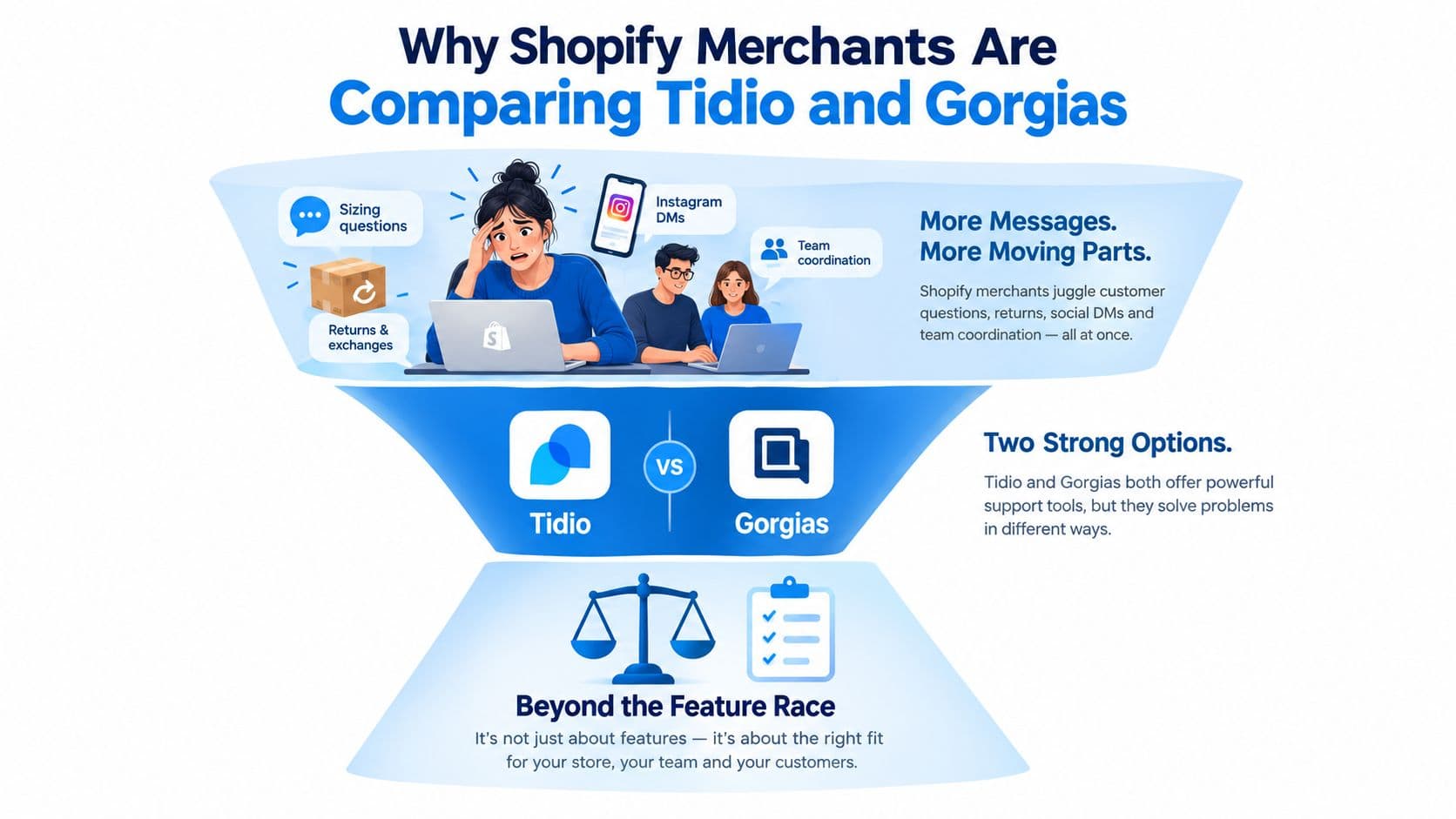
The decision is workload first
Tidio and Gorgias both sit in the customer-support stack, but they solve different problems. Tidio started in 2013 in Szczecin and reports more than 300,000 companies using its platform, which shows broad reach across business types Tidio about. Gorgias started in 2015 and, by August 2022, reported more than 10,000 online-store customers and 245 employees, according to Gorgias materials, which points to deeper focus on e-commerce support.
That difference matters more than people think. A store with heavy pre-purchase questions needs fast answers, product guidance, and light automation. A store with frequent order changes needs a helpdesk that can pull in order history and take action without forcing agents to hop across tabs.
Practical rule: if the team spends more time explaining products than fixing orders, start with a conversational layer. If the team spends more time resolving orders than answering product questions, start with the helpdesk.
A third option also belongs in the conversation for storefront-heavy stores. Carti is an AI shopping assistant for Shopify that answers pre-purchase questions on the storefront, recommends products, and works with the catalog, policies, and FAQs. Some merchants do not need a heavier helpdesk first, they need fewer repetitive buying questions first.
What Each Platform Is Built For
Tidio is built for conversation volume
Tidio fits merchants that want chat, automation, and AI in one place. Its strength is frontline conversation, not back-office ticket handling. In practice, that means it works well for greeting shoppers, answering product questions, and pushing people toward the right page before they leave.
A good Tidio setup might use a pre-chat survey to route visitors by intent, then trigger abandoned-cart recovery when a shopper drops off after asking about shipping or sizing. That is what conversation volume looks like in real use. Carti's Tidio comparison page is useful if you want to see where a storefront-first assistant fits alongside that kind of flow.
Gorgias is built for order-linked support
Gorgias began as a Chrome extension for email automation before moving into e-commerce customer service. That history still shows in the product. It is built for merchants who need order history, customer context, and shipping data inside the same workspace, along with actions like refunds, cancellations, and order edits.
That changes the day-to-day job for agents. An agent can refund an $89 order and edit the shipping address without leaving the ticket. Gorgias feels like a support console because it is designed for operational control around the order, not just conversation handling.
Tidio gives broader conversational coverage. Gorgias gives deeper control once the issue is tied to an order.
Feature Comparison for Shopify Stores
Chat, automation, and AI are not the same thing
Tidio is the stronger choice for storefront chat and automation. It is built to catch questions early, guide shoppers toward the right product, and keep the conversation moving before an issue becomes a ticket. Gorgias can handle chat too, but its center of gravity is support operations and order resolution.
The AI claims in the comparison material are not a clean like-for-like match. Tidio says Lyro delivers a 75% resolution rate, while Gorgias is described there as reaching 60% automation Tidio vs Gorgias. Those figures measure different things, so do not treat them as the same benchmark. The practical read is straightforward, Tidio pushes harder on automated customer conversation, while Gorgias is set up for support work after the question turns into a service issue.
Shopify integration depth changes the job
Gorgias reaches deeper into the order. Independent comparison material says agents can work with order history, customer context, shipping data, refunds, cancellations, and edits inside the same workspace Zigpoll comparison. Tidio gives Shopify customer identification, cart and order visibility, and basic context in the conversation, but not the same write access.
That difference shows up fast in daily operations. If your inbox is full of “where is my order?” tickets, Gorgias cuts out a lot of tab switching and lets agents finish the job inside one place. If most of the pressure comes from pre-purchase questions about fit, shipping, or product choice, Tidio keeps the experience lighter and faster.
Language support and social inbox coverage matter
Tidio publishes Lyro support in multiple languages, which makes its automation layer easier to use for stores serving several markets. Gorgias documents its own support language coverage in the helpdesk and answer experience, so multilingual teams should check that against their main store markets before they commit.
Social channels are a bigger separator than most feature tables admit. Tidio covers Instagram and Messenger alongside chat, which helps stores that get product questions in social DMs. Gorgias is stronger once the message needs to become a tracked support case, especially when the work depends on order status and agent action.
| Capability | Tidio | Gorgias |
|---|---|---|
| Primary strength | Storefront chat and automation | Order-linked support work |
| Shopify context | Customer identification, cart and order visibility | Order history, shipping data, refunds, cancellations, edits |
| AI angle | Lyro pushes automated conversation handling | Support automation inside the helpdesk |
| Multilingual support | Lyro supports multiple languages | Helpdesk and answer language support documented by the vendor |
| Social inbox | Instagram and Messenger coverage | Better fit for support cases than social-first chat |
For a wider view of Shopify support apps, see this Shopify support app comparison.
Pricing and Total Cost at Different Volumes
The bill changes with demand, not just the headline price
Tidio prices around billable conversations that include at least one human-agent message. Its pricing page lists Starter at $24.17 per month with annual billing and 100 billable conversations, and Growth at $49.17 per month with annual billing starting from 250 billable conversations Tidio pricing. That looks simple until the store gets busy.
Gorgias uses tickets instead of per-agent pricing. Its pricing page shows plans ranging from 50 to 5,000 tickets per month, and the helpdesk is not priced per agent Gorgias pricing. The vendor's plan overview also shows 50 tickets and 30 automated interactions on the smallest tier, 2,000 tickets and 190 automated interactions on a higher tier, and 5,000 tickets and 530 automated interactions on the largest tier Gorgias plan blog.
The overage math decides the real cost
Gorgias publishes the overage rates too. The Starter plan is $10 per month for 50 billable tickets, the Basic plan is $60 per month for 300 billable tickets, and the Pro plan is $360 per month for 2,000 billable tickets Gorgias plan blog. Overages are $0.40 per additional ticket on Starter and Basic, and $0.25 per additional ticket on Pro Gorgias plan blog.
The difference shows up fast in a real month. A store with 40 billable conversations can stay on Tidio Starter at $24.17, while a store with 220 billable conversations needs Tidio Growth at $49.17 because Starter would be over quota. On Gorgias, 40 tickets fit inside Starter at $10, but 400 tickets on Basic would cost $60 plus 100 overage tickets at $0.40 each, for a total of $100.
Peak demand is where the gap widens. A shop that runs 250 conversations on Tidio Growth stays inside the included volume, while the same store on Starter would push past its allowance. On Gorgias, 400 tickets on Pro cost $360 because the volume still sits inside the plan, but the same store on Basic would be paying the base fee plus overages. Quiet months favor the cheapest entry tier. Launches, returns spikes, and paid social surges favor the platform whose included volume matches the workload.
Why the pricing models feel different in practice
Tidio charges against conversations that include a human message. Gorgias charges against tickets and gives automation its own allowance. That difference matters because a store can see a low sticker price and still end up paying more once support volume rises.
Stores with repetitive pre-purchase questions often get better economics from the lighter chat layer. Stores where the work turns into order edits, refunds, cancellations, and other post-purchase cases should price the helpdesk side carefully, because ticket volume is what drives the bill.
Best Fit Scenarios for DTC Stores
Fashion stores usually need both layers, but not in the same place
Fashion brands get hit with sizing, fit, fabric, and comparison questions before checkout. That leans toward Tidio on the storefront, because the assistant can reduce hesitation early and keep shoppers moving. Carti also fits that pre-purchase use case because it learns the catalog, policies, and FAQs, then answers sizing, shipping, returns, and product-comparison questions on the storefront.
Gorgias becomes the stronger side of the stack once the order is placed. Returns, cancellation requests, and order edits are exactly where a helpdesk with transaction controls saves time. The warning sign is simple, if agents keep opening Shopify just to finish a support task, the store has outgrown chat-only support.
Beauty brands often win or lose on advice quality
Beauty shoppers ask about ingredients, routines, and compatibility. That makes pre-purchase chat valuable, because the conversation can stop confusion before the cart is abandoned. Tidio is usually the cleaner fit there because it stays close to the buying flow.
Gorgias becomes useful when the workload shifts toward order edits, replacements, and post-purchase case handling. The common mistake is choosing a helpdesk just because the brand wants support. Support for beauty shoppers is often sales support first, ticket handling second.
Home and wellness stores need patience, not just tickets
Home and wellness catalogs often have longer consideration cycles. Shoppers want reassurance, not just answers. Tidio fits that pattern when the store wants proactive chat triggers and multilingual replies in the browsing journey.
Gorgias fits better when the same store also gets lots of carrier questions, billing issues, and subscription-related follow-ups after purchase. The pattern to watch is simple. If the queue is mostly “help me choose,” lean conversational. If it is mostly “help me fix this order,” lean helpdesk.
The most common pattern across these verticals is split demand. The store thinks it needs one tool, but the real need is a storefront assistant for pre-purchase friction and a helpdesk for the mess after checkout.
Which Tool Should You Pick
Pick Tidio when the store needs a storefront assistant
Tidio is the better choice for merchants whose support load is mostly pre-purchase, whose team is small, and whose catalog changes often. It works when the store wants chat-led engagement, automated flows, and a lighter support setup without building a full helpdesk operation around it.
It's also the cleaner fit when the business doesn't need deep order actions inside the agent workspace. If the main goal is to answer questions quickly and keep shoppers moving, Tidio does the job without overbuilding the stack.
Pick Gorgias when support is really order operations
Gorgias is the stronger choice for merchants whose load is mostly post-purchase, whose team is larger, and who need order actions from inside the support console. Refunds, cancellations, edits, and shipping context are the reasons to buy it.
That's the blunt answer. If support agents keep leaving the inbox to finish the job, Gorgias is the right tool. If most conversations are still happening before checkout, the helpdesk is probably heavier than the problem.
Carti is the focused alternative for pre-purchase shopping help
For merchants who want an AI shopping assistant rather than a full helpdesk, Carti sits in a narrower lane. It's an AI shopping assistant for Shopify, with Free (50 AI conversations a month), Starter $49 (250), Growth $99 (600), and Scale $249 (1,750), plus a 14-day free trial on paid plans Carti. It also offers Instant Answers, Smart Suggestions, Proactive Triggers, an Insights Dashboard, replies in 92 languages, and support for Instagram and Facebook Messenger.
That makes it relevant when the store wants fewer repetitive shopping questions and better pre-purchase guidance, not a broader support desk. Merchants should still verify current plan details on the app listing they're buying, because pricing and limits can change.
Migration Tips When Switching
Move the history before you move the workflow
Conversation history should come first, because agents need context on day one. Then map the old automations, whether that means Gorgias Flows or Tidio Automations, into the new tool. After that, rebuild Shopify tags and macros so the team isn't manually redoing basic work after cutover.
The most common mistake is going live before the support logic is rebuilt. If the macros, order actions, and escalation rules aren't ready, the new tool feels broken even when the integration is fine.
Stage the cutover in a soft launch
A two-week soft launch is the safest way to switch. Run both tools in parallel, route a small share of traffic to the new setup, and let the team compare how the workflows behave in live conditions. That gives enough time to catch gaps in routing, tagging, and response templates before the switch becomes permanent.
Order the move by channel. Live chat first, then helpdesk tickets, then social channels. If the business depends on Instagram or Facebook messaging, check the handoff rules carefully, because those conversations are usually where duplicate replies show up first.
Use a simple cutover checklist
- Export conversation history: keep past threads accessible for agents who need context.
- Rebuild macros and automations: don't assume old logic will transfer cleanly.
- Preserve Shopify tags: matching tags helps reporting stay usable after the switch.
- Test order actions early: refunds, cancellations, and edits should work before launch.
- Route a small share first: a soft launch catches mistakes without breaking the whole queue.
This migration guide for Shopify chatbot setups is worth using if the move is from a storefront assistant into a different support stack, or from one conversational setup into another.
If the store's real problem is pre-purchase friction, Carti gives Shopify merchants a focused AI assistant that answers product, sizing, shipping, and policy questions without turning the whole support stack into a helpdesk project. For merchants comparing Tidio and Gorgias, that's the cleanest way to reduce repetitive shopper questions before checkout. Visit Carti to see how it fits alongside the support setup already in place.

Written by
Daniel AndersonFounder of Carti. 10+ years building ecommerce brands in apparel and supplements. Still runs a Shopify store and built Carti to help merchants convert more browsers into buyers.
Ready to boost your store's sales?
Install Carti in 5 minutes and let AI handle customer questions, recommend products, and close sales 24/7.
Start Free Trial14-day free trial