
You're probably seeing the same pattern every week on your Shopify dashboard. People land on product pages, browse a few collections, maybe add something to cart, and then disappear. Traffic isn't the actual problem. Silence is. Your store often has no mechanism to respond to shopper intent while it's happening.
That's where behavioral targeting starts to matter. If you've ever asked what is Behavioral Targeting, the practical answer is simple: it's using what shoppers do, such as clicks, searches, product views, and cart activity, to make your store more relevant in the moment. Done well, it feels less like tracking and more like good retailing. The digital version of a store associate notices what someone is looking at and helps them move forward.
For Shopify brands in 2026, this isn't an advanced tactic reserved for enterprise teams. It's part of the baseline playbook for converting more of the traffic you already paid for. If you're also tightening your testing and personalization process, this guide to step-by-step AI CRO for growth leaders is a useful companion because it connects shopper behavior to actual conversion work, not just reporting.
Why Half Your Store Visitors Leave Without Buying
A shopper lands on your store from Instagram, Google Shopping, or an email campaign. They view two product pages, compare variants, scroll through reviews, and leave. In a physical store, a sales associate would step in with a useful question or a product suggestion. Online, most stores let that signal go to waste.
Behavioral targeting fixes that gap. It uses shopper actions to decide what message, product suggestion, or follow-up should appear next. That could mean showing related products after someone spends time in a category, changing a homepage banner for a returning visitor, or sending a cart reminder after checkout is abandoned.
The reason this matters isn't theoretical. Behavioral targeting has become a major part of modern commerce infrastructure. The global market was valued at USD 10.5 billion in 2023 and is projected to reach around USD 29.8 billion by 2032, with a 12.5% CAGR, according to Amplitude's overview of behavioral targeting. That kind of growth tells you merchants aren't treating this as a nice-to-have.
Behavioral targeting works best when it answers a real shopper question. What are they interested in, what's blocking the purchase, and what would help them decide faster?
A lot of store owners make the same mistake. They think the answer is always more traffic, more creative, or a bigger discount. Sometimes it is. But often the issue is that the experience doesn't adapt to intent.
Three common leaks show up again and again:
- Category drift: A shopper clearly prefers one product type, but your store keeps showing generic content.
- Cart hesitation: Someone adds to cart, then runs into uncertainty about shipping, sizing, or timing.
- Return visits without progress: The shopper comes back, but the site still treats them like a stranger.
That's why the question isn't just what is behavioral targeting. The better question is whether your store is paying attention when shoppers raise their hands through behavior.
The Mechanics of Behavioral Targeting
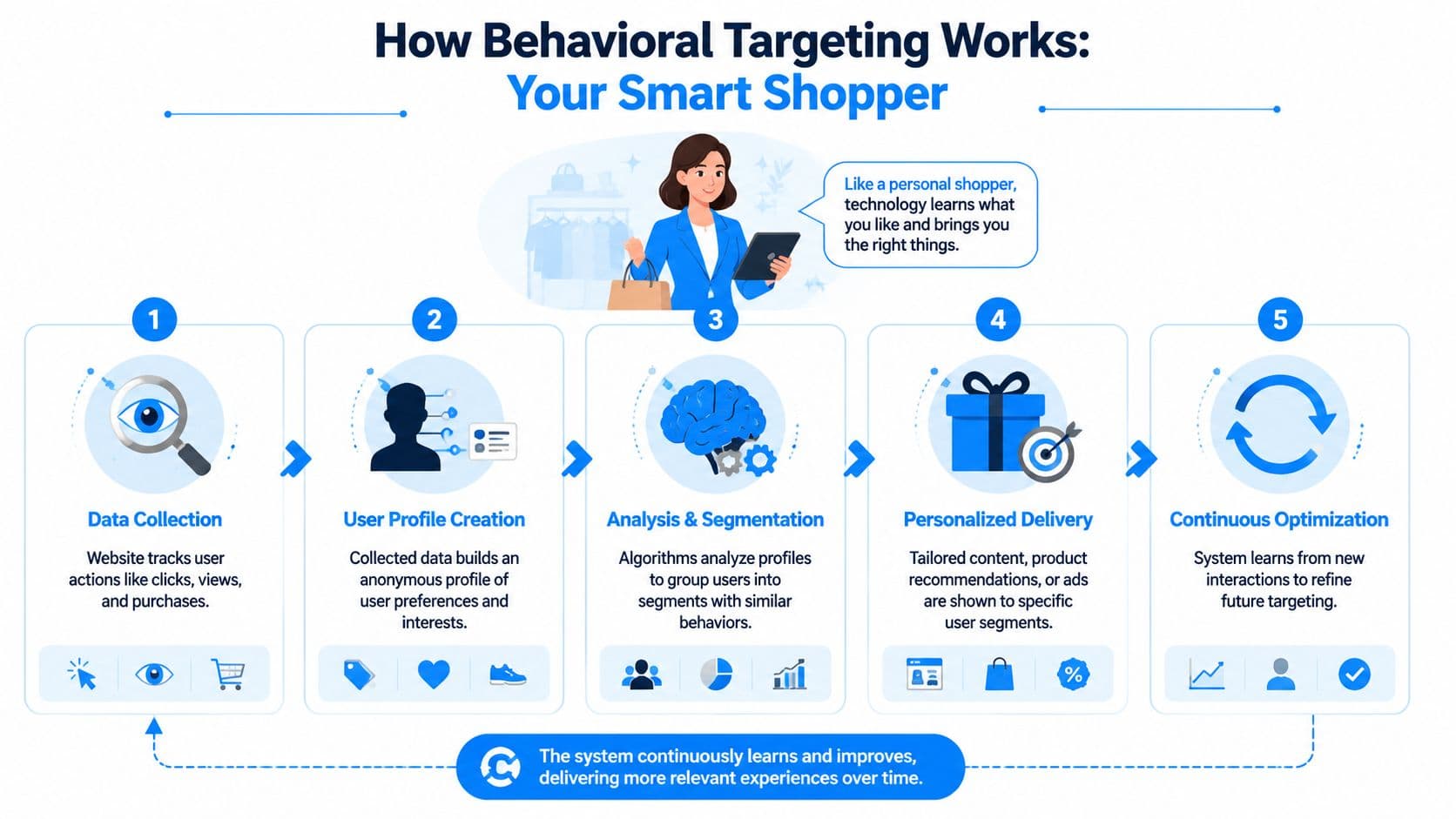
Behavioral targeting starts with event data. Your store records what shoppers do, then turns those actions into rules, segments, and triggered experiences that are more relevant than a one-size-fits-all storefront.
It starts with observation
On Shopify, the inputs are usually simple. Product views, collection visits, internal search terms, cart adds, cart removals, checkout starts, repeat visits, and past orders. Adobe's explanation of behavioral targeting mechanics outlines the core model: first-party behavioral signals are combined into a profile that updates as new actions come in.
The most useful signals tend to be:
- Product interest: Collections or products a visitor returns to more than once
- Search behavior: Terms entered into site search, especially specific product or problem-focused queries
- Cart behavior: Adds, removals, and abandoned checkout activity
- Engagement depth: Whether someone skims and leaves or spends time comparing options
The quality of your targeting depends less on how much data you collect and more on whether the signals point to a clear business action.
If you want a practical companion to this topic from the email side, understanding behavioral email concepts helps clarify how those same actions can trigger better lifecycle messages.
Then the system turns events into intent
A single page view means very little. A pattern does.
Someone who visits one product page once may be casually browsing. Someone who searches the same category twice, checks reviews, compares variants, and starts checkout is much closer to buying. Good behavioral targeting looks for that difference and groups visitors based on likely intent, not broad demographic assumptions.
On a Shopify store, those groups might include:
- returning visitors focused on one category
- first-time shoppers who read shipping or returns before adding to cart
- premium-product browsers who compare options but stop short of purchase
Practical rule: If a segment does not lead to a different message, offer, or support action, it is not useful.
This is also where AI tools earn their keep. A solid recommendation engine can spot product affinities faster than a manual rules setup, and a chatbot can respond to hesitation in the moment. For merchants comparing options, this guide to AI product recommendations for e-commerce is a useful next step.
Then your store responds
The response can happen on the site, in email, by SMS, or inside a chatbot. What matters is timing and relevance.
Common outputs include:
- Recommendation blocks that shift based on browsing behavior
- Support prompts when a shopper spends time on shipping, returns, or sizing pages
- Cart recovery flows triggered after checkout starts but does not finish
- Personalized banners for returning visitors with category-specific interest
Many stores often get sloppy. They collect the signal but respond too aggressively. If a new visitor gets hit with a popup, an irrelevant discount, and a chatbot message within seconds, the experience feels pushy, not helpful.
The trade-off is simple. More personalization can raise conversion, but only if it reduces friction. If it makes shoppers feel watched, performance drops and privacy risk goes up. The best setup is measured: use first-party behavior, ask for consent where required, and let the message match the level of intent.
Behavioral Targeting Examples in E-commerce
Most Shopify merchants already see behavioral targeting every day. They just don't always label it that way. The clearest examples are the ones that remove friction close to purchase.
Onsite recommendations
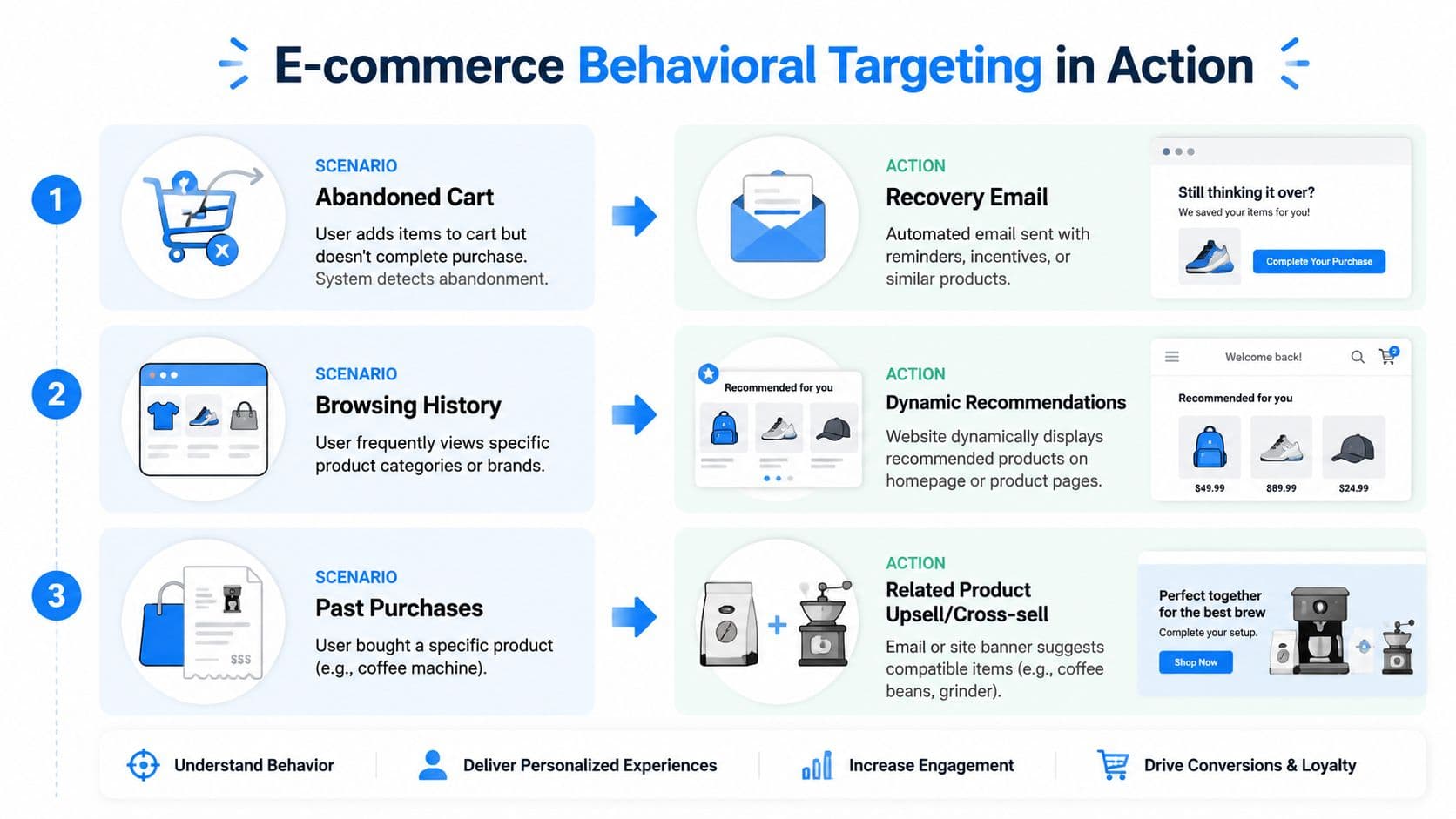
A visitor spends time on running shoes, compares sizes, then checks one product twice. A generic storefront shows your bestseller grid to everyone. A behavior-aware storefront surfaces socks, insoles, or related gear tied to that category.
That's a simple use case, but it changes buying momentum. Recommendations work best when they reflect current intent, not just storewide popularity. This is also where search behavior becomes valuable. If your shoppers use internal search heavily, these site search strategies for digital marketers are worth reviewing because search terms often reveal stronger intent than page views alone.
For stores building this out, product recommendation logic matters as much as design. This guide to AI product recommendations for e-commerce is useful if you want to think through recommendation placement and relevance.
Cart recovery
This is one of the most practical forms of behavioral targeting because the signal is obvious. The shopper wanted the item enough to add it, then stopped.
The best recovery flows don't jump straight to discounting. They address hesitation first. In many stores, the main blockers are shipping cost, delivery timing, returns, bundle confusion, or a final product question.
A stronger sequence usually looks like this:
- First nudge: A reminder that the cart is still available
- Support follow-up: A message that answers likely objections
- Selective incentive: A discount only if margin and category allow it
Abandoned cart recovery performs better when the message solves uncertainty before it tries to bribe the shopper.
Personalized messaging
Some forms of targeting are quieter but still effective. A returning visitor who keeps browsing skincare doesn't need a homepage hero about men's basics. They need the store to reflect the category they already care about.
That can show up as:
- Homepage adjustments: Category-led banners for returning visitors
- Collection sorting: Surfacing products related to prior interest
- Post-purchase follow-up: Cross-sell offers based on the last item bought
Many brands make a common mistake. They personalize the surface but ignore the question underneath. If the shopper's concern is fit, ingredients, or compatibility, changing a banner alone won't move the sale. Behavioral targeting is strongest when messaging, merchandising, and support all react to the same signal.
Measuring Success Key Metrics and KPIs
A Shopify store can show strong click-through rates on a quiz, popup, or AI chatbot and still fail to grow revenue. That is the trap with behavioral targeting measurement. If the experience feels more personalized but does not increase orders, basket size, or repeat purchase rate, it is not working well enough.
A useful scorecard stays close to commercial outcomes. Industry benchmarks suggest behavioral targeting often outperforms demographic targeting on conversion because it responds to real shopper actions, as noted in Insider's behavioral targeting guide. Benchmarks are a reference point, not proof. The key question is whether your version of personalization improves performance inside your own store, with your margins, traffic mix, and consent setup.
What to watch first
Four KPIs usually give Shopify merchants the clearest read on whether behavioral targeting is paying off:
- Conversion rate: Are more visitors completing a purchase after seeing a behavior-based experience?
- Average order value: Are recommendations, bundles, or chatbot prompts increasing basket size?
- Customer lifetime value: Are personalized follow-ups bringing buyers back for a second or third order?
- Cart abandonment rate: Are targeted interventions reducing the number of shoppers who drop off before checkout?
If your reporting is spread across Shopify, ad platforms, and app dashboards, it gets hard to connect behavior to revenue. A strong customer analytics solution for e-commerce teams helps tie on-site actions to outcomes so you can see which triggers are worth keeping.
Judging performance accurately
Judge success by whether the behavior-driven experience changed buying outcomes.
That sounds obvious, but plenty of stores still evaluate targeting by click rate alone. A popup can attract clicks because it interrupts the session. An AI chatbot can get engagement because shoppers are curious. Neither metric matters much if the interaction fails to move the sale, raise order value, or improve repeat purchase behavior.
A practical review process looks like this:
| KPI | What it tells you | Good use in behavioral targeting |
|---|---|---|
| Conversion rate | Whether intent turned into orders | Compare behavior-triggered experiences with your standard store experience |
| Average order value | Whether relevance increased basket size | Measure recommendation, bundle, and upsell performance |
| Customer lifetime value | Whether buyers came back and spent again | Track repeat purchase patterns after personalized follow-up |
| Cart abandonment rate | Whether friction was reduced before checkout loss | Measure recovery flows, support prompts, and checkout reassurance |
One pattern matters here. Stores often launch several triggers at once, then struggle to tell what caused the lift or the drop. Start with one use case. Measure a clean before-and-after period or compare against a simple control. That discipline matters more than adding another app, another popup, or another AI layer.
The Privacy Puzzle Navigating Consent in 2026
Behavioral targeting can raise conversion. It can also create legal and trust problems if you collect too much, explain too little, or rely on invasive tracking methods. Shopify merchants can't treat privacy as a side note anymore.
The big shift is that more brands are reassessing where behavioral targeting should happen and how far it should go. A Funnel analysis on behavioral versus contextual targeting cites a 2025 McKinsey report saying 68% of DTC brands now prioritize contextual over behavioral targeting to reduce compliance exposure. The same source notes GDPR and CCPA fines surged 35% in 2024 due to invasive user tracking.
Why the privacy trade-off matters now
Not all targeting carries the same risk. When a store relies heavily on cross-site tracking and opaque data collection, the compliance burden goes up. When it relies on first-party behavior happening on its own site, the model is easier to explain and govern.
That distinction matters in practice. There's a difference between:
- using on-site browsing activity to improve recommendations for a current visitor
- following people around the web based on behavior collected across multiple properties
The first can still require consent and clear disclosure, but it's easier to defend because the connection to the customer experience is direct.
The safest targeting strategy is the one you can explain clearly to a customer in one sentence.
Behavioral vs contextual targeting
Contextual targeting is often the cleaner alternative when you want relevance without building a user-level profile. If someone is reading a recipe article, cookware ads make sense because of the page context, not because of that person's browsing history.
Here's the practical difference:
| Aspect | Behavioral Targeting | Contextual Targeting |
|---|---|---|
| Data basis | User actions and behavior history | The content or environment around the ad |
| Personalization style | Tailored to the individual or segment | Tailored to the page or topic |
| Privacy risk | Higher if tracking is broad or cross-site | Lower because it doesn't depend on detailed user profiles |
| Best use case | Onsite personalization, cart recovery, lifecycle flows | Privacy-sensitive acquisition and ad placement |
| Main weakness | Can feel invasive if poorly implemented | Less precise for returning-user intent |
For many Shopify brands, the practical answer isn't choosing one forever. It's using first-party behavioral data carefully on your own store, while leaning on contextual approaches where privacy exposure is harder to justify.
How to Start Using Behavioral Targeting on Shopify
Most stores don't need a complex personalization program to get started. They need a clean setup, one useful trigger, and a tool stack that can act on shopper behavior without a custom build.
A major reason merchants stall is execution. A 2024 Gartner study found 72% of Shopify stores fail to activate effective lookalike modeling because they lack tools to synthesize the 12+ behavioral signals AI-driven targeting requires, as summarized in the earlier Adobe-linked research context. In plain terms, merchants have data, but they don't have a reliable way to use it.
Start with the data you already own
Your first move should be boring and useful. Make sure Shopify Analytics and your core measurement stack are capturing the key events you care about.
Focus on signals such as:
- Viewed product pages
- Used site search
- Added to cart
- Started checkout
- Returned to the same category or product
This doesn't require a giant implementation. It requires discipline. If you can't see those behaviors clearly, you can't personalize responsibly.
Launch one use case first
Cart recovery is usually the best starting point because intent is obvious and the business case is easy to understand. Product recommendations are also strong if your catalog supports natural add-ons or repeatable category logic.
Good first projects include:
- Recovering abandoned carts with a support-first message
- Showing category-based recommendations on product pages
- Prompting help when shoppers stall on shipping, fit, or returns questions
If you're evaluating the tool side of this, it helps to review what modern e-commerce personalization software can automate on Shopify before you install multiple overlapping apps.
After you've got the basics in place, this walkthrough gives a clear visual example of how merchants use AI assistance in-store:
Add automation carefully
The best automation responds to clear intent. The worst automation interrupts everyone the same way.
Use this filter before turning on any behavior-based workflow:
- Is the signal meaningful? A cart add means more than a quick homepage click.
- Is the response helpful? Answering a likely objection beats showing a random coupon.
- Is the timing appropriate? Immediate isn't always better if the shopper is still exploring.
- Can you explain the data use clearly? If not, the workflow needs work.
That's the practical version of what is Behavioral Targeting on Shopify. It's not a massive AI project. It's a sequence of small, observable, revenue-linked interventions based on signals your shoppers already give you.
Make Your Store More Human Not Just More Automated
The best behavioral targeting doesn't feel like surveillance. It feels like competent retail. A shopper shows interest, hesitates, comes back, compares, or asks a question. Your store notices and responds in a way that helps them keep moving.
That's why the most useful definition of what is Behavioral Targeting isn't technical. It's operational. You're using behavior to make merchandising, messaging, and support more relevant. Not louder. Not creepier. Just more aligned with what the shopper is already trying to do.
Three principles keep it effective:
- Start with first-party signals: Use the behavior happening on your own store before chasing anything more complex.
- Solve friction before pushing urgency: Support, clarity, and relevance often convert better than pressure.
- Measure business outcomes: Judge the work by conversion, order value, repeat buying, and recovered carts.
Stores usually don't lose sales because shoppers lacked interest. They lose sales because the store failed to respond to that interest in time.
If you want a smart first move, don't launch six campaigns. Pick one. Cart recovery is usually the cleanest place to start. Then make sure the message answers a real question, not just repeats the offer.
If you want a simple way to act on shopper behavior without turning your store into a science project, Carti is built for exactly that. It helps Shopify stores respond to browsing, product interest, and cart activity with instant answers, smart suggestions, and timely recovery nudges, so your store feels more helpful while doing more of the selling work automatically.

Written by
Daniel AndersonFounder of Carti. 10+ years building ecommerce brands in apparel and supplements. Still runs a Shopify store and built Carti to help merchants convert more browsers into buyers.
Ready to boost your store's sales?
Install Carti in 5 minutes and let AI handle customer questions, recommend products, and close sales 24/7.
Start Free Trial14-day free trial