
Average Order Value equals Total Revenue ÷ Number of Orders. If your store makes $56,000 from 2,000 orders, your AOV is $28 because $56,000 ÷ 2,000 = $28.
That number matters because it tells you how efficient each transaction is, not just how many orders came through. A lot of Shopify owners run into the same problem. Orders are coming in, ads are running, customers are checking out, but profit still feels tight. In most cases, the issue isn't only traffic or conversion rate. It's that each cart isn't carrying enough value.
When you understand the average order value formula, you stop looking at revenue as one big pile and start seeing where the business gets stronger. A store with modest traffic and healthier baskets can outperform a store with more orders but weaker carts. That's why AOV deserves attention right next to conversion rate, return rate, and customer acquisition cost.
Your Guide to Average Order Value
A new Shopify store can feel busy and still leave money on the table. Orders come in, traffic looks healthy, and revenue inches up, but the average cart stays light. That is usually the point where average order value becomes more than a dashboard number. It becomes a growth lever.
The formula is simple. Average Order Value = Total Revenue ÷ Number of Orders. The useful part is not memorizing it. The useful part is using it to decide how to raise the value of each checkout through bundles, thresholds, add-ons, and product recommendations.
That distinction is important because order count alone can hide weak cart economics. A store with 100 small orders can be less efficient than a store with 70 stronger ones, especially if paid traffic is getting more expensive. Raising AOV helps you get more from the buyers you already worked hard to acquire.
Practical rule: If you want more revenue without relying only on more traffic, improve what happens inside the cart.
This is also where many guides stop too early. They give the formula, then leave you to figure out what to do with it. In practice, AOV improves when your store responds to shopper behavior in real time. If someone adds a protein powder, the next move might be a shaker, a subscription option, or a free shipping prompt tied to a sensible threshold. Tools like Carti help automate those decisions so AOV becomes something you can actively increase, not just report on later.
AOV also sharpens the questions that move revenue. Are shoppers buying one hero product and checking out too soon? Which collections naturally create larger baskets? Are discounts pushing low-value combinations instead of profitable ones?
Three habits make AOV useful in daily operations:
- Track one consistent time window: Review it weekly or monthly so changes mean something.
- Pair it with cart behavior: Check which products are bought together, not just which ones sell most.
- Test one lever at a time: Adjust a bundle, free shipping threshold, or recommendation rule, then measure the effect on basket size.
New store owners often chase more sessions first. Experienced operators look at basket size early, because increasing spend from existing buyers is often faster, cheaper, and easier to control than forcing more shoppers into the funnel.
What Average Order Value Really Measures
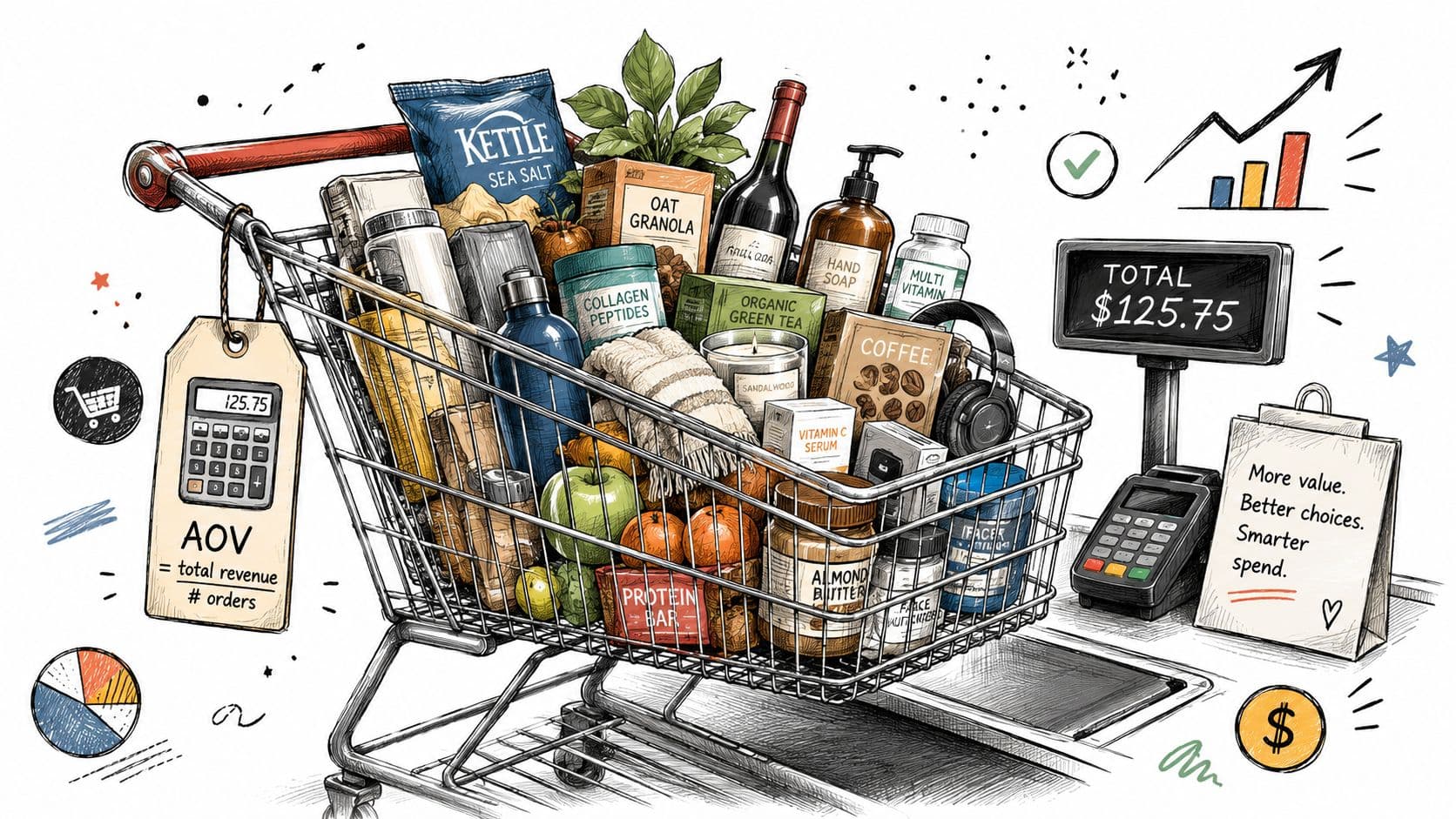
AOV measures the value of a transaction. That's the cleanest way to think about it. It doesn't tell you how loyal a customer is, how often they come back, or how profitable a channel is by itself. It tells you how much revenue is attached to the average checkout.
Think of AOV like the checkout cart total
Think about a grocery store checkout lane. Two shoppers can both count as one transaction. One arrives with a basket holding a few essentials. The other arrives with a full cart, plus a few impulse items near the register. The store records both as one order, but the checkout value is very different.
That's what AOV captures. It answers a simple question: how much is inside the cart when someone buys?
For Shopify brands, this matters because many growth decisions happen before the customer hits "Pay now." Product pairings, threshold messaging, add-ons, subscriptions, and FAQs all influence whether a shopper checks out light or checks out heavy.
AOV is the cart-size metric. It tells you whether your store is getting broader baskets or thinner ones.
AOV is not the same as customer value
A common point of confusion for new operators is that AOV is a per-transaction metric, not a per-customer metric, which means the same customer can count multiple times if they place multiple orders in the chosen period, as explained in Wall Street Prep's breakdown of AOV.
That distinction matters in practice:
| Metric | What it focuses on | Best used for |
|---|---|---|
| AOV | Order size | Upsells, bundles, shipping thresholds |
| Customer value metrics | Repeat purchase behavior | Retention, loyalty, lifecycle planning |
If you mix those up, you'll make bad decisions. For example, a free shipping threshold should be based on transaction behavior, not on how valuable a customer might become months later. Upsell placement should respond to what shoppers are putting in the basket now, not what a customer segment might buy over time.
AOV is one of the fastest ways to see whether your merchandising is helping people build stronger carts. That's why it sits close to revenue optimization, not just reporting.
How to Calculate Average Order Value Accurately
You pull your monthly report, see AOV jump, and assume your upsell offer is working. Then you look closer. The increase came from a reporting change, not from shoppers building bigger carts. That mistake is common on Shopify, and it leads to bad decisions fast.
The formula itself is simple:
Average Order Value = Total Revenue ÷ Number of Orders
If your store generated $56,000 from 2,000 orders in March, your AOV is $28. If you did $100,000 from 2,000 orders in a quarter, your AOV is $50. Same math. Different period.
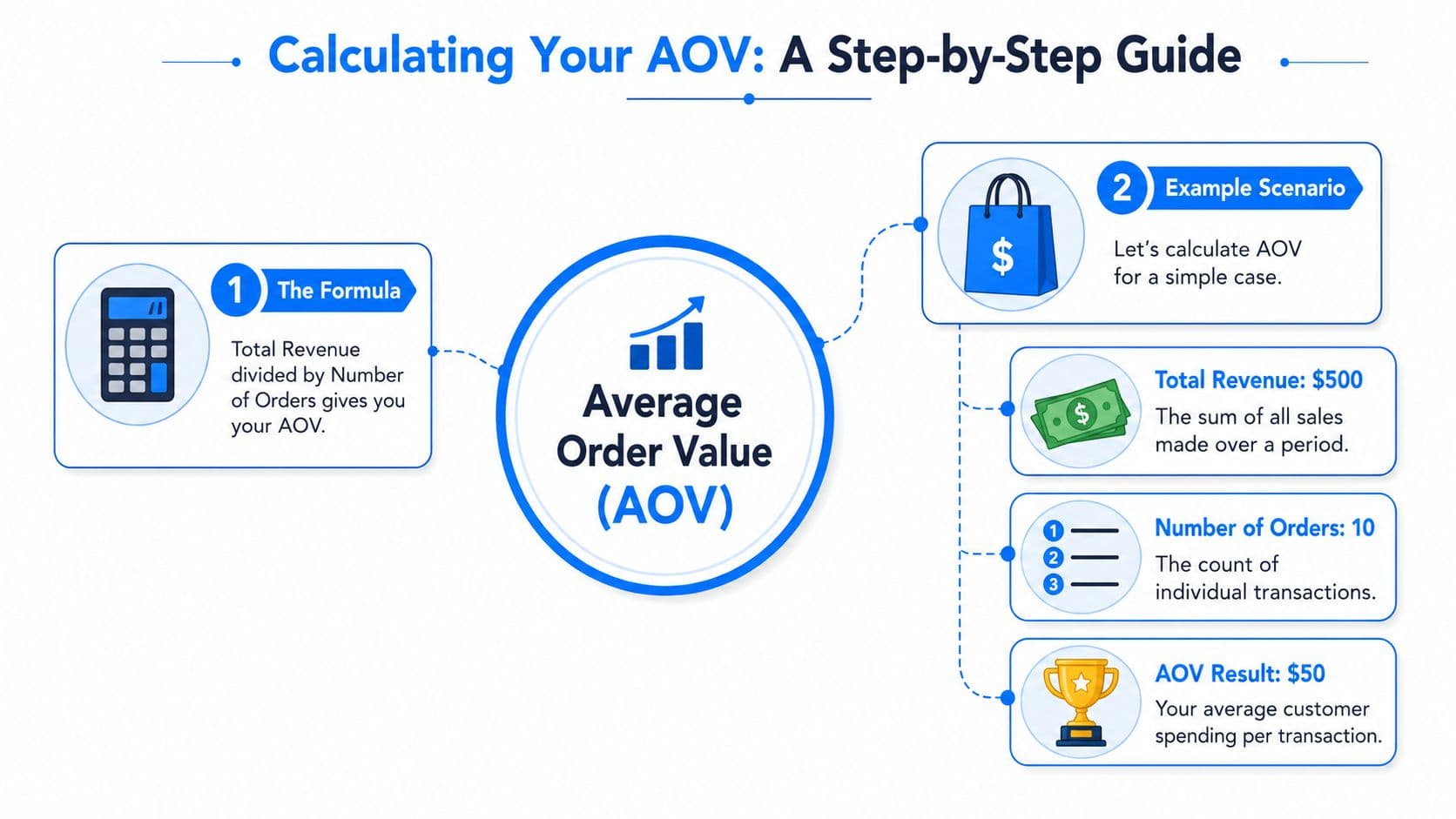
Where store owners get tripped up is not the division. It is the input.
Start with one clean definition
Pick a revenue rule before you compare weeks, months, or channels. If one report includes shipping and another excludes it, your AOV trend is noisy. If one dashboard shows revenue before returns and another shows revenue after refunds, you are not measuring the same thing twice.
AOV works like a cart-size scorecard. If the scorecard changes every month, you cannot tell whether your offer improved or your reporting changed.
Use one definition and document it. For example:
- For merchandising decisions: use the value of what the shopper agreed to buy at checkout.
- For finance-oriented reporting: use a net revenue view that handles discounts and returns the same way every time.
- For multi-channel brands: line up Shopify, subscriptions, and marketplaces so all orders follow the same rules.
That discipline matters because AOV should guide action. If you plan to use product bundles, threshold offers, or AI upsells, the metric has to reflect real basket behavior, not accounting drift. A broader e-commerce KPI framework for Shopify stores helps keep AOV aligned with the rest of your reporting.
Check the inputs before you trust the number
Write down your rules once. Then keep using them.
- Which period are you measuring? Daily, weekly, monthly, and quarterly views all answer different questions.
- Are you using gross revenue or net revenue? Pick one.
- How are discounts treated? Include them the same way every time.
- How are refunds and returns handled? Decide whether AOV is reported before or after those adjustments.
- How are subscriptions counted? Renewals can distort comparisons if they are mixed in without a clear rule.
- Are canceled orders removed? They should be, but only if that rule is applied consistently.
One practical note. New brands often calculate AOV inside Shopify analytics, then compare it with a spreadsheet export from another system. That is where inconsistencies creep in. The fix is boring but effective: one source of truth, one formula, one rule set.
Accurate AOV is useful because it leads to action
AOV is not just a reporting metric. It is the starting point for revenue experiments.
If your current AOV is stable and trustworthy, you can test what raises it. Bundle placement. Cart add-ons. Free shipping thresholds. Post-purchase offers. AI product recommendations. Tools like Carti matter here because they connect the measurement to execution. Instead of stopping at "our AOV is $42," you can start asking, "Which offer should we show to push that to $46 without hurting conversion?"
That is also why AOV should sit next to retention metrics, not replace them. Gainsty's tips for customer value are useful here because a bigger first order and a stronger repeat purchase engine solve different problems.
AOV does not need complicated math. It needs clean inputs and consistent rules. Once that foundation is solid, you can use the number to improve the cart, not just report on it.
Interpreting Your AOV and Setting Realistic Goals
AOV on its own doesn't tell you whether you're doing well. A low-priced consumable brand and a premium furniture store won't interpret the same number the same way. Product mix, buying frequency, and margin structure all shape what "good" looks like.
A good AOV depends on your catalog
Start with your own store, not a benchmark screenshot on social media. If you sell naturally paired items, bundling may raise basket size quickly. If you sell one main product with fewer logical add-ons, improvement may come from threshold offers or better replenishment logic instead.
This is also why clean reporting matters. If your calculation changes based on shipping, discounts, returns, or subscription handling, the trend becomes hard to trust. That's one reason many Shopify operators benefit from reviewing a wider KPI set alongside AOV. A practical place to start is this guide to e-commerce key performance indicators, which helps frame AOV next to the rest of your store economics.
Watch the direction of your AOV more closely than the absolute number. Trend quality usually tells you more than vanity comparisons.
For a broader retention lens, Gainsty's tips for customer value are worth reading alongside AOV analysis. They complement each other well. AOV tells you what happens in a transaction. Customer value work tells you what happens across the relationship.
Segment your AOV before you try to improve it
The fastest path to useful insight is segmentation. Instead of asking, "What is my AOV?" ask more specific questions.
- By channel: Do shoppers from email build larger carts than shoppers from paid social?
- By device: Does mobile produce thinner baskets because add-on discovery is weaker?
- By customer type: Do returning buyers respond better to bundles, while first-time buyers need trust signals first?
- By collection: Which product categories naturally support multi-item purchases?
This changes how you set goals. You stop chasing a store-wide number blindly and start looking for pockets of opportunity. Sometimes the right move isn't a sitewide upsell campaign. It's a targeted fix on one collection page, one landing page flow, or one post-purchase path.
Actionable Strategies to Increase Your Average Order Value
The best AOV tactics feel helpful to the shopper. The worst ones feel like pressure. If the extra item makes the purchase more complete, shoppers often accept it. If it feels random, they ignore it.
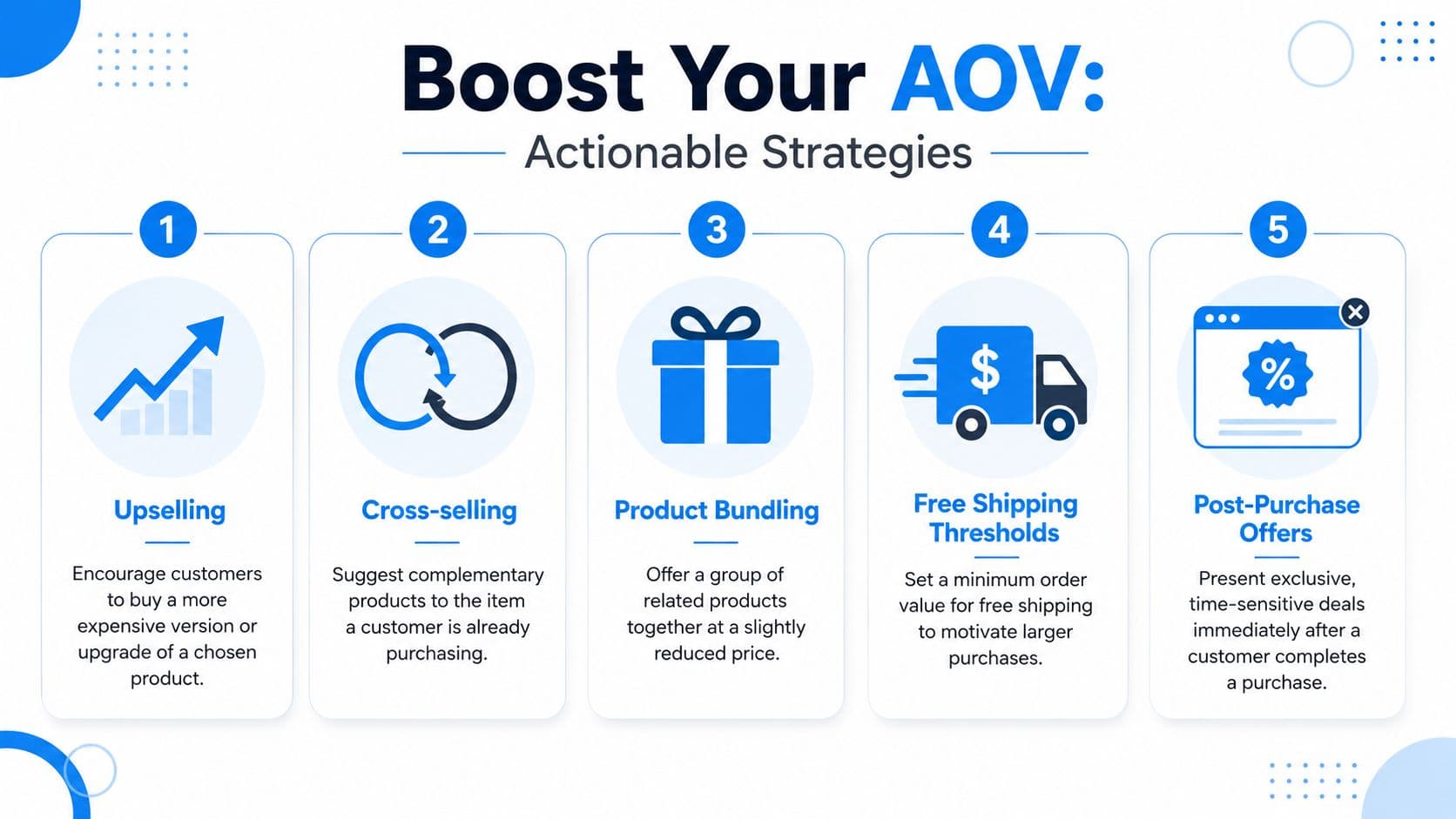
Five tactics that actually change basket size
-
Bundle products that belong together
Good bundles remove decision fatigue. Skin care routines, bedding sets, coffee starter kits, and grooming systems work because the shopper already sees them as a group. The key is relevance. Don't bundle leftovers. Bundle products that solve the same job. -
Set a free shipping threshold with logic
A threshold works when it feels close enough to reach. If the gap is reasonable, shoppers often add one more item rather than abandon the reward. This is one of the cleanest ways to turn a single-product order into a multi-item cart. -
Use cross-sells, not distractions
Recommend items that improve the main purchase. A phone case after a phone purchase makes sense. An unrelated novelty item doesn't. If you want a stronger product recommendation framework, this guide to Shopify product recommendations covers what to place and where to place it. -
Offer quantity incentives where repeat use is natural
This works best for consumables, basics, and replenishable products. If shoppers already expect repeat usage, a multi-unit option can lift basket size without feeling forced. -
Use post-purchase offers carefully
After the main checkout, shoppers are more open to a small complementary addition than a whole second decision tree. Keep the offer simple and relevant.
A solid outside perspective on this topic is tactics for higher AOV from Ecommerce Boost. It's useful reading if you want more examples of where these plays fit inside a storefront.
Here's a practical walkthrough that complements the tactics above:
What usually doesn't work
Some AOV ideas look good in a meeting and fail in a cart.
- Generic upsells: If every product page pushes the same add-on, shoppers tune it out.
- Huge bundles: When the package becomes too broad, it creates more friction than value.
- Thresholds with no visible progress: People respond better when they can see how close they are.
- Over-discounting: This can raise basket size while subtly training customers to wait for deals.
The strongest AOV tactic is usually the one that makes the cart feel more complete, not more expensive.
How Carti's AI Automates AOV Growth
Manual AOV optimization breaks down fast. Product recommendations go stale. Support questions pile up. Merchants set one bundle, one threshold, and one cart upsell, then hope it keeps working for every shopper.
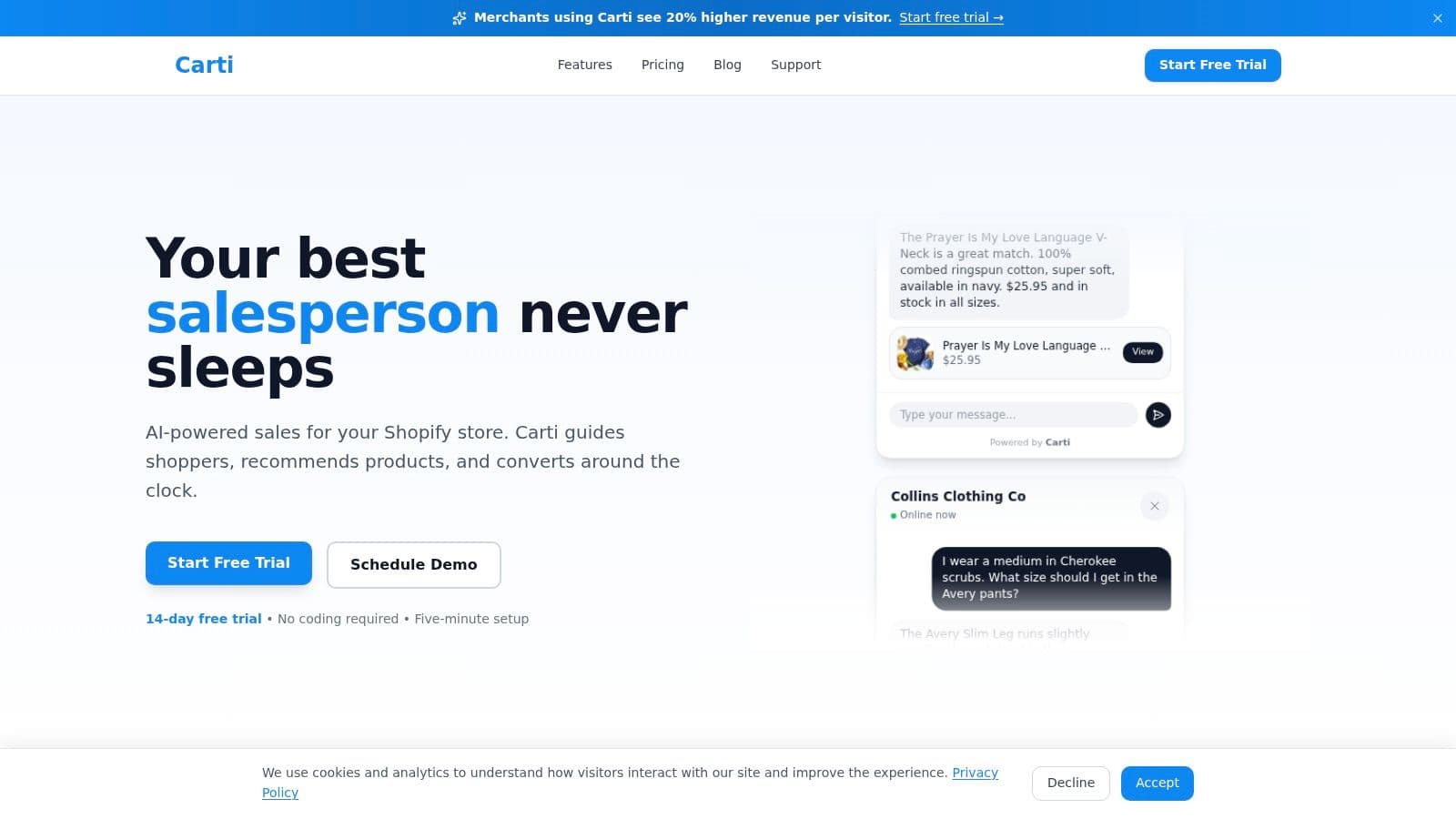
AI helps at the exact moment basket decisions happen
A tool like Carti earns its keep. Instead of relying on static merchandising alone, it can respond while the shopper is still deciding. That matters because most AOV gains happen in the small moments. A customer wonders whether two items work together. They ask about sizing, ingredients, compatibility, delivery timing, or return policy. If they get clarity fast, they're more likely to complete the fuller basket.
Carti's Instant Answers help remove that friction. When shoppers don't have to wait for support, they can keep moving. Its Smart Suggestions can also surface relevant add-ons or upgrades based on what the shopper is already viewing, which is much closer to how a strong in-store associate sells.
If you want a deeper look at the recommendation side, this article on AI product recommendations gives a useful foundation for how automated suggestions fit into ecommerce merchandising.
Where automation beats manual merchandising
Automation is especially useful in three AOV scenarios:
- When your catalog is too large for hand-built pairings: AI can surface relevant complements more consistently than a static list.
- When support questions block add-on purchases: Fast answers reduce the hesitation that keeps carts thin.
- When merchandising clues are buried in conversations: An insights dashboard can reveal what shoppers keep asking, which often points to missing bundles, missing comparison content, or unclear PDP copy.
Carti's Cart Recovery also matters here. Some abandoned checkouts aren't lost because the shopper changed their mind. They're lost because the cart wasn't complete enough to justify the purchase right then. Recovery prompts and better suggestions can bring that decision back into motion.
For merchants who are still sorting out what "AI" means in practical terms, understanding AI vs AGI vs ASI is a helpful plain-English explainer. It clears away the hype and keeps the focus where it belongs, which is using applied AI to support real buying decisions.
The point isn't replacing merchandising judgment. It's scaling the best parts of it across every session.
From Measurement to Mastery
A lot of Shopify owners reach the end of an AOV article with a number in hand and no clear next move. They know the formula. They still do not know which cart decision to fix first, what to test next, or how to scale the wins without turning merchandising into a full-time job.
That is the gap between measurement and mastery.
AOV grows when the store removes friction at the exact moments shoppers hesitate, adds the right product at the right time, and gives people a stronger reason to complete a fuller order now instead of later. The formula helps you spot the opportunity. Execution is what changes revenue.
The practical approach is simple. Measure AOV cleanly. Break it out by traffic source, device, and customer type. Then improve the parts of the buying journey that increase basket size, such as product pairings, bundle structure, cart thresholds, and pre-purchase support.
Small cart improvements compound.
Stores that raise AOV consistently rarely do it with one dramatic change. They improve one decision point at a time, then let those gains stack across more sessions. Tools like Carti fit naturally into that process by automating product suggestions, answering buying questions, and recovering carts that were close to converting. If you're ready to turn AOV from a reporting metric into a growth system, that is the next step.

Written by
Daniel AndersonFounder of Carti. 10+ years building ecommerce brands in apparel and supplements. Still runs a Shopify store and built Carti to help merchants convert more browsers into buyers.
Ready to boost your store's sales?
Install Carti in 5 minutes and let AI handle customer questions, recommend products, and close sales 24/7.
Start Free Trial14-day free trial