
You've probably felt this tension already.
A retailer gives you distribution, shelf space, and built-in traffic. Then your product goes live at a price you didn't want, beside competitors you didn't choose, with packaging that doesn't explain what makes you different. Sales happen, but the customer relationship belongs to someone else.
Your Shopify store flips that equation. You control the offer, the merchandising, the checkout flow, the post-purchase experience, and the data. But you also own the hard parts. You have to earn every visit, answer every pre-purchase question, manage returns, and keep fulfillment from breaking as order volume rises.
That's the B2C vs D2C decision. It isn't just about whether you sell through retailers or direct on Shopify. It's about who controls margin, who controls the customer relationship, and when operational complexity starts eating the upside you expected from going direct.
The Fork in the Road for Every Brand
The usual framing of B2C vs D2C is too simple. People talk about reach on one side and control on the other. That's true, but it misses the operational reality that determines profit.
If you sell through retail or marketplaces, you give up a lot. You usually don't control how your product is presented, what data comes back, or how customers experience your brand after purchase. But you also avoid carrying the full burden of customer acquisition, service, and fulfillment at the same intensity.
If you sell direct through Shopify, you gain ownership of the storefront, messaging, pricing, and customer insight. You can improve the purchase journey faster because fewer parties are involved. That's why many founders gravitate toward D2C early.
The catch is straightforward. Higher margin per order doesn't automatically mean a better business model.
The best channel is the one that leaves you with more usable profit after marketing, support, returns, and fulfillment are fully accounted for.
For some brands, D2C is the engine and retail is a supporting channel. For others, wholesale or marketplace distribution funds growth while direct channels handle retention, launches, and customer intelligence. And for a lot of Shopify merchants, the strongest answer isn't either-or. It's a blended model built on what each channel does best.
That's the decision worth making. Not “Which model sounds more modern?” but “Which model gives my brand the best economics and the best customer influence at my current stage?”
Defining the Playing Field B2C and D2C
At a practical level, the difference comes down to who stands between your product and the buyer.
B2C is the traditional consumer model. You sell through an intermediary such as a retailer, distributor, or marketplace, and that channel sells to the end customer. Your business may still be consumer-facing in the broad sense, but the relationship is filtered through someone else's storefront.
D2C means the brand sells straight to the customer through its own site or brand-owned environment. On Shopify, that usually means your store becomes the primary place where discovery, product education, purchase, and retention happen.
One simple way to consider it:
- B2C is the grocery store route. Your product reaches shoppers through someone else's shelves.
- D2C is the farm stand route. You meet the buyer directly and control the whole exchange.
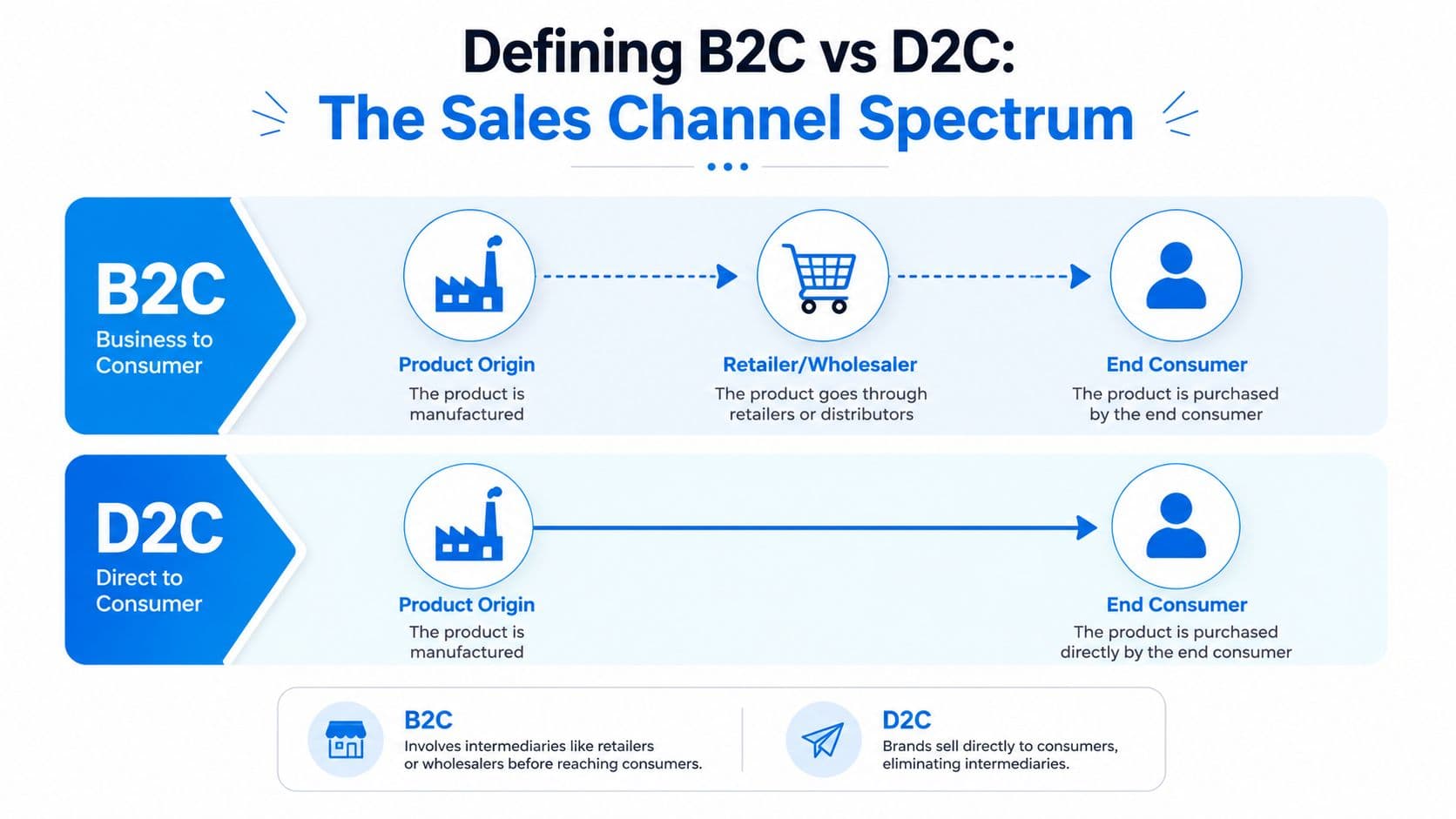
How value moves in each model
In B2C, three things usually get diluted as your product moves through the channel:
| Flow | B2C | D2C |
|---|---|---|
| Product | Brand to intermediary to buyer | Brand to buyer |
| Money | Shared across channel layers | Captured more directly by brand |
| Data | Often sits with retailer or platform | Captured by the brand |
That last line matters most. In D2C, the brand owns first-party behavior, customer feedback, and pricing decisions. In B2C, much of that sits with the intermediary.
One useful historical marker is that D2C is no longer a niche experiment. Salesforce notes that D2C sales have expanded from 15% to over 40% in some contexts, which shows how quickly direct selling can scale when brands control the customer relationship (Salesforce on B2B, B2C, and D2C).
Why Shopify merchants care about this distinction
Shopify makes D2C accessible, but accessibility isn't the same as simplicity.
Running direct gives you room to shape merchandising, retention, offers, and post-purchase communication in a way retail rarely allows. If you want a cleaner breakdown of how direct selling works in practice, this guide to D2C e-commerce is a useful companion read.
The important point is operational. In B2C, the channel helps carry the selling burden. In D2C, your store has to do the convincing. That changes everything from site design to support workflows.
A Head-to-Head Comparison of Core Differences
Most Shopify merchants don't need another abstract definition. They need to know how B2C vs D2C changes margins, control, speed, and workload.
Here's the clearest side-by-side view.
| Area | B2C | D2C |
|---|---|---|
| Reach | Faster access to existing retail or marketplace demand | You build traffic and demand yourself |
| Customer relationship | Indirect. The retailer or platform often owns the interaction | Direct. The brand owns the relationship |
| Brand control | Limited control over placement, pricing context, and presentation | Strong control over messaging, merchandising, and pricing |
| Data access | Limited consumer insight | First-party customer insight |
| Operations | Some burden shifted to channel partners | Brand owns more execution end to end |
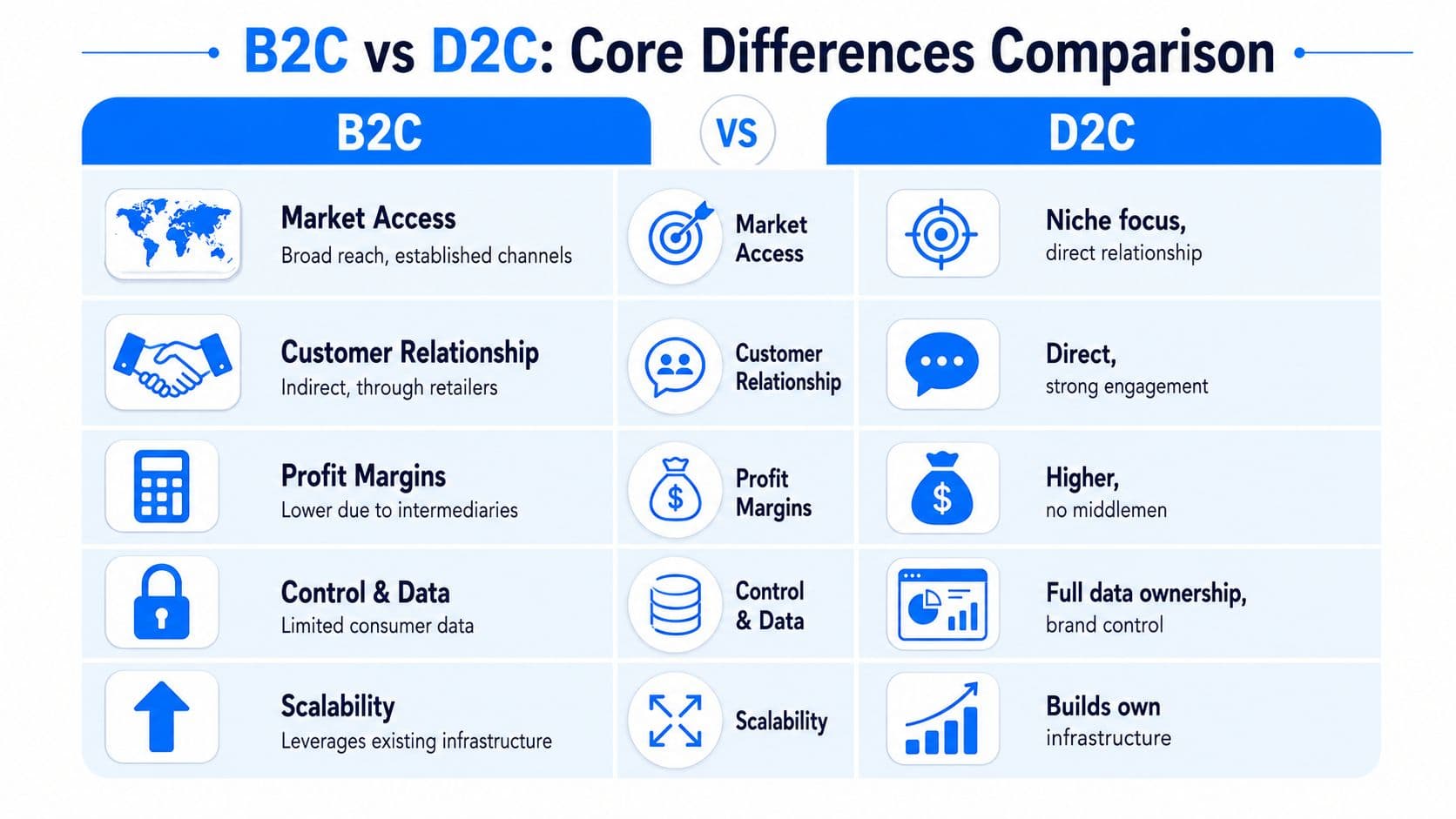
Profit margin versus real operating burden
D2C is attractive for a reason. Contentstack notes that D2C often carries gross margins of 40–60%, but also comes with materially higher operational complexity in fulfillment, customer service, and logistics because the brand absorbs functions intermediaries usually handle (Contentstack on B2C vs D2C).
That trade-off gets misunderstood all the time. Founders see stronger gross margin and assume the model is superior. But if support volume is high, return handling is messy, and paid acquisition is doing too much heavy lifting, that margin advantage can disappear fast.
Critical trade-off: D2C gives you more margin room on paper, but it also hands you more jobs to perform well.
Control over the brand experience
Retail can broaden exposure, but control gets diluted the moment your product enters someone else's system. The product title may change. The imagery may be compressed into a standard template. Adjacent products may redefine your price position in ways you didn't plan.
D2C fixes that. Your Shopify storefront controls the story. You choose the bundle logic, the landing page sequence, the reviews placement, the upsell path, and the post-purchase messaging.
That control is especially valuable when the product needs education. Skincare, supplements, technical apparel, home equipment, and specialty wellness products usually sell better when the brand can explain context, not just list features.
Customer data and retention
Here, the gap becomes strategic.
In B2C channels, you often know what sold. You may not know much about who bought, what almost converted, what questions blocked the sale, or which product page pattern predicts repeat purchase. In D2C, that information can feed email, SMS, merchandising, support, and retention.
That's also why many merchants now think in channel combinations instead of binaries. If you're weighing owned storefronts against marketplace visibility, this omnichannel guide: Shopify vs Amazon is worth reviewing because it highlights how channel choice affects control and discoverability.
If your product wins because of narrative, education, or repeat purchase behavior, direct channels usually create more long-term leverage.
Scaling looks different in each model
B2C scale often comes from distribution access. D2C scale comes from system quality.
A retailer can put you in front of buyers quickly. Your direct store has to convert traffic you generate yourself. That means site speed, offer structure, merchandising, lifecycle marketing, and support responsiveness matter more than many teams expect.
The practical takeaway is simple. B2C scales with channel access. D2C scales with operational discipline.
Measuring Success with the Right KPIs
A lot of channel mistakes happen because brands track the wrong scoreboard.
If you run a retail-heavy model, success usually looks like clean sell-in, healthy reorder behavior, and strong partner performance. If you run D2C on Shopify, the dashboard shifts toward shopper behavior and unit economics. The same business can look healthy in one model and fragile in the other, depending on what you measure.
What matters more in B2C
In B2C, the operating mindset is usually scale and velocity. Qubstudio notes that early-stage consumer businesses often target about 15% monthly user growth, with attention on conversion-rate lift and repeat-purchase frequency rather than B2B-style retention benchmarks (Qubstudio on startup metrics for B2C products).
That framing is useful even for Shopify merchants with mixed channels. When retail or marketplace distribution drives exposure, your KPI set usually emphasizes:
- Sell-through quality: Are products moving once they enter the channel?
- Channel repeatability: Do partners reorder with confidence?
- Conversion velocity: Does demand turn into sales quickly?
- Purchase frequency: Do buyers come back often enough to support the model?
What shifts in D2C
Direct channels require a tighter operating dashboard because more variables sit inside your control.
For a Shopify store, that usually means watching:
- Acquisition efficiency: Which campaigns bring qualified traffic, not just sessions.
- Onsite conversion: Where product pages, cart flows, or support friction suppress purchase.
- Average order value and mix: Whether bundles, upsells, or merchandising improve order economics.
- Cart recovery and checkout completion: Whether intent is being rescued before it disappears.
- Retention signals: Whether the first order becomes a repeatable customer relationship.
A strong KPI stack isn't a list of vanity metrics. It's a diagnostic system. If you want a sharper framework for building that dashboard, Carti's overview of e-commerce key performance indicators is a practical reference for what to monitor on a live store.
The wrong KPI set creates false confidence. A channel can produce revenue while quietly destroying margin or overloading your team.
Match the metric to the model
This is the operating rule I'd use.
If the channel owns the relationship, evaluate partner performance and sales velocity. If your store owns the relationship, evaluate friction, conversion quality, and repeat purchase behavior. Don't judge a D2C business like a wholesale account. Don't judge a retail-led business like a retention-first Shopify brand.
The better your KPI model matches your go-to-market model, the faster you'll spot where the economics actually work.
The Decision Framework Choosing Your Go-to-Market Strategy
The strongest brands don't ask whether D2C is the best choice. They ask when it's better for them.
That's a more useful question because the answer changes with product complexity, operational readiness, support burden, and customer acquisition efficiency. The issue isn't just margin. It's the point where the cost to serve direct starts offsetting the control and margin benefits of D2C.
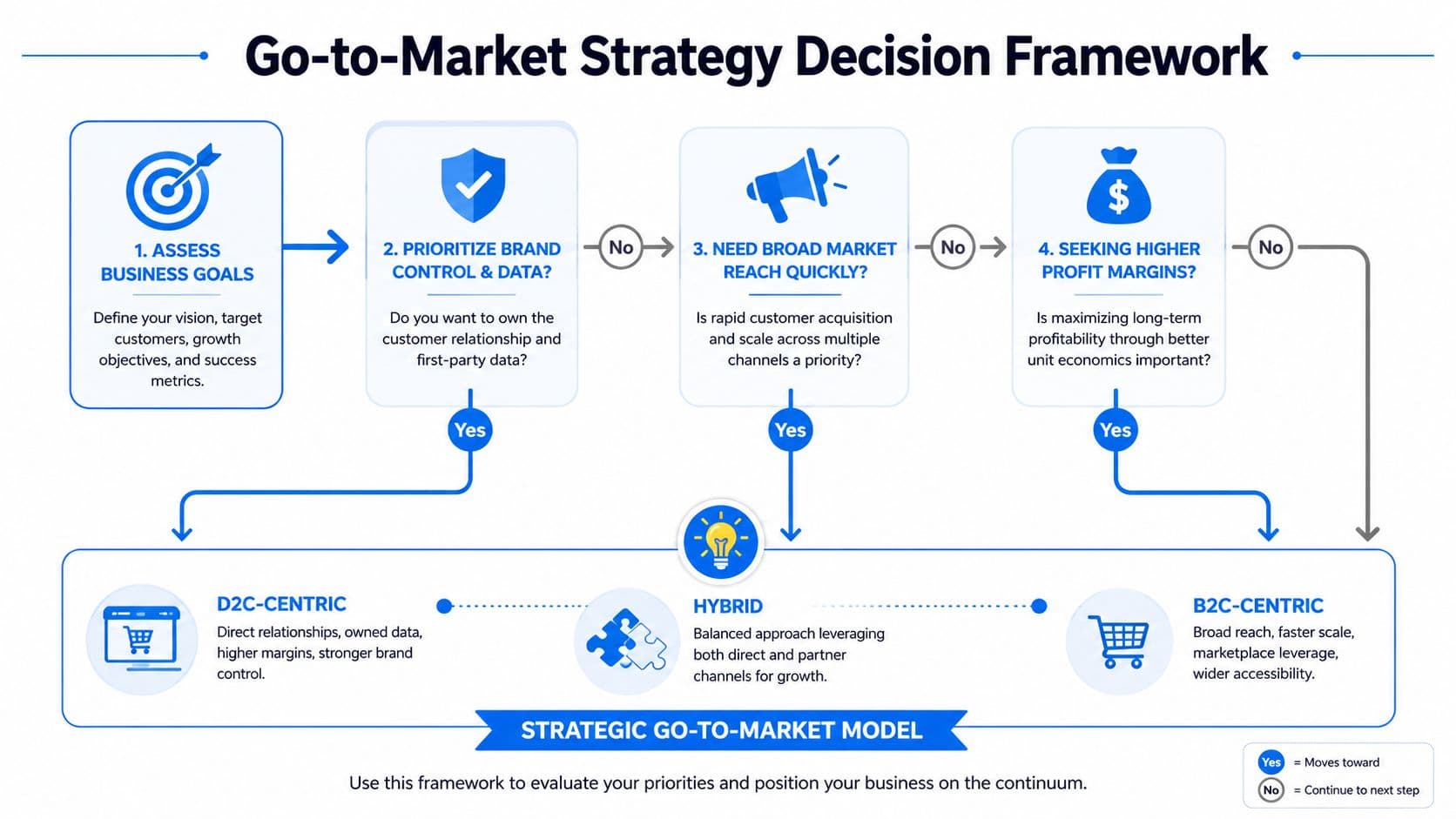
The crossover point most brands miss
Atwix gets to the core issue well: a key question is at what order volume, return rate, and support intensity D2C stops being operationally superior, even if it still looks better on paper, because the brand owns conversion, post-purchase support, and cart recovery end to end (Atwix on D2C and B2C explained).
That's the crossover point.
You hit it when one or more of these conditions start stacking up:
- Support demand rises faster than revenue. Product questions, shipping inquiries, and returns create labor drag.
- Returns become structurally expensive. Categories with fit issues, expectation gaps, or fragile fulfillment can erode direct profitability.
- Paid acquisition gets less forgiving. If your store depends heavily on paid traffic, small drops in efficiency can hurt quickly.
- Fulfillment complexity grows. Bundles, subscriptions, multiple warehouses, or international shipping can make direct operations harder than expected.
A simple way to choose
Use these lenses together, not separately.
| If this is true | You may lean toward |
|---|---|
| Your product needs education, storytelling, or controlled merchandising | D2C-centric |
| You need broad market reach quickly | B2C-centric |
| You want first-party insight but also wider distribution | Hybrid |
| Your support and fulfillment load is becoming heavy | Hybrid or selective B2C |
A hybrid model often works best when your Shopify store handles the jobs only a direct channel can do well, while retail or marketplace channels handle broader distribution.
That can look like this:
- Direct for launches: Test new products, bundles, and positioning on your own site first.
- Retail for scale: Move proven core products into broader channels once demand is clearer.
- Direct for retention: Keep subscription, loyalty, education, and high-intent repeat purchase behavior inside owned channels.
If you're comparing how platform choice affects this balance, Skup's analysis of eCommerce platforms is helpful because it shows how owned and third-party channels create different trade-offs.
What the framework looks like in practice
Don't start with ideology. Start with your current constraints.
If customers need explanation before purchase, D2C often deserves priority. If your catalog is straightforward and channel discovery matters more than storytelling, B2C may outperform. If your post-purchase workload is growing and your direct store still matters strategically, hybrid is often the adult answer.
To make that call well, look closely at how customers behave after purchase, not just before it. Patterns in support, repeat ordering, and returns often reveal more than topline sales do, which is why this breakdown of post-purchase behavior is useful when pressure-testing your model.
Decision rule: Choose the model that your team can operate well, not the one that looks best in a margin spreadsheet.
Tactical Execution Optimizing Your Chosen Model
Once the channel choice is made, execution becomes the separating factor.
A weak direct store turns D2C into expensive chaos. A sloppy hybrid strategy creates channel conflict, unclear pricing, and broken customer expectations. The merchants who win are the ones who build operations around the actual demands of the model, not the idea of the model.
Customer experience has to match channel strategy
If you're D2C-first, your store has to answer buying questions quickly. Customers won't wait long for fit guidance, shipping clarity, bundle logic, or product comparisons. Every unanswered question becomes friction.
That's why the storefront has to behave like a sales environment, not just a product catalog.
A few practical moves matter more than cosmetic redesigns:
- Tighten product page clarity: Put the deciding information where customers hesitate, not buried in tabs.
- Reduce checkout doubt: Surface shipping, returns, and delivery expectations before the final step.
- Support discovery with guidance: Collections, bundles, quizzes, and recommendations should help people choose faster.
Fulfillment and support need their own operating plan
A lot of D2C brands over-focus on acquisition and under-build the back end. That's where margin leaks.
For direct-heavy stores, I'd pressure-test three areas every month:
-
Order handling consistency
Fast growth is great until picking, packing, and delivery expectations slip. If service quality drops, support demand climbs right behind it. -
Return friction
If a category naturally creates exchanges or dissatisfaction, your D2C model needs stronger product education and clearer expectation-setting before checkout. -
Support load by question type
The best support optimization often starts with removing repetitive questions from the queue through better merchandising, better copy, and automation.
If you're building that stack, these e-commerce automation tools offer a useful view of where merchants typically automate first.
Operational efficiency in D2C doesn't come from doing more work. It comes from preventing repetitive work.
Pricing and channel discipline matter in hybrid models
Hybrid sounds flexible, but it can get messy fast.
If your Shopify store and external channels don't have clear roles, customers notice. They compare pricing, bundle value, shipping promises, and product availability across touchpoints. If those signals conflict, trust drops.
Keep the model clean:
- Reserve exclusivity for direct: Limited editions, bundles, early access, or richer education fit best on your own store.
- Use external channels for core demand: Let broader channels handle products that don't need much explanation.
- Align the brand promise: Messaging can adapt by channel, but the fundamental value proposition should stay consistent.
Acquisition should support margin, not sabotage it
In D2C, bad traffic is expensive twice. It wastes ad spend and creates poor conversion data.
The practical fix isn't just “spend less.” It's to send the right traffic to the right landing experience, then remove friction aggressively once shoppers arrive. If a campaign attracts curious but low-intent visitors, the site needs stronger education. If the traffic is high-intent, the site needs speed and clarity.
For B2C-heavy or hybrid brands, acquisition looks different. Retail presence or marketplace visibility may do some discovery work for you, so direct acquisition can focus more on retention, launches, and brand-owned demand rather than trying to carry the full volume target alone.
Making the Transition or Starting Strong
D2C is no longer a side experiment. In the United States, D2C e-commerce sales were estimated at $239.75 billion in 2025, representing nearly 20% of total retail e-commerce revenue, which shows how large the channel has become (Hustle Marketers on B2C vs D2C business models).
That doesn't mean every brand should go all-in on direct immediately. It means every serious brand should know what role direct is going to play in its growth.
A practical checklist
- Audit your economics: Look past gross margin and review support burden, return handling, and fulfillment complexity.
- Decide what your direct channel is for: Brand building, product testing, retention, higher-margin orders, or all of the above.
- Choose where retail helps: Use external channels where they expand reach without weakening your positioning.
- Build the operating layer first: Strong merchandising, clear policies, lifecycle marketing, and reliable support matter before aggressive scaling.
- Pilot before expanding: Start with a focused D2C offer or a selective hybrid structure, then expand based on what the operation can sustain.
The strongest answer in the B2C vs D2C debate is often a disciplined blend. Let retail or marketplaces do what they do well. Let your Shopify store do the jobs only an owned channel can do well. Then review the economics objectively enough to know when complexity is outrunning control.
If you want your Shopify store to do more of the heavy lifting without adding more manual support work, Carti helps turn browsing into buying with instant answers, smarter product recommendations, and automated cart recovery. It's built for merchants who want stronger D2C performance without letting customer service overhead swallow the margin.

Written by
Daniel AndersonFounder of Carti. 10+ years building ecommerce brands in apparel and supplements. Still runs a Shopify store and built Carti to help merchants convert more browsers into buyers.
Ready to boost your store's sales?
Install Carti in 5 minutes and let AI handle customer questions, recommend products, and close sales 24/7.
Start Free Trial14-day free trial