
Engaged shoppers convert at roughly 3.5 times the store baseline, and skincare is one of the strongest chatbot categories because its biggest buying questions, ingredients, routines, and sensitivity, can be answered from catalog data. The best Shopify chatbot for skincare is therefore not the one with the longest FAQ library, but the one that can explain a product accurately, recommend within clear safety limits, and move a hesitant shopper toward checkout.
Skincare creates a difficult retail problem. Customers rarely ask only, “What does this cost?” They ask whether a serum may sting, whether two actives can be layered, whether a moisturizer suits sensitive skin, or whether a product contains fragrance. A generic support bot can answer shipping questions. A useful skincare assistant must understand the products themselves.
That distinction matters commercially. Independent ecommerce analysis found that chat-engaged shoppers converted at 12.3%, compared with 3.1% for non-engaged shoppers, a roughly 4x difference, while median purchase time fell from 15 minutes to 8 minutes. (CloudTech's ecommerce analysis)
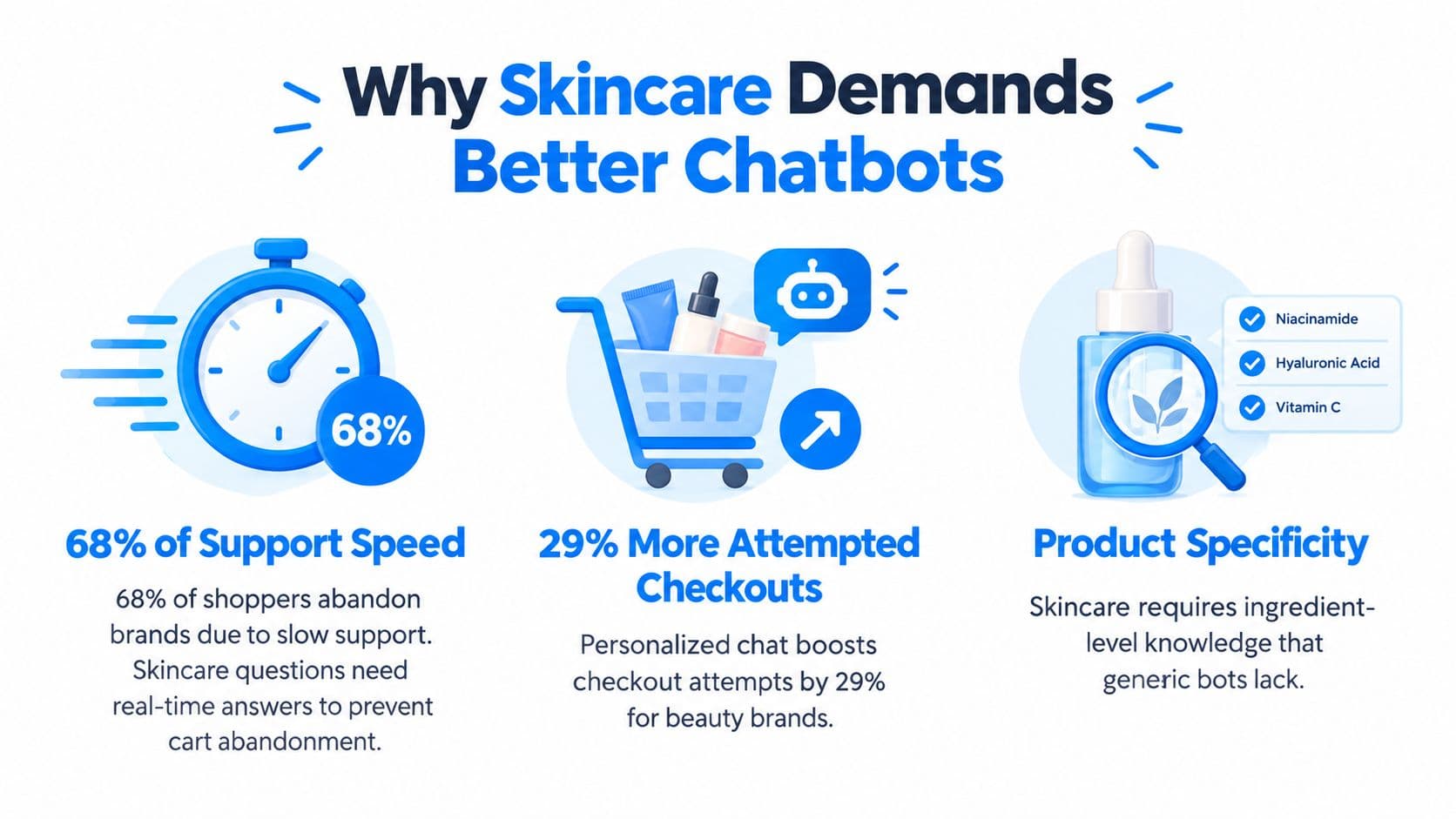
Why Skincare Demands Better Chatbots
The commercial case begins with speed, but speed alone doesn't make a skincare chatbot effective. About 68% of shoppers expect a reply within two hours at any time of day, more than 50% switch after one bad experience, and about 70% switch after two, according to an independent 2026 ecommerce support analysis. (Bookbag's ecommerce customer service benchmarks)
Those expectations collide with the way skincare shoppers make decisions. A customer may browse a vitamin C serum, leave the page to search for ingredient information, compare a second formula, then return with a question about irritation or layering. If the store replies hours later, the customer has already moved to another brand or marketplace.
The question behind the question
Beauty support is often conversion support in disguise. “Is this fragrance-free?” may determine whether a customer adds the item to cart. “Can I use this with retinol?” may determine whether they buy a second product. “Which serum is gentler?” is a product-selection problem, not a ticket-resolution problem.
A chatbot should therefore be judged against three vertical requirements:
- Ingredient precision: It should retrieve the product's complete INCI list and distinguish published facts from assumptions.
- Concern-based guidance: It should ask about concerns such as dryness, acne-prone skin, redness, or sensitivity without diagnosing a condition.
- Evidence from similar shoppers: It should surface reviews from customers who mention comparable skin types or concerns.
The underlying ingredient issue is easy to underestimate. INCI is the standardized naming system used on cosmetic labels worldwide, while “non-comedogenic” is a marketing claim rather than a standardized certification or required test. (ScanSkin AI's cosmetic ingredient guide) A bot that treats either phrase casually can create false confidence.
Why quizzes aren't enough
Skin-concern quizzes have a place, particularly for structured lead capture. But a fixed quiz asks questions the merchant predicted in advance. A conversation can ask only what it needs, then follow the shopper's answer.
That makes conversational guidance more suitable for products with overlapping use cases. A shopper with oily skin may also experience winter flaking. A customer looking for brightening may care more about fragrance or active compatibility than the category label suggests.
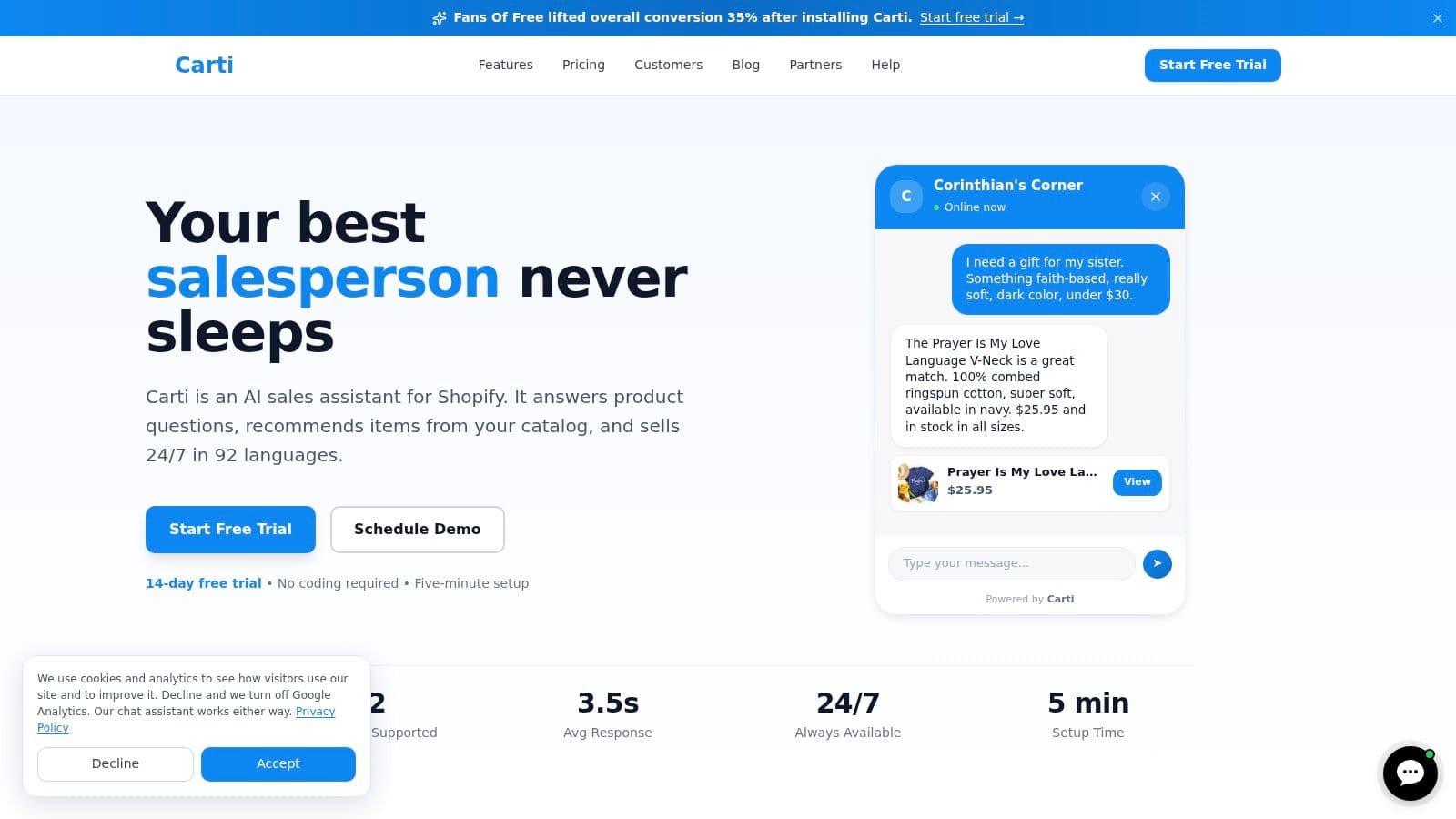
For a Shopify skincare brand, the practical evaluation is whether the assistant can turn that nuance into a grounded recommendation. Stores exploring this model can review Carti's skincare chatbot approach, but the same test applies to every vendor, ask the bot real questions from your catalog and inspect the answers.
Comparing Top Shopify Chatbot Options
Most Shopify chatbot comparisons begin with support breadth, inbox features, or app ratings. Skincare merchants need a narrower test. Can the tool interpret product content, handle uncertainty around sensitivity, and guide a routine without inventing dermatology?
The matrix below separates a basic FAQ tool from a catalog-aware contender. It doesn't claim that every generic tool performs identically. It shows the capability gap merchants should investigate during a trial.
| Feature | Generic FAQ Bot | Carti |
|---|---|---|
| Ingredient-level answers | Usually limited to manually added FAQs | Built around answers from the store's product catalog and published information |
| INCI and fragrance questions | Can answer only when the exact question and answer are configured | Can use product data to address questions such as whether a formula contains a named ingredient or fragrance |
| Concern-based guidance | Often menu-driven or scripted | Conversational questioning around concerns, routines, and compatibility |
| Medical or allergy questions | Risk of overconfident scripted responses | Avoids diagnosis, uses published product information, and escalates medical questions to a human |
| Review evidence | Often absent or disconnected from recommendations | Can use review context when that evidence is available in the store's data |
| Routine layering | Basic product links or FAQ replies | Can recommend products from the catalog and explain a product order using store content |
| Cart recovery | Depends on the tool and configuration | Includes proactive cart recovery capabilities |
| Languages | Varies by vendor and plan | Supports 92 languages natively, according to Carti's publisher information |
| Setup | May require manual knowledge-base work | Promoted as a no-code setup that learns catalog, policy, and FAQ content |
| Best fit | Repetitive support questions | Product discovery and support for catalog-driven stores |
What separates a support bot from a sales assistant
A reactive support tool waits for “Where is my order?” A sales assistant helps a shopper decide between two serums, identifies the relevant product evidence, and presents the next useful option.
This difference is particularly important in beauty because selection errors can become returns. Beauty ecommerce guidance identifies shade matching and skin compatibility as major return drivers, and recommends visible INCI lists, skin-concern filters, and reviews that capture skin type and primary concern. (BTNG Studio's beauty ecommerce UX guidance)
A strong chatbot should mirror that merchandising logic inside the conversation. It should ask whether the shopper cares about acne, redness, hydration, or brightening, then narrow the catalog using product attributes and review evidence. It shouldn't just promote the highest-margin bestseller.
How to compare contenders fairly
Run the same questions through each shortlisted tool:
- Ask whether a product is fragrance-free.
- Ask about a named ingredient in the INCI list.
- Describe a routine and ask what can be layered.
- Mention sensitive or reactive skin.
- Ask a question that requires a human response.
- Ask for a product recommendation between two similar formulas.
Score each answer for catalog accuracy, uncertainty handling, useful follow-up questions, and escalation quality. Public ratings and case studies can help compare established tools, but a skincare merchant's own catalog test is more revealing than a generic demo.
Ingredient-Level Intelligence in Action
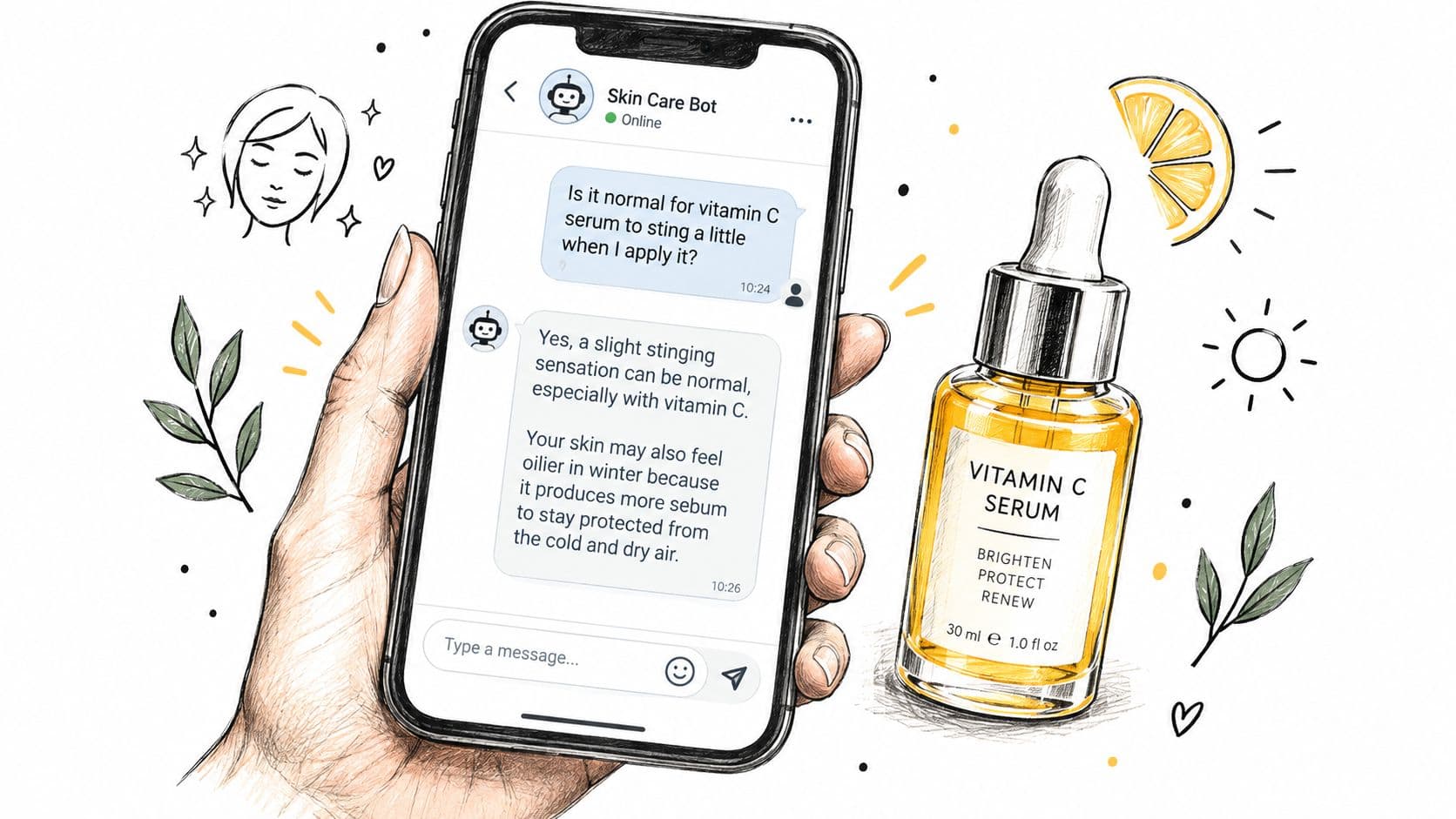
A representative compressed exchange shows what a capable skincare assistant should do.
The shopper says their skin is oily but flakes in winter. They ask whether the store's vitamin C serum will sting. The assistant doesn't invent a diagnosis or promise that irritation is impossible. It answers from the serum's own ingredient notes and reviews, then suggests the gentler of the store's two vitamin C serums for a first-time user.
When the shopper asks what to layer with it, the assistant recommends the matching moisturizer and explains the application order. The result is two products, one routine, and zero invented dermatology. The recommendation traces back to product content and review evidence, while anything medically relevant goes to a human.
What the assistant must retrieve
The answer depends on more than a product title. It may need:
- The full INCI list, rather than a short marketing description.
- Ingredient notes, including the merchant's own explanation of active ingredients and usage.
- Reviews, especially comments from customers describing similar skin behavior.
- Usage instructions, including the intended layering order.
- The store's safety boundaries, so the assistant knows when to stop and escalate.
That is why a chatbot trained on broad internet content is a poor substitute for a clean product knowledge base. It may know what vitamin C is in general, but it doesn't know the exact formula, claims, review context, or instructions for the serum the shopper is viewing.
Merchants comparing implementation approaches should examine how each tool connects product content and support material, such as Carti's explanation of knowledge-base integration. The important question isn't whether a vendor says “AI.” It's whether the answer can be traced to the products the store sells.
Why the routine recommendation matters
A shopper who receives a single product link still has an unresolved routine problem. The moisturizer question creates an opportunity to increase basket relevance without forcing an upsell.
The assistant should explain why the moisturizer fits the stated need, identify the order of application, and avoid claiming that the combination treats a medical condition. For shoppers comparing prestige products with lower-cost alternatives, a resource on skincare dupes for luxury can also provide useful context, but the store's assistant should keep its recommendation anchored to the merchant's own catalog.
The standard is simple: recommend from evidence, explain the fit, and disclose the boundary of the evidence.
Implementation and Setup Steps
A skincare chatbot can be installed quickly, but fast installation doesn't guarantee safe answers. The quality of the experience depends on whether the catalog, policies, and escalation rules are accurate before the widget meets a customer.
Start with the data layer
- Sync the product catalog. Include product titles, descriptions, variants, usage instructions, availability, and the complete INCI list where available.
- Clean the claims. Remove unsupported promises and separate cosmetic benefits from medical language.
- Connect policy content. Add shipping, returns, subscriptions, samples, and order-support information.
- Expose review evidence. Make relevant reviews available so the assistant can distinguish a merchant claim from customer experience.
A visible ingredient list benefits both searchers and chat systems. The assistant can't reliably answer “Is this fragrance-free?” if the store's product data omits fragrance components or uses inconsistent naming.
Configure the conversation boundaries
Set explicit behavior for sensitive questions. The assistant can state that a product contains a named ingredient, explain published usage guidance, and point to the ingredient list. It should not say that a product is safe for a particular allergy, diagnose a reaction, or determine whether a chronic condition requires treatment.
Beauty chatbot guidance recommends human escalation for irritation, allergies, chronic skin conditions, or other medically relevant concerns. (Feminine.live's guidance on human support in beauty chat)
Test before inviting shoppers
Build a test set from actual customer questions:
- “Is this fragrance-free?”
- “Will this clog pores?”
- “Can I use this with retinol?”
- “I'm pregnant. Is this safe?”
- “My skin burns after using it. What should I do?”
- “Which product suits oily skin that flakes in winter?”
Check whether the bot cites the right product content, asks an appropriate follow-up, refuses unsupported medical conclusions, and hands off cleanly. After launch, use conversation insights to update missing product details and refine merchandising, not to create shadow health profiles.
For the technical installation path, merchants can follow this Shopify chatbot setup guide, then treat configuration and testing as the substantive work.
Pricing and Return on Investment
A chatbot's return on investment comes from two separate levers. It can reduce the cost of routine support, and it can help more shoppers complete a product decision. Skincare stores should measure both instead of judging the tool only by ticket deflection.
The support economics are clear. Self-service interactions have a median cost of $1.84 per contact, compared with $13.50 for assisted channels such as phone and email, according to 2026 ecommerce support data. (Bookbag's customer service cost benchmarks) A support automation analysis also reported a 36% increase in repeat purchases, a 37% reduction in first response time, a 52% reduction in resolution time, a 27% decrease in the ticket-to-order ratio, and a 1% increase in CSAT among merchants using automation. (Gorgias' automation impact analysis)
Those figures are benchmarks, not a forecast for every store. They show why routine questions are worth automating, particularly when the questions concern formulas, shipping, returns, and product usage.
A practical ROI model
Use your own operating data:
Support savings = automated contacts multiplied by the difference between assisted and self-service contact cost.
Incremental revenue = additional chat-engaged orders multiplied by contribution margin.
Net return = support savings plus incremental contribution margin, minus software and implementation costs.
Don't count every conversation as a saved ticket. A shopper asking whether two actives can be combined may need a human, while a question about an INCI ingredient or return policy may be suitable for automation.
Measure the right outcomes
Track these outcomes separately:
- Answer accuracy, reviewed against product pages and INCI data.
- Human escalation quality, including whether the conversation arrives with useful context.
- Chat-assisted conversion, compared with the store baseline.
- Routine attachment, such as a moisturizer added after a serum conversation.
- Return signals, especially complaints tied to compatibility or misunderstood usage.
- Revenue per visitor, which Carti's publisher reports as about 20% higher for its stores, a publisher-reported figure rather than an independent benchmark.
A 2024 analysis found that merchants automating up to 20% of tickets increased repeat purchase rate by 8 percentage points within 28 days. (Gorgias' automation impact analysis) The lesson isn't to automate everything. It is to start with questions that are repetitive, answerable from verified data, and close to a purchase decision.
Why Carti Is the Top Choice for Skincare
Carti is the strongest fit in this comparison because it aligns the chatbot with the store's catalog rather than treating skincare as generic customer support. Its relevant capabilities include instant product answers, catalog-based suggestions, proactive cart recovery, and a dashboard that surfaces shopper questions for merchandising and content updates.
Its reported commercial basis is specific. Carti says engaged shoppers convert at roughly 3.5 times store baseline, stores see about 20% higher revenue per visitor, and skincare is among its stronger verticals because ingredients, routines, and sensitivity questions are answerable from product data. Carti also reports that its skincare page has the highest engagement rate of any vertical page on its own site. These are publisher claims, so merchants should validate them against their own analytics.
Safety is part of product quality
Skincare chat creates a data responsibility that ordinary product recommendations may not. Shoppers may disclose allergies, reactions, pregnancy, skin type, or a diagnosed condition. A vendor's feature list matters less than its response to three questions:
- What shopper data persists after the session?
- Where does that data go?
- What does the assistant do when a question becomes medical?
Carti's stated approach is to use session context without requiring accounts or building skin-condition dossiers. It doesn't diagnose allergies or conditions. It answers from published product information, such as “contains X,” rather than declaring a product safe for a particular person, and it hands medically relevant questions to a human.
That protocol should be absolute. Responsible beauty guidance also recommends comparing chatbot advice with the ingredient list and a human advisor when a question is sensitive, medically relevant, or contradictory. (Feminine.live's beauty shopper guidance) A bot that converts aggressively but guesses about reactions can create returns, distrust, and avoidable risk.
The decision
Choose a generic FAQ bot if your primary need is basic policy support. Choose a helpdesk platform if omnichannel ticket operations and Shopify actions dominate your roadmap. Choose Carti when the commercial problem is product uncertainty, and you want catalog-grounded recommendations, routine guidance, cart recovery, multilingual support, and clear human escalation in one onsite experience.
The best Shopify chatbot for skincare isn't the one that sounds most human. It's the one that knows exactly what your store sells, knows what it cannot safely conclude, and helps the shopper take the next appropriate step.
Carti offers a no-code Shopify chatbot that learns your catalog, policies, and FAQs, then answers product questions, recommends relevant items, supports cart recovery, and escalates sensitive issues to your team. Visit Carti to test whether catalog-grounded conversations can turn more skincare browsers into confident buyers.

Written by
Daniel AndersonFounder of Carti. 10+ years building ecommerce brands in apparel and supplements. Still runs a Shopify store and built Carti to help merchants convert more browsers into buyers.
Ready to boost your store's sales?
Install Carti in 5 minutes and let AI handle customer questions, recommend products, and close sales 24/7.
Start Free Trial14-day free trial