
You've seen the pattern. A shopper looks at a product, adds it to cart, maybe asks one question, and your store still serves up a bland row of “more like this.” More jackets after they already chose a jacket. More serums when they're clearly trying to solve sensitivity or dryness. The recommendation widget is active, but it isn't helping a decision.
That's the core mistake in most ecommerce recommendation setups. They recommend for the customer profile, not for the mission the shopper is on right now.
If you want to understand how to recommend a product in a way that converts, start there. The strongest recommendation systems don't act like a memory test. They act like a good sales associate. They pay attention to what the shopper is doing now, what they've already committed to, and what constraints they've made clear.
Why Most Product Recommendations Miss the Mark
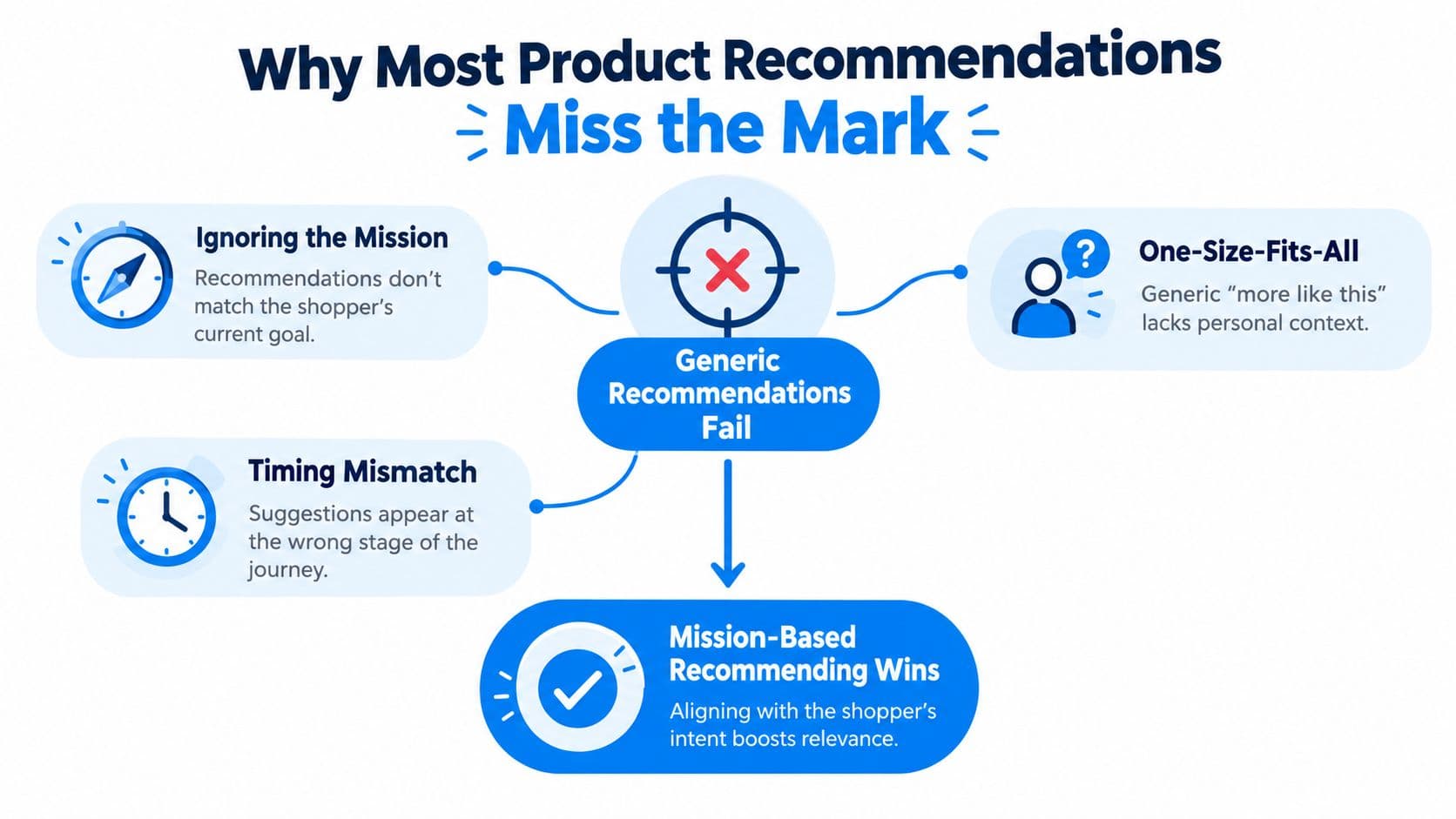
Most product recommendations fail because they answer the wrong question.
They answer, “What does this customer usually like?” when the question is, “What is this shopper trying to get done in this session?” Those are not the same thing. A returning customer who bought gifts last month may be shopping for themselves today. A beauty buyer who usually purchases premium skincare may be looking for a budget-friendly travel option today. History helps, but it's weak when it fights the present moment.
Shoppers have also become less tolerant of vague personalization. Interest in AI-assisted shopping is strong. 68% say they are prepared to act on Gen AI recommendations, and 58% prefer Gen AI product recommendations over traditional search according to Email Conversion Lab's summary of current recommendation-quiz research. But there's a catch. The same source notes that only 15% of shoppers say product recommendation emails feel extremely relevant. That gap matters. Expectations are rising faster than execution.
The usual failure mode
The default setup in many Shopify stores is still some version of this:
- Viewed item equals similar items: The shopper sees products that compete with the product already under consideration.
- Past purchases dominate: A buyer gets pigeonholed into an old pattern that may have nothing to do with today's task.
- Placements ignore timing: Recommendations appear because a widget slot exists, not because the shopper is ready for a suggestion.
That's how you end up with recommendation blocks that look populated but feel irrelevant.
Practical rule: Session intent beats biography almost every time.
This is also why substitute-heavy logic underperforms in high-intent moments. If someone has already chosen a coffee machine, showing five other coffee machines introduces doubt. You've turned a committed moment into a comparison moment. Once commitment appears, the job changes. The recommendation should help complete the purchase, not reopen it.
What relevance actually looks like
A relevant recommendation usually has three traits:
- It fits the shopper's immediate goal.
- It respects what they've already decided.
- It explains itself clearly enough to feel trustworthy.
That last point is getting more important. Research highlighted by Odicci's guide to product recommendation strategy shows 71% of consumers want generative AI integrated into shopping experiences, 68% are willing to act on its recommendations, 70% of U.S. consumers are more likely to buy fashion items when customer feedback and advice are available, and one in three shoppers buy from creator recommendations. In practice, that means a recommendation can't just be accurate. It has to be legible.
A shopper doesn't just want “you may also like.” They want “this pairs with what you picked because it solves the next problem.”
Define What a Good Recommendation Must Achieve
Before choosing any engine, quiz flow, chatbot script, or app, decide what a recommendation is supposed to do in your store.
This sounds obvious, but it's where a lot of recommendation programs go sideways. Merchants mix together discovery, upsell, support deflection, and cart recovery, then measure all of it with the same click metric. That produces noisy data and bad decisions.
Give each recommendation a job
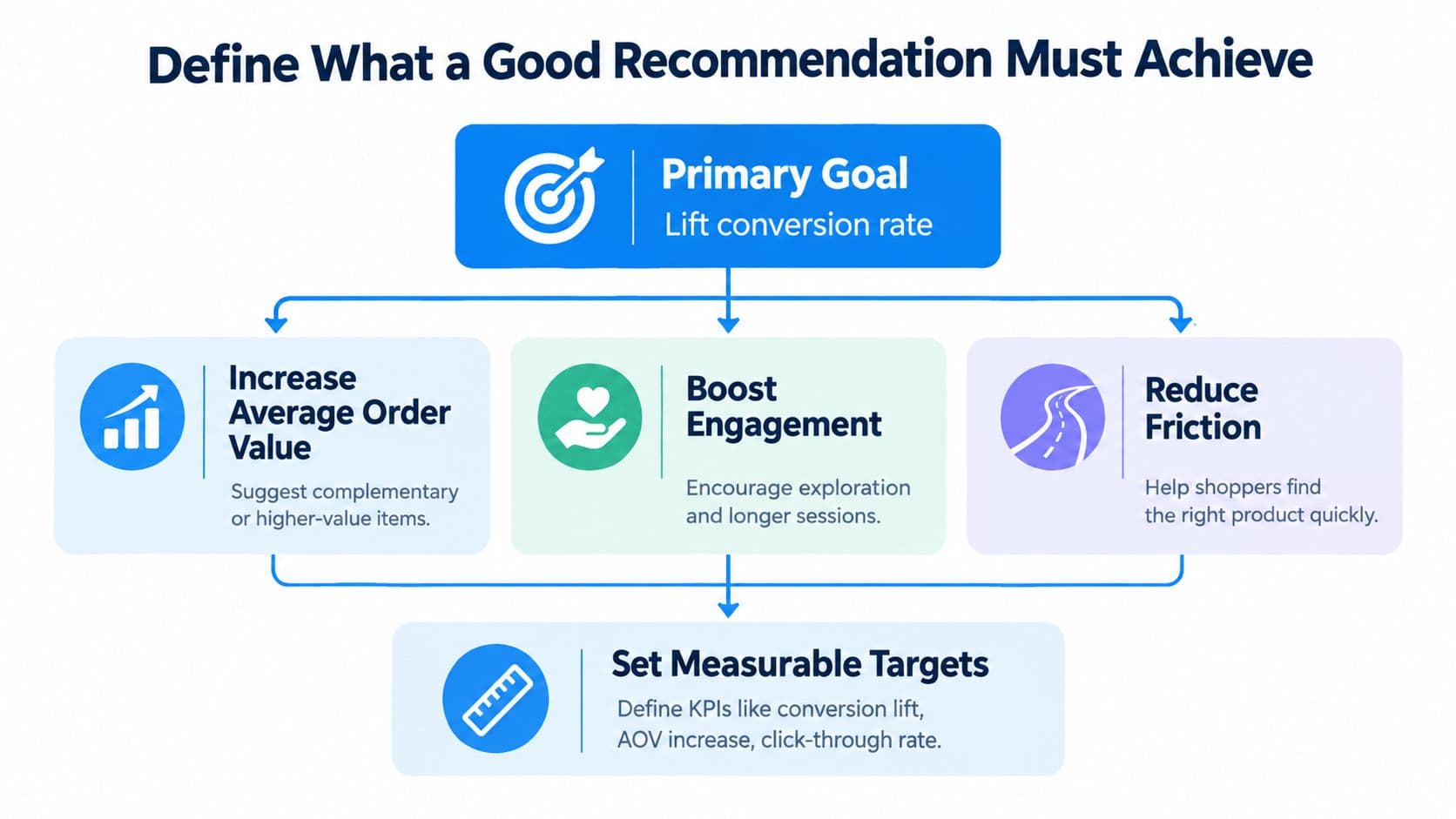
A recommendation usually needs to do one of three things well.
- Lift conversion: Help the shopper choose the right item faster.
- Increase order value: Add a genuine companion item after commitment exists.
- Reduce friction: Answer uncertainty when the shopper can't translate their need into a product choice.
If you don't name the job, you'll end up rewarding the wrong behavior. A substitute recommendation might get curiosity clicks on a product page while lowering checkout confidence. A companion recommendation in cart might get fewer clicks but produce stronger order quality.
Watch acceptance before revenue
When I refine recommendation logic, the first metric I want is recommendation acceptance. Did the shopper engage with the suggestion at all?
That's the earliest honest feedback loop. Revenue matters, but it trails. Acceptance tells you right away whether the recommendation arrived at the right moment and answered a real question. If shoppers keep ignoring a suggestion, the issue is usually timing, framing, or logic. Sometimes all three.
An ignored recommendation is rarely a creative problem. It usually means you asked the wrong question at the wrong moment.
After acceptance, track the outcomes that confirm business value:
- Attributed orders: Did the conversation or suggestion lead to a purchase?
- Revenue per visitor: Did the shopping session become more valuable?
- Average order value: Did post-add complements improve basket quality without disrupting conversion?
Avoid vanity clicks
Not every click is good news. A click can mean confusion just as easily as interest.
Use a simple filter when judging recommendation quality:
- Good click: The shopper engaged, stayed on path, and moved toward purchase.
- Bad click: The shopper bounced into more comparison, more indecision, or a dead end.
- No click: The suggestion was mistimed, unclear, or irrelevant.
That's why “more engagement” is too broad on its own. Define what kind of engagement you want. If the recommendation's job is cart completion, then an exploratory detour is not success.
A good recommendation strategy is less about showing more products and more about creating fewer, better moments.
Choose the Right Signals and Data Sources
When people ask how to recommend a product, they often jump straight to algorithms. That's usually premature. Recommendation quality depends first on what signals you trust.
The hierarchy I use is simple. What the shopper is doing right now comes first. What's in the cart comes second. Stated constraints come third. Purchase history is useful support for returning shoppers, but it shouldn't overrule present intent.
Start with current-session behavior
Current-session behavior is the cleanest expression of intent because it reflects the shopper's active mission. A shopper's search terms, clicks, viewed products, cart additions, and product-detail engagement usually tell you more than a profile stitched together from older sessions.
That matches how many ecommerce systems should behave. Quikly's recommendation strategy guide explicitly says search queries, clicks, viewed products, cart additions, and engagement with product details should outrank purchase history because they reflect current intent more reliably.
Here's the working order I'd use.
| Signal | Weight | Best Use |
|---|---|---|
| Current session activity | Highest | Infer the shopper's live mission from product views, search terms, clicks, and questions |
| Cart contents | High | Trigger completion-focused complements once commitment appears |
| Stated constraints | High | Narrow recommendations by budget, size, recipient, use case, or other requirements in the shopper's own words |
| Purchase history | Supporting | Personalize for returning customers only when it doesn't conflict with present behavior |
For teams trying to clean up noisy customer data before building recommendation logic, a strong starting point is reviewing your customer analytics solution so you can separate stale identity data from live buying signals.
Treat the cart as a commitment signal
Cart data deserves its own layer because it means something different from browsing. Browsing can be curiosity. Carting is commitment.
That distinction matters operationally. Once an item goes in the cart, the recommendation shouldn't behave like a discovery carousel. It should behave like a completion assistant. The shopper has moved from “What should I buy?” to “What else do I need for this to work?”
A cart can also disambiguate fuzzy browsing. Someone who viewed several categories may finally reveal their real direction with one cart addition. At that point, older browsing paths should lose influence.
The cart is where intent becomes expensive to misread.
Capture constraints in the shopper's own language
The third signal is the one many stores underuse. Shoppers often can't specify the ideal product, but they can describe boundaries.
Those boundaries tend to sound like this:
- Budget limits: “I need something under a certain price.”
- Fit or compatibility: “It has to work with this skin type, machine, room size, or body shape.”
- Recipient context: “This is a gift for my partner.”
- Use case: “I need it for travel, daily wear, side sleeping, a small apartment, or sensitive skin.”
These details are gold because they convert broad intent into matchable logic. They also help when preferences are contradictory. A shopper may want luxury feel, lower price, and easy maintenance all at once. The recommendation doesn't need to solve that perfectly. It needs to acknowledge the trade-off and steer.
That's one reason plain product metadata matters so much. If your catalog attributes are sloppy, no amount of AI language wrapping will save the recommendation.
Pick the Right Recommendation Method for the Moment
No single recommendation method works everywhere. The right logic depends on the moment, the catalog, and the amount of usable signal you have.
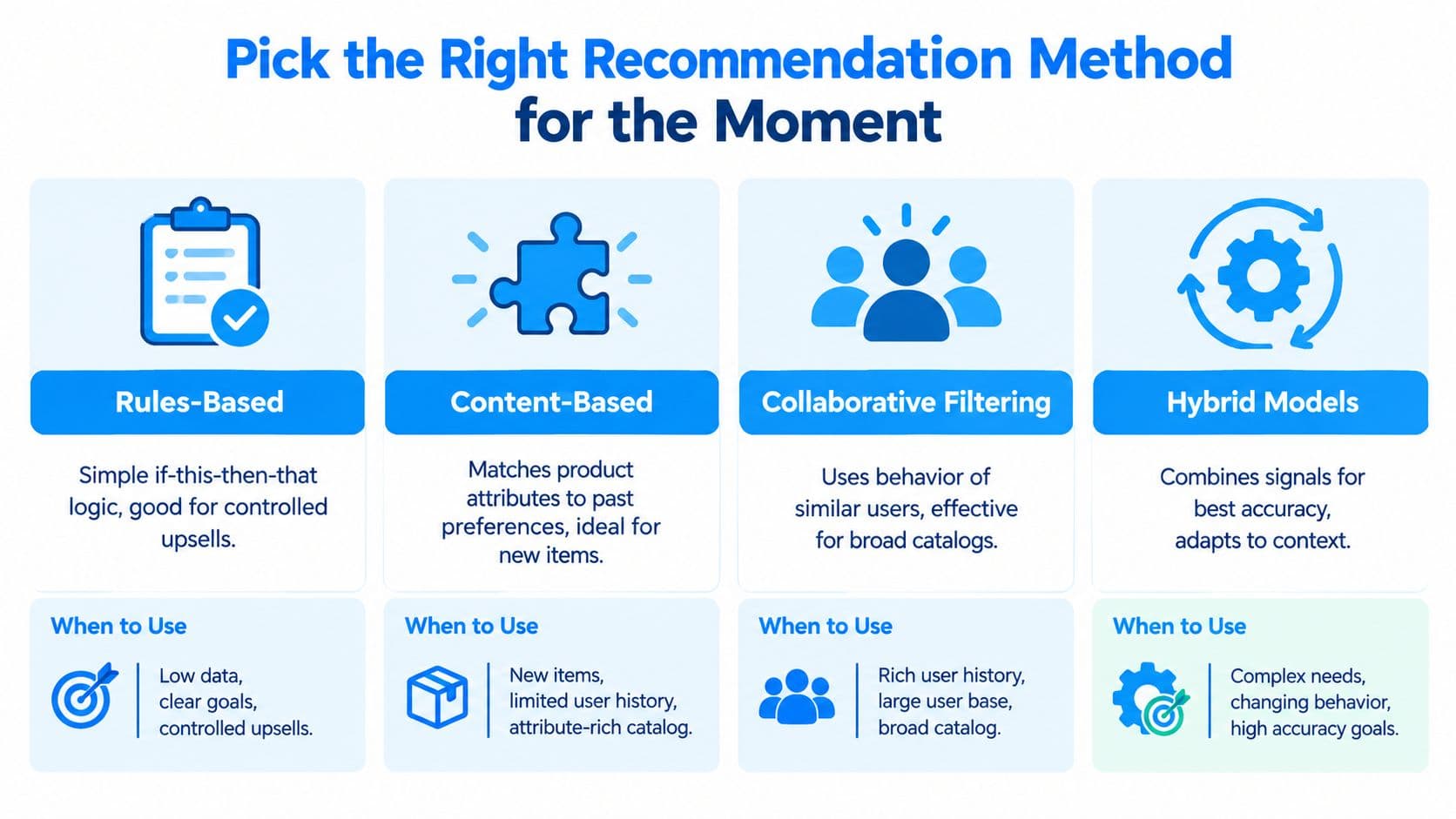
Stores usually cycle through four core approaches. The mistake is treating them like competing ideologies instead of tools.
Rules work well when the decision is obvious
Rules-based logic is underrated because it's unfashionable, not because it's weak.
If someone adds a coffee machine, recommend filters, cleaning tablets, or compatible accessories. If someone buys a blazer, suggest the belt, shirt, or trousers that complete the look. For cart moments, this kind of deterministic pairing is often better than cleverness.
This is also where complements beat substitutes. Bluebarry's recommendation examples guide advises stores to recommend complementary items during cart consideration, not unrelated or competing products. That lines up with what tends to work in live stores. Once the customer has chosen, don't compete with the choice.
Content-based logic helps when catalog detail is strong
Content-based recommendations use attributes. Material, style, skin concern, room type, scent family, wattage, compatibility, and so on.
This method is especially useful when:
- New products lack historical interaction data
- The catalog has rich, reliable attributes
- The shopper's need is specific
- You need an explanation that sounds concrete
A content-based recommendation can say, in effect, “This matches what you're asking for because it's fragrance-free, travel-sized, and made for sensitive skin.” That's easier to trust than a vague popularity signal.
If you want a practical walkthrough of behavior-aware merchandising logic, Smart Recommends by Skup is a useful resource because it shows how recommendation methods map to different shopping contexts rather than treating one engine as universal.
Collaborative filtering is helpful, but easy to misuse
Collaborative filtering can be powerful in larger catalogs because it learns from patterns across shoppers. A common version is “people who bought this also bought.”
It's useful for discovery. It's weaker when the shopper's current mission is narrow or when the moment demands precision. Collaborative signals can blur intent. They may reflect broad co-purchase behavior without understanding whether the shopper is shopping for a gift, replacing a broken item, or trying to solve a specific problem.
That's why I wouldn't let collaborative logic control high-intent cart moments by itself.
Hybrid logic wins when uncertainty is high
The strongest setups combine methods.
A hybrid model might use current session behavior to understand the mission, content attributes to filter for fit, rules to protect cart moments from substitutes, and collaborative signals to rank among several good options. That combination is usually more resilient than any single method.
Good recommendation systems don't just predict preference. They manage trade-offs.
This becomes critical when the shopper is uncertain. They may ask for a gift that feels premium but stays within budget, or skincare that's effective but gentle enough for reactive skin. In those moments, the recommendation should surface one strong option and explain the reason. Transparency matters because trust matters.
Integrate Recommendations Into Chatbots and Onsite Touchpoints
Recommendation logic only matters if it appears at the right moment. Placement and trigger quality decide whether a suggestion feels helpful or intrusive.
The highest-value trigger I've seen is the add-to-cart moment. Right after an item goes into the cart, and especially right after the cart drawer closes, the shopper is highly committed and unusually receptive to one relevant companion suggestion.
Use post-add moments for companions, not alternatives
Weak recommendation logic does damage. It often shows more of the same. More jackets after a jacket. More grinders after a grinder. That competes with the decision already made.
A better move is one companion suggestion framed around the shopper's situation:
- For apparel: “Want to pair that jacket with a belt or layer that fits the same look?”
- For beauty: “Do you want a fragrance-free option to use with this if your skin gets reactive?”
- For home or kitchen: “Do you already have the filters that fit this machine?”
That question format matters. It turns the recommendation into assistance instead of interruption.
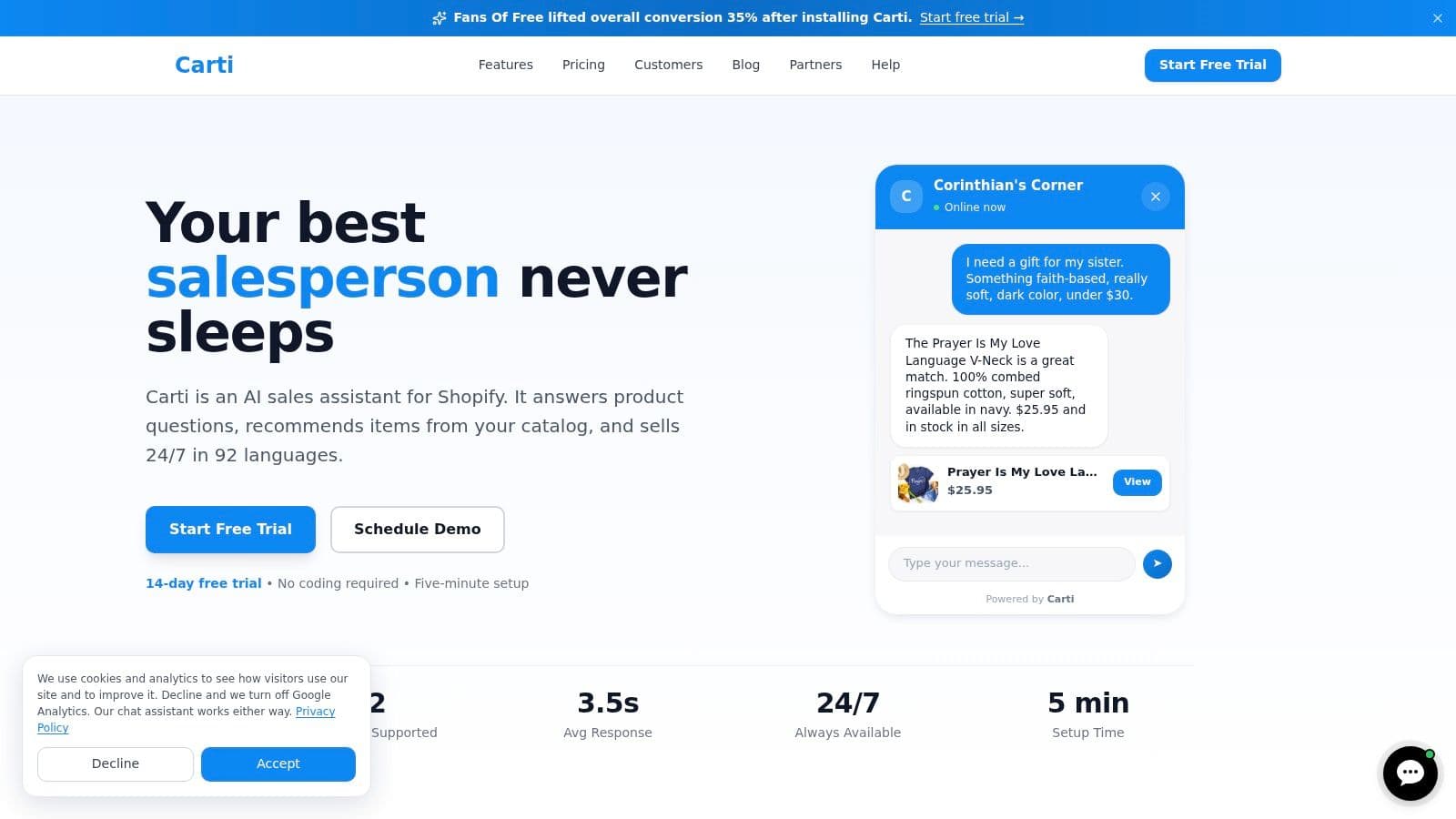
This kind of workflow is common in conversational selling tools. Carti is one example on Shopify that uses catalog knowledge and shopper behavior to surface suggestions in chat and cart contexts, which is useful when you want recommendations tied to live questions rather than static widget slots. If you're building your own flow, a practical place to start is this product recommendation template.
Use answered-objection moments inside chat
The runner-up trigger is the moment right after a shopper's concern gets resolved.
If someone asks, “Will this fit a small apartment?” and gets a clear answer, that's a natural opening for a related recommendation. If someone asks whether a moisturizer is safe for sensitive skin and gets reassurance, a complementary cleanser or travel-size version can follow naturally.
The recommendation works because it inherits trust from the answer that came right before it.
Don't interrupt uncertainty with an upsell. Resolve the uncertainty, then recommend in the direction of that resolution.
Chatbots can outperform static blocks. They hear the objection, answer it, and then narrow the suggestion using the exact language the shopper just used.
Build recovery around intent signals, not timers
Some recommendation moments happen after the session starts to cool. Recovery still matters, but the trigger should reflect intent hierarchy.
OneSignal's ecommerce strategy documentation lays out a useful progression using product_added_to_cart as a cart-recovery priming step, cart_viewed as an active-shopping anchor, and checkout_started as the entry point for abandonment journeys. That's a practical sequence because it mirrors commitment levels rather than treating every reminder the same.
For merchants in price-sensitive categories, it also helps to understand how financing or payment flexibility affects recommendation framing. In some cases, a relevant recommendation should point shoppers toward options that support affordable retail shopping, especially when budget is part of the hesitation.
What doesn't work well is a timer-based nudge with no behavioral context. “Still thinking about it?” is weak compared with “Need the matching filter for the machine already in your cart?”
Test Measure and Optimize Your Recommendation Flow
Recommendation systems don't stay good on their own. Product mix changes. Seasonal missions change. Shopper questions change. The flow needs a tight feedback loop.
I prefer testing recommendation behavior against real conversation outcomes, not just page-level click experiments. That means pairing each suggestion with its engagement outcome and any resulting order. A recommendation that gets ignored is useful data. It usually tells you the suggestion was early, late, too broad, or framed around the wrong problem.
Start with acceptance, then confirm with revenue
The first metric to watch is recommendation acceptance. Did the shopper engage with the suggestion?
That metric diagnoses much faster than revenue does. Revenue can lag because traffic mix, inventory, promotion calendars, and repeat behavior all muddy the picture. Acceptance exposes broken logic immediately. If a suggestion never gets touched, there's no need to wait for a sales report to tell you something's off.
For the back end, you still need proper attribution. If your recommendation layer is tied to chat or assisted selling, make sure clicks and resulting orders can be connected cleanly. A setup with visible revenue attribution is what lets you tell the difference between a recommendation that gets attention and one that creates money.
Compare behaviors, not just layouts
A useful test compares recommendation behaviors like these:
- Substitute versus complement: Does the shopper see alternatives or companions after adding to cart?
- Statement versus question: Is the recommendation presented as a generic product card or as a situation-based prompt?
- Immediate versus delayed: Does the suggestion appear at the moment of commitment or after a delay?
- Broad versus constrained: Does the system show “popular picks” or options filtered by fit, budget, or use case?
Those tests reveal more than color changes or placement tweaks.
There's also a solid evidence base for recommendations themselves being commercially meaningful. A Salesforce analysis summarized by Clerk.io's roundup of recommendation statistics found that sessions where shoppers clicked a recommendation represented 7% of traffic but generated 26% of revenue, while also lifting average order value by 10.3% across devices and 15.2% on tablet. And a peer-reviewed study summarized in Information Systems Research found that recommendation systems increased sales of recommended products by 9%, reduced sales of focal products by 1.9%, and produced a net 11% lift in product sales. That's a useful reminder that recommendations work, but they work by redirecting attention intelligently, not by showing more stuff everywhere.
Keep the optimization loop honest
The recommendation change with the clearest effect across stores is usually simple. Switch post-add logic from substitutes to genuine complements.
That sounds minor, but it changes the psychology of the moment. You stop competing with the shopper's decision and start helping them complete it. If acceptance rises after that change, you've usually fixed something fundamental.
The basic cadence is straightforward:
- Review ignored suggestions first
- Check whether timing matched intent
- Look for substitute logic leaking into committed moments
- Tighten constraints using the shopper's own language
- Confirm with attributed orders and revenue, not clicks alone
That loop keeps recommendation logic aligned with the shopper's mission instead of drifting back toward generic personalization.
Carti gives Shopify stores a way to turn support chats and cart moments into recommendation moments by answering product questions, suggesting relevant items, and tying those interactions back to revenue. If you want recommendation logic that follows current intent instead of stale history, visit Carti.

Written by
Daniel AndersonFounder of Carti. 10+ years building ecommerce brands in apparel and supplements. Still runs a Shopify store and built Carti to help merchants convert more browsers into buyers.
Ready to boost your store's sales?
Install Carti in 5 minutes and let AI handle customer questions, recommend products, and close sales 24/7.
Start Free Trial14-day free trial