
The most popular advice about FAQs is also the least reliable: gather a team in a room, brainstorm the questions customers might ask, publish the answers on a page, and wait for support volume to fall. That approach creates a document. It doesn't create a useful FAQ management system.
Shopify shoppers usually don't visit a help center before they feel friction. They hesitate over delivery timing on a product page, question the fit at checkout, or wonder whether a return is possible after opening the chat widget. The answer has to appear where uncertainty occurs, not sit in a navigation menu.
The shift is from a static FAQ page to a dynamic knowledge layer. It listens to real conversations, identifies unanswered intent, references current store data, and delivers approved guidance at the moment a shopper needs it. That makes FAQ management part of both support operations and conversion design.
Why Static FAQ Pages Fail Modern Shoppers
A static FAQ page assumes customers will search for help in the same way a support manager organizes information. Shoppers don't think in categories such as “fulfillment policy” or “post-purchase operations.” They ask, “Will this arrive before Friday?”, “Can I exchange the wrong size?”, or “Does this work with my existing device?”
That mismatch explains why having an FAQ page alone isn't enough. Shipping cost and delivery time usually lead ecommerce inquiries, followed by returns and exchanges, product fit, order status, and discounts. Those answers may already exist somewhere on the store, yet customers still open chat because placement beats existence. A policy buried in a footer has little value when the shopper is deciding whether to add an item to the cart.
Customer behavior supports treating self-service as an operating layer rather than a documentation project. 81% of customers try to solve issues themselves before contacting a live agent, and 67% prefer self-service over speaking to a company representative. (Self-service customer behavior data) If the store doesn't provide a fast, relevant answer, the customer may abandon the decision or create a ticket instead.
A useful reference for organizing common customer questions is this guide to frequently asked questions. But the stronger operational principle is to let your own conversations determine what belongs in the system. Support tickets, chat transcripts, search queries, and failed assistant responses reveal demand far more accurately than a brainstorming session.
The question customers ask is the content brief
The most effective workflow starts with unanswered questions. Carti mines actual shopper chats and surfaces suggested FAQs for questions the store couldn't answer well. A merchant can then approve, edit, or reject each suggestion, keeping a human as the editor of record while the system handles the listening.
That distinction matters. An AI assistant shouldn't independently invent policy, rewrite brand commitments, or publish an unverified answer. It should detect repeated intent, propose a draft grounded in store information, and send the suggestion through a clear approval process.
Practical rule: Your customers are already writing your FAQ, one unanswered question at a time.
The same logic applies to automated customer engagement. Proactive assistance works when it responds to a demonstrated point of doubt, not when it interrupts every visitor with a generic message.
A modern FAQ system therefore has two jobs. It captures routine intent before it becomes a ticket, and it brings the answer into the buying journey before uncertainty becomes abandonment. That turns support knowledge into a demand-management tool, not a passive content library.
Core Features of a Dynamic Knowledge Layer
A dynamic knowledge layer combines structured content, live store context, search, AI interpretation, and governance. Remove any one of those elements and the system becomes fragile. A searchable library without current data gives confident but outdated answers. Live data without editorial rules creates inconsistent explanations. AI without approval controls creates risk.
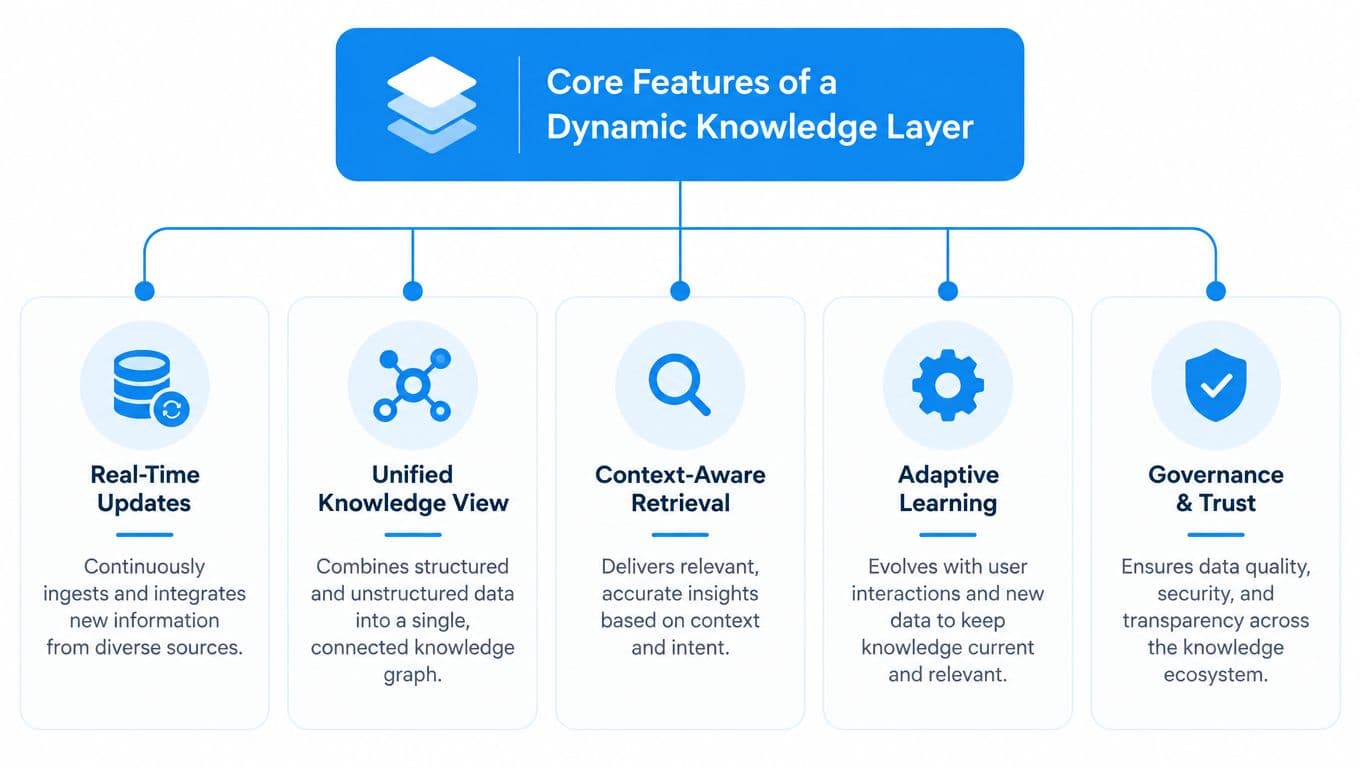
Five layers that need to work together
Intent recognition connects natural shopper language to the right answer. “When will it get here?” should map to delivery information even if the FAQ uses the formal phrase “estimated shipping time.” Closed-ended, single-topic articles make that mapping easier because each entry has a clear question and answer.
Searchability determines whether the content can be found quickly. Use the terms customers type in chat and onsite search, including ordinary phrasing, product names, regional terms, and common misspellings. A beautifully written article that doesn't match customer language is operationally invisible.
Live data access keeps volatile facts out of static copy. Prices, inventory, product availability, and current policy details should come from the store's source of truth at answer time. The knowledge layer should hold interpretation and guidance, while the system retrieves facts that change frequently.
Answer boundaries protect accuracy. Define which questions the assistant can resolve, which require a product lookup, and which must move to a human. A delivery estimate can be useful when tied to current order or destination data, while an unusual refund dispute may require escalation.
Governance gives the system accountability. Multiple documentation spaces increase governance overhead, so ownership, approval workflows, version control, and review cadence matter for fast-changing ecommerce policies. (FAQ governance guidance)
The practical trade-off is flexibility versus control. Broad AI generation may produce smoother conversations, but tightly grounded answers are safer for shipping, returns, discounts, and warranty commitments. The right system doesn't try to answer everything. It answers supported intents clearly and escalates the rest with context intact.
A useful integration should also expose how content enters the answer, when it was updated, and which source supplied the fact. That visibility helps agents trust the system and gives operators a direct path for correcting weak answers.
Integrating AI Chatbots for Instant Resolution
An FAQ system without a delivery mechanism still makes the shopper do the work. The customer must find the page, interpret the category, open the article, and decide whether the answer applies. An AI chatbot can compress that journey into a natural question and a grounded response inside the storefront.
The value is not just that a chatbot speaks conversationally. The value comes from connecting intent recognition to approved knowledge and live commerce context. A shopper asking about sizing may need a product-specific fit note. Someone asking about delivery may need the relevant policy, destination, and current order status. A system that only searches static text can't reliably handle those differences.
Let conversations decide what gets added
Across DTC stores, the inquiry hierarchy is stable enough to guide initial coverage: shipping cost and delivery time, returns and exchanges, product fit, order status, then discounts and codes. The important operational observation is that the first two topics are often already documented. Their continued appearance in chat shows that visibility and timing matter more than publication alone.
An assistant should quote or summarize approved policy content directly in the chat widget, then offer the next useful action. For example, it might answer a delivery question and link to the relevant product or order details, or respond to a sizing concern with the store's fit guidance and a recommendation to compare measurements.
Carti is one option for this workflow. It reads a Shopify store's catalog, policies, and FAQs, answers shopper questions in real time, surfaces smart suggestions, and uses chat insights to identify content gaps. Merchants can also review knowledge base integration practices when connecting conversational support to existing documentation.
Keep automation inside clear boundaries
Proactive engagement needs restraint. A message triggered by genuine hesitation can help, while a generic interruption can distract a ready buyer. Configure prompts around meaningful signals such as product-page questions, shipping uncertainty, or an explicit request for assistance.
The assistant should also know when to stop. Escalation is appropriate for exceptions, sensitive account matters, unclear policy cases, or questions outside the approved knowledge scope. The handoff should include the conversation history and detected intent so the agent doesn't ask the customer to repeat the problem.
The strongest operating model is not “AI replaces support.” It's “AI handles repeatable certainty, while people handle judgment.” That division gives shoppers faster answers without removing human control over policy, tone, or edge cases.
Structuring Content and Governance Workflows
Writing FAQ answers is straightforward. Keeping them accurate as products, policies, and promotions change is the operational challenge. A strong content model separates information that the system can retrieve from information that requires editorial judgment.
Separate facts from judgment
Volatile facts include current prices, stock status, delivery estimates, exact shipping charges, and active discount conditions. Don't duplicate those details across static articles. Reference the live Shopify source instead, so the assistant can answer from current data rather than a stale snapshot.
Judgment answers explain how a product behaves or what a customer should do in an unusual situation. Examples include how a particular fabric fits, whether assembly is difficult, how to handle an item that arrives damaged, or how ingredients affect a use case. These answers need human review because nuance and brand policy matter.
That separation also makes maintenance easier. When a price changes, the product source updates. When the brand changes its position on damaged goods, an owner revises the judgment answer and records the change.
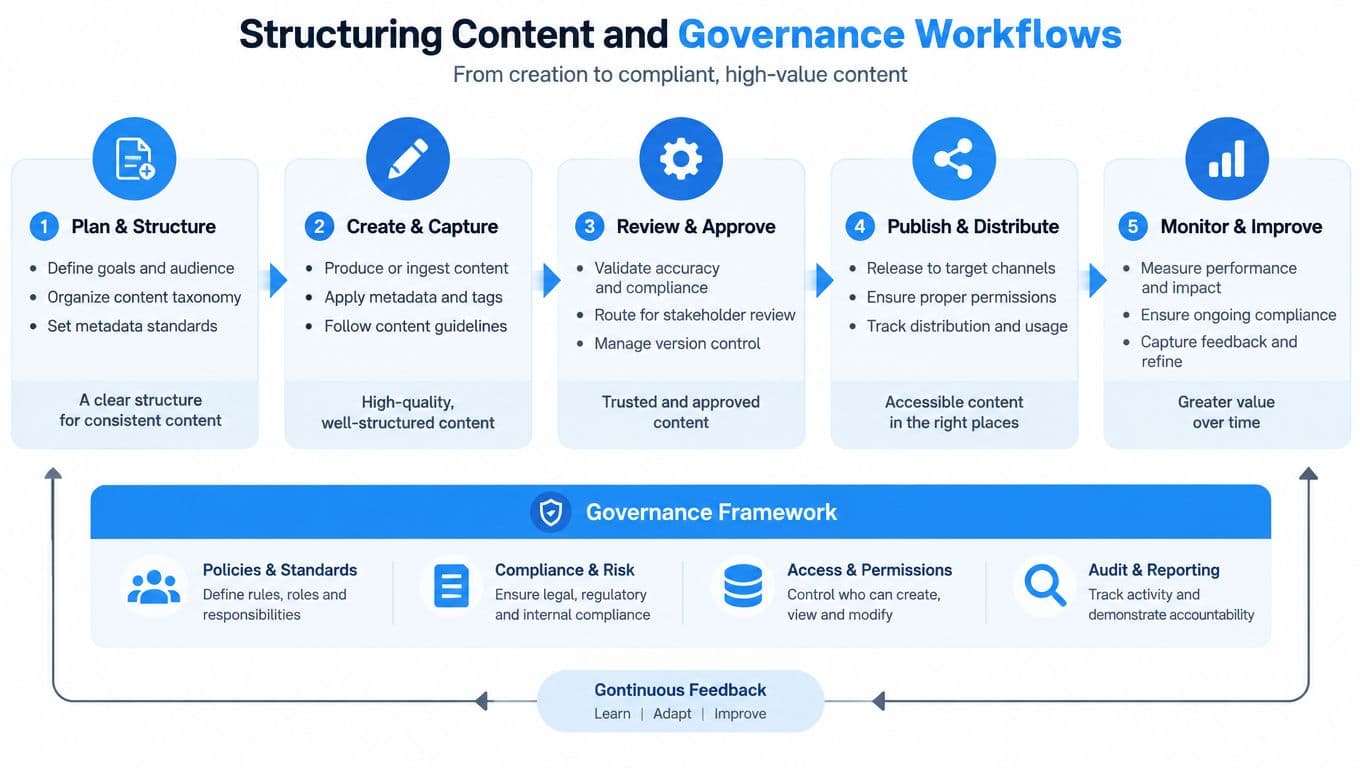
Build a repeatable review loop
Start with the support queue, then organize questions by intent, product, and complexity. Guidance recommends using support tickets, chat logs, email, social mentions, internal search, and survey feedback to identify recurring questions rather than relying on internal assumptions. A practical workflow exports the last 90 days of tickets, then isolates repetitive questions, which can represent 40-50% of support topics in some cases. (FAQ ticket analysis workflow)
For each proposed entry, assign:
- An owner: Someone accountable for accuracy, not just publication.
- A source: The policy, product record, or approved operational document behind the answer.
- An approval state: Draft, approved, scheduled, published, or retired.
- A review trigger: A routine calendar review plus an immediate update when the source changes.
- An escalation rule: The situations in which the assistant must transfer the conversation.
Review FAQ content at least once per quarter and update it immediately whenever a product or service changes. (FAQ maintenance guidance) Teams should also use support policy documentation as a shared reference when defining customer service policies, especially for refunds, damaged goods, and exceptions.
Real World Examples of Ticket Deflection
A recurring ecommerce pattern starts with a product quirk. A garment runs small, a piece of furniture needs assembly, or an item ships separately from the rest of the order. The product page may mention the detail, but shoppers still ask because the information isn't prominent enough at the moment they hesitate.
The first signal appears in conversations. Several shoppers ask variations of the same question before purchase. Some receive a manual answer, others escalate, and a few leave without buying. The support team sees separate chats, but an FAQ management system can identify the shared intent across different wording.
From repeated doubt to approved guidance
The merchant reviews the suggested FAQ, checks the product information, and edits the answer into a concise response. The entry might explain how the item fits, point to measurements, or clarify that assembly is required. The merchant approves it, making the human the editor of record.
The next shopper asks the same question in the chat widget. Instead of opening a ticket, the assistant answers in-line using the approved guidance. If the shopper needs more help, the assistant can pass the conversation to a person with the context already attached.
The most useful sign isn't a page view. It's a topic disappearing from human handoffs.
This is why the escalation mix matters. When a product-specific question stops appearing in support escalations, the FAQ entry is resolving uncertainty upstream, before a ticket exists. The resulting conversation may end in a cart rather than a handoff, protecting both customer experience and agent capacity.
The pattern also shows what doesn't work. Publishing a generic “check the size guide” article may technically address the question, but it leaves the shopper to interpret the answer. A stronger entry names the product behavior, explains the practical consequence, and appears inside the conversation where the uncertainty surfaced.
KPIs to Track System Performance
Page views are easy to report and poor at proving resolution. A customer can open an article, fail to find the answer, and contact support immediately afterward. A serious FAQ management system measures what happened after the customer encountered the content.
Measure confirmed outcomes
Modern service platforms distinguish between an article view and a confirmed resolution. A request counts as deflected when the customer selects an article during request creation and confirms that it helped, rather than loading the page. (Confirmed knowledge-base deflection measurement)
Track these signals together:
| Signal | What it reveals |
|---|---|
| Confirmed deflection | Whether the customer marked the answer as helpful or solved |
| Requests resolved | Which intents end without agent involvement |
| Escalation mix | Which topics still reach human support |
| Search queries | The language customers use and the gaps they encounter |
| Dwell and scroll behavior | Whether shoppers engage with enough content to find an answer |
| Handoff context | What the assistant couldn't resolve and why |
The most important metric is not a single dashboard number. It's the relationship between answer exposure, confirmed resolution, and later escalation. A high view count with weak confirmation suggests poor relevance, unclear writing, or incorrect placement. A lower view count with strong resolution may indicate that the assistant is surfacing answers efficiently.
Use logs to improve the system
Session-level logs should preserve query text, timestamps, dwell time, scroll depth, selected articles, and “mark solved” events. These details help separate accidental clicks from genuine self-service. They also show where the content model needs work.
For example, repeated searches for “arrive separately” may indicate a missing shipping explanation, even if the store already has a broad delivery page. A sharp escalation rate for one product can point to a fit, compatibility, or assembly problem that merchandising should address.
Track the escalation mix by intent, product, and journey stage. When one topic stops appearing in handoffs, investigate the answer and its placement. When another keeps returning, don't respond by adding more paragraphs automatically. First check whether the assistant can find the relevant source, whether the answer is specific enough, and whether the shopper sees it before leaving the page.
Implementation Checklist for DTC Merchants
A migration works best when the team treats it as an operating change, not a copy refresh. Start with evidence from the existing support queue, then connect the knowledge layer to the systems that contain current product and policy facts.
-
Export the last 90 days of tickets. Group repeated questions by shipping, returns, fit, order status, discounts, and product-specific issues. Repetitive questions can represent 40-50% of support topics in some cases, making the queue a practical starting point rather than a brainstorming exercise. (FAQ support-queue workflow)
-
Audit the current FAQ page. Mark each entry as current, judgment-based, duplicated, vague, or dependent on changing data. Retire content that no longer reflects the store.
-
Move volatile facts to live sources. Connect catalog, inventory, prices, shipping rules, and policy records so the assistant doesn't rely on copied values in static text.
-
Write judgment answers around customer intent. Use the shopper's wording, answer one question at a time, and include the practical implication. “Runs small, compare your measurements with the product chart” is more useful than “See our sizing information.”
-
Set approval and ownership rules. Decide who edits suggested FAQs, who approves policy language, and who handles escalations. Keep revision history so agents can understand why an answer changed.
-
Configure the chat experience. Add relevant prompts near high-friction product and checkout moments, but avoid interrupting every visitor. Give the assistant clear escalation boundaries.
-
Turn on continuous mining. Review unanswered chats and failed searches regularly. Approve useful suggestions, reject unsafe ones, and feed recurring product questions back to merchandising.
-
Measure confirmed resolution. Use solved events, session logs, search terms, and escalation mix. Don't treat article views as proof that a customer found the answer.
-
Schedule governance reviews. Review the knowledge layer at least quarterly and update it immediately after product or policy changes. (FAQ content maintenance guidance)
A static FAQ page can remain as a reference, but it shouldn't carry the whole self-service strategy. The scalable model combines live facts, reviewed judgment answers, conversational delivery, and a feedback loop that learns from every unanswered question.
Carti connects a Shopify store's catalog, policies, FAQs, and shopper conversations into an AI chat layer that answers questions, suggests relevant products, and surfaces content gaps for review. Visit Carti to turn your existing FAQ content into timely, conversational support that helps shoppers move from doubt to purchase.

Written by
Daniel AndersonFounder of Carti. 10+ years building ecommerce brands in apparel and supplements. Still runs a Shopify store and built Carti to help merchants convert more browsers into buyers.
Ready to boost your store's sales?
Install Carti in 5 minutes and let AI handle customer questions, recommend products, and close sales 24/7.
Start Free Trial14-day free trial