
Most sales funnel automation advice starts in the wrong place. It tells you to capture more leads, add another email sequence, and build a larger workflow. That can fill your pipeline, but it doesn't answer the question that decides ecommerce revenue: what happens when a shopper wants the product but hesitates before checkout?
For Shopify merchants, the highest-value automation often sits between the product page and the completed order. A shopper may need sizing guidance, reassurance about returns, confirmation that an accessory fits, or a quick answer about delivery. If the store responds with silence, a generic discount, or a delayed email, intent can disappear before the buyer reaches the checkout.
Top and middle funnel automation fill the pipe. Bottom-funnel automation turns the pipe into orders. Carti's engaged shoppers convert at roughly 3.5 times the store baseline, and Carti stores see about 20% higher revenue per visitor, according to the performance figures provided by the publisher. Those outcomes belong to the same bottom-funnel territory, where a conversational assistant can answer a blocking question, recommend the right variant, and recover an exit while the shopper is still present.
Rethinking Sales Funnel Automation for Modern Ecommerce
The popular definition of sales funnel automation is too narrow for ecommerce. It usually means a lead magnet, a landing page, a welcome sequence, and a chain of scheduled emails. Those tools still have a place, particularly for long consideration cycles, but they don't automatically solve the most expensive leak in a product business.
A store can capture a visitor's email, nurture that person for weeks, and still lose the sale because the shopper couldn't decide between two sizes. A campaign can generate clicks while a product page leaves a critical question unanswered. Adding more messages to an already crowded inbox won't repair friction that exists on the site itself.
The neglected moment before checkout
The critical window starts when a shopper shows meaningful product intent and ends when the order is placed. Signals include adding an item, opening and closing the cart drawer, returning to a product page, comparing variants, or pausing after a purchase path has begun.
This journey isn't linear. Salesforce describes buyers as researching, comparing, disappearing, and returning across channels rather than moving neatly through fixed stages, with an expectation that systems remember earlier actions. That changes the job of automation. The system must preserve context, not just send the next message in a flowchart.
A useful overview of conventional automation mechanics is Machine Marketing's automation guide, especially for merchants reviewing lead capture, segmentation, and follow-up infrastructure. But ecommerce operators should extend that framework onsite, where the buyer's question is visible and the response can influence the transaction immediately.
Revenue is lost through unanswered questions
The broad benchmark makes the problem clear. One 2026 lead-generation dataset reports an average lead-to-customer conversion of 2.4%, with B2B stage averages of 2.9% visitor-to-lead, 36% lead-to-MQL, 13% MQL-to-SQL, 43% SQL-to-opportunity, and 27% opportunity-to-customer (sales funnel benchmark data). The same source says 73% of leads aren't immediately sales-ready, which explains why nurturing matters, but it also shows why operators shouldn't treat every stage as an email problem.
For a Shopify store, the equivalent leakage often happens much later. A shopper may already be qualified by behavior, yet the merchant still treats that person like an anonymous lead. The better model is to identify the hesitation, answer it with store truth, and make the next action easy.
Practical rule: Automate the repetitive explanation, not the buyer's entire decision.
The ecommerce conversion funnel should therefore be read from both directions. Acquisition and nurturing create demand, while product-page assistance, cart recovery, and relevant recommendations protect the demand you've already paid to earn.
Core Components of an Automated Buyer Journey
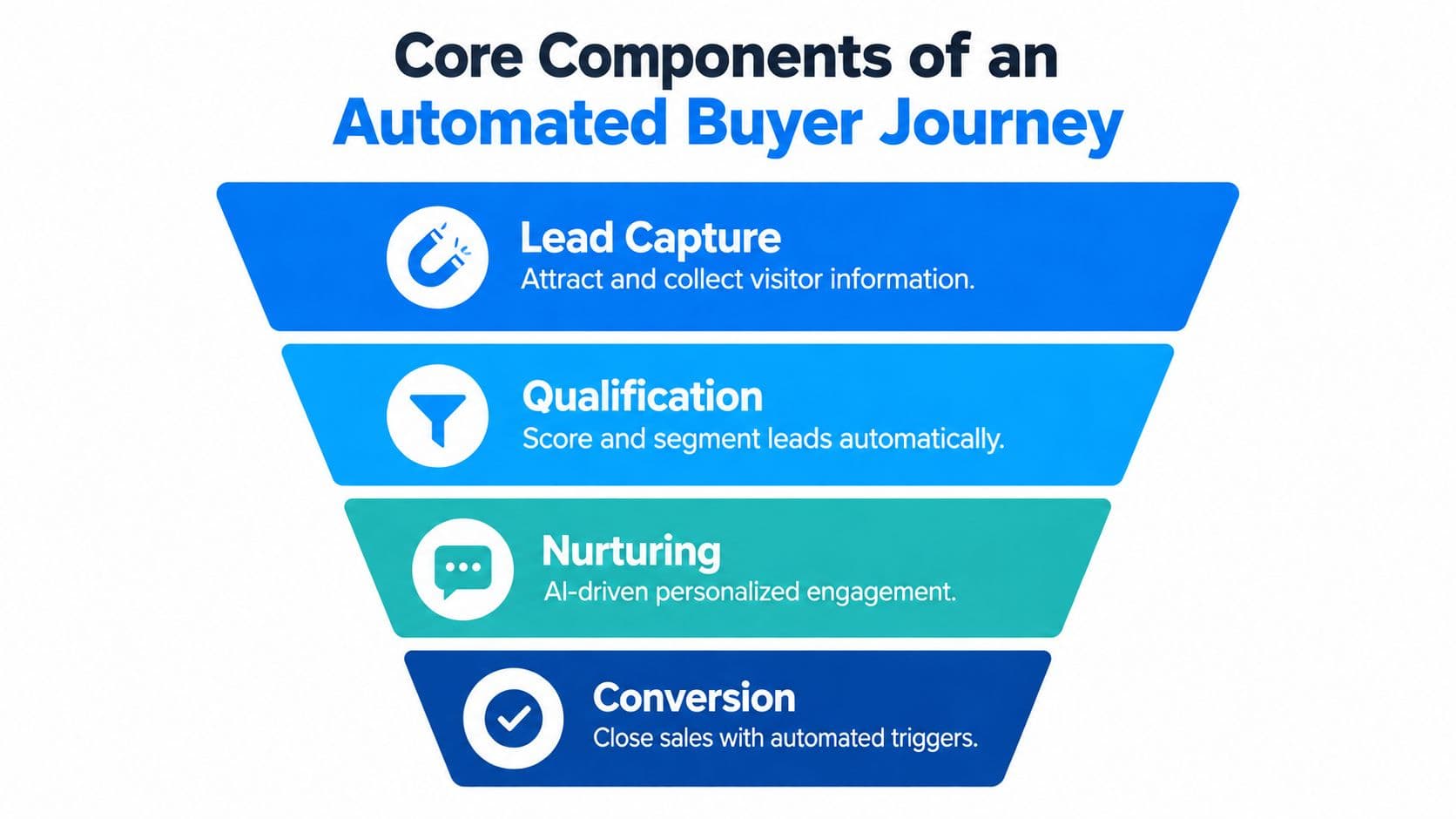
A modern automated buyer journey still includes familiar components, but they no longer operate as a one-way conveyor belt. Lead capture, qualification, nurturing, conversion, and retention must share enough context for the shopper to move between channels without restarting the conversation.
Capture and qualification need behavioral context
Lead capture is more than collecting an email address. It identifies a person who may have a problem your product solves, but the useful qualification signals often arrive afterward. A visitor who reads a buying guide behaves differently from someone who compares variants, adds a product, and asks about delivery.
Qualification should combine declared information with observed intent:
- Source and entry point: Record whether the shopper arrived from search, a paid campaign, an Instagram post, or a direct conversation.
- Product engagement: Track categories viewed, variants compared, questions asked, and cart activity.
- Commercial intent: Separate casual browsing from actions that indicate a realistic path to purchase.
- Support needs: Preserve the exact question, not just a generic segment label such as “interested.”
That last point matters because the same shopper can change stage without changing identity. Someone may begin with an Instagram DM, visit a product page, leave, and return through a cart reminder. A system that sees three unrelated events sends three disconnected experiences.
Nurture should follow the shopper, not the calendar
Nurturing still helps buyers who aren't ready. Industry-compiled benchmarks report a 451% increase in qualified leads and a 225% increase in prospects converting to sales opportunities for businesses using marketing automation to nurture prospects. The same source reports that automated nurturing can improve conversion rates by up to 23%, shorten the buying cycle by as much as 72%, and produce response rates 4 to 10 times higher than standalone email blasts (lead nurturing benchmarks).
The operational lesson isn't to send more email. It's to make each interaction reflect the shopper's latest context. A product comparison should lead to guidance. A question about stock should lead to availability information. A return to the same item may justify a concise prompt, while a completed purchase should immediately remove the buyer from promotional recovery sequences.
Conversion and retention complete the loop. The system should hand buyers a clear path to checkout, then use purchase information to support onboarding, replenishment, cross-sell relevance, and service. That continuity is more valuable than a rigid stage label because buyers often re-enter the journey with new needs.
Middle-Funnel Tactics for Qualification and Nurturing
The middle of the funnel is where interest becomes intent, or where a distracted shopper starts comparing alternatives. Scheduled messaging treats every subscriber alike. Behavior-triggered automation responds to what the person did, which makes it more useful and less intrusive.
Omnisend reports that one in three people who click an automated message make a purchase, compared with one in 18 for scheduled messages (Omnisend's ecommerce marketing report). The difference supports a practical conclusion: timing and trigger quality matter more than building a larger broadcast calendar.
Replace arbitrary delays with meaningful events
A middle-funnel sequence should begin with a decision about the event, not the email copy. For example, a store selling technical equipment might treat repeated visits to one product family as a request for guidance. A fashion store might use category affinity and variant comparisons to determine whether the shopper needs fit help, styling ideas, or reassurance about exchanges.
Useful trigger groups include:
- Exploration signals: Repeated category views, product comparisons, and returns to the same collection can prompt educational content or a buying guide.
- Evaluation signals: A product-page question, review interaction, or variant change can trigger a concise answer tied to that exact concern.
- Commercial signals: Add-to-cart activity and checkout entry should move the shopper out of broad nurturing and into high-intent assistance.
- Negative signals: Unsubscribes, repeated dismissals, or completed purchases should suppress irrelevant outreach.
Qualification isn't about assigning a score and forgetting it. The score should explain why the shopper is being moved forward. A high-intent label without the underlying question gives a sales or support agent too little to work with.
Protect the bottom of the funnel
The middle funnel should prepare the shopper for a clean buying decision. It shouldn't bombard a person with unrelated product education after they've already demonstrated purchase intent. It also shouldn't push a discount when the obstacle is uncertainty about compatibility, fit, delivery, or returns.
Use the store's actual catalog and policy information as the source of answers. If the system can't verify a claim, it should route the question to a human rather than improvise. That boundary protects trust and prevents automation from converting a short-term click into a costly service problem.
A qualified shopper isn't simply someone with a high score. It's someone whose need, product interest, and remaining objection are clear enough to support the next useful action.
The best middle-funnel setup passes that context downstream. By the time the shopper reaches the product page or cart, the assistant should know what brought them there, what they've considered, and what still needs clarification. That continuity keeps the bottom of the funnel from starting with a generic greeting.
Bottom-Funnel Automation for Cart Recovery and Conversion
Top-of-funnel automation can create demand, but revenue is often lost later. At the product page and checkout, the shopper usually has a specific obstacle: uncertainty, interruption, price sensitivity, low confidence, or a practical question the page failed to answer. Bottom-funnel automation should identify that obstacle and address it before offering an incentive.
Start with signals, not coupons
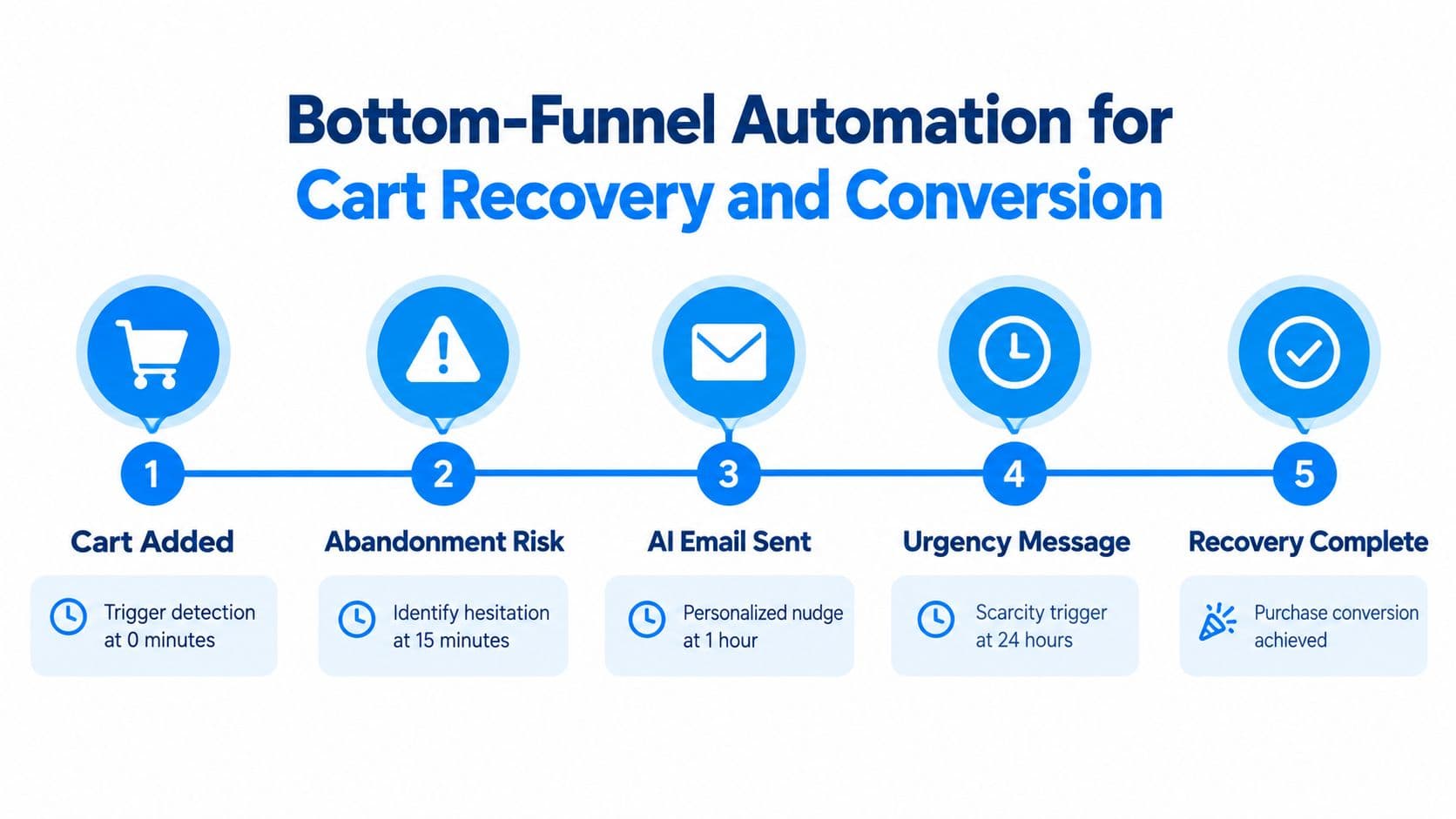
Cart recovery should respond to more than a formal checkout abandonment event. Relevant signals include an item added to cart, a closed cart drawer, extended inactivity, and exit intent. Omnisend's abandoned-cart automation guidance recommends combining add-to-cart activity with exit or inactivity conditions, with timing commonly set around one hour of inactivity.
The first intervention should be useful and specific. Ask whether the shopper needs help with the product, variant, fit, delivery, or another visible concern. A discount may reduce margin while leaving the actual objection unresolved, so reserve it for cases where price is the stated barrier.
Intent declines with time. Benchmark data reports a 20.3% conversion rate when the first recovery message arrives within one hour, compared with 12.2% after 24 hours. The same source reports that a three-message sequence sent around one hour, 24 hours, and 72 hours can recover about 15% to 30% of abandoned carts, compared with roughly 5% to 8% for basic email-only programs (cart abandonment timing benchmarks).
A practical recovery sequence
Use this operating logic:
- At the cart event: Record the cart contents, selected variant, acquisition source, and preceding conversation.
- During the first hour: Watch for exit intent, inactivity, or a closed cart drawer. Ask a short question connected to the likely hesitation.
- At the next touchpoint: If the shopper has not replied, send a concise reminder with relevant product context rather than a generic promotion.
- After a response: Answer from catalog and policy data, then provide a direct route back to checkout in the same conversation.
- After purchase: Stop recovery messages immediately and move the buyer into post-purchase support.
Recovery timing should match the store's buying cycle and tolerance for message frequency. Broader guidance commonly places the first email at 30 to 60 minutes, followed by later touches at 6 to 12 hours, 24 hours, and 48 hours, using a three-to-four-email sequence over 48 hours (abandoned-cart recovery timing). For a fuller cart abandonment recovery playbook, adapt the sequence to product complexity, purchase urgency, and the shopper's prior engagement.
High-value or complex orders need a clear human path. Automation can identify the issue, capture the cart context and transcript, then hire closers or route the conversation to internal sales staff when judgment is required. The handoff should give the person enough context to continue the conversation without making the shopper repeat the problem.
Measure recovered economics, not only messages sent or clicks generated. One industry source cites 3% to 6% more revenue versus its own baseline after engaged-shopper automation, which supports tracking revenue per visitor alongside recovered carts and conversion activity (revenue per visitor guidance).
Replacing Rigid Workflows with Conversational AI
Workflow builders are useful when the path is predictable. They become fragile when a shopper asks an unexpected question, changes products, switches from Instagram to onsite chat, or returns after a long pause. Every exception creates another branch, and the workflow eventually becomes a maintenance project rather than a revenue system.
Carti works differently from a conventional workflow builder. Its built-in behavior responds to real shopper signals such as exit intent, a cart drawer closing after an add, or a cart going idle. It doesn't interrupt within the first minute on a page, uses frequency caps, and asks about the specific hesitation instead of automatically announcing a discount.
The important distinction is conversational completion. If the shopper asks which variant fits, the assistant can answer from the store's catalog and policies. If the shopper raises a concern, it can attach relevant review evidence. If the answer resolves the objection, the item can move toward checkout in the same conversation instead of forcing the buyer through a separate email flow.
One assistant, several operational jobs
The practical replacement isn't “automate everything.” It's to remove repetitive work while keeping judgment available for edge cases.
- Pre-sale questions: Sizing, shipping, stock, and returns can be answered consistently at any hour.
- Social triage: Messenger and Instagram conversations can flow through the same assistant, preserving the context before the shopper reaches the store.
- Contextual recommendations: After an add-to-cart, the assistant asks one question about the shopper's situation and suggests one relevant complement, such as a belt for a jacket or a filter for a machine.
- Human escalation: Complex qualification, objections, and trust-building conversations should arrive with the shopper's contact, question, and transcript rather than a blank ticket.
That contextual upsell isn't a campaign blast. A campaign pushes an offer to a segment, while a conversational recommendation responds to one shopper's moment. The resulting upsell revenue belongs inside the same measured outcomes as engaged conversion and revenue per visitor, not inside an invented standalone campaign figure.
The operating effect is also different from claiming a universal labor saving. The large majority of conversations never need a human, while the conversations that do can arrive as a complete package. A solo founder gets nights and weekends back. A support team can handle more demand without answering the same questions repeatedly.
For a deeper treatment of this operating model, see conversational AI for ecommerce. The principle is simple: use automation for speed and repetition, then reserve humans for ambiguity, sensitivity, and high-value decisions.
Essential KPIs and Common Automation Pitfalls
Automation can make a weak funnel look busy. Opens, clicks, captured leads, and completed conversations may all rise while revenue per visitor stays flat. That happens when the system optimizes activity rather than purchase quality.
A stronger measurement model connects each trigger to an economic outcome. Track where the shopper entered, what question appeared, whether the assistant answered it, whether the cart changed, and whether the order followed. Compare those outcomes against the store's own baseline and segment by product, traffic source, and shopper intent.
Metrics that deserve attention
| Metric Type | Vanity Metric (Avoid Focusing Here) | Revenue Metric (Prioritize This) |
|---|---|---|
| Acquisition | Lead volume | Qualified shoppers entering product evaluation |
| Engagement | Open rate | Revenue from triggered interactions |
| Conversation | Chat count | Assisted checkout progression |
| Cart recovery | Messages delivered | Recovered orders and revenue per visitor |
| Support | Tickets deflected | Resolution quality and human escalation rate |
Revenue per visitor is particularly defensible because it captures the value of converting existing traffic, not just the percentage of visitors who take one action. A store should also monitor margin impact, because discount-heavy recovery can increase order count while weakening contribution.
Where automation fails
Over-automation creates distrust. Frequent prompts, irrelevant recommendations, and messages that ignore the shopper's previous answer make the store feel inattentive. Frequency caps and suppression rules are basic safeguards, not optional refinements.
Data silos break continuity. If the onsite assistant doesn't see the cart, the email system doesn't know about the conversation, and social support starts from zero, the shopper repeats the same question. Salesforce's description of non-linear journeys makes this failure especially important: the system must remember the interaction across interruptions and channels.
Unqualified confidence creates service debt. The assistant shouldn't invent stock information, promise a delivery outcome it can't verify, or handle a complex objection with a templated reassurance. Build a clear human fallback and pass the transcript along.
Efficiency without quality is another trap. Omnisend's comparison between triggered and scheduled messages shows why behavior matters, but a trigger alone doesn't guarantee relevance. The event, context, response, and business outcome all need review.
Measure the conversation by what it helps the shopper do next, not by how many messages the system sends.
Your Funnel Automation Implementation Checklist
Start with the leak, not the tool. Review product-page exits, cart inactivity, repeated support questions, and conversations that move between social channels and the store without a clear handoff.
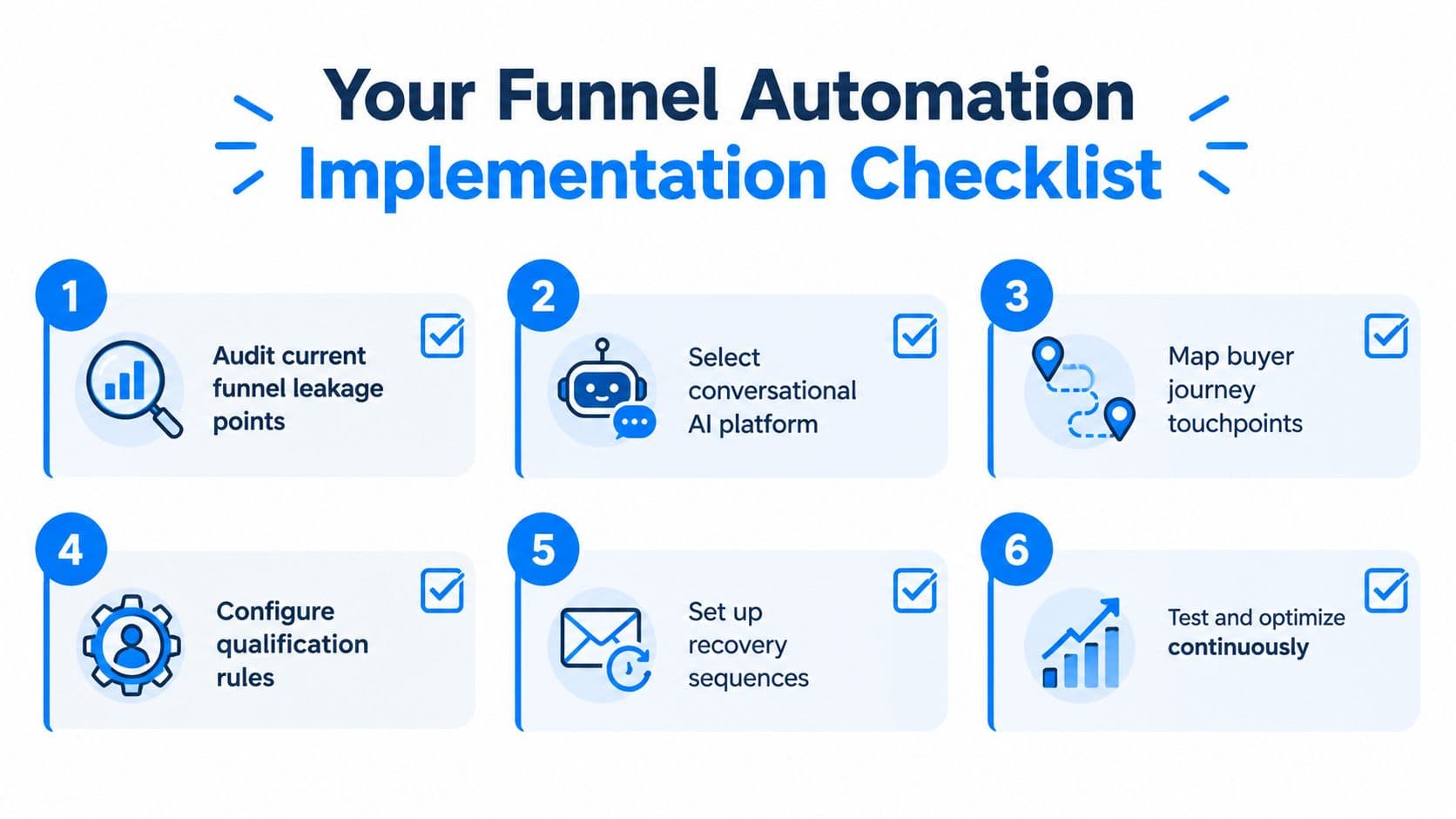
Use this sequence:
- Audit current funnel leakage points: Identify where high-intent shoppers stop and which questions appear repeatedly.
- Select a conversational AI platform: Require catalog-aware answers, clear escalation, cart context, and suppression controls.
- Map buyer journey touchpoints: Include product pages, cart drawers, checkout, email, Messenger, and Instagram.
- Configure qualification rules: Define which actions indicate research, evaluation, purchase intent, or a need for human help.
- Set up recovery sequences: Prioritize immediate, context-specific prompts and stop messages after purchase.
- Test and optimize continuously: Review revenue per visitor, assisted orders, unanswered questions, escalations, and margin impact.
Don't remove every human interaction. Keep people available for unusual product needs, sensitive service issues, high-value prospects, and objections that require judgment. The most resilient setup automates repetitive answers and preserves context, while the team improves the catalog, policies, and content based on recurring questions.
The strategic shift is straightforward. Keep top-funnel capture and middle-funnel nurturing where they earn their place, but put serious attention on the product-page-to-checkout moment. That's where a relevant answer can turn an exit into an order.
Carti gives Shopify stores a 24/7 AI sales assistant that answers product questions, recommends relevant items, and supports cart recovery from the same conversational layer. Visit Carti to see how bottom-funnel sales funnel automation can help your store convert more browsers without adding another rigid workflow.

Written by
Daniel AndersonFounder of Carti. 10+ years building ecommerce brands in apparel and supplements. Still runs a Shopify store and built Carti to help merchants convert more browsers into buyers.
Ready to boost your store's sales?
Install Carti in 5 minutes and let AI handle customer questions, recommend products, and close sales 24/7.
Start Free Trial14-day free trial