
The most popular advice about customer service policies is wrong: a longer, more generous policy isn't automatically a better policy. A vague promise such as “we'll work with you” may sound accommodating, but it leaves shoppers, agents, and AI assistants guessing about what happens next.
A useful policy behaves more like executable code than a legal page. It gives a shopper a quotable answer, gives a support team a rule they can apply consistently, and gives an AI assistant approved language to repeat without improvising. The hard truth is simple: precision reduces friction better than generosity alone.
Why Generous-Sounding Policies Often Backfire
Merchants often extend return windows, add flexible exceptions, and soften every rule with phrases such as “reasonable time” or “case by case.” The intention is good. The result is often a customer who still doesn't know whether their order qualifies, what evidence they need, or when their money will come back.
That uncertainty appears before checkout as hesitation and after checkout as a ticket. A policy can be technically customer-friendly while operationally useless if it forces every shopper to request a personal interpretation.
Precision beats flexibility
A crisp 30-day return window is easier to understand than an undefined promise. Guidance from Narvar's ecommerce return-policy guide describes 30 days as a common standard and explains that the window usually starts on the delivery date. Independent research on return-policy design also recommends a 30-day window as a balance between convenience, perceived fairness, and satisfaction, while cautioning against both very short and very long windows (Wageningen University research).
That doesn't mean every store should copy the same rule. A merchant selling low-risk accessories may support a different window from a merchant selling personalized goods, cosmetics, or clearance inventory. The point is to choose a rule your margin, product category, fraud exposure, and reverse-logistics process can support, then state it in absolute terms.
Practical rule: If a shopper can't quote your policy back in one sentence, the policy is probably too vague.
Write “You can request a return within 30 days of delivery” instead of “Returns are accepted within a reasonable time.” Write “Refunds are issued to the original payment method after the returned item passes inspection” instead of “Refund timing varies.” If exceptions exist, name them and explain the path rather than hiding them in a general clause.
Treat every sentence as an instruction
Customer service policies serve three audiences at once:
- Shoppers need certainty at the moment they decide whether to buy.
- Agents need boundaries that prevent inconsistent promises.
- AI assistants need unambiguous source text they can retrieve and quote.
“Contact us and we'll see what we can do” fails all three. It creates a new conversation instead of resolving the existing question, gives agents no consistent decision rule, and forces an assistant to escalate unnecessarily.
A strong policy separates standard rules from judgment-based exceptions. The standard rule should be direct. The exception should specify who reviews it, what information the customer must provide, and what response window applies. That preserves flexibility without making every order a negotiation.
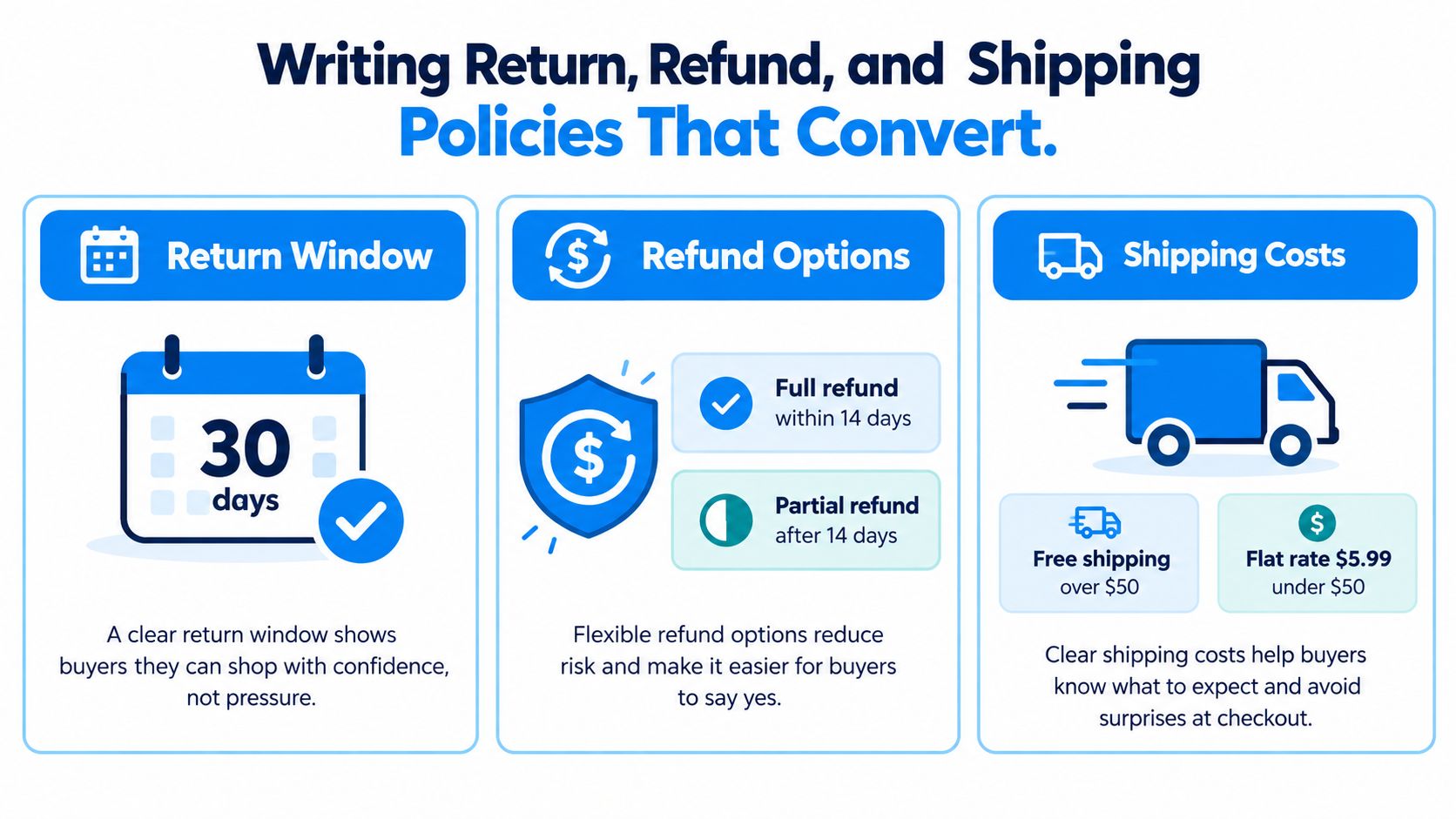
Writing Return, Refund, and Shipping Policies That Convert
Returns, refunds, and shipping create the most damaging kind of uncertainty because shoppers encounter them before placing an order. Your policy should answer not only “Can I return this?” but also “When does the clock start?”, “What condition does it need to be in?”, “How will I receive my refund?”, and “What happens if the package arrives damaged?”
Start with the return window. Anchor it to delivery date, not purchase date, unless your category or legal requirements demand something else. State the window in a sentence that a human or AI assistant can quote without interpretation:
“You can request a return within 30 days of delivery. The item must be unused, in its original condition, and accompanied by proof of purchase.”
Then separate the refund rule from the return rule. Tell shoppers whether you issue a refund to the original payment method, offer an exchange, or provide store credit. Explain when processing begins and what happens if the item is damaged, missing parts, marked as final sale, or purchased during a promotion.
Remove the questions that block checkout
An exact free-shipping threshold eliminates a recurring decision-point question. Put the threshold beside the cart total, not only in a footer policy. If the shopper is below the threshold, show the remaining amount needed. If shipping is calculated by destination, say so before payment.
Sizing deserves the same treatment. A short product-level note such as “Runs small, size up” is more useful than sending every shopper to a general sizing page. The policy and the product page should work together, because customers ask product-specific questions in product-specific places.
For edge cases, create a decision path:
| Situation | Policy wording should clarify | Operational owner |
|---|---|---|
| Standard return | Window, condition, and proof required | Front-line support |
| Damaged delivery | Evidence, reporting channel, and replacement or refund path | Support lead |
| Final-sale item | Whether returns are excluded and what damage exception applies | Front-line support |
| Late delivery | Tracking, carrier escalation, and customer remedy | Fulfillment support |
| Promotion order | Whether discounts affect refund or exchange value | Support lead |
Returns matter beyond immediate ticket volume. UPS's 2025 returns guidance reports that 81% of consumers read return policies before buying, 71% say a poor returns experience makes them less likely to shop again, and 86% prefer no-box, no-label returns with instant refunds. Those figures point to a clear content gap: many policies explain eligibility but fail to explain speed, convenience, and certainty.
Use your margin to choose the rule, but use precise language to make the rule usable. A sample chat support conversation can help your team test whether real shopper questions receive direct answers rather than links to a policy maze.
Benchmarking Response Times Against Modern Expectations
A response-time policy written for email can't be copied into live chat. Shoppers judge each channel by a different standard, and the fastest channels now operate on near-immediate acknowledgement rather than a promise to reply later.
A 2025 consumer survey found that about 2 in 5 customers expect a response within 5 minutes, while 7 in 10 want contact within 1 hour (Customer Experience Dive). An independent 2024 e-commerce wait-time study found that 96% of shoppers expect a chat response within 5 minutes, 80% want an answer within 2 minutes, and almost half may leave a site if they don't see someone typing within 1 minute, as reported in the same source.
Email tells a different story. Across 1,000 companies, the average email response time was 12 hours and 10 minutes, and only 36% replied within 4 hours (Customer Experience Dive benchmark summary). That gap is precisely why a single “we reply within 24 hours” promise creates a poor experience in chat. It applies a slow-channel standard to a high-intent buying moment.
Set channel-specific service levels
Publish separate commitments for:
- Live chat: immediate acknowledgement and a clear handoff if a human is needed.
- Email: a realistic human first-response window.
- Social messaging: ownership, response target, and routing rules.
- Escalations: a separate target for issues requiring judgment.
Benchmarking also needs consistent definitions. APQC recommends measuring complaint rates with normalized denominators such as complaints per 1,000 orders or per 10,000 customers, comparing performance against a 12–24 month baseline, and investigating sustained performance at 2 standard deviations above baseline for two consecutive weeks (APQC customer service benchmarks). Use those methods only if your team defines “complaint,” “resolution,” and “escalation” consistently across systems.
Don't optimize for tickets closed alone. Track first-response time, resolution time, escalation rate, first-contact resolution, and customer satisfaction together. One benchmark set recommends email and social replies within 60 minutes, resolution within 24 hours, fewer than two replies per ticket, and customer satisfaction of at least 85%. For live chat in North America, it lists a 58-second first-response target, 14-minute total handle time, 92% customer satisfaction, and 70.2% first-contact resolution (Zoom customer service benchmarking).
Your policy is credible only when your dashboard can prove whether the team meets it. The customer service response time guide is useful for turning those targets into channel-level operating rules.
Shifting from Business Hours to Around-the-Clock Support
“We reply within 24 hours on business days” is a reasonable ceiling for a small human team. It isn't a complete support experience for someone shopping at night, comparing products on a weekend, or trying to understand a return rule before paying.
The practical answer isn't to promise impossible human coverage. Split support into two layers: instant answers for predictable questions and human follow-up for judgment, exceptions, and problems.

An AI assistant can answer catalog and policy questions immediately, including shipping, sizing, returns, compatibility, and subscription terms. IBM explains that AI chatbots can provide immediate answers to common questions at any time of day, while human agents handle more complex requests (IBM customer service research). That creates a realistic two-speed model instead of disguising limited staffing as a universal SLA.
Publish both promises
Your public policy should say what happens at each layer:
- Instant layer: product and policy questions receive an immediate answer from the store's approved knowledge.
- Human layer: escalated cases receive a human response within a clearly stated window tied to your actual staffing.
- Handoff layer: the customer doesn't need to repeat the issue because the transcript, contact details, and relevant order context travel with the escalation.
The wording matters. “Get instant answers to product and policy questions. For issues requiring human review, we'll respond within one business day” is more honest than claiming a human will always respond immediately.
Businesses comparing internal staffing with external capacity can also review customer support outsourcing companies, particularly when order volume spans time zones. Outsourcing may extend coverage, but it won't fix unclear rules. An agent outside your team still needs exact refund, shipping, and escalation language.
The around-the-clock support approach works when the assistant uses the same source of truth as your team. Keep policy text current, record effective dates, and make the assistant distinguish a standard answer from an escalation rather than inventing an exception.
A two-tier model protects the human queue from repetitive questions while giving night-time shoppers a usable answer. It also gives you a measurable boundary: instant answers should resolve known information requests, while human performance should be judged on escalations and complex problems.
The human team still owns the hard calls. Automation should reduce waiting, not remove accountability.
Building an Escalation Policy That Actually Gets Enforced
An escalation policy fails when it lives only in a handbook. Agents may understand the document, but a busy queue rewards improvisation unless the help desk or assistant enforces the trigger and carries the relevant context forward.
Start with a short trigger list. A conversation should move to a human when the customer explicitly asks for one, the topic requires judgment, or the interaction shows frustration. Refund exceptions, damaged orders, disputed delivery outcomes, and abusive behavior need clearly assigned owners rather than vague instructions to “escalate if necessary.”
Define the handoff payload
Every escalation should include the same minimum information:
- Customer identity: name, email, and any approved contact details.
- Order context: order identifier, affected product, purchase status, and relevant dates.
- Conversation record: the full transcript, not a summary that forces the agent to reconstruct the problem.
- Reason for escalation: the exact trigger, such as damaged delivery or an exception request.
- Requested outcome: refund, replacement, exchange, explanation, or review.
The default behavior should be collect and forward, never improvise. If a shopper asks for an exception, the assistant should acknowledge the request, gather the required details, and pass it to the person authorized to decide. It shouldn't promise approval merely to end the conversation.
The customer should explain the problem once. Every additional re-interview is a process failure.
Assign an owner to each trigger. Front-line support may resolve standard returns. A lead may review exceptions. A fulfillment or operations owner may handle carrier disputes. The exact roles depend on your store, but “someone from the team” isn't an owner.
Audit the workflow, not just the document
Review a sample of escalations every week. Check whether the trigger was valid, whether the transcript and contact details were attached, whether the assigned owner responded within the published window, and whether the final answer followed the policy.
Use the audit to refine the rule set. If agents repeatedly escalate a question because a policy sentence is unclear, rewrite the sentence. If an assistant escalates routine questions, add the missing policy detail to the approved knowledge base. Enforcement improves when the workflow exposes ambiguity instead of asking people to compensate for it.
A strong escalation policy protects customers from repetition and merchants from inconsistent concessions. It also gives automation a responsible limit. The assistant handles facts. Humans handle judgment.
Placing Policies Where Shoppers Need Them Most
A policy hidden in a footer is technically available and practically absent. Shoppers don't open a general policy page at random. They ask questions when a specific uncertainty blocks the next action, usually beside a product choice, cart total, delivery estimate, or payment decision.
That means policy distribution deserves the same attention as policy writing. Put the relevant sentence where the doubt appears, then let the full policy provide depth for customers who need it.

Match each doubt to a location
A Shopify merchant should map the most common pre-sale questions to storefront elements:
| Shopper hesitation | Put the answer | Example of a useful snippet |
|---|---|---|
| “Will shipping be free?” | Cart and product page | “Free shipping applies to orders over the stated threshold.” |
| “Will this fit?” | Beside the size selector | “This style runs small. Choose one size up.” |
| “Can I return it?” | Near the add-to-cart button | “Return requests are accepted within 30 days of delivery.” |
| “What if it arrives damaged?” | Product page and chat | “Contact support with photos and your order details for review.” |
| “When will I get my money back?” | Refund policy and order help flow | “Refund timing begins after the returned item is received and reviewed.” |
Don't hide the answer behind three clicks. A shopper who can ask in chat should receive the relevant policy sentence immediately, not a generic link to a page containing several unrelated rules.
Make the assistant quote the same rule
Your storefront, support inbox, and AI assistant should use one maintained source of truth. If the product page says one thing and the chat assistant says another, customers lose trust and agents inherit the conflict.
Use short policy blocks with explicit subjects, conditions, and actions. Avoid pronouns with unclear references. “Items purchased during a final-sale promotion can't be returned unless they arrive damaged” is easier to retrieve than “These items are excluded, except in certain cases.”
The return-policy content should also answer the edge cases that standard FAQ pages often overlook. Gap's return-policy FAQ illustrates how online and in-store timelines, final-sale exclusions, proof of purchase, and damaged-item instructions can sit in separate rules. A shopper doesn't experience those as separate documents. They experience one decision about whether to buy and what to do if something goes wrong.
That distinction matters because 67% of consumers say a bad return experience would discourage them from shopping again, and 46% have abandoned a purchase because the return process or options were unsatisfactory, according to the retailer policy example cited in the same source. Your policy should therefore explain damaged, late, partial, and promotional orders in a single decision path rather than scattering those answers across subpages.
Let support data improve merchandising
Repeated questions aren't only a service problem. They reveal missing product information. If shoppers repeatedly ask whether a garment runs small, add the sizing note to the product page. If they ask about the free-shipping threshold, expose the threshold beside the cart total. If damaged-delivery questions cluster around fragile products, add the process near those products before checkout.
A tool such as Carti can read store policies, FAQs, catalog information, and shipping rules, then answer shopper questions in chat and surface recurring questions for content updates. That makes policy distribution operational rather than static, but the merchant still needs to review the source text and approve changes.
Write the policy once, precisely. Publish the right sentence at the decision point. Make chat quote the same rule. That combination reduces avoidable tickets without forcing customers to search for information your store already has.
Carti reads your Shopify catalog, customer service policies, shipping details, returns rules, and FAQs so shoppers can get immediate answers while humans handle escalations with full context. Visit Carti to put precise policy answers directly into product and checkout conversations.

Written by
Daniel AndersonFounder of Carti. 10+ years building ecommerce brands in apparel and supplements. Still runs a Shopify store and built Carti to help merchants convert more browsers into buyers.
Ready to boost your store's sales?
Install Carti in 5 minutes and let AI handle customer questions, recommend products, and close sales 24/7.
Start Free Trial14-day free trial