
The $40 monthly Starter fee covers 50 tickets, but it does not show the whole bill. AI resolutions add a separate usage charge, so the total depends on the subscription, ticket volume, and how many conversations AI resolves.
For a Shopify store, estimate those costs together and test the total against a peak month. A quiet week can make a plan look affordable; a busy trading period shows how the bill changes when ticket volume and AI use rise.
Published Gorgias Rates You Can Verify
The listed subscription price is only one part of a Gorgias bill. To compare costs, first identify the meter, rate, and expected volume for each charge.
Read the unit before the price
The table separates the helpdesk subscription from AI usage and shows which rates are listed in the current pricing information.
Gorgias charges published for 2026
| Charge | Published rate | Unit | Billing note |
|---|---|---|---|
| Starter helpdesk | $40 per month | 50 tickets | Monthly billing on the official pricing page |
| AI Agent on most plans, annual | $0.90 | One AI-resolved conversation | Annual billing |
| AI Agent on most plans, monthly | $1.00 | One AI-resolved conversation | Monthly billing |
| AI Agent on Starter | From $1.00 | One AI-resolved conversation | Starter starts at this rate |
| Included AI resolutions | Roughly 90 to more than 2,500 | AI-resolved conversations per month | Range across plans, not one tier |
| Support + Shopping Assistant overage | $1.50 | One interaction | After the included allowance |
| Support-only overage | $1.00 to $2.00 monthly | One interaction, by tier | Confirm the selected tier's rate |
The Gorgias AI pricing explanation lists AI charges separately from the helpdesk subscription. Higher helpdesk tiers are priced according to ticket allowance, and their current quotes are on Gorgias's official pricing page.
An allowance range is not a plan entitlement. Match the included AI volume and overage rate to the specific tier before estimating the bill.
Compare equivalent billing units
For each charge, record the billing cycle, included volume, billable event, and rate. Comparing a monthly subscription with an annual monthly equivalent or a per-resolution fee is like comparing a fixed rent with a meter: the units must match before the totals mean anything.
For a separate example of how an AI support service presents its pricing, browse AI support pricing. Compare the billing units and service scope, not just the headline price.
Use the live ticket allowance for the tier under consideration when estimating costs. This keeps the worksheet tied to the store's expected volume instead of an outdated listing.
How Tickets and AI Resolutions Are Billed
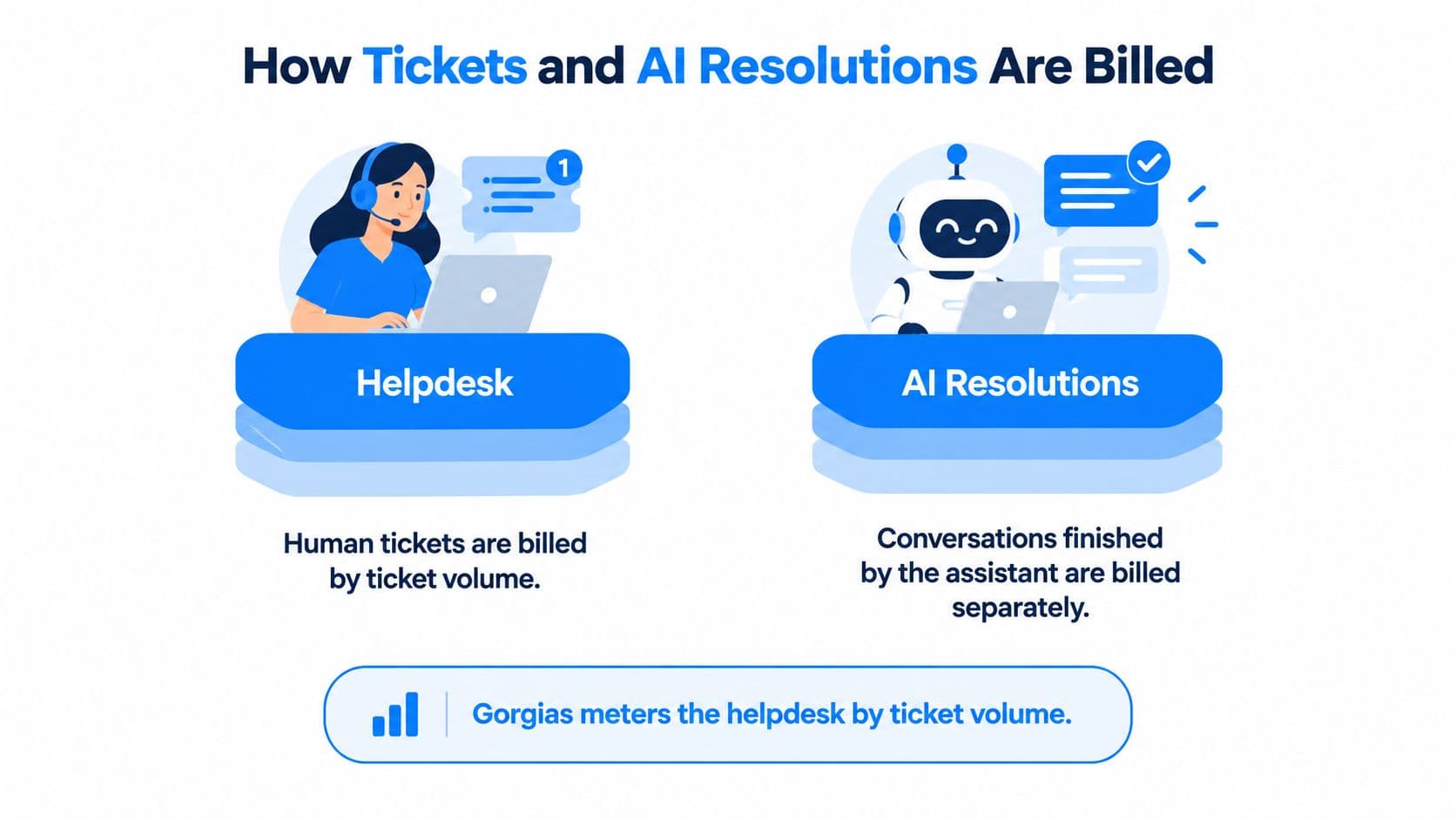
Gorgias pricing is easier to understand as separate stacks of work. The helpdesk stack contains human-handled tickets, while the AI stack contains conversations the assistant finishes independently.
According to Gorgias's billing documentation, the Helpdesk subscription is metered by human-handled ticket volume, and AI Agent adds an outcome-based charge for successfully automated conversations. Usage above the included units can trigger overage, with the applicable rate set by the subscription.
Automation changes the mix, not just the total
Say a Shopify clothing store receives questions about fit alongside requests to investigate missing parcels. Some fit questions may be completed automatically, while a parcel investigation may still require a person.
The merchant needs separate forecasts for those outcomes. Moving work away from staff doesn't make the resulting automated resolutions free, and counting every incoming message as a successful AI resolution would overstate the automation forecast.
A handoff also matters. An assistant that starts a conversation and then passes it to a person hasn't necessarily produced the independently completed outcome that attracts the AI resolution fee.
Monthly cost equals base subscription plus human-ticket overage plus AI-resolved conversation charges.
The spreadsheet should distinguish included AI capacity from additional AI usage. If the selected package already contains a paid AI allocation, that committed charge belongs in the fixed portion of the forecast, not in an imaginary free allowance.
This distinction prevents a common accounting error: treating no overage as no AI cost. The account's actual package determines what has already been purchased.
Account history can change the applicable structure
Gorgias's plan explanation identifies May 28, 2025 as the transition date, with older accounts remaining on legacy pricing unless they adopt the newer AI Agent and Shopping Assistant model. The same explanation lists most-plan AI resolutions at $0.90 with annual billing or $1.00 with monthly billing, Starter resolutions beginning at $1.00, and allowances ranging from roughly 90 to more than 2,500 AI-resolved conversations per month.
An existing merchant therefore shouldn't assume a new-account example reproduces an older invoice. The account's adopted pricing structure needs to be identified before forecasting.
The operational question is equally important: which inquiries need human judgment? Refund exceptions, delivery disputes, and ambiguous product requests shouldn't be assigned to the automated pile merely because an assistant can send an initial response.
For a companion review of support workflows, SupportGPT's cost-saving strategies offer another resource for examining service costs. Any proposed change should still be translated into a measurable billing effect, such as fewer human-required tickets or fewer avoidable contacts.
The verdict comes after that exercise. A volume-based desk can suit a store's workload, but the merchant needs to know which meter each workflow affects.
Sample Bills for Quiet and Peak Months
The following sketches are illustrations from published rates, not quotes for an unopened tier. Each identifies the volume and rate before showing the resulting charge.
Gorgias's AI pricing explanation describes approximately $0.90 per AI-resolved conversation on annual billing, $1.00 on monthly billing, and $1.50 per Support + Shopping Assistant overage interaction, while support-only monthly overage ranges from $1.00 to $2.00 by tier. The applicable overage arrangement must be confirmed before using any of those rates in a budget.
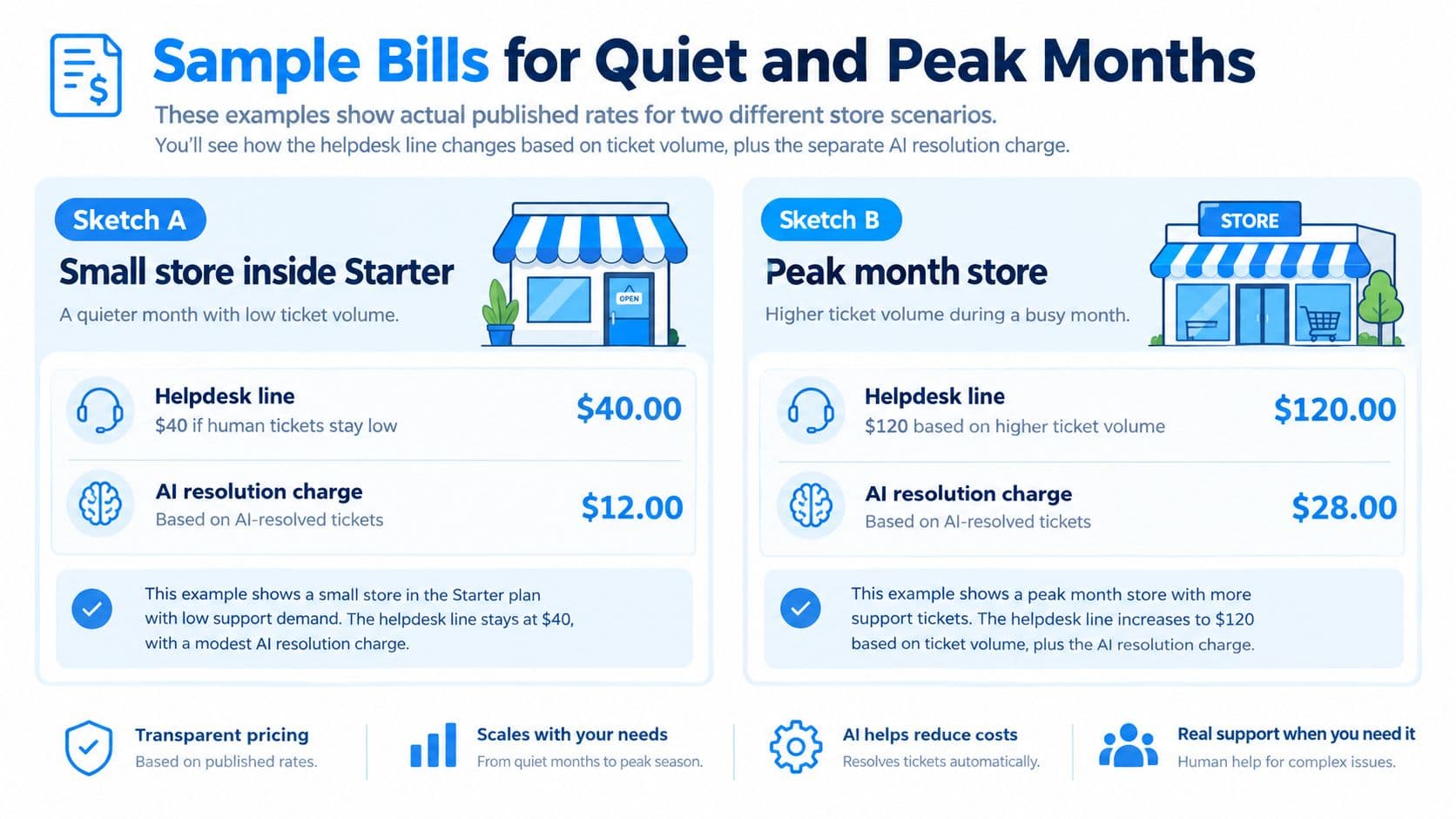
Sketch A, a quiet Starter month
The meter is human tickets, and the illustrated volume stays within Starter's included ticket allowance. With no human-ticket overage and no AI overage, the sketch contains only the published helpdesk base.
That isn't proof that an account with an AI add-on owes only the helpdesk amount. Any separately purchased AI package still needs to be added. The quiet-month sketch isolates the base and overage lines rather than inventing a free AI entitlement.
Sketch B, an automation peak
The meter is additional AI-resolved conversations. For a hypothetical block of 1,000 additional resolutions, applying $0.90 produces $900, while applying $1.00 produces $1,000.
The arithmetic changes that slice of the forecast by $100. However, those are rate illustrations, not a promise that the lower resolution rate is the selected tier's excess-usage rate.
Sketch C, Shopping Assistant overage
The meter is interactions beyond the included Shopping Assistant allowance. A hypothetical 200 interactions × $1.50 produces $300 in incremental charges.
That amount sits on top of the chosen base and any applicable support-ticket charges. A merchant shouldn't substitute the support-only rate for a combined Support + Shopping Assistant interaction.
Illustrative monthly charges from published rates
| Sketch | Base plan | Human overage | AI overage | Illustrated total |
|---|---|---|---|---|
| A, quiet Starter month with tickets at or under 50 | $40 | $0 | $0 | $40, excluding any separate AI package |
| B, 1,000 AI conversations over allowance at $0.90 | Selected live base | Excess tickets × tier rate | $900 if this rate applies | $900 plus base and human overage |
| B, same volume at $1.00 on monthly billing | Selected live base | Excess tickets × tier rate | $1,000 if this rate applies | $1,000 plus base and human overage |
| C, 200 Shopping Assistant interactions over allowance at $1.50 | Selected live base | Excess tickets × tier rate | $300 | $300 plus base and human overage |
The important change happens when usage leaves an allowance. A store then pays the incremental rate for additional units, which may be higher than the effective rate inside its package.
A peak-month forecast should therefore preserve the separate lines rather than compressing everything into an average cost per chat. An average can hide the point at which overage begins.
Forecast line: Selected base ______ + human overage count ______ × tier rate ______ + AI overage count ______ × applicable AI rate ______.
How to Estimate and Lower the Bill
A reliable Gorgias pricing estimate starts with the store's own conversation history. The merchant should use Gorgias's live pricing page to attach current allowances and rates to that workload, rather than assuming a historical annual discount still applies.
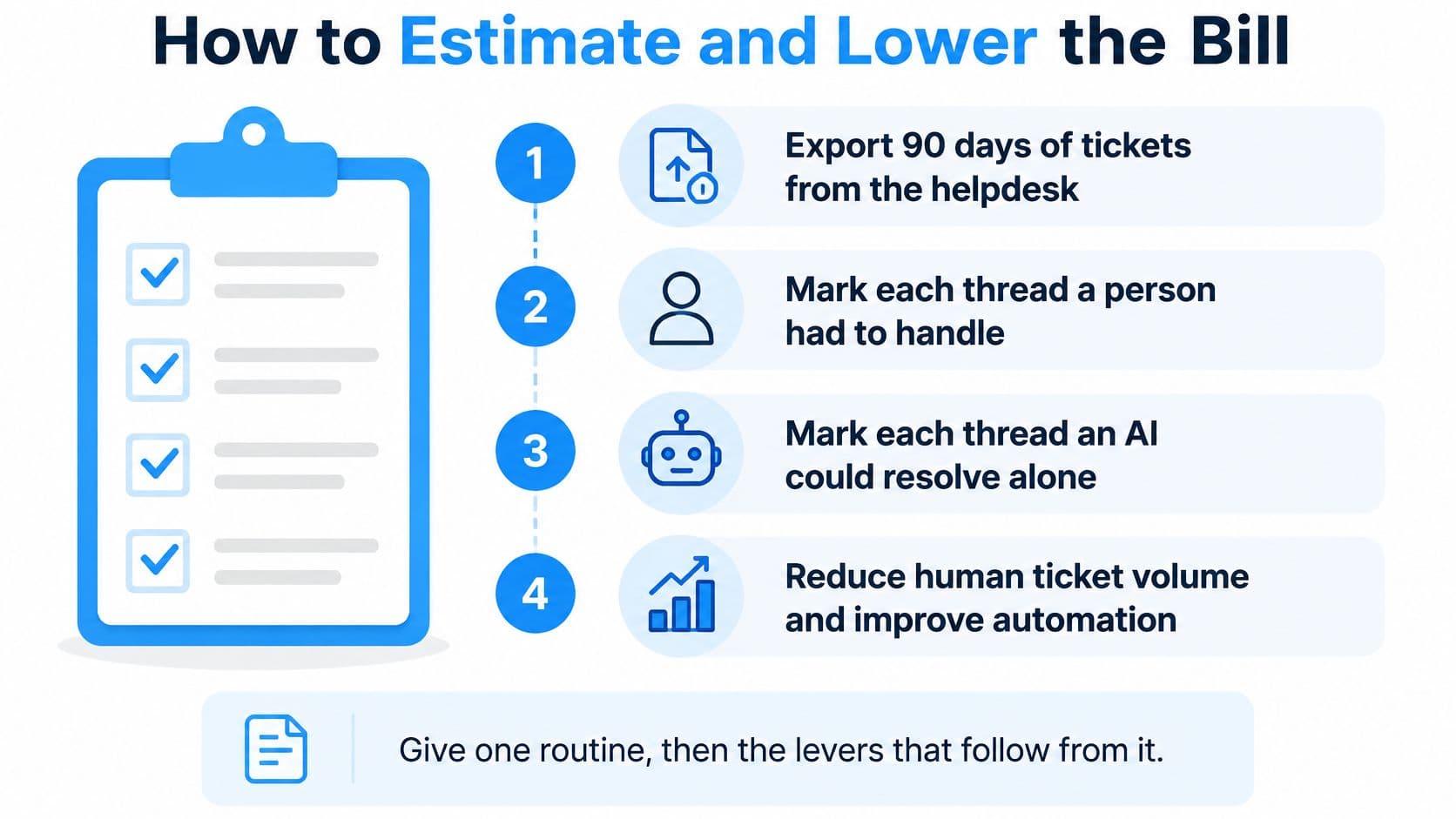
Build the estimate from actual threads
- Export a representative period. A practical working window is the previous 90 days of helpdesk tickets, retaining dates and resolution information.
- Mark human-required threads. Flag conversations that needed a person's judgment, approval, investigation, or action.
- Mark independently automatable threads. Separate inquiries an assistant could finish without a person from those it could only begin.
- Apply the selected billing arrangement. Record the fixed subscription, included capacity, and excess-unit rates separately. Multiply chargeable usage by the applicable rate.
- Replay the busiest month. Check whether either usage pile exceeds its allowance, and price the excess rather than assuming the average month represents peak demand.
Change a rate or reduce a volume
Only changes that affect the billing calculation belong in the savings estimate. A faster reply may improve service, but it doesn't automatically reduce billable usage.
- Billing commitment: Compare the current monthly and annual quotes, including the published AI rate and the full commitment. A lower unit price isn't automatically a better choice for a store with uncertain demand.
- Resolution classification: Don't count a human handoff as an independent AI completion. Forecasting errors can make automation appear more expensive or more effective than it is.
- Avoidable contacts: Improve product-page sizing, shipping information, and policy explanations when those gaps repeatedly generate inquiries.
- Routing: Where another tool already answers pre-purchase questions, avoid unnecessarily sending every completed exchange into the human helpdesk workflow.
The store should preserve a route to human help for unresolved cases. Reducing ticket volume by hiding support isn't the same as answering shoppers' questions.
For changes beyond software selection, the guide to reducing operational costs provides a broader planning resource. Any projected saving should remain separate from the helpdesk forecast until the merchant can identify the specific rate or volume it changes.
When a Storefront Assistant Fits Better
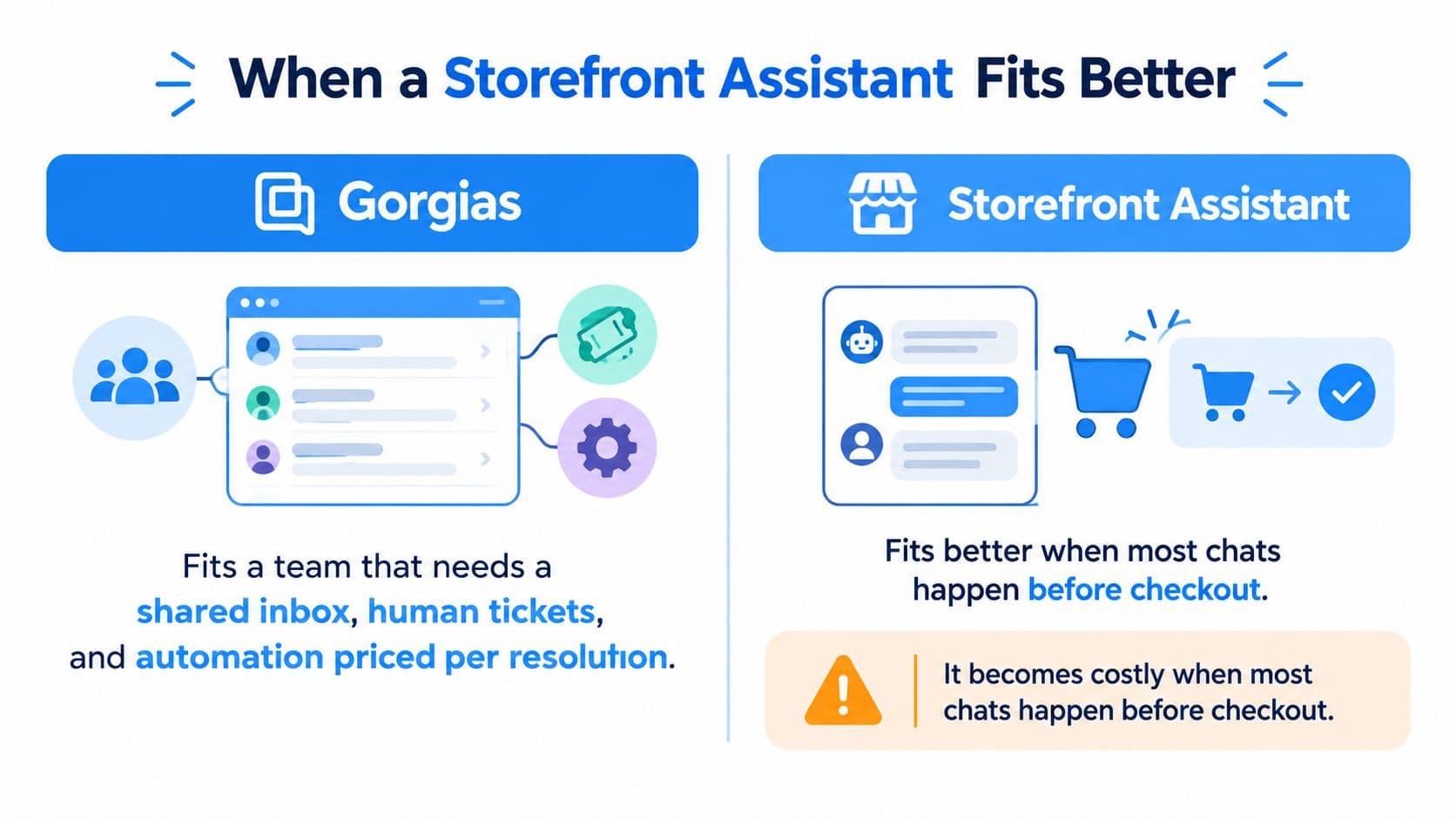
The choice starts with the job. A team managing human support cases needs a different billing comparison from a store whose conversations mostly concern product selection before checkout.
Gorgias fits a helpdesk-led workflow involving a shared inbox, human tickets, and automation priced by successful resolution. A storefront assistant deserves consideration when shoppers mainly need help with sizing, shipping policies, returns information, or product comparisons.
Compare the job and the meter
| Store requirement | Helpdesk-led approach | Storefront-assistant approach |
|---|---|---|
| Human investigation | Budget for ticket handling | Preserve a clear escalation route |
| Pre-purchase guidance | Price the applicable resolution or interaction | Compare included conversation capacity |
| Seasonal demand | Stress-test ticket and AI allowances | Stress-test conversation limits |
| Mixed workload | Keep human and automated costs separate | Include the cost of escalated cases |
Carti is an AI shopping assistant for Shopify with Free including 50 AI conversations a month, Starter at $49 per month for 250, Growth at $99 for 600, and Scale at $249 for 1,750. Paid plans include a 14-day free trial, and none of these current plans is unlimited.
The assistant's pricing page is the relevant place to compare those conversation allowances. Escalation can be disabled, sent by email to a specified support address, or configured to create tickets in Zendesk or Gorgias.
A complementary tool can still create support costs
An integration doesn't eliminate the downstream helpdesk bill. If a shopper's question becomes a Gorgias ticket, that escalated work belongs in the support forecast.
For merchants reviewing the pre-purchase experience itself, Yassine Malti on chatbot conversion strategies provides context on answering shopper questions. That resource shouldn't replace a store-specific estimate of conversation volume or expected escalations.
Pre-purchase volume alone doesn't prove one product is cheaper. The merchant should price the relevant allowance, excess usage, and remaining human workload before choosing a standalone assistant, a helpdesk, or a combination.
Gorgias Pricing Questions Answered
Does Gorgias charge per agent?
No. The helpdesk pricing model uses monthly ticket volume rather than the number of agent seats. A merchant should forecast the work handled, not just multiply the support team's headcount by a seat price.
Is AI billed on top of the helpdesk?
Yes. AI Agent is a separate add-on with outcome-based charges. The account's committed AI capacity and additional usage both need to be included where applicable.
Which pricing applies to older accounts?
An older account may remain on legacy pricing unless it adopts the newer AI Agent and Shopping Assistant structure. The account's billing arrangement matters more than a price shown to a new customer.
Which Starter price is correct?
The official Gorgias pricing page is the appropriate reference for a current quote. An older third-party listing shouldn't override the amount and billing cycle shown for the merchant's selected configuration.
Does the base price cover everything?
Not necessarily. Usage above included quantities can create overage, and an AI add-on can add a separate charge even when the helpdesk stays inside its ticket allowance.
The merchant should check these fields before approving a subscription:
- Included units: Identify the ticket and AI allowances separately.
- Excess-unit rate: Record the rate for each meter.
- Commitment: Distinguish monthly payment from an annual obligation.
- Account structure: Confirm whether the quote matches the existing account's pricing arrangement.
Does this guide establish switching terms?
No migration, cancellation, refund, or transition-charge terms are established here. A merchant moving away from Gorgias should confirm data export, billing start dates, and transition costs directly before scheduling the change.
The Gorgias comparison page can support a product evaluation. It shouldn't be treated as confirmation of contractual migration terms.
Confirm the Live Quote Before You Subscribe
A store can make this decision with a live quote and a classified workload, without guessing at future automation performance. The owner should copy the selected base from the official pricing page, add realistic excess usage, and keep any unconfirmed rate blank.
If the existing support team needs the helpdesk workflow and the full forecast fits the budget, the merchant can compare the available billing commitments. If pre-purchase inquiries make up the larger workload, that pile should also be priced as storefront conversations before buying additional Shopping Assistant capacity.
Record the decision in a usable form
The purchasing record should contain the quote's billing cycle, included allowances, and the month used for the peak test. That makes the decision auditable when the next invoice arrives.
Decision line: Helpdesk base ______ + expected human overage ______ + expected AI overage ______.
A blank isn't a zero. Any missing figure needs confirmation before the merchant treats the forecast as a complete bill.
The final choice should follow the store's larger workload, whether that's human support cases or storefront conversations. A combined setup also needs a forecast for the cases that move between products.
The merchant should recheck actual usage after the next peak week, not just after a quiet period. That review will show whether the chosen allowance still matches the store's workload and whether routing changes reduced chargeable work.
Carti offers an AI shopping assistant for Shopify that answers pre-purchase questions and recommends relevant products. Merchants pricing that workload can visit the site, compare included conversation capacity with expected demand, and test a paid plan with the 14-day free trial.

Written by
Daniel AndersonFounder of Carti. 10+ years building ecommerce brands in apparel and supplements. Still runs a Shopify store and built Carti to help merchants convert more browsers into buyers.