
Choosing the cheaper starting plan is poor advice for a Shopify merchant comparing Tidio vs Zipchat. A low subscription price doesn't establish what the store will pay to resolve a shopper's product question, especially when the shopper asks follow-ups.
The useful comparison starts with the work each tool must complete. Tidio's documented strengths center on customer-support operations, while Zipchat emphasizes ecommerce selling. The decision should turn on cost per resolved pre-purchase conversation, with answer quality and staff intervention measured alongside it.
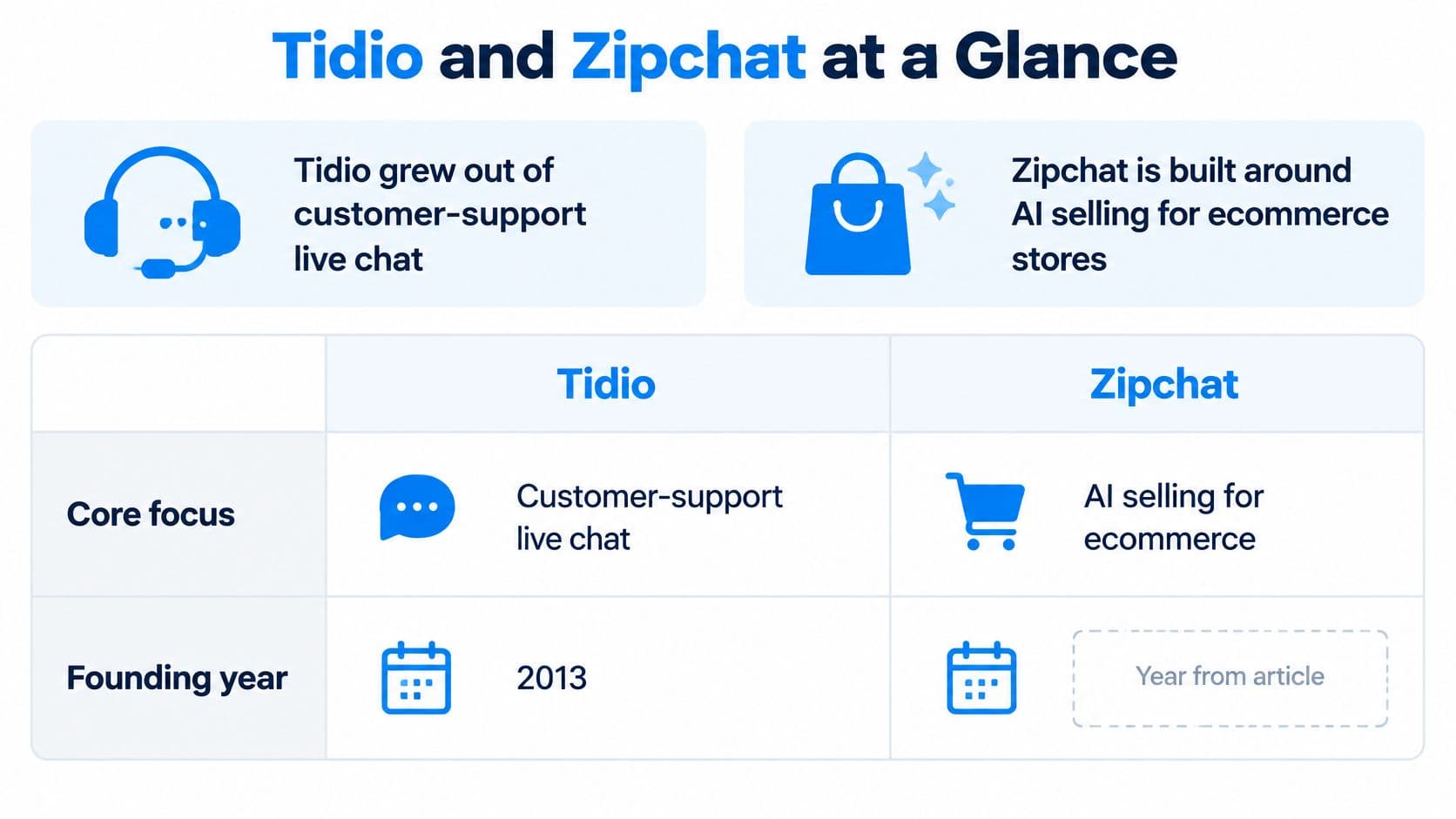
Tidio and Zipchat at a Glance
Tidio grew out of customer-support live chat, while Zipchat is built around AI selling for ecommerce stores. That distinction matters more than treating both products as interchangeable chat widgets.
Tidio and Zipchat side by side
| Criterion | Tidio | Zipchat |
|---|---|---|
| Founded | Founded in 2013 in Szczecin, Poland, according to Tidio company information | Founded in 2024, according to Zipchat's company statement |
| Publicly reported scale | More than 300,000 business customers and $25 million in Series B funding, in the company information linked above | Nearly $1 billion in gross merchandise value supported, a company claim in its statement linked above |
| Primary focus | Live chat and customer support with flows | AI sales agent for ecommerce stores |
| Free plan | Tidio's FAQ lists 50 conversations a month and up to 10 live-chat operators | Free-plan details aren't confirmed in the available official pricing information |
| AI billing unit | AI and human conversations billed separately, a distinction discussed by Software Advice's comparison | Commonly described as per AI reply in the same comparison |
| Shopify setup | Shopify integration with order actions inside the chat panel | Installation through Shopify App Embeds, followed by catalog training |
What the scale figures establish
The customer and funding figures describe Tidio's organizational footprint, not the quality of a particular product answer. Zipchat's gross merchandise value figure describes ecommerce activity supported by its technology, not independently established incremental sales.
These measures aren't directly comparable. A business customer count doesn't measure conversion performance, and supported merchandise value doesn't establish how much revenue the assistant caused.
The setup and billing rows identify different operating choices rather than a winner. Human order controls favor a support workflow, while catalog training fits a product-guidance workflow.
The cited materials don't provide independent conversion, response-time or containment benchmarks for either vendor. The comparison therefore describes positioning and documented capabilities, not measured performance.
What Each Plan Includes and Costs
Plan prices and included usage
| Plan | Price | Included usage |
|---|---|---|
| Tidio Free | Free, no credit card required, according to its FAQ | 50 conversations a month, up to 10 operators, flows for up to 100 unique monthly visitors, according to its FAQ |
| Tidio Starter | $24.17 per month, billed annually, on Tidio's official pricing page | 100 billable conversations |
| Tidio Growth | $49.17 per month, billed annually, on the same pricing page | 250 billable conversations |
| Tidio Plus and Premium | A comparable price isn't established by the available pricing-page details | Included usage isn't established by those details |
| Zipchat Starter | $80 per month billed monthly or $64 per month billed annually, on Zipchat's official pricing page | 750 replies, approximately 300 conversations, training on 1,000 pages |
| Zipchat Pro | $300 per month billed monthly, on the same pricing page | 3,000 replies, approximately 1,250 conversations, training on 75,000 pages |
| Zipchat other two plan levels | Prices aren't established by the available official pricing-page details | Included usage isn't established by those details |
The free-plan row comes from Tidio's FAQ rather than its pricing page. It shouldn't be treated as confirmation that the same allowance applies to every AI feature. Similarly, an unconfirmed Zipchat free allowance isn't evidence that no free option exists.
A conversation isn't a reply
Tidio's billable-conversation allowances and Zipchat's reply allowances shouldn't be compared as equivalent quantities. A merchant needs to establish which messages consume an allowance, whether a human handoff creates another charge, and whether automation has a separate meter.
Zipchat's approximate conversation counts are useful planning estimates, but the reply allowance is the firmer capacity constraint. A product comparison that needs clarification, an alternative recommendation and a shipping answer consumes more replies than a direct stock question.
Budgeting rule: Compare the allowance with complete shopper sessions, not just the opening question.
For example, consider a hypothetical store receiving 500 pre-purchase questions each month. At one reply per question, its hypothetical 500 replies would fit within the Starter reply allowance quoted on Zipchat's pricing page.
If each question instead requires three replies about size, shipping and alternatives, the hypothetical requirement becomes 1,500 replies. That exceeds Starter's included reply capacity and fits within Pro's allowance, although any available add-on route should also be checked before choosing a plan.
For Tidio, the same hypothetical question volume exceeds Growth's included conversation allowance if each question becomes a distinct billable conversation. Its official pricing information also describes increasing monthly conversation limits from 50 to 1,000, with AI and human conversations billed separately. The available details don't establish the resulting charge for that store.
What belongs in the actual quote
The subscription alone isn't a complete cost comparison. A merchant should record the required AI allowance, human-conversation allowance, flow usage, channel access and any additional charges separately.
A closer examination of Zipchat pricing can help organize the reply-based side of that worksheet. Every price, billing commitment and usage definition should still be rechecked on the relevant vendor's pricing page before purchase.
Shopify Workflows, Channels and Automation
A shopper asking for a refund creates a different operational requirement from a shopper comparing products. A fair comparison starts with whether staff must complete a transaction, retrieve information or guide a purchase.
Tidio's Shopify integration documentation describes agents viewing customer orders inside the chat panel and taking actions such as cancellations, refunds and shipping-address edits. Agents can also browse a product directory and send products through website chat or Messenger.
Its prebuilt Shopify flows cover delivery tracking, shipping zones and product availability. That supports a workflow in which merchants define the path and staff intervene when the conversation requires judgment.
Order controls versus product guidance
Zipchat's documented setup begins with enabling the app through Shopify App Embeds and training the assistant on catalog and business information. Its product-page approach centers on making product questions easier to ask and answer.
Zipchat's documentation describes an AI ecommerce agent on website chat and WhatsApp. Its Shopify listing also advertises Instagram and email, proactive greetings, product recommendations, upsells, cart recovery, order tracking, returns, refunds, discounts and stock checks.
These descriptions don't establish identical operational depth. A listing that includes refunds doesn't, by itself, demonstrate the same permissions, approval process or agent interface as an explicitly documented order-action panel.
Channels and automation features compared
| Capability | Tidio | Zipchat |
|---|---|---|
| Website live chat | Yes | Yes |
| Yes | Yes | |
| Yes | Yes, per Shopify listing | |
| Messenger | Yes | Unconfirmed in the cited documentation |
| Unconfirmed in the cited materials | Yes, per Shopify listing | |
| Video call | Built-in option | Unconfirmed |
| Multilingual support | Yes | Unconfirmed in the cited materials |
| Multiple Shopify stores | Yes | Unconfirmed |
| Automation builder | Node-based flows with triggers, conditions and actions | AI agent with proactive greetings |
| Flow statistics | Available per flow | Equivalent flow-level reporting is unconfirmed |
| Cart recovery | Supported through flows | Listed on Shopify listing |
| Order tracking, returns and refunds | Order visibility and agent actions inside the chat panel, including cancellations and refunds | Listed on Shopify listing |
“Unconfirmed” means the available documentation doesn't establish the capability. It doesn't mean the vendor cannot provide it.
What the channel rows mean operationally
Website chat and WhatsApp appear in both vendors' documented channel coverage. Instagram also appears for both, although Zipchat's coverage is identified through its Shopify listing. Channel presence is only the starting point for evaluation.
A merchant should check whether the selected plan supports the intended channel, whether conversation history follows the shopper and how an agent takes over. An assistant that answers storefront questions well may still require a different handoff process for social messages.
Tidio's documented Messenger support, video-call option and multilingual support may matter when staff already use those methods. Equivalent Zipchat coverage shouldn't be assumed without confirmation, particularly when a sales process depends on a specific channel.
Multiple-store handling deserves its own operational test. An agency should verify that staff can distinguish stores, apply the correct policies and avoid sending information from another client's catalog.
Controlled flows and autonomous selling
Tidio's node-based flows connect triggers to conditions and actions, with statistics available at the flow level. A merchant can inspect a delivery-question path or cart-abandonment flow and change the relevant branch.
Zipchat presents a broader autonomous sales-agent scope. That may suit product discovery, but the merchant still needs to verify how the assistant chooses recommendations, handles missing information and hands off exceptions.
For teams planning that division of labor, Grumspot's guide to chatbots for ecommerce support teams provides useful context for mapping automation around human support. The practical task is to specify which requests the assistant may finish and which require staff approval.
Before comparing subscriptions, the store should complete a workflow checklist:
- Order permissions: Verify what staff can view and change without leaving chat.
- Recommendation grounding: Check that suggested products satisfy the shopper's stated constraints.
- Policy exceptions: Test an ambiguous return request rather than only a straightforward policy lookup.
- Handoff continuity: Confirm that staff receive the shopper's question and the assistant's previous answers.
- Channel access: Confirm availability on the intended subscription rather than assuming every listed channel is included.
Neither feature coverage nor flow statistics establish independent latency or containment performance. Those outcomes require testing against the store's actual catalog, policies and support process.
Which Tool Fits Your Store and When to Look Elsewhere
Which tool fits which store
| Store profile | Better fit | Reason |
|---|---|---|
| Staff must cancel, refund or edit orders from chat | Tidio | Agents act on orders inside the chat panel |
| Stores running delivery, shipping zone or stock flows | Tidio | Prebuilt Shopify flows with flow statistics |
| Agencies running several Shopify stores | Tidio | Documented multi-store support |
| Product-page sellers wanting proactive guidance | Zipchat | Proactive greetings and product recommendations on its Shopify listing |
| Stores with long product-comparison chats | Test both | Reply-based billing can grow faster than conversation counts |
| Stores selling mainly through Instagram DMs | Test both | Both list Instagram, but Zipchat's Messenger coverage is unconfirmed |
The better fit depends on the task that remains unfinished without the tool. A support-heavy store should prioritize completing order work correctly, while a product-led store should prioritize helping shoppers make a defensible purchase decision.

Match the purchase to the unresolved task
Tidio is the stronger documented starting point when staff need transactional controls and repeatable support paths. Agencies should also weight its multi-store coverage because operating several stores is a different requirement from answering questions for a single catalog.
Zipchat merits a focused trial when product-page conversations are the main opportunity. The relevant question isn't whether it produces attractive recommendations, but whether those recommendations answer the shopper's constraints without unnecessary follow-up or incorrect claims.
Instagram-led stores should test the complete DM workflow. Messenger is a separate channel, so uncertainty about Messenger shouldn't be mistaken for uncertainty about Instagram.
Long product comparisons deserve particular attention regardless of the preferred vendor. A helpful conversation may legitimately require clarification, and a merchant shouldn't penalize useful follow-ups merely to minimize message usage.
When a shopping assistant belongs on the shortlist
If neither tool handles the store's sizing, compatibility, returns and alternative-product questions well enough, Carti is another option: an AI shopping assistant for Shopify with Free at 50 AI conversations a month, Starter at $49 for 250, Growth at $99 for 600 and Scale at $249 for 1,750, plus a 14-day free trial on paid plans. It can recommend products from the live catalog with real prices and stock shown in chat, add an add-to-cart button, offer cart-abandonment recovery in chat and escalate conversations to a human.
Those capabilities still need the same evaluation as the competitors. A feature's presence doesn't establish that a particular catalog, policy exception or shopper question will be handled correctly.
Merchants reviewing the broader app stack can also compare plugins for Shopify brands with Class A Media. The useful purchasing question is whether the new app closes an operational gap or duplicates work already handled elsewhere.
How to Run a Fair Test on Your Store
The test should produce comparable transcripts and billing records, not impressions from separate vendor demonstrations. A shared catalog and question set reduce the chance that different inputs explain the outcome.
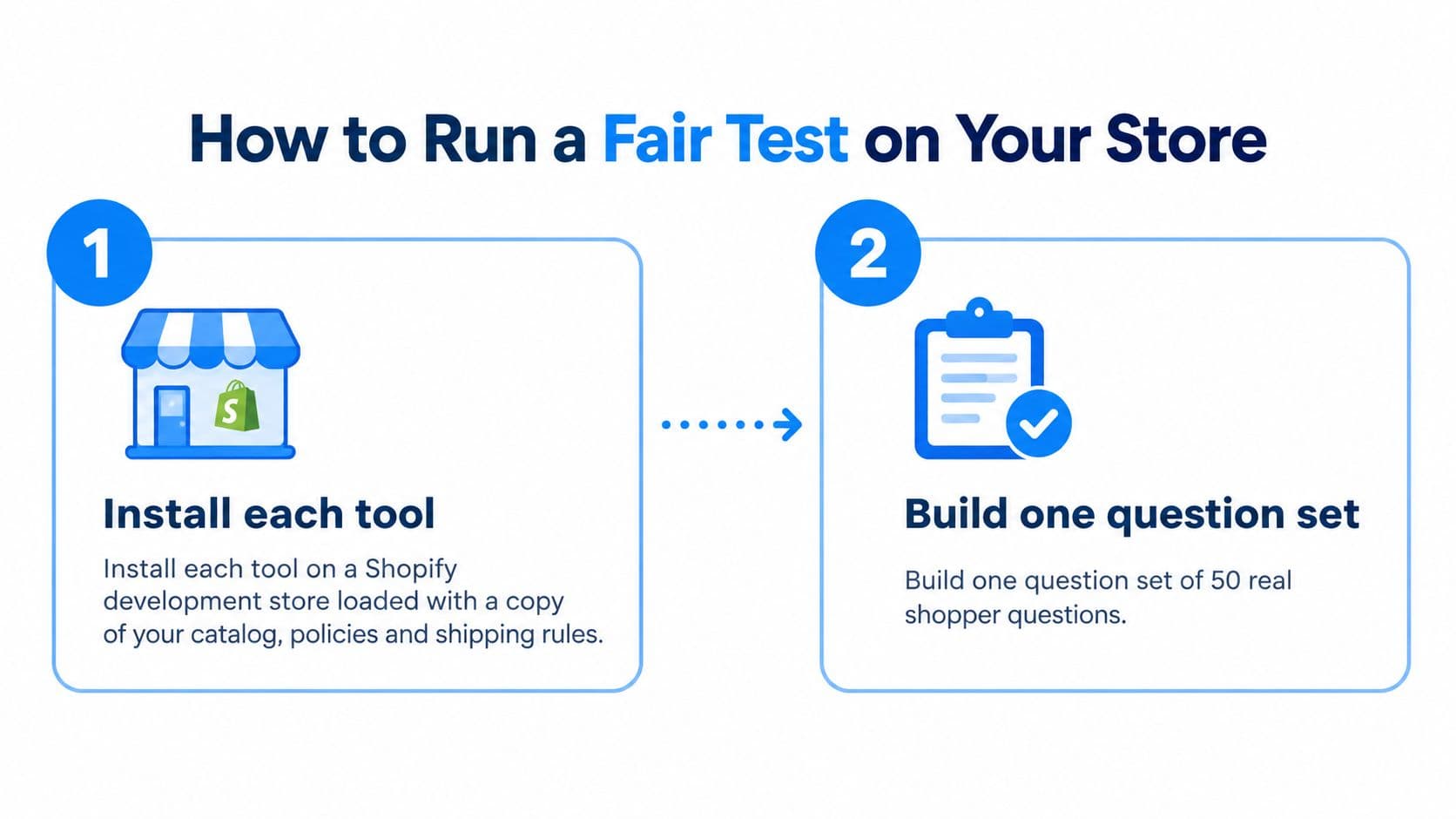
A repeatable evaluation routine
-
Install each tool on a Shopify development store. Load a copy of the same catalog, policies and shipping rules, with sensitive customer information removed. Equal source material makes answer differences easier to interpret.
-
Build a test set of 50 real shopper questions from the store's inbox. This is a proposed test size, not a performance benchmark. Include follow-ups about sizing, compatibility, shipping, returns and alternatives, along with cases where the catalog doesn't contain enough information.
-
Run the same questions in separate sessions. Record the full transcript and every billable unit, distinguishing Tidio conversations from Zipchat replies. Keep conversational context intact so follow-up handling remains part of the test.
-
Measure median and 95th-percentile response time, catalog-answer accuracy, escalation rate and assisted conversion rate. Time from the shopper's submission to a usable answer, and score correctness against a written answer key. Conversion measurement requires a controlled live pilot because scripted development-store sessions can't establish genuine purchasing behavior.
-
Calculate cost per resolved conversation. Divide total monthly billing by resolved pre-purchase conversations, using a documented definition of resolution. Include required subscriptions and usage charges, and keep human labor as a separate cost line if the merchant also wants an operational comparison.
-
Test an order action, such as a refund or shipping-address edit, using a safe test order. Record whether an agent can finish the task from chat and whether the intended staff role has the required permission.
-
Repeat during a peak week. Seasonal demand may change both question complexity and the appropriate allowance. Keep the scoring rules unchanged so the results remain comparable.
The common mistake is testing only greetings. That excludes the long, reply-heavy conversations most likely to expose billing differences, weak product reasoning and incomplete handoffs.
Define success before scoring
A resolved question should mean that the shopper received a correct, usable answer, not merely that the assistant stopped replying. Escalation should be judged separately because an appropriate handoff can be safer than an unsupported answer.
For purchase measurement, a consistent revenue-attribution method helps distinguish orders following a chat from revenue demonstrably caused by it. Both tools need the same attribution window and eligibility rules.
A correct refusal to guess can be more valuable than a confident answer that sends the shopper toward the wrong product.
The completed scorecard should contain measured results rather than vendor claims.
| Measure | Tidio | Zipchat |
|---|---|---|
| Response latency | Record median and p95 | Record median and p95 |
| Catalog-answer accuracy | Record scored correct answers | Record scored correct answers |
| Escalation rate | Record handoffs and reasons | Record handoffs and reasons |
| Assisted conversion rate | Record controlled-pilot result | Record controlled-pilot result |
| Cost per resolved conversation | Calculate from billing and resolutions | Calculate from billing and resolutions |
Choose the Winner and Set It Up
Pick Tidio when the test confirms that staff need order actions, structured delivery or stock flows, or multi-store operations, and the resulting cost per resolved conversation meets the store's target. Its operational fit matters only if the selected configuration also answers shopper questions accurately.
Pick Zipchat when product-page engagement and catalog guidance are the priority, and measured performance justifies the reply-based expense. The decision should include complete conversations rather than an estimate based only on first replies.
Decision rules for close results
When both tools meet the accuracy and escalation requirements, the less expensive configuration that handles the expected peak month is the practical choice. An annual commitment shouldn't be selected merely because its monthly equivalent looks lower before actual usage is understood.
If neither tool meets the required answer-quality threshold, a larger allowance won't fix the underlying problem. The shopping-assistant alternative should receive the same catalog test rather than an easier demonstration.
For merchants evaluating a move away from a support-oriented setup, the Tidio switching guide provides a relevant starting point. Any migration should preserve the policies, handoff rules and question coverage that worked during testing.
Put the tested configuration into production
- Preserve the inputs: Load the same catalog content, shipping rules and policies used in the successful test.
- Verify staff access: Check each role's order permissions and chat workflow before launch. Where a tool doesn't support an action in chat, document the external process.
- Own the handoff: Assign an escalation owner and review escalated conversations weekly.
- Watch allowance consumption: Compare monthly usage with the plan limit each week, especially after promotions begin.
- Reconcile the bill: Review the first full billing cycle and reassess the configuration before peak season.
A successful deployment needs both commercial and operational checks. A low bill isn't a win if shoppers receive incorrect recommendations, and strong answers aren't enough if staff cannot finish necessary order work.
The final purchasing action is to export the test transcripts, record each tool's cost per resolved pre-purchase conversation and subscribe to the winner only after checking its current official pricing.
An AI shopping assistant can be a relevant alternative when product guidance matters more than order administration. Merchants can visit Carti to assess its Shopify shopping-assistant plans against the same question set, resolution criteria and monthly volume used for Tidio and Zipchat.

Written by
Daniel AndersonFounder of Carti. 10+ years building ecommerce brands in apparel and supplements. Still runs a Shopify store and built Carti to help merchants convert more browsers into buyers.