
You're probably in one of two places right now. Your Shopify store has an NPS program, but the score sits in the middle and nobody agrees on what to do with it. Or you're collecting feedback inconsistently, skimming comments in a spreadsheet, and calling it a customer insight process.
That's where many organizations get stuck. They treat NPS like a reporting metric when it should function like an operating system for customer experience. If the score drops after support interactions, your support flow is the problem. If first-time buyers score lower than repeat customers, your onboarding and post-purchase journey are the problem. The score itself isn't the work. The work is fixing the friction behind it.
For Shopify brands, that friction usually lives in familiar places: vague shipping timelines, confusing return rules, product pages that answer half the question, and chat experiences that respond fast but don't resolve anything. If you want to learn how to improve NPS scores, stop asking how to get more promoters and start asking where customers are losing confidence.
Why NPS Is a Growth Engine Not Just a Number
A mediocre NPS score creates a specific kind of confusion. The dashboard tells you something is off, but it doesn't tell you whether the problem is delayed shipping updates, poor support handoffs, product expectation gaps, or a returns policy that reads like legal copy. Teams often respond by trying to improve the survey itself instead of improving the customer experience.
That's the wrong move.
NPS matters because it connects to commercial outcomes, not because it looks good in a quarterly deck. CustomerGauge reports that a 10-point increase in NPS correlates with a 3.2% increase in revenue growth, which is why experienced teams treat it as a leading indicator rather than a vanity metric, as summarized in these NPS statistics.
For e-commerce brands, that link is practical. Customers don't score you based on abstract brand love. They score you based on whether they got what they expected, whether support solved the issue, and whether buying again feels safe and easy.
Practical rule: If your NPS program doesn't change operations, it won't change the score for long.
On Shopify, the biggest NPS gains usually come from tightening a few high-friction moments:
- Onboarding after first purchase: Order confirmation, delivery expectations, and post-purchase education shape confidence fast.
- Support resolution quality: A quick response that misses the actual issue often creates more frustration than a slightly slower, accurate answer.
- Repurchase readiness: Saved preferences, clean reorder paths, and consistent service quality turn a one-time buyer into a repeat customer.
There's also a measurement discipline behind this. NPS uses the standard question, “How likely are you to recommend us?” and the score is calculated as the percentage of promoters minus the percentage of detractors. That sounds simple, but small shifts in response mix can signal meaningful movement across a large customer base, especially when those shifts map to retention, conversion, and revenue.
The teams that get real value from NPS don't obsess over the headline score alone. They use it to locate avoidable friction, assign owners, and make the next customer journey better than the last one.
Laying the Foundation Asking the Right Questions
Bad survey design creates fake clarity. You'll still get a score, but the score won't tell you what to fix.
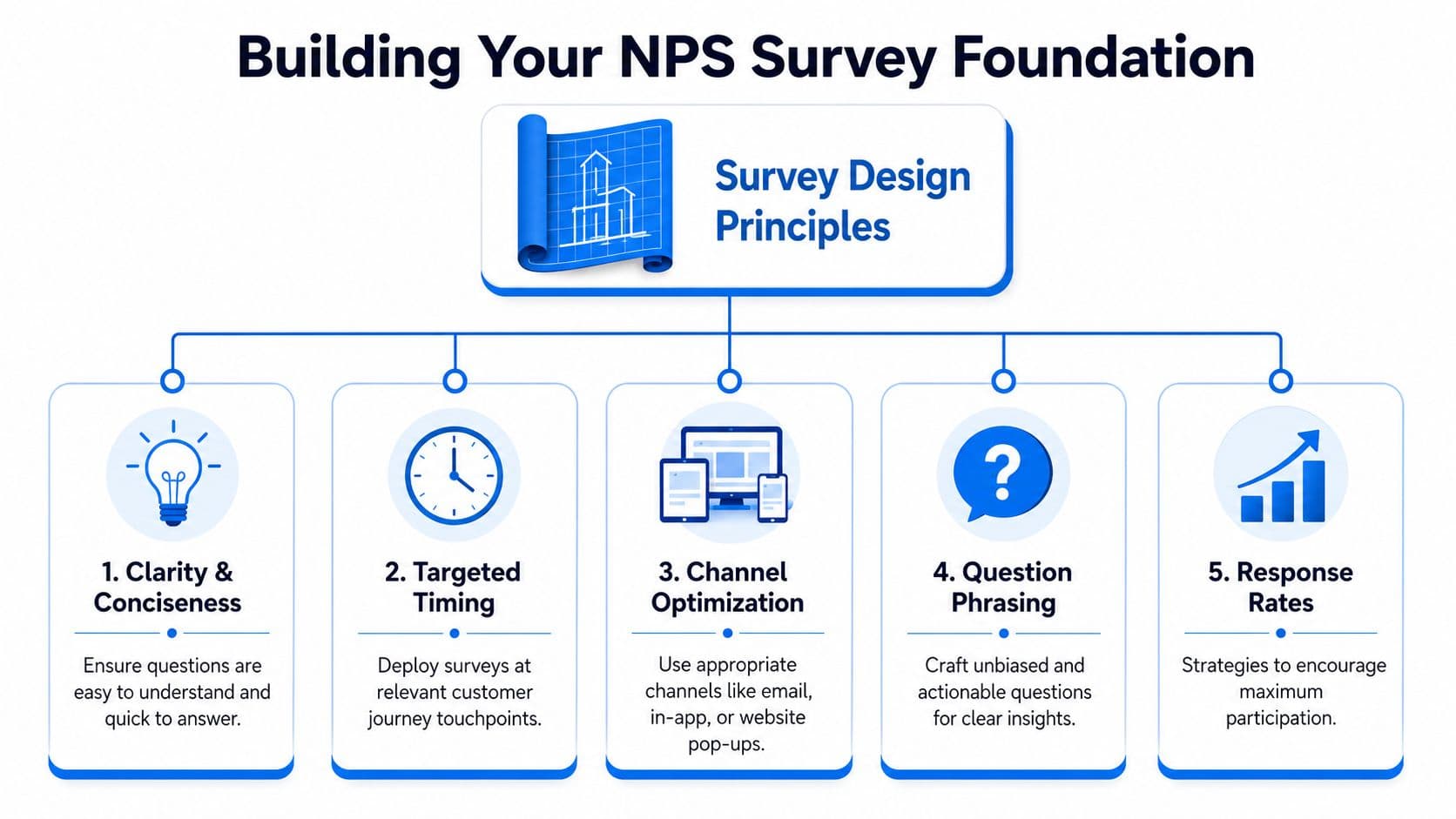
For Shopify brands, the foundation is simple. Ask for feedback at moments customers can evaluate, keep the survey short, and always collect the reason behind the rating. If you're trying to learn how to improve NPS scores, the quality of the program is won or lost with these fundamental practices.
Separate relationship and transactional surveys
Not every survey should ask the same thing at the same time.
A relationship survey measures overall brand loyalty. This is the one you send on a regular cadence to understand how customers feel about the business as a whole. CustomerGauge says relationship surveys run on a regular quarterly cadence can produce a 5.2% increase in retention, and it also reports that surveys sent on Thursdays and Fridays tend to see response-rate gains of about 3%, as explained in its guidance on how to improve NPS.
A transactional survey measures a specific touchpoint. For e-commerce, that matters more than most brands realize because customer sentiment often changes at very specific moments. The same CustomerGauge guidance recommends sending an NPS survey 10 minutes after a phone resolution or about a week after an eCommerce transaction.
That timing makes sense on Shopify. A customer can't fairly rate the buying experience right after checkout if the actual friction shows up during fulfillment, delivery, or returns.
Ask one score question and one driver question
The score tells you severity. The follow-up tells you cause.
Keep the main question standardized. Then ask a short, open-ended driver question such as: what's the main reason for your score? That second question does the heavy lifting. Without it, you're left guessing whether a detractor was angry about sizing, slow support, misleading product photos, or a promo code that failed at checkout.
If you want examples that stay practical rather than academic, it's worth taking a minute to explore Formbricks' NPS questions. It's a useful reference for wording follow-ups that produce actionable answers instead of vague compliments or complaints.
Customers rarely say, “your cross-functional handoff failed.” They say, “support told me one thing and the tracking page said another.”
That's the level you want your survey to capture.
Get the mechanics right before you trust the data
Survey timing and question design matter, but so does channel fit. Email works well for post-purchase feedback. Onsite or in-app prompts can work for active customers. Post-support outreach should happen in the same channel family the customer just used, when possible, so the experience feels connected rather than random.
A few operating rules help:
- Match the survey to the journey: Don't ask a broad brand question right after a support ticket. Ask about the interaction they just had.
- Avoid bloated forms: If the survey feels like work, response quality drops even when response volume looks acceptable.
- Check for bias in who replies: If only loyal customers answer, your score will flatter you. If only angry customers answer, it will mislead you in the opposite direction.
- Use adjacent metrics for context: If you're also tracking satisfaction after support, this guide to what a CSAT score is helps clarify when to use CSAT versus NPS.
Strong NPS data starts with discipline, not tooling. The store that asks at the right moment with the right follow-up will beat the store running prettier surveys every time.
From Raw Scores to Root Causes Analyzing Feedback
Once responses start coming in, many teams make the same mistake. They calculate the score, read a few comments, and move on.
That leaves the most valuable part of the process untouched. The essential work is finding patterns that point to fixable operational issues.
Segment before you summarize
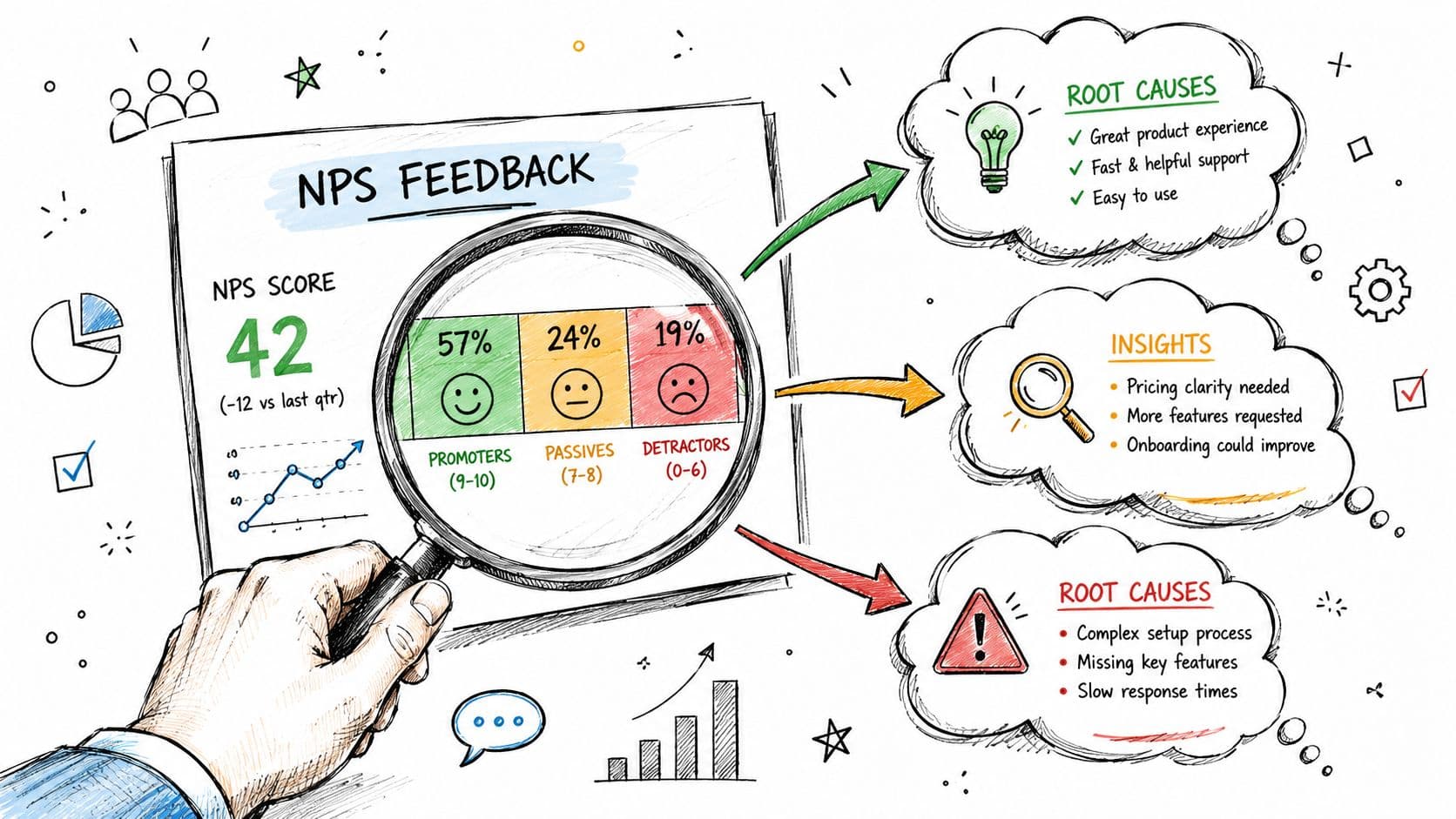
Start with score bands. Promoters, passives, and detractors behave differently, so they shouldn't be analyzed as one blended audience. But don't stop there. Segment by customer type, because aggregate NPS often hides where the damage really sits.
For a Shopify brand, useful cuts usually include:
- First-time buyers versus repeat customers
- High-AOV customers versus low-AOV customers
- Customers who contacted support versus those who didn't
- Buyers by product category
- Customers by fulfillment region
- Subscribers versus one-time purchasers
A blended score can look stable while a critical cohort gets worse. I've seen stores with decent overall sentiment but terrible feedback from first-time buyers. That's not a survey issue. It usually means the promise on the product page doesn't match the reality after purchase.
Turn comments into usable themes
The open-ended response is where root causes appear. You need a tagging system that lets you group comments by issue, not just by emotion.
For smaller stores, manual tagging works fine. Read every response and assign one primary theme, plus a secondary theme if needed. For larger stores, use AI-assisted theme detection to speed up categorization, but still review edge cases manually. Automation is great at surfacing repeated language. It's weaker at interpreting context, especially when customers mix praise and frustration in the same comment.
A practical tagging model for Shopify looks like this:
| Theme | Examples of customer language | Typical owner |
|---|---|---|
| Shipping clarity | “I didn't know it would take this long” | Operations or CX |
| Product expectation | “It looked different online” | Merchandising |
| Support quality | “I got a fast reply but no answer” | CX leadership |
| Returns friction | “The policy was confusing” | CX and operations |
| Site usability | “I couldn't find sizing info” | E-commerce team |
A useful tag is specific enough to act on. “Bad experience” is not a tag. “Sizing chart missing on mobile PDP” is a tag.
Prioritize what customers felt and where it happened
Once themes are tagged, combine two lenses. First, look at frequency. Second, look at where in the journey the issue occurred. The strongest NPS analysis tells you not just what people disliked, but exactly where trust broke.
That usually produces a shortlist like this:
-
Pre-purchase confusion
Customers can't find shipping thresholds, material details, compatibility info, or return terms. -
Post-purchase anxiety
Order updates are thin, delivery expectations are fuzzy, or customers don't know what happens next. -
Support breakdowns
The team answers quickly but inconsistently, or customers repeat themselves across channels. -
Product mismatch
The item is fine, but the page sold the wrong expectation.
When you do this well, the spreadsheet stops being a feedback archive and starts becoming an action queue. That's the shift most brands never make. They collect comments as evidence. Strong teams use comments as instructions.
Closing the Loop How to Turn Detractors into Fans
Most NPS programs fail here. They gather feedback, maybe review themes in a monthly meeting, and never reconnect the comment to a real customer or a real fix.
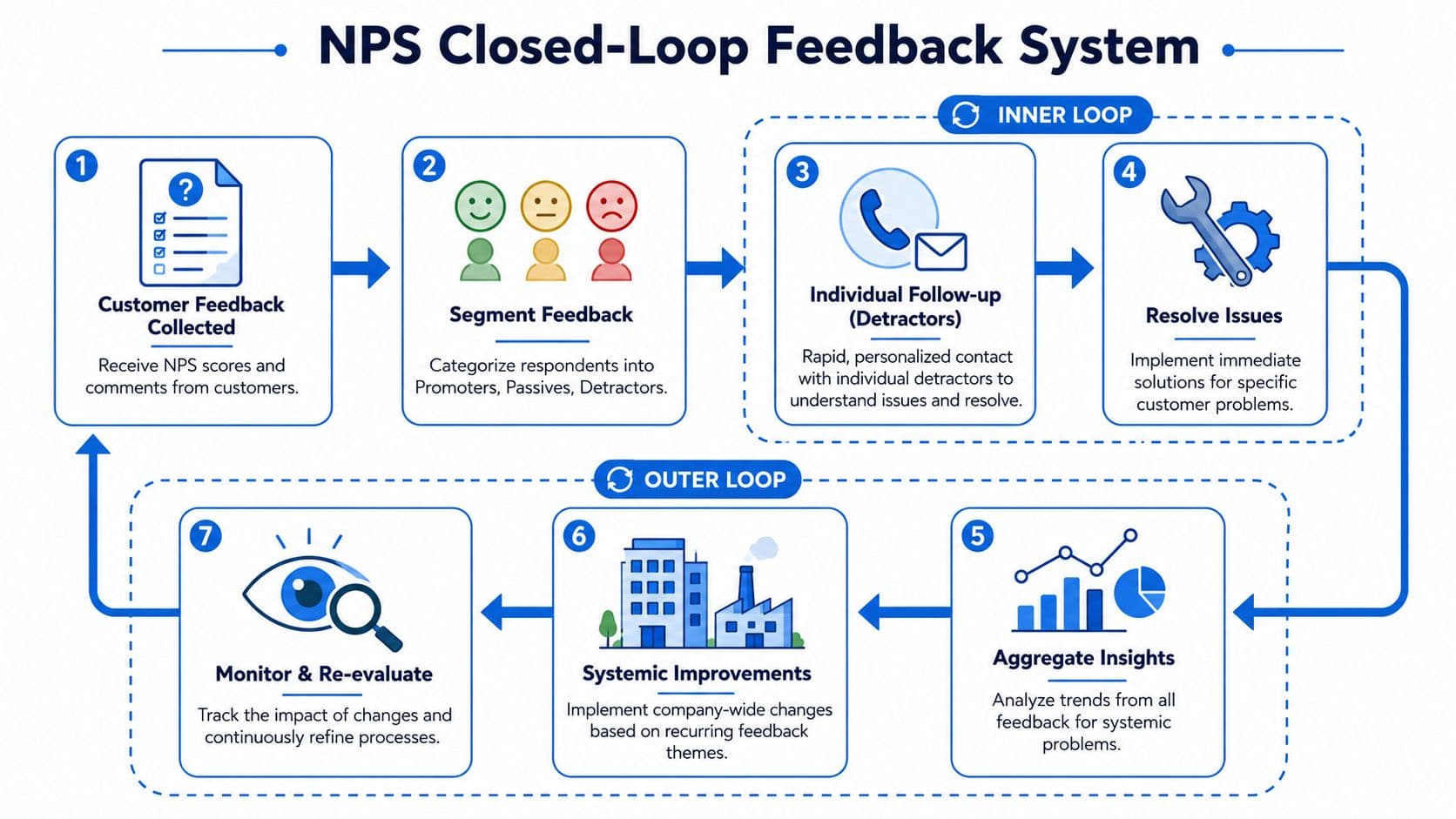
A stronger model is a closed-loop Voice of Customer program. Industry guidance recommends combining a short score survey with a follow-up open-ended driver question, then routing detractors into immediate recovery workflows, as outlined in this piece on improving NPS through a closed-loop VoC program.
That sounds formal, but the idea is practical. Someone gives you a low score. You respond quickly, understand what failed, solve what you can, and log the pattern so the business can stop repeating it.
Build an inner loop that moves fast
The inner loop is individual recovery. Your CX team follows up directly with detractors and passives who show signs of risk.
For Shopify brands, the best inner-loop follow-up usually includes:
- A named owner: One person on CX owns the response and the resolution.
- Context before contact: Review the order, support history, fulfillment notes, and any chatbot transcript before reaching out.
- A direct message: Acknowledge the issue, summarize what you understand, and offer a next step.
- A clear resolution path: Refund, replacement, clarification, escalation, or operational correction.
Conversation history is critical. If a customer already had a failed chatbot exchange, a generic “sorry you had a bad experience” email will make things worse. The rep needs to know whether the issue was a wrong policy answer, a dead-end chat flow, or a broken handoff to human support.
A documented customer service workflow helps here because detractor recovery falls apart when ownership is fuzzy.
Use the outer loop to fix what keeps repeating
The outer loop is the system layer. It takes repeated complaints and converts them into business changes.
If detractors keep mentioning “I didn't know it was final sale,” the answer isn't better apology copy. It's changing how final-sale language appears on product pages, cart, checkout, and confirmation emails. If customers keep saying support was fast but unhelpful, the answer isn't a tighter SLA alone. It's better knowledge sources, agent guidance, and escalation logic.
At this stage, NPS becomes operational discipline instead of a reporting exercise.
Here's a simple way to run the outer loop each week:
| Repeating theme | Operational fix | Likely owner |
|---|---|---|
| Shipping expectations unclear | Rewrite delivery messaging across PDP, cart, and post-purchase emails | E-commerce and operations |
| Product details incomplete | Add fit, materials, usage, or compatibility details to PDPs | Merchandising |
| Chat answers inconsistent | Update knowledge sources and escalation rules | CX and systems |
| Returns feel painful | Simplify policy language and return steps | CX and operations |
A score only improves sustainably when the outer loop reduces the reasons people become detractors in the first place.
A simple detractor recovery playbook
Follow-up is often overcomplicated. The message should be personal, brief, and useful.
A good structure looks like this:
-
Acknowledge the issue
“Thanks for the honest feedback. I reviewed your order and support history, and I can see why this was frustrating.” -
Reflect the root problem
“You expected a clearer delivery timeline, and our updates didn't give you that.” -
Offer a concrete next step
“I've escalated this shipment review and I'm sending you a direct update as soon as I have it.” -
Close the loop visibly
If the issue exposed a broader flaw, tell the customer what changed.
Later in the section, it helps to reinforce what good follow-up looks like in practice:
Don't argue with detractors. Diagnose, resolve, and learn.
That's how low scores stop being a morale hit and start becoming a repair mechanism.
Proactive Improvements Using CX Insights to Lift Your Score
The fastest way to drag down NPS is to let the same preventable questions hit support every day. Customers ask where their order is, whether an item fits true to size, whether a return is free, or whether a product works with something they already own. If your store makes them ask, your CX operation is already behind.
The better move is proactive improvement. Use what customers keep asking to redesign the journey before the next complaint happens.
Fix the pre-purchase experience first
A lot of NPS damage starts before the order is even placed. Customers don't always complain in the moment. They click through uncertainty, hope for the best, and score you later when the gap shows up.
For Shopify stores, pre-purchase fixes usually live in these places:
- Product pages: Add sizing guidance, materials, dimensions, compatibility notes, care instructions, and delivery expectations where shoppers look.
- Policy visibility: Put shipping and returns language near the buy decision, not buried in the footer.
- Cart and checkout messaging: Reinforce timelines, threshold rules, and exclusions before payment.
- Post-purchase flows: Use confirmation and tracking messages to reduce anxiety instead of repeating generic order text.
A useful mental model is simple. Every repeated support question points to content that should have existed earlier.
Use AI carefully or it will hurt trust
A lot of merchants assume faster support automatically improves sentiment. It doesn't. Fast wrong answers create a specific kind of frustration because they waste the customer's time while sounding confident.
That trade-off matters more now because service expectations are rising. As discussed in guidance on improving NPS in an AI-driven support environment, the gain often comes less from raw speed alone and more from resolving the right issue. For Shopify merchants, AI chat improves NPS only when it has accurate catalog and policy knowledge plus clear escalation paths. Otherwise, faster but incorrect answers can raise frustration.
That means your AI setup needs guardrails:
- Ground it in real store knowledge: Product data, policies, FAQs, and shipping rules must be current.
- Escalate cleanly: If confidence is low or the issue is sensitive, move to a human.
- Preserve context: Customers shouldn't have to repeat order details or problem history.
- Follow up after handoff: Resolution quality matters more than response novelty.
If you want a broader companion read on the same operating principle, Halo AI's guide to enhancing customer satisfaction is useful because it complements NPS work with service-quality thinking.
Turn recurring contacts into permanent fixes
The best use of AI in CX isn't just answering questions. It's revealing where the business keeps creating them.
If chat logs show constant questions about shipment timing, your delivery messaging is weak. If customers keep asking whether two products are compatible, your merchandising content is incomplete. If return-policy questions spike after a campaign, your offer terms likely weren't clear enough in the funnel.
That creates a loop worth building into your weekly operating rhythm:
- Review top support themes from chat, email, and survey comments
- Map each theme to the exact touchpoint
- Decide whether the right fix is content, policy, workflow, or training
- Update the store and support playbooks
- Watch whether the complaint volume and sentiment shift
Better NPS usually comes from fewer avoidable contacts, not prettier survey reporting.
This is the part many teams miss. They treat support as a cleanup function. High-performing e-commerce brands use support insight to improve merchandising, policy communication, and post-purchase trust. That's how NPS starts moving for the right reasons.
Tracking and Iterating The KPIs That Drive NPS Improvement
If you only track the NPS number, you'll always be reacting late. The score tells you what customers felt after the experience. To manage improvement well, you need a short list of operating metrics that influence that experience before the next survey goes out.
That's especially important on Shopify, where the biggest NPS swings often come from execution details across service, merchandising, and fulfillment. Teams that improve steadily usually review NPS alongside a balanced set of leading and lagging indicators.
Use a practical scorecard
Here's a simple framework to keep the team focused on actions, not just outcomes.
| Metric Type | KPI | Why It Matters |
|---|---|---|
| Leading | First response time | Shows how quickly customers get initial acknowledgment |
| Leading | Resolution quality | Reflects whether the issue was actually solved, not just answered |
| Leading | Chatbot containment with safe escalation | Helps measure whether automation resolves simple issues without trapping complex ones |
| Leading | Product page clarity gaps | Surfaces whether merchandising content is preventing pre-purchase confusion |
| Leading | Returns workflow friction | Exposes whether policy and process create avoidable dissatisfaction |
| Lagging | Repeat purchase rate | Indicates whether customers come back after the first experience |
| Lagging | Customer lifetime value | Shows whether better experience translates into deeper customer relationships |
| Lagging | Churn or subscription cancellation patterns | Highlights where dissatisfaction turns into revenue loss |
| Lagging | Refund and complaint patterns | Reveals recurring failure points after purchase |
This is the lens that keeps NPS grounded. If your score improves but your service quality stays inconsistent, the number won't hold. If your score is flat while response quality, policy clarity, and repurchase behavior improve, you're probably fixing the right things and the survey will catch up.
Review trends, not isolated wins
Don't celebrate one good survey batch and call it progress. Look for trend movement by cohort, by touchpoint, and by issue category. A first-time buyer segment getting steadily less negative is often more important than a small overall score bump.
For teams that want a wider performance lens, this roundup of e-commerce key performance indicators is a useful companion. It helps connect CX metrics to the broader commercial picture.
The discipline is straightforward. Track the score. Track the drivers behind the score. Then keep fixing the parts of the customer journey that create hesitation, repeat contacts, and broken trust.
If your Shopify store needs a faster way to answer questions, reduce avoidable support friction, and uncover the issues dragging down customer sentiment, Carti is worth a look. It gives merchants an AI-powered storefront assistant that can handle product and policy questions, support proactive buying journeys, and surface the recurring themes your team should fix next.

Written by
Daniel AndersonFounder of Carti. 10+ years building ecommerce brands in apparel and supplements. Still runs a Shopify store and built Carti to help merchants convert more browsers into buyers.
Ready to boost your store's sales?
Install Carti in 5 minutes and let AI handle customer questions, recommend products, and close sales 24/7.
Start Free Trial14-day free trial