
A 5% increase in customer retention can raise profits by 25% to 95%, according to a widely cited benchmark set summarized by Rivo. That should change how most Shopify brands think about growth.
Too many stores chase more traffic, more first orders, and more campaigns, while ignoring the customers they already paid to acquire. That's backwards. Existing customers are also reported to spend 67% more than new customers in that same benchmark set, which is why profitable brands spend less time asking, “How do we get one more click?” and more time asking, “How do we earn the second, third, and fourth order without crushing margin?”
That second question matters more now because repeat purchase on its own isn't enough. If you train customers to wait for the next coupon, you may lift repeat rate while weakening the business underneath it. The better target is profit-adjusted CLV. Not just more orders, but better orders, healthier retention, stronger service, and smarter timing.
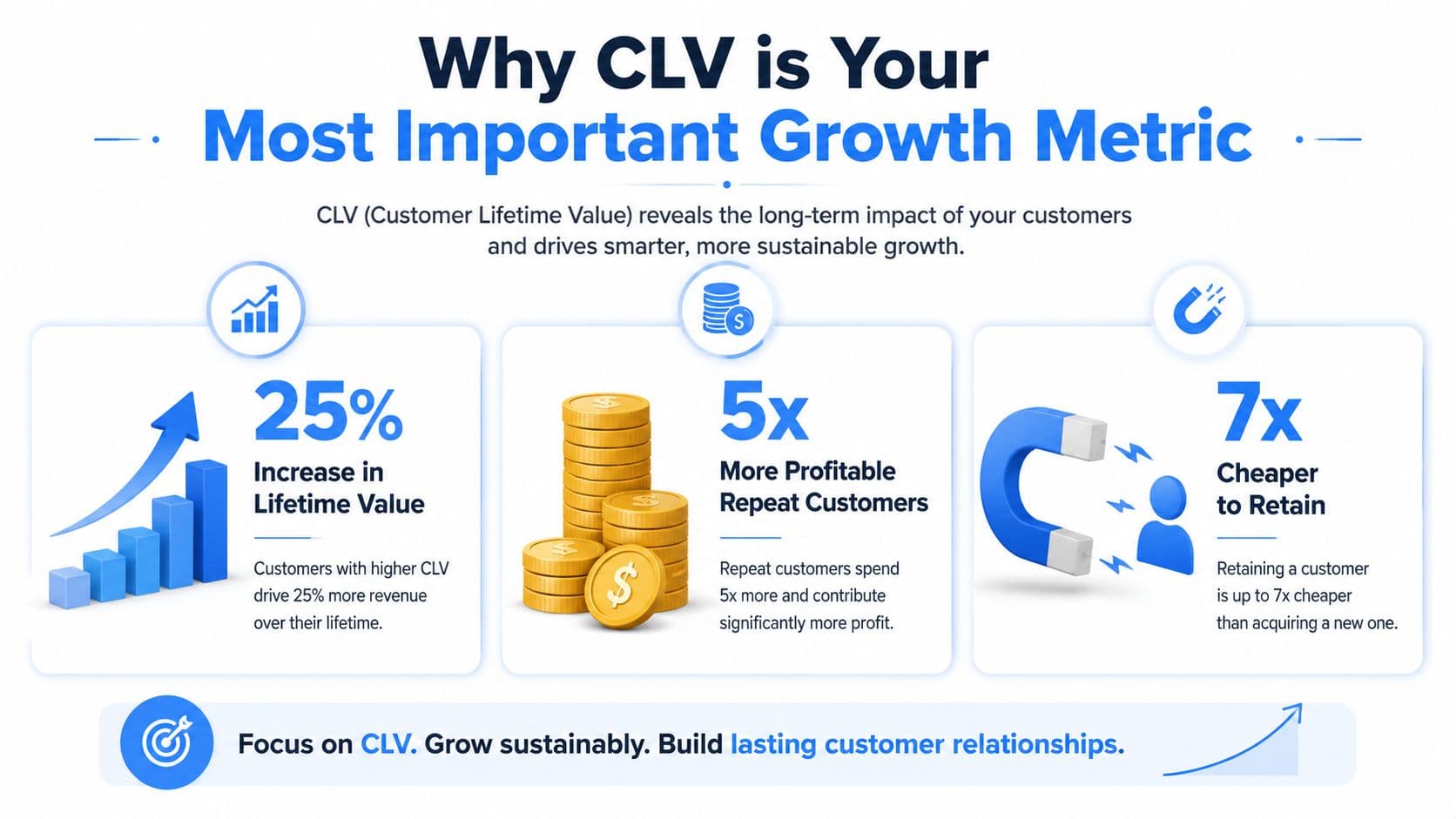
Why CLV Is Your Most Important Growth Metric
A 5% increase in customer retention can raise profits by 25% to 95%. That range gets attention, but the operating lesson is simpler. Stores usually grow faster and more profitably when they improve what happens after the first purchase instead of paying more every month to replace one-time buyers.
Customer lifetime value is the metric that keeps that work honest. It shows whether your acquisition, merchandising, support, and post-purchase experience are creating customers who come back at healthy margins, or just generating first orders that need another discount to happen.
Why retention beats brute-force acquisition
Many Shopify brands ask how to grow CLV and jump straight to points programs, coupon sequences, or VIP tiers. That approach often lifts repeat order rate while also hurting contribution margin. A better question is which systems get a second and third purchase without training customers to wait for a deal.
That is why retention usually outperforms brute-force acquisition as a growth priority. Existing customers already know your product, your shipping speed, and your service quality. If those experiences are strong, bringing them back costs less than winning a cold prospect from scratch.
If you want a practical companion perspective, this guide on how to increase customer lifetime value is worth reading because it frames CLV as a growth discipline rather than a reporting afterthought.
A store can survive weak first-purchase efficiency for a period. It rarely stays healthy with poor repeat behavior, post-purchase confusion, and no reliable way to bring customers back near full price.
Practical rule: If a customer buys once and disappears, acquisition did its job. Retention did not.
Profit-adjusted CLV is the metric that matters
Revenue-only CLV can hide bad decisions. Repeat orders look good in a dashboard even when they came from broad discounts, expensive remarketing, or support issues that forced appeasement offers. The customer came back, but the order may not have added much profit.
Profit-adjusted CLV gives a cleaner view. It asks whether the customer relationship gets stronger over time without constant margin giveaways. For most Shopify stores, that means looking at repeat purchase behavior alongside order mix, return rate, support load, and discount dependence. Merchants who want a tighter scorecard should review these e-commerce key performance indicators and decide which ones reflect durable customer value.
This is also where automation earns its place. Carti can help a store increase CLV by showing relevant cross-sells, guiding shoppers to higher-value product combinations, and reducing abandoned revenue opportunities without defaulting to blanket discounts. The goal is not more offers. The goal is better-timed offers and fewer preventable drop-offs.
In practice, the highest-quality CLV gains often come from ordinary operational fixes:
- Reducing avoidable churn: Fix delivery confusion, product mismatch, and missing post-purchase guidance.
- Improving support quality: Fast, accurate answers remove hesitation before the second order.
- Using smarter offers: Upsells, cross-sells, and bundles should raise order value without eroding trust or margin.
The value of CLV is that it forces discipline. It pushes every growth decision back to one question. Did this create a more profitable customer, or just a temporary sale?
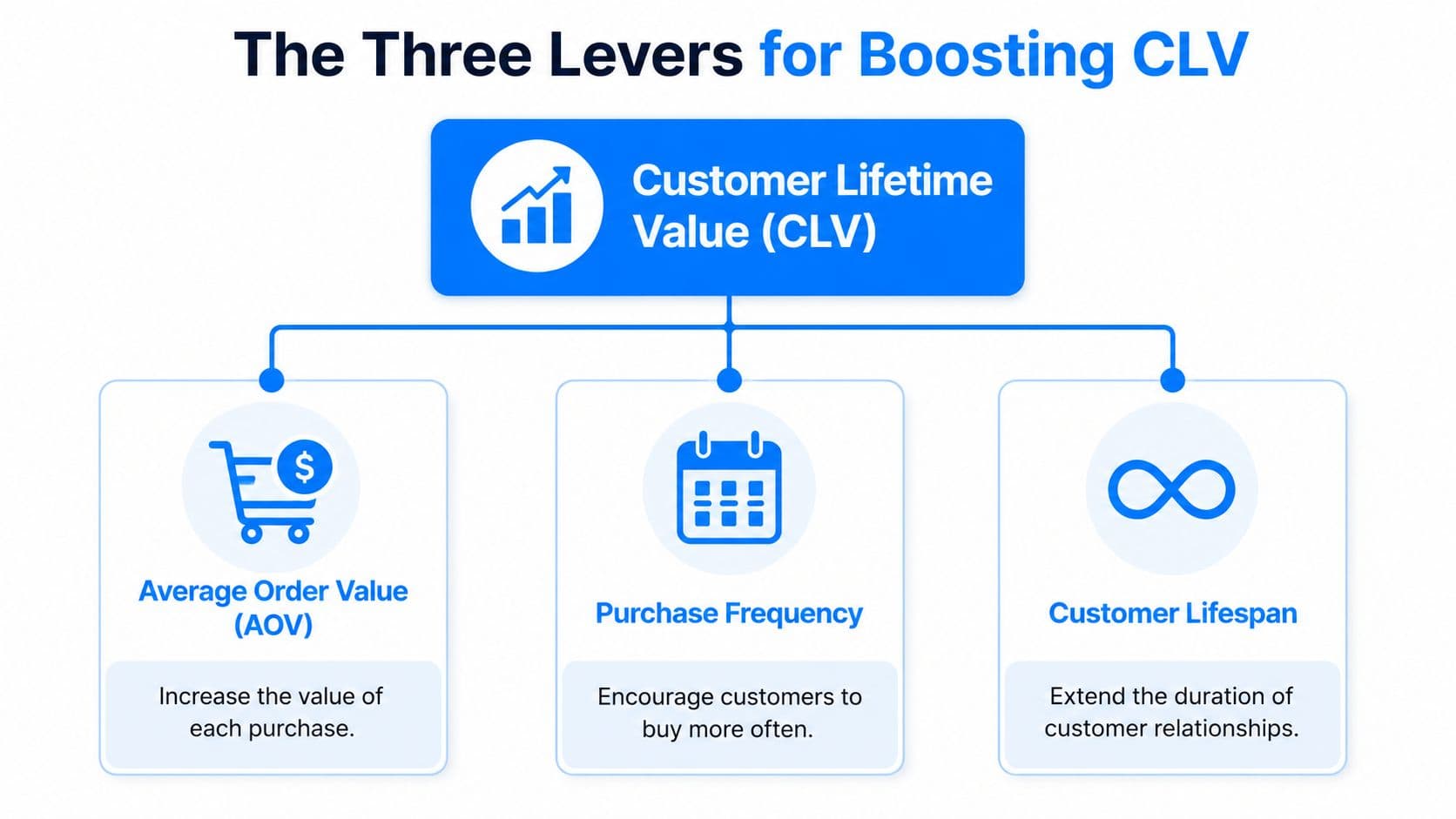
The Three Levers for Boosting CLV on Shopify
Customer lifetime value has long been treated as a core CRM metric because it connects customer relationships to long-term revenue, and current guidance consistently frames it around average order value, purchase frequency, and customer lifespan, as explained in Monday.com's CLV overview. That framing is useful because it turns an abstract target into three levers a Shopify merchant can pull.
Average order value
Average order value asks a simple question. When a customer buys, how much do they buy in that session?
The easiest mistake is forcing this lever with irrelevant upsells. If someone adds a cleanser, showing them an unrelated high-ticket accessory usually creates friction, not lift. Better options include:
- Bundles with logic: Pair products that naturally go together.
- Threshold incentives: Free shipping or gifts should encourage a sensible basket, not an awkward one.
- Variant guidance: Help the shopper choose the larger size, the refill pack, or the routine set when it fits intent.
AOV usually rises when the store reduces uncertainty. Clear recommendations outperform aggressive selling.
Purchase frequency
Purchase frequency is about shortening the time between orders. On Shopify, this often comes down to timing and relevance more than promotion.
For consumables, replenishment reminders work best when they're tied to likely usage windows. For apparel, frequency often improves when you launch new arrivals to the right past buyers instead of blasting the whole list. For home and wellness, educational content and use-case follow-ups often bring people back more effectively than generic “we miss you” emails.
The fastest repeat purchase strategies don't feel like marketing. They feel like good memory and good timing.
Customer lifespan
Customer lifespan is the hardest lever because it reflects everything the brand does after the excitement of the first order fades. Service quality, product reliability, message relevance, return handling, and trust all shape whether the relationship lasts.
A simple way to think about it is this:
| Lever | Core question | Strong Shopify example |
|---|---|---|
| AOV | How do we make each order more valuable? | Bundles, routines, better product pairing |
| Purchase frequency | How do we bring customers back sooner? | Replenishment prompts, launch targeting, use reminders |
| Customer lifespan | How do we keep the relationship going longer? | Win-back flows, proactive support, better onboarding |
Segmentation makes these levers sharper. High-value cohorts deserve more attention than one-size-fits-all campaigns. If you're also evaluating infrastructure choices for more complex commerce operations, this B2B eCommerce platform decision guide gives useful context on platform considerations that affect retention workflows and customer experience.
Perfecting the Post-Purchase and Onboarding Experience
Most merchants underrate what happens in the hours after checkout. That's often where a one-time buyer decides whether your brand feels dependable or disposable.
The customer has already taken the risk. They paid. Now they're watching for signals. Was the confirmation clear? Do shipping updates make sense? Does the product arrive with guidance that removes doubt? If the answer is yes, the path to a second order gets much easier.
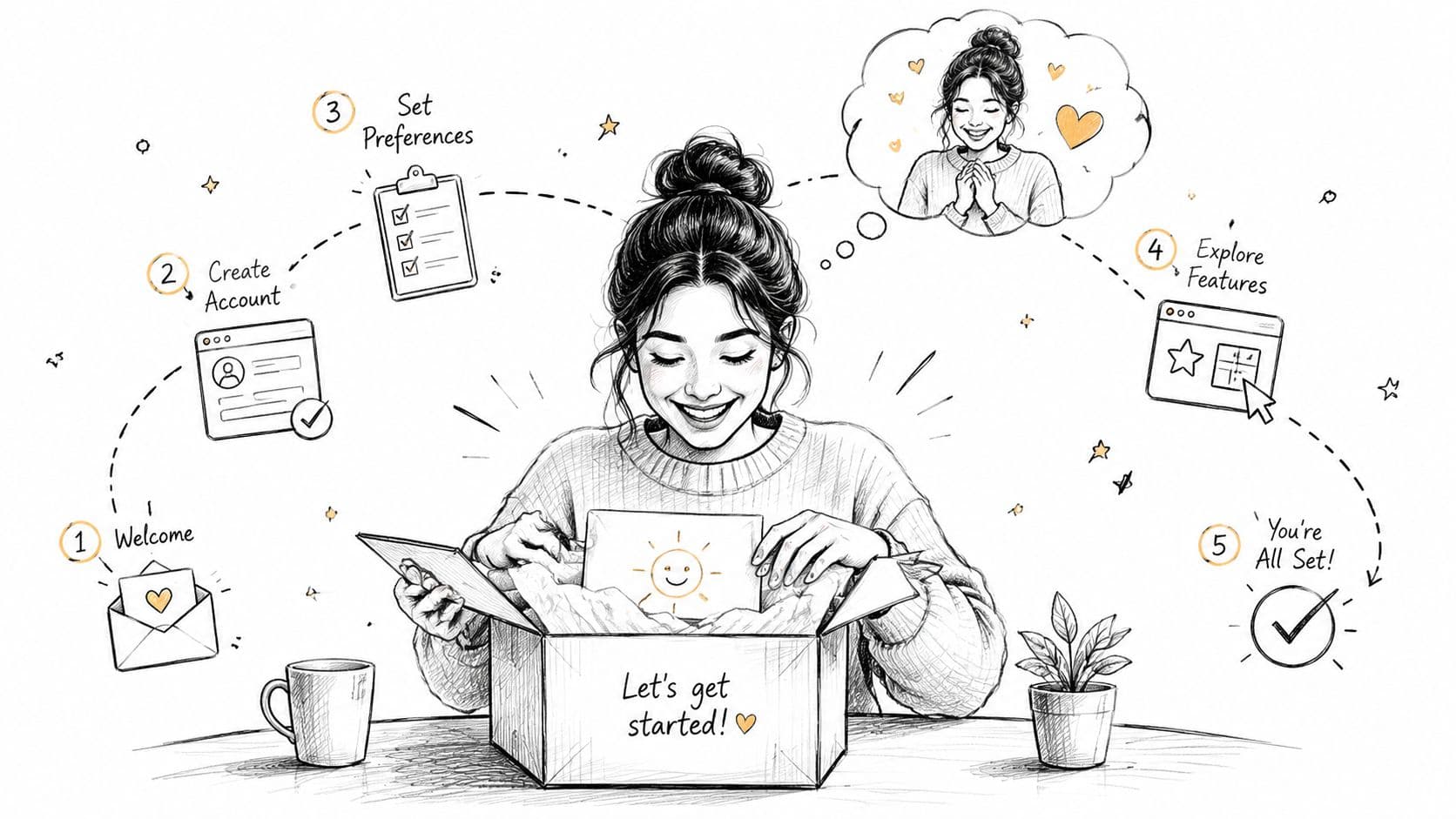
The first order is the start of the real sale
A customer buys a skincare product for the first time. The order confirmation arrives instantly, but it doesn't stop at a receipt. It confirms what they bought, what happens next, and how to get help if anything feels unclear.
Then the thank-you page does actual work. Instead of repeating “order received,” it guides the next step:
- Set expectations: Shipping timing, support contact, and what to expect in the package.
- Reduce misuse: Quick usage guidance or fit guidance.
- Suggest the right next product: Not a random upsell. A logical companion item.
For brands that want to understand what drives repeat buying after checkout, this breakdown of post-purchase behavior is useful because it focuses on what customers do when the transaction is already complete.
What the first week after purchase should feel like
The best onboarding doesn't feel like a drip campaign. It feels like competent follow-through.
A practical post-purchase sequence often includes:
- Confirmation with reassurance: The brand acknowledges the order and removes anxiety.
- Pre-arrival education: How to use, prepare for, or get value from the product.
- Delivery follow-up: A message that checks whether the product arrived and whether anything is confusing.
- Early outcome prompt: Help the customer get a quick win from the purchase.
- Second-purchase bridge: Recommend the next step only after the first product has had time to land.
That cadence matters more than design flourishes. Customers don't need more brand voice after purchase. They need clarity.
Later in the journey, video can do a lot of the heavy lifting for education and reassurance:
Where support prevents churn before it starts
Support is part of CLV strategy, not a cost center sitting outside it. A customer who can't find care instructions, ingredient details, fit advice, or return help is much less likely to place the next order.
The brands that keep customers longest do a few things well:
- They answer questions before tickets pile up.
- They treat delivery and first-use friction as retention issues.
- They use support conversations to improve product pages, FAQs, and packaging inserts.
A weak first delivery experience doesn't just create one complaint. It lowers the odds of the second order.
One practical fix is to review every question customers ask within the first week of purchase. If the same uncertainty appears repeatedly, that isn't a support problem alone. It's an onboarding design problem.
Using Personalization to Drive Repeat Purchases
Personalization works when it behaves like a good sales associate. It notices context, narrows choices, and helps the shopper move forward. It fails when it acts like an ad server bolted onto a storefront.
That distinction matters because a lot of “personalization” in e-commerce is still superficial. Merchants install recommendations, show a few related products, and assume they've built a retention engine. They haven't. They've added widgets.
Personalization that helps margin instead of hurting it
The goal isn't to show more products. The goal is to show the right product, to the right person, at the right point in the buying cycle.
That changes how you should think about recommendations:
- During first session browsing: Reduce overwhelm. Lead with best-fit options.
- After a first purchase: Recommend complements, not substitutes.
- Before likely replenishment: Nudge full-price reorders with convenience and relevance.
- During hesitation: Answer the objection before offering an incentive.
This is why many operators now look beyond generic app stacks and review broader tooling categories such as these top AI solutions for online stores, especially when they want recommendations and support to work together instead of in separate silos.
Segments that actually change what customers buy
Good segmentation isn't demographic decoration. It should change what the customer sees.
The most useful Shopify segments are behavioral:
- First-time buyers need reassurance, education, and a clear next product.
- High-intent browsers need fast answers on fit, shipping, ingredients, compatibility, or use case.
- Repeat purchasers often respond best to replenishment cues, bundles, or premium versions.
- At-risk customers need service, not noise. If they've had a delayed order or return issue, pushing another sale too early is a mistake.
A product recommendation strategy should reflect those states. If you want inspiration for structuring on-store discovery, these Shopify product recommendations examples are a solid reference point.
Here's a simple operating table:
| Shopper state | Best personalization move | What to avoid |
|---|---|---|
| New visitor | Narrow choices and answer buying questions | Flooding the page with too many items |
| First-time buyer | Suggest a logical companion product | Promoting a discount immediately |
| Repeat buyer | Replenishment or routine expansion | Recommending what they just bought if it's not time |
| Frustrated customer | Service-first help and clarification | Upselling before resolving the issue |
How Carti can execute this on-store
Execution quality matters. A store can know exactly what it should personalize and still fail because the customer has to dig for answers.
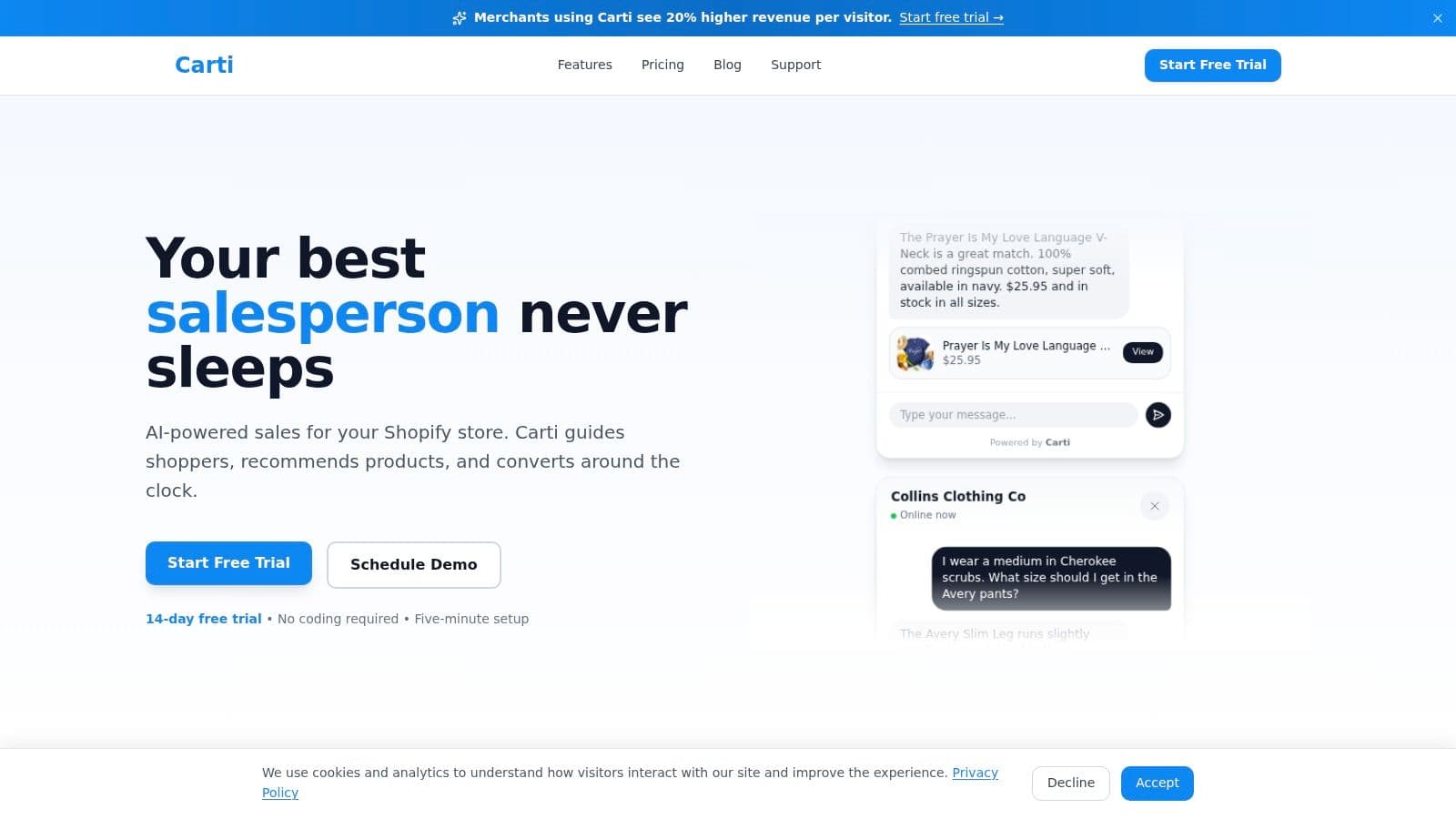
Carti is useful here because it doesn't just wait for support requests. It can act like an always-on sales assistant inside the store:
- Instant Answers can handle policy, sizing, shipping, and product questions before hesitation turns into abandonment.
- Smart Suggestions can recommend relevant products based on what the shopper is viewing or asking about.
- Cart Recovery can re-engage shoppers who leave mid-checkout with timely nudges instead of forcing a broad email blast.
- Insights Dashboard can show recurring questions, which helps merchants improve merchandising, FAQs, and product page clarity.
The important part isn't the feature list. It's the sequence. Answer first. Clarify intent second. Recommend third. That order protects trust and usually produces better repeat behavior than jumping straight to a promo.
Personalization works best when the customer feels understood, not tracked.
Building Retention Engines Beyond Points and Discounts
A frequently overlooked question is how to grow CLV without defaulting to discounts, points, or generic loyalty programs. That gap matters because many mainstream CLV guides still emphasize broad tactics while leaving merchants without a clear answer on which levers improve profit-adjusted lifetime value when margin pressure is real, as discussed in Nextdoor's CLV perspective for merchants.
The issue isn't that discounts never work. It's that they often become the only language the brand knows how to speak.
Why constant discounts create weak loyalty
When a customer buys only because the next code arrived, the brand hasn't earned loyalty. It has rented demand.
This is especially dangerous in categories like fashion, beauty, home, and wellness, where it's easy to boost repeat activity while still compressing contribution margin. The merchant sees more returning orders and assumes CLV improved. In reality, the store may have built a customer base that waits for sales, ignores launches at full price, and treats every campaign as a negotiation.
A healthier retention engine creates reasons to return that aren't purely price-driven.
Three retention engines that protect margin
The strongest alternatives tend to look like this.
Subscription where the product naturally fits
If the product is consumed, replaced, or replenished on a predictable cycle, subscription can remove friction and lift frequency without retraining the customer to chase promos. The model works best when it emphasizes convenience, continuity, and timing.
Subscription isn't for every SKU. It usually performs best when the reorder logic is obvious and the customer already understands the product.
Exclusivity that feels earned
Customers come back when the brand gives them access, not just offers. Early product drops, members-only education, limited collections, insider content, or community access can create retention without direct price erosion.
This approach works especially well for brands with identity, expertise, or a strong point of view. It gives customers a reason to stay close even between purchases.
Automation built around help
A lot of retention flows fail because they're just discount machines with better timing. The stronger model is service-led automation:
- Cart recovery with context: Remind shoppers what they left and answer likely objections.
- Win-back based on behavior: Ask whether they need help choosing the next product or replacing a previous one.
- Replenishment nudges: Focus on convenience and fit, not urgency theater.
The best win-back message often says, “Need help choosing the right next product?” not “Here's 15% off.”
When to use offers and when to hold the line
Offers still have a place. The mistake is using them indiscriminately.
A practical policy looks like this:
- Use service first for high-value customers, recent support issues, and post-purchase friction.
- Use full-price nudges when the customer has clear replenishment or repeat intent.
- Use bundles when they raise value while preserving margin.
- Use discounts selectively for true reactivation or first-order risk, not as a permanent retention crutch.
That discipline is what separates repeat revenue from profitable loyalty. If you're serious about how to increase customer lifetime value, this is the pivot that matters most.
How to Measure and Systematically Improve CLV
Most CLV work fails in measurement, not strategy. Merchants launch bundles, post-purchase flows, chat prompts, and win-back campaigns, then judge success by whichever dashboard number moved first.
That creates bad decisions. A higher repeat rate can still hide weaker margins. More recovered carts can still include low-quality orders. Better AOV can still come from offers that reduce long-term trust.
Track the customer journey not just the headline number
Use CLV as the umbrella metric, but manage with supporting indicators that explain why it moved.
A practical review rhythm should include:
- Repeat customer behavior: Are more first-time buyers returning?
- Average time between orders: Is your reorder cycle getting shorter or longer?
- Order composition: Are bundles, cross-sells, or replenishment purchases improving basket quality?
- Support friction after purchase: Which issues appear before customers go silent?
- CLV by acquisition channel: Which sources bring customers who stick, not just convert once?
Look at those metrics by cohort, not only in aggregate. Customers acquired through one campaign may behave very differently from customers acquired through another. The same is true for product lines, first-order bundles, and seasonal spikes.
Run tests that connect to profit not vanity
You don't need a complicated experimentation program. You need a disciplined one.
Test one meaningful variable at a time:
- Post-purchase messaging: Compare a reassurance-led welcome flow against a promo-led one.
- Product recommendation logic: Test bundles versus single-item add-ons.
- Cart intervention timing: Trigger help earlier for hesitant shoppers and later for high-intent ones.
- Win-back framing: Compare service-led outreach against coupon-led outreach.
- Replenishment prompts: Test convenience language against urgency language.
Then ask three questions after every test:
- Did this improve customer behavior beyond the first order?
- Did it preserve or improve margin quality?
- Is the result strong enough to operationalize across the store?
If you can't explain which lever changed, you haven't learned enough from the test.
The merchants who improve CLV consistently don't hunt for one magic tactic. They build a system. They tighten the first week after purchase, personalize recommendations around intent, and use automation to reduce friction instead of spraying discounts. Then they measure, adjust, and repeat.
If you want to put this into practice fast, Carti gives Shopify stores a practical way to do it. It answers shopper questions instantly, recommends relevant products, recovers abandoned carts, and surfaces the issues that block repeat purchases, all without adding more manual support work. For brands focused on profitable retention instead of constant promotions, it's a strong way to turn customer conversations into higher lifetime value.

Written by
Daniel AndersonFounder of Carti. 10+ years building ecommerce brands in apparel and supplements. Still runs a Shopify store and built Carti to help merchants convert more browsers into buyers.
Ready to boost your store's sales?
Install Carti in 5 minutes and let AI handle customer questions, recommend products, and close sales 24/7.
Start Free Trial14-day free trial