
Most buying guides for these two apps start with a feature grid and end with a winner. That is the least useful way to choose a storefront assistant in 2026, because the features that decide a purchase are rarely the ones that cause a return.
The harder question is which assistant you can safely let near a shopper who is about to spend real money on something they cannot touch, smell or try on. Answer that, and the platform question mostly answers itself.
Both vendors are real, both have paying customers, and both publish performance numbers that should be treated as marketing until a store's own trial says otherwise. Keeping documented facts and company claims apart is the whole job here.
Manifest AI and Rep AI at a Glance
These two products sit at opposite ends of the same conversation. One is sold as a platform for building agents across channels, the other as a concierge that sells on the storefront.
Manifest AI started life as an independent division of BIK in 2023 and reports serving more than 500 brands globally. It also promotes conversion improvements of 20% to 45% and up to 90% ticket automation, figures the company publishes itself in its own comparison write-up. Treat that brand count and those lifts as vendor-reported, not audited.
Rep AI took the narrow road. It built a conversational concierge for online retailers, most of them on Shopify, using behavioral AI to read shopper intent, steer product selection and handle post-purchase questions. Its named customers include OLLY, NutraBio, HigherDOSE, Bikes Online and Cloth & Paper, which places it across supplements, wellness, apparel and other direct-to-consumer categories.
| Criteria | Manifest AI | Rep AI |
|---|---|---|
| Public positioning | Configurable omnichannel agent platform for e-commerce | Conversational sales and support assistant for online retailers |
| Origin | Independent division of BIK, launched 2023 | Built as a Shopify-focused concierge, launch year not published in the material reviewed |
| Reported brand footprint | More than 500 brands globally, company reported | Named customers include OLLY, NutraBio, HigherDOSE, Bikes Online and Cloth & Paper |
| Shopify focus | Works with Shopify and connects to other platforms through its API | Built particularly for Shopify merchants and direct-to-consumer brands |
| Core strength | Multi-channel agent building across support, discovery and marketing | Commerce-trained sales and support on the storefront |
Read the table as a map of where each product expects to earn its keep. Manifest AI competes on configuration and channel coverage. Rep AI competes on the quality of a single storefront conversation and on how early it can spot a shopper who is stalling.
Neither company has published an independently audited benchmark. If a merchant wants to weigh the two side by side from a storefront selling angle, a direct comparison of Rep AI against Carti shows the same criteria applied to a third option, which is a useful sanity check before a trial.
The practical takeaway is that both sets of numbers need re-testing on your own catalog, with your own hardest questions, before any contract.
How Their Pricing Models Differ
Rep AI publishes its Shopify prices on its own site, structured around monthly website sessions for stores with up to 3,000 sessions. Per Rep AI's pricing page, the Support plan costs $19 per month billed monthly or $15 per month billed annually. Sales is $39 or $29, and Concierge, which bundles sales and support, is $46 or $37. Each additional 1,000 sessions adds $12.
Its app listing adds a second meter. Rep AI's Shopify App Store listing shows the app as free to install with usage-based charges: $12 per 1,000 sessions, plus $0.75 per AI-resolved conversation for AI handled through email and social channels.
| Plan or model | Monthly billing | Annual billing (per month) | What it covers |
|---|---|---|---|
| Rep AI Support | $19 | $15 | Support plan for up to 3,000 monthly sessions |
| Rep AI Sales | $39 | $29 | Sales plan for up to 3,000 monthly sessions |
| Rep AI Concierge | $46 | $37 | Sales and support combined, up to 3,000 monthly sessions |
| Rep AI overage | $12 per additional 1,000 sessions | $12 per additional 1,000 sessions | Charged beyond the included allowance |
| Manifest AI | From $500 per month, per the company FAQ | Contract discounts of 20% on 24 months and 25% on 36 months, no per-month annual price published | Monthly platform fee set by model tier and conversation volume, with Manifest AI Labs as a possible one-time service |
Manifest AI's structure is different in kind, not just in size. Its official FAQ states that plans start at $500 per month and scale to enterprise needs, that there is no free plan, and that a free trial is available. Its pricing page describes a monthly platform fee set by the chosen model tier and the number of AI conversations handled, with 20% off 24-month contracts and 25% off 36-month contracts.
A worked example makes Rep AI's arithmetic concrete. Say a store runs 5,000 monthly sessions on the annual Sales plan. It pays $29 plus two blocks of 1,000 overage sessions at $12 each, which lands at $53 per month. Manifest AI at 5,000 sessions is a conversation-volume quote that starts from $500.
Ask before signing: what counts as one conversation, whether unused conversations roll over, and what the price becomes after a price change.
For more on how these meters compare across the category, this breakdown of Shopify AI chatbot pricing models is worth reading before a sales call.
Chat, Catalog and Language Features Side by Side
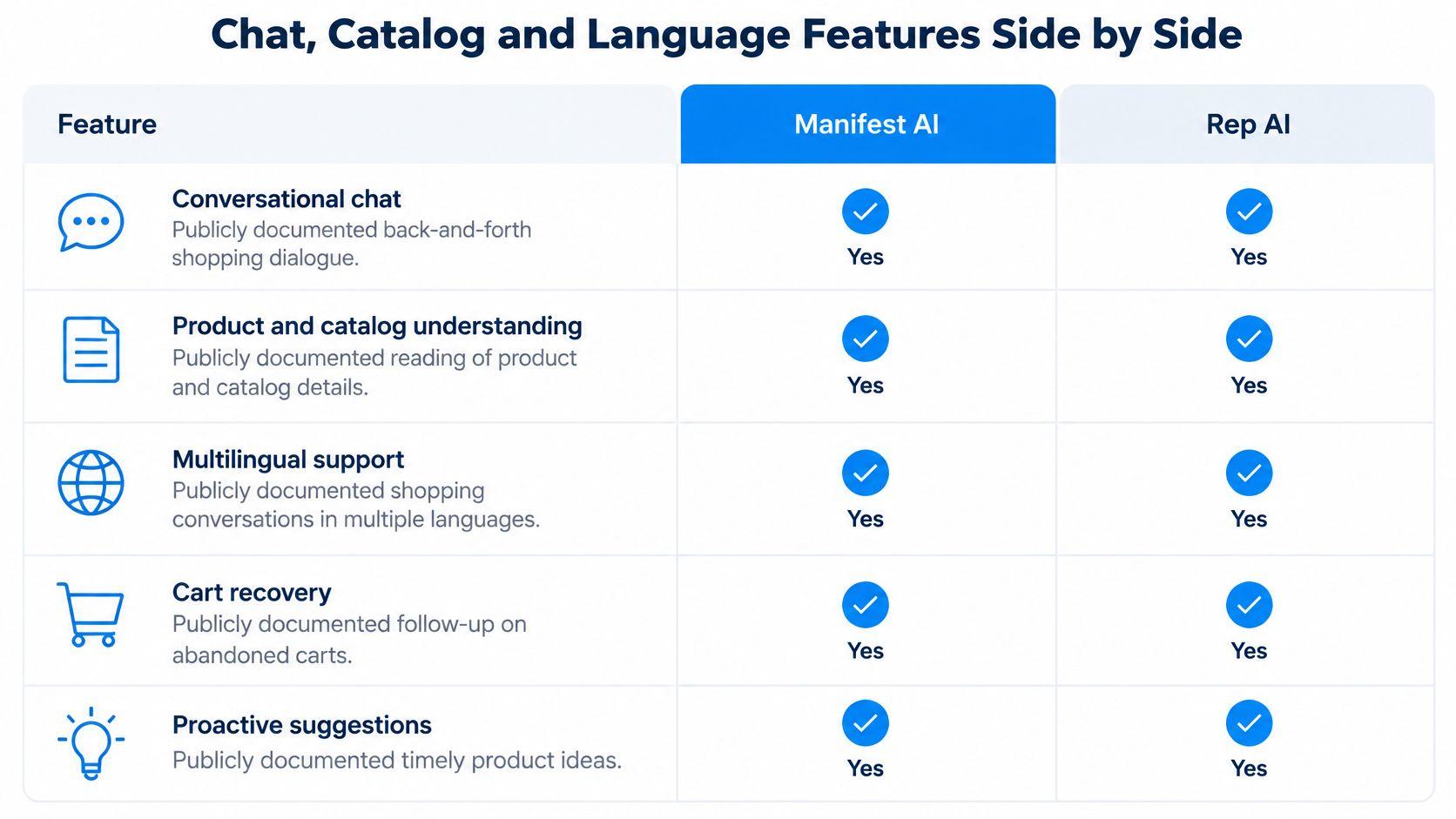
Five criteria decide most storefront evaluations. Take them in order and note what is documented, not what a demo implies.
Conversational chat. Rep AI answers shopper questions on the storefront and resolves order status, returns and address changes, routing the rest to a helpdesk. Manifest AI runs agent-based support and discovery across several channels.
Product and catalog understanding. Rep AI detects shopper intent and guides product selection from the live catalog. Manifest AI describes support, discovery and marketing agents, though the depth of catalog question answering is not documented in public material.
The last three criteria are where public information runs out. Language coverage, cart recovery and proactive triggers are not confirmed for either product in the material available, so the table marks them as open questions rather than filling the gaps with guesses.
| Capability | Manifest AI | Rep AI |
|---|---|---|
| Conversational chat | Agent-based support and discovery across several channels | Answers shopper questions on the storefront using behavioral AI and language models |
| Product and catalog understanding | Support, discovery and marketing agents described, catalog Q&A depth not documented | Detects shopper intent and guides product selection |
| Multilingual support | Not confirmed in public material, test during trial | Not confirmed in public material, test during trial |
| Cart recovery | Marketing workflows described, cart recovery not confirmed | Not confirmed in public material, test during trial |
| Proactive suggestions | Not confirmed in public material, test during trial | Post-purchase assistance described, proactive triggers not confirmed |
A four-check trial script
Run the same checks on both products inside one week, on the same catalog, and write down the answers.
- Ask a sizing or compatibility question with a known correct answer, using a product where the answer lives in the description.
- Ask the same question in a second language your customers use.
- Abandon a cart at checkout and watch whether any recovery message arrives within 24 hours.
- Count how many times the assistant opens a conversation without being asked.
Score each answer as correct, partially correct or wrong, and keep the transcript. A tool that chats fluently but answers a fit question wrong is worse than a plain FAQ page, because it sounds confident while doing it. Feature lists cannot show you that. Only your own product questions can.
Integrations, Onboarding and Support to Verify
The Shopify connection sets the pace of going live. Rep AI is listed on the Shopify App Store, so installation happens inside the admin and the catalog sync follows the standard app flow. Manifest AI states that it works with Shopify and can connect to other e-commerce platforms through its API, which matters for stores running a custom front end or more than one platform.
Get the integration list in writing
Neither vendor's public material confirms native connectors for common CRMs and helpdesks. Ask for a written list before the trial, not a verbal yes on a call. A connector that exists but syncs only tickets, not conversation history, solves less than it appears to.
Onboarding questions worth asking
- Setup time: how many working days from install to a live assistant on the storefront.
- Content loading: whether the vendor loads the catalog, policies and FAQs, or the merchant does.
- Training data: exactly which sources the assistant learns from, and how removals work.
- Export: whether conversations, transcripts and analytics can be exported, and in what format.
- Escalation: how a human takes over a live chat, and what the shopper sees during the handoff.
Those five answers predict go-live friction better than any feature page.
Support expectations
Ask which channels support covers, who answers, and whether response expectations are written into the contract rather than described on a call. A named support contact with stated hours is worth more than a promise of a dedicated expert.
Copy the five onboarding questions and the three support questions into one email and send it to both vendors on the same morning. Compare the answers, not the sales decks.
This comparison makes no uptime or service level claims for either product. Any availability figure a merchant needs should come from the contract itself.
Which Purchases Carry the Most Risk
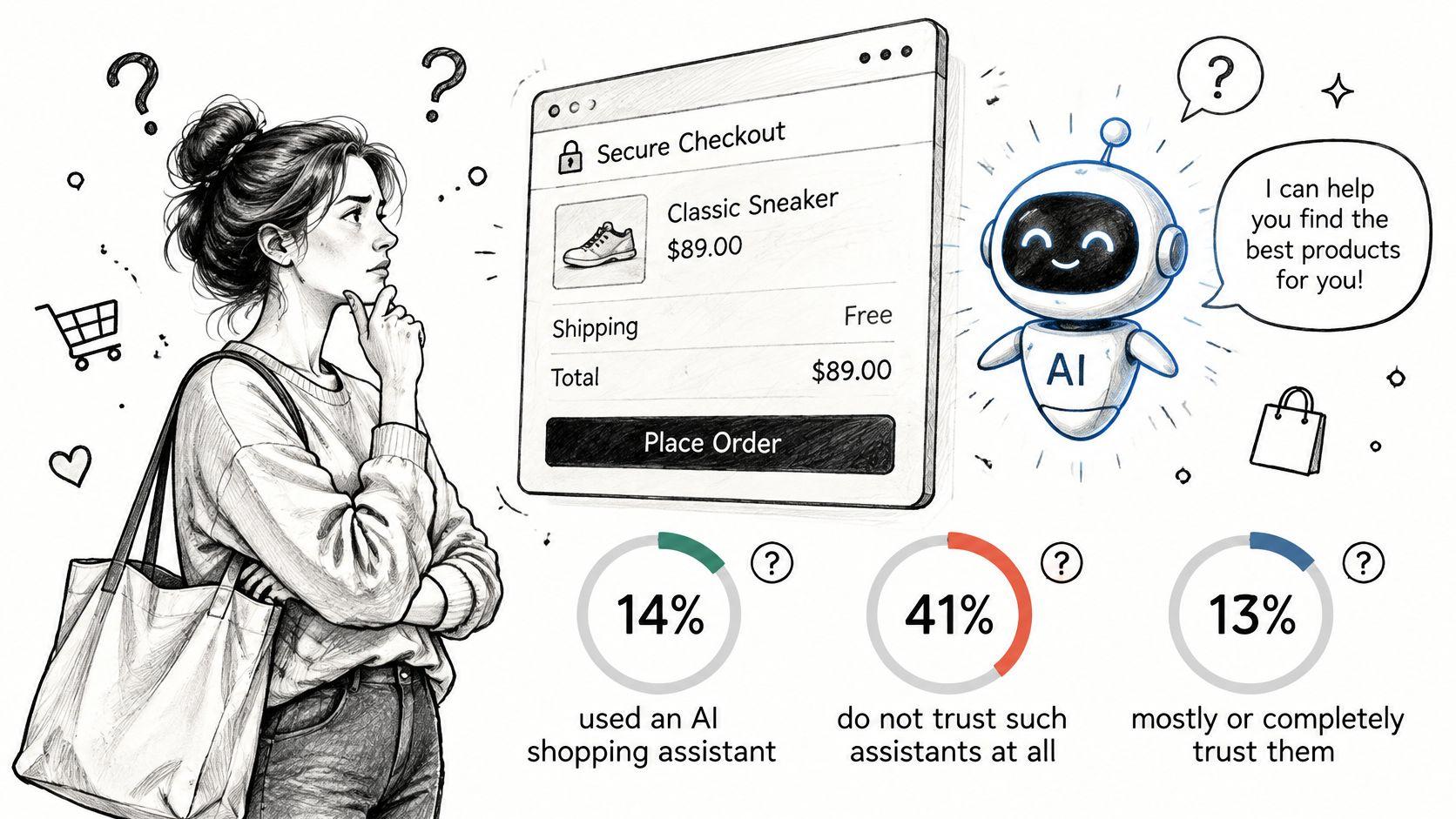
The popularity story is weaker than the vendor marketing suggests. YouGov research on AI shopping assistants found that only 14% of Americans had used an AI shopping assistant, while 41% said they did not trust such assistants at all. Only 13% mostly or completely trusted AI shopping advice, against 48% for consumer reviews and 53% for personal recommendations.
That gap defines the test. Shoppers will accept help finding a product and resist being told what to buy, especially when the stakes rise. The comparison is trust, control and purchase-risk fit, not feature count. Merchants should test both platforms on the purchases most likely to cause returns, hesitation or regret, then decide which assistant behaves better under that pressure.
Sort the catalog into three risk bands before comparing a single feature.
- Low consideration: supplements, accessories, consumables and repeat purchases. Shoppers want a fast, accurate answer and a nudge back to the cart. Automation earns its keep here.
- Fit and suitability: fashion sizing, beauty compatibility, wellness claims, home-product measurements. These questions produce returns that eat margin, and a confident wrong answer costs more than no answer.
- High value: purchases where the shopper wants a person before committing. The assistant's job is a clean handoff, not a close.
For each band, test four behaviours. Does the tool separate advice from action, so a recommendation is not mistaken for a promise? Does it cite the product evidence behind an answer? Does it say when it does not know? Does it escalate sizing, safety, warranty or high-value questions to a human?
The same test should include control. A merchant needs to know whether the assistant can use the store's brand voice, answer from product attributes such as sizing, materials and compatibility, and show a live catalog recommendation with real price and stock in the chat. Those details matter more on risky purchases than a broad claim of intelligence.
Four numbers to watch after launch
- Unsupported-answer rate: the share of replies with no basis in product data or policies.
- Escalation rate: how often the assistant hands off, and whether those handoffs convert.
- Return rate after AI-assisted sessions: compared with sessions where no chat happened.
- Conversion by confidence level: whether cautious answers sell as well as confident ones.
Customer results both companies publish are vendor-reported and are not controlled benchmarks. These store-level numbers are the only ones that describe the merchant's own catalog, shoppers and return profile. That is the practical dividing line: an assistant that sells smoothly on low-risk items but mishandles fit, claims or high-value hesitation creates a bigger cost than it removes.
Switching Costs and Vendor Stability
The main cost of moving platforms is the retraining, not the subscription. Any switch means rebuilding the assistant's knowledge of your catalog, policies and FAQs, then retesting the questions that matter most.
The sequence that avoids a gap in coverage runs like this.
- Export conversation history, transcripts and analytics from the outgoing tool while the contract is still active.
- Load the catalog, policies and FAQ set into the new assistant and let it index fully.
- Retest the twenty product questions that generate the most pre-purchase traffic.
- Run both widgets in parallel for a short window, with only one visible to shoppers at a time.
- Remove the old widget only after escalation routing is confirmed working.
Then compare total cost across the term, using the contract discounts and billing rules rather than the headline monthly price.
On stability, Rep AI has the clearer public record. Its reported funding history totals approximately $14.4 million, including an $8.2 million Series A announced in August 2024 and a further $6.2 million strategic follow-on announced on May 28, 2026, led by Silicon Road Ventures with participation from Osage Venture Partners, Flashpoint Venture Capital and Zendesk as a strategic investor, as set out in Rep AI's published company material. That follow-on represented roughly 43% of cumulative funding.
Manifest AI's available sources do not disclose a funding total, so ask directly for financial context and a reference customer on a similar platform. Funding signals investor confidence, not product accuracy.
Put it in the contract: exit terms, who owns the conversation data, and the exact export format available on the last day of service.
If a migration is already on the table, this walkthrough of switching from Rep AI to another assistant covers the export and retraining steps in order.
Choose the Platform That Matches Your Store
Start with the situation, not the feature count. The table below maps common store profiles to the platform worth testing first.
| Store situation | Test first | Why |
|---|---|---|
| Multi-channel brand running support, discovery and marketing in one system | Manifest AI | Positioned as a configurable agent platform across several channels |
| Shopify storefront focused on turning product questions into sales | Rep AI | Built for storefront sales and support on Shopify |
| Store under 3,000 monthly sessions on a tight budget | Rep AI | Support plan starts at $19 per month billed monthly |
| Fashion or beauty store with frequent fit or suitability questions | Test both | Run the risk checks on both before deciding |
| Commitment planned for 24 or 36 months | Compare total cost | Manifest AI lists 20% and 25% contract discounts, Rep AI lists annual billing |
A multi-channel brand juggling support, discovery and marketing in separate tools has a reason to look at Manifest AI first. Its value proposition is consolidation across channels, and that only pays off if you run those channels.
A Shopify store whose problem is unanswered product questions on the product page should start with Rep AI. Its whole design assumes the storefront is where the sale is won or lost.
Budget matters at the small end. Stores under 3,000 monthly sessions can start Rep AI at $19 per month, while Manifest AI's plans begin at $500 per month, so the trial math differs sharply.
Fashion and beauty merchants carry the most return risk per conversation and should not pick on price. Run the four risk checks on both platforms with your ten hardest fit and suitability questions, then compare error rates before comparing invoices.
If you are planning a multi-year commitment, total cost across the term decides more than the first invoice. Apply the contract discounts and the overage rules to your own traffic forecast.
One more option belongs on the shortlist. Carti is an AI shopping assistant for Shopify with a Free plan that includes 50 AI conversations a month, Starter at $49 for 250 conversations, Growth at $99 for 600 and Scale at $249 for 1,750, with a 14-day free trial on paid plans. It answers product questions from a store's own catalog and policies, which makes it directly comparable on the criteria above.
Whatever lands on the shortlist, the measurement discipline matters as much as the tool. The ecommerce conversion advice from Chicago Brandstarters is a useful companion while a trial runs, because it keeps attention on the storefront experience around the widget rather than the widget alone.
Shortlist two platforms. Run the same four trial checks on each, in the same week, on the same products. Then pick the one with the better answer accuracy and the cleaner escalation path, because that is the pair of results a shopper feels.
Carti is an AI sales assistant for Shopify that answers product questions from a store's own catalog and policies, recommends items that fit, and sells around the clock. Plans run from Free with 50 AI conversations a month to Scale at $249 for 1,750, with a 14-day free trial on paid plans, so a store can run the same accuracy and escalation checks used above before committing. Visit Carti to see the plans and start a trial on your own catalog.

Written by
Daniel AndersonFounder of Carti. 10+ years building ecommerce brands in apparel and supplements. Still runs a Shopify store and built Carti to help merchants convert more browsers into buyers.