
The usual advice about Richpanel alternatives starts with the wrong question: which help desk has the cheapest seats? A Shopify merchant can choose a cheaper ticketing system and still leave the main problem untouched if shoppers need product answers before placing an order.
The better starting point is the work that needs fixing. Post-purchase queues, storefront product questions and social messages require different capabilities. A fair comparison separates those jobs, tests the tools against actual conversations and checks whether the expected benefit covers the full monthly bill.
Richpanel Alternatives at a Glance
| Option | Category | Best For | Verify Pricing At |
|---|---|---|---|
| Richpanel | Shopify customer support platform | Teams wanting help desk and inbox workflows in one Shopify-focused tool | Richpanel's own pricing page |
| Help Scout | Help desk | Email-first teams that want a shared inbox and knowledge base | Help Scout's own pricing page |
| Freshdesk | Help desk | Teams that need ticket automation and reporting across agents | Freshdesk's own pricing page |
| Re:amaze | Omnichannel help desk | Stores answering chat, email and social messages in one inbox | Re:amaze's own pricing page |
| Shopify Inbox | Shopify messaging managed through the admin | Low-volume stores that want basic storefront chat | Shopify's own pricing and Inbox information |
| Carti | AI shopping assistant for Shopify | Stores whose main bottleneck is pre-purchase product questions, including sizing, shipping, returns and comparisons | The product's own pricing information |
Richpanel is the reference point for this search, but a replacement doesn't have to reproduce its entire operating model. Help Scout, Freshdesk and Re:amaze belong on a shortlist when agents need to share, assign and resolve customer requests.
Shopify Inbox belongs in a lighter evaluation for stores that need straightforward messaging. It shouldn't be treated as requiring no installation or configuration because Shopify provides it.
Categories before feature counts
A shopping assistant addresses a different job: helping a visitor decide what to buy. Its evaluation should emphasize product knowledge and the quality of recommendations, rather than assuming that ticket assignment proves sales usefulness.
The table deliberately quotes no prices. Plan structures can change, and competitor prices, allowances and billing terms should be confirmed on each vendor's own pricing page before a comparison becomes a purchasing decision.
Shortlist rule: A tool belongs in the trial because it matches an operational problem, not because it appears near the top of an alternatives list.
The merchant should select three candidates whose categories match the store's main bottleneck. Existing workflows still matter, but reproducing every feature of the current system shouldn't become the default requirement.
Do You Need a Help Desk or a Shopping Assistant
Does the store lose more time after an order, or more opportunity before checkout? That distinction determines whether ticket management or purchase assistance deserves the first investment.
According to Shopify's customer-service statistics, 70% of Shopify Inbox conversations involved customers making a purchasing decision, and 17% of pre-purchase conversations converted into sales in November 2023. Those figures describe the conversations Shopify reported, not a promised conversion rate for another store or software product.
They nevertheless establish an important point: customer conversations aren't exclusively a post-purchase workload. A sizing question and a damaged-delivery complaint may arrive through the same widget, but success means something different in each case.
Signals that favor a help desk
A steady stream of post-sale emails points toward a help desk, particularly when requests need ownership and follow-up. Order-status tickets strengthen that case when agents must inspect order context rather than repeat a general shipping policy.
Several agents sharing an inbox create another requirement. The merchant needs to test assignment, internal context and escalation so that requests don't receive conflicting responses or remain unowned.
Signals that favor purchase assistance
Repeated sizing or compatibility questions suggest that shoppers need help interpreting the catalog. Product-comparison requests require a system that can distinguish relevant attributes, rather than return a generic FAQ.
An abandoned session following an unanswered question deserves investigation too. It doesn't prove that the missing answer caused abandonment, but it identifies a conversation worth testing against checkout outcomes.
The distinction between chatbots and live chat also matters operationally. Automated assistance needs a defined fallback, while live chat needs someone available to take responsibility for the reply.
A store may need both categories. The first purchase should solve the more costly bottleneck, not the most visible inbox.
A practical starting test is to classify last month's questions as pre-purchase or post-purchase. The larger group becomes the initial priority, with exceptions for smaller groups that require unusually expensive handling or carry substantial commercial risk.
Criteria That Separate Strong Alternatives
A trial should produce evidence, not a longer feature checklist. Merchants can score each criterion from 1 to 5, using failed tests, partial results and consistently successful results as the basis for the score.
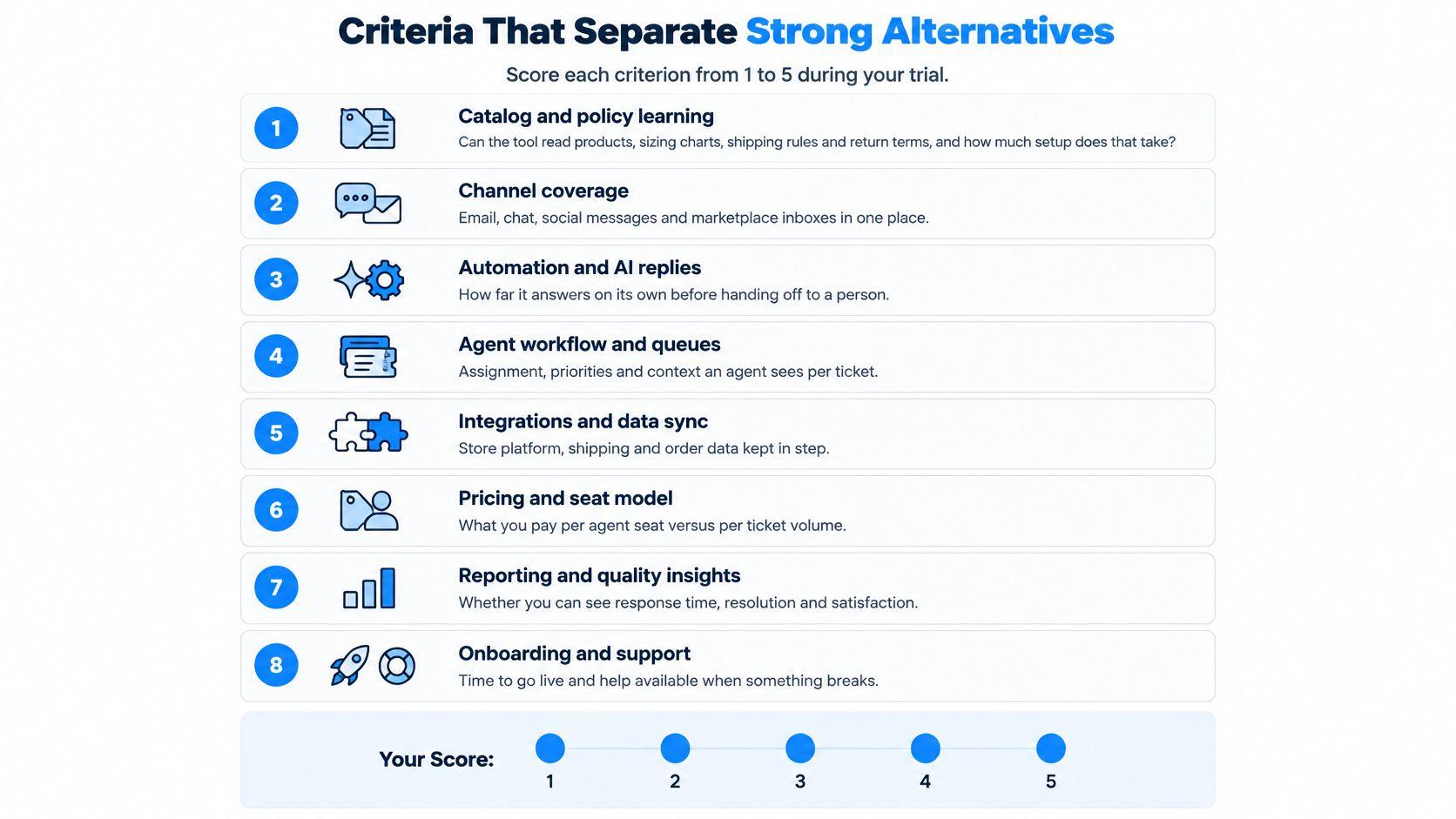
- Catalog and policy learning: Test whether the tool reads products, sizing charts, shipping rules and return terms, then measure how quickly a changed source affects its answers.
- Answer traceability and confidence thresholds: Check whether reviewers can identify the source behind an answer and control when uncertainty triggers a human handoff.
- Human handoff and transcript export: Move a conversation to an agent and export it, checking whether the original question, replies and relevant context survive.
- Audit logs and policy versioning: Change a rule and inspect whether the system records the editor, timing and previous version.
- Channel coverage: Send representative requests through storefront chat, Instagram, Messenger and email, checking each required channel separately.
- Language coverage: Have a competent speaker review answers in the store's selling languages, including ambiguous wording and policy exceptions.
- Review use: Where supported, test whether fit and quality answers accurately reflect customer reviews without presenting individual opinions as universal facts.
- Unanswered-question reporting: Check whether the team can identify recurring gaps and turn them into approved FAQs or catalog improvements.
Score outcomes alongside capabilities
For context, eDesk's ecommerce customer-service statistics report first-contact resolution around 68% on average, with 80% or higher considered best-in-class. These are reference points, not acceptance criteria for every store or conversation type.
The stronger test compares each candidate with the merchant's existing baseline. Containment, meaning conversations handled without human intervention, should be recorded separately for product discovery, sizing, shipping, returns and order status.
Answer accuracy, customer satisfaction, conversion after interaction and assisted revenue belong beside containment. A system that ends conversations without resolving uncertainty hasn't necessarily improved service.
Exception-heavy cases need particular attention. An answer about a published return window differs from a request involving a damaged item, an expired deadline and a disputed delivery.
A broader ecommerce live-chat software evaluation can help merchants assess the surrounding workflow. No checklist score should outweigh a material policy error or an unusable handoff.
Detailed Comparison by Decision Criterion
| Criterion | Help Desks | Shopify Inbox | AI Shopping Assistant |
|---|---|---|---|
| Primary job | Post-purchase ticket handling | Basic store messaging | Pre-purchase product questions and recommendations |
| Learns catalog and policies | Test source ingestion and update behavior | Test catalog and policy behavior in the current installation | Yes, catalog, policies and FAQs |
| Instagram and Messenger | Confirm both channels on the selected plan | Confirm supported channels before selection | Yes, replies to Instagram and Messenger |
| Uses product reviews for fit | Request a demonstration with the store's review app | Test review access rather than assuming it | Yes, through Judge.me, Loox, Yotpo, Okendo, Fera or Areviews |
| Languages | Confirm required languages and translation workflow | Test required languages directly | Automatically detects and replies natively in 92 languages |
| Setup effort | Test migration, routing and knowledge setup | Managed through Shopify admin, with setup checks required | A few minutes, no code |
| Pricing model | Check the vendor's own pricing page | Check Shopify's current pricing information | Conversation-based plans |
The shopping-assistant column describes Carti's published capabilities, rather than every product in that category. Unconfirmed cells are explicit trial checks, not evidence that a competitor lacks the feature.
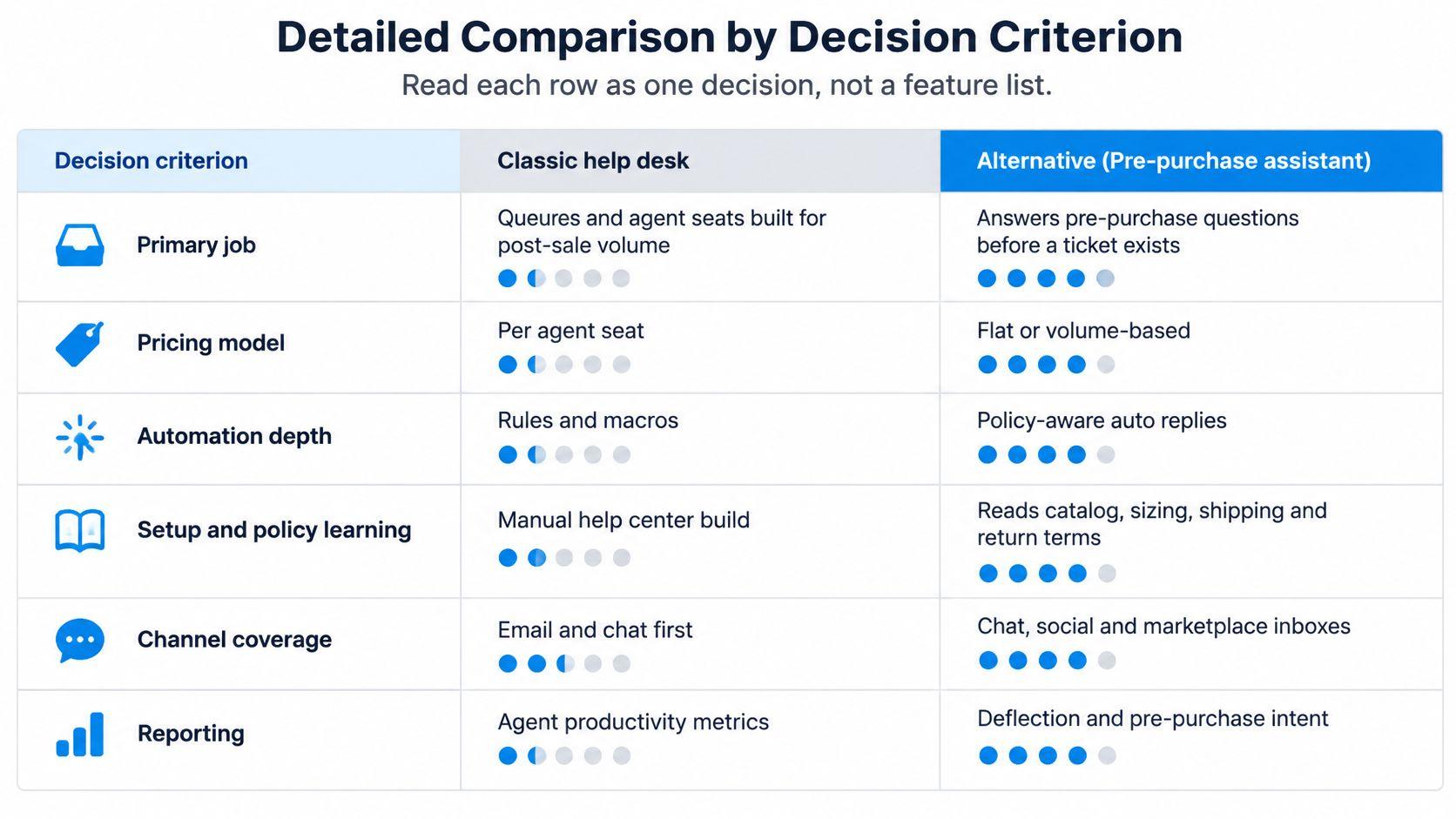
Read each row as a purchasing decision
The primary-job row separates queue coordination from purchase guidance. A help desk trial should establish whether agents can work through the store's post-sale volume without losing ownership or context.
Shopify Inbox is a candidate for basic messaging, but its position in the table doesn't establish that it lacks product-answering capabilities. Merchants should inspect the current installation rather than rely on a blanket claim that it offers little pre-purchase help.
The learning row asks a deeper question than whether a vendor advertises AI. A tool may accept an FAQ document without correctly interpreting product variants, conflicting policies or a recently changed shipping rule.
The review row deserves similar scrutiny. A useful demonstration should show which review content informed a fit answer and whether the wording preserves uncertainty, such as differences between individual customers' preferences.
Verify connections and operational boundaries
Channel coverage means more than displaying a social-media logo. The trial should establish whether the tool receives the required message type, answers in the correct account and preserves the conversation when a person becomes involved.
Language breadth also needs quality testing. Automatic language detection removes a configuration task, but a merchant still needs to validate product terminology and policy meaning in the markets served.
Native escalation integrations with Re:amaze, Help Scout and Freshdesk are coming soon for the named shopping assistant and aren't currently available. A merchant requiring those connections should not assume that a combined deployment already provides them.
Pricing is intentionally absent from this comparison table. Before purchase, each vendor should provide written confirmation of required features, plan eligibility and integration boundaries, supported by a working demonstration rather than a sales-call assurance.
What Each Option Really Costs Per Month
Carti plans and conversation limits
| Plan | Monthly Price | AI Conversations per Month | Trial |
|---|---|---|---|
| Free | $0 | 50 | Not applicable |
| Starter | $49 | 250 | 14-day free trial on paid plans |
| Growth | $99 | 600 | 14-day free trial on paid plans |
| Scale | $249 | 1,750 | 14-day free trial on paid plans |
The Free plan includes proactive customer outreach through triggers, smart search, product recommendations and automatic learning of the store's products, policies and content. The allowances are numerical caps, not unlimited usage.
Break-even extra orders = monthly software cost ÷ contribution profit from an extra order.
A simplified hypothetical example uses an assumed $99 monthly cost, an assumed $80 average order value and an assumed 40% gross margin. Those assumptions produce $32 gross profit per order, so $99 divided by $32 is about 3.1, requiring at least four additional orders to cover the subscription before other incremental costs.
Use contribution profit for the actual decision
Gross profit is only a starting estimate. Payment fees, fulfillment costs, discounts and expected return costs can reduce the amount available to cover software.
A merchant should replace every assumption with store-specific figures and use contribution profit wherever possible. The relevant orders are incremental orders attributable to the tool, not every purchase made after someone opens chat.
Cost check: Assisted revenue is a reporting measure. It isn't automatically additional revenue, and revenue isn't profit.
A controlled comparison helps distinguish purchases the assistant influenced from purchases that would have happened anyway. The same principle applies to labor savings: theoretical minutes saved matter less than work the team can remove or redeploy.
Compare complete bills, not headline prices
For other Richpanel alternatives, the merchant should inspect each vendor's own pricing page for the charging unit. Possibilities to check include agent seats, ticket allowances, visitor caps, metered AI conversations and resolution-based fees.
The quote should also clarify automation add-ons, overage handling and what happens during a launch or sale. A conversation that starts with automation and ends with an agent may have billing consequences that aren't obvious from a headline price.
An explanation of Gorgias pricing mechanics can help frame those questions, but it doesn't replace that vendor's current pricing page. No competitor price is quoted here because an unconfirmed figure would create false precision.
Recommendations by Store Type and Use Case
A store's catalog and service workload should determine the first trial. The same platform can be a sensible choice for an email-heavy operation and an unnecessarily complex purchase for a merchant whose main problem is product uncertainty.
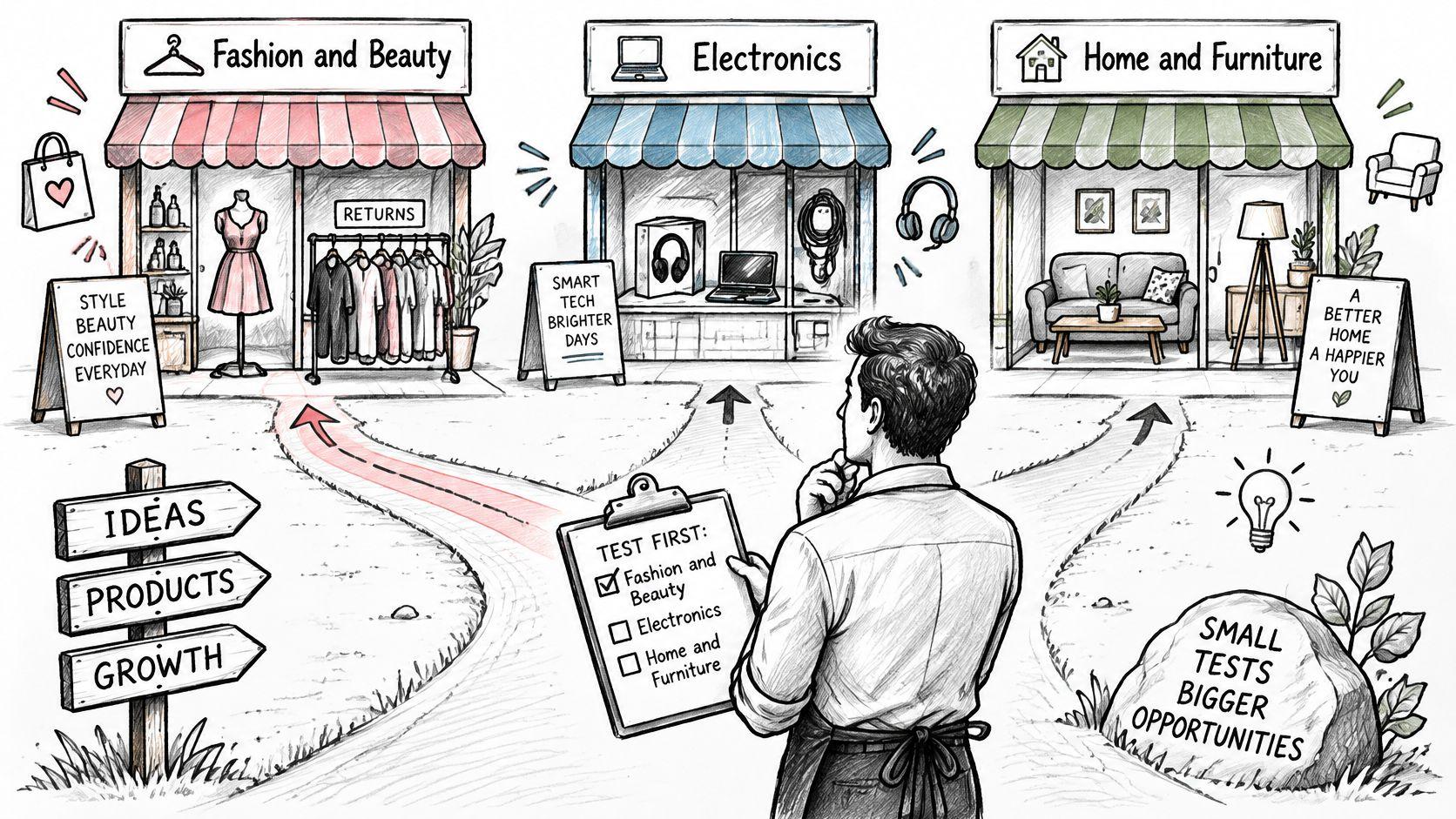
Product-led and social-led stores
Fashion and beauty stores with frequent sizing, shade or skin-type questions should test whether answers distinguish relevant product attributes without making unsupported suitability promises. When those conversations precede purchase, the first option to test is an AI shopping assistant.
Home and wellness stores facing compatibility, ingredient or setup questions need careful source boundaries. The assistant described in the comparison can recommend live-catalog products with real prices and stock shown in chat, plus an add-to-cart button, making a catalog-aware shopping assistant the first option to test when product selection is the bottleneck.
Stores selling mainly through Instagram and Messenger messages should establish channel eligibility before evaluating convenience features. Message receipt, account permissions and a workable human fallback should be demonstrated in the actual accounts, making a channel-compatible tool the first option to test.
Returns-heavy stores and larger operations
Stores with substantial return-related work should separate return-policy questions from return-processing requests. A 2024 National Retail Federation study reported that retailers' online return rates were, on average, 21% higher than their overall return rates, supporting distinct tracking of the online workload and making a help desk the first test when processing dominates.
Large teams with several agents and escalation rules should prioritize ownership, permissions and case continuity. Help Scout, Freshdesk or Re:amaze belongs in the first help desk trial, selected according to the required workflow rather than an assumed ranking.
Agencies managing multiple client stores should test configuration isolation as well as setup speed. Each client's top five intents can form an initial test set, with separate policies, branding and catalog checks, making the tool that passes those client-specific tests the first deployment candidate.
These recommendations aren't declarations of a universal winner. A store with product questions and complex returns may need a combined stack, but any missing connection between tools should be treated as an operational cost rather than an implementation detail.
Pilot Your Shortlist Before You Switch
A replacement should earn the switch through measured results. The pilot needs separate records for purchase assistance and post-purchase service so that a strong result in one workload doesn't conceal a weakness in the other.
Build and run the test
-
Export the current operating material. The merchant should collect tickets, macros, FAQs and policy pages from the existing tool, then verify that files open and preserve useful context. Export completeness is the first acceptance check.
-
Create a representative question set. A suggested test uses 50 real questions from the last month across sizing, shipping, returns, order status and product comparison. Each question needs an approved answer or a documented reason for escalation so that scoring doesn't depend on reviewer preference.
-
Configure the strongest two candidates. The team should use available free or trial allowances before committing to a subscription and record hands-on setup effort. For the shopping assistant described above, setup is self-serve through a dashboard and requires no coding.
-
Run a controlled parallel pilot. A suggested minimum is two weeks that include a busy period, with a longer test if conversation volume is insufficient. Candidates shouldn't send conflicting replies to the same shopper, and the team should compare equivalent intents rather than unmatched inbox totals.
Measure quality and complete the migration
-
Score capabilities and inspect policy accuracy. Reviewers should apply the evaluation checklist and check every tested policy answer against the written policy. A material error should trigger investigation and retesting, not disappear inside an average score.
-
Measure response by channel against the existing baseline. eDesk's ecommerce support guidance supports examining channel-specific response performance and separating pre-purchase questions from post-purchase tickets. The merchant should record median and tail-end first-response times, human escalation and resolution by intent, without treating a vendor promise as a measured result.
-
Complete the switch checklist before cancellation. The team should reconnect storefront chat and social accounts, update saved replies and routing, and verify that forwarded email reaches a person. It should also inspect the existing contract's notice requirements and test the full incoming-message path.
-
Keep the candidate that passes the operational and financial checks. The decision should combine answer quality, workflow results, conversion evidence and the full expected bill. The losing candidate should be cancelled only after records are exported and the replacement demonstrably handles the required workload.
The final decision record should name the winning use case and any unresolved limitation. That gives the merchant a clear reason to retain, expand or reconsider the tool after the initial trial.
For Shopify merchants comparing Richpanel alternatives because shoppers need product answers before checkout, Carti offers an AI shopping assistant that learns the store's catalog, policies and FAQs. Merchants can visit the site for trial and setup details, then test representative purchase questions before deciding whether a shopping assistant belongs beside or instead of a help desk.

Written by
Daniel AndersonFounder of Carti. 10+ years building ecommerce brands in apparel and supplements. Still runs a Shopify store and built Carti to help merchants convert more browsers into buyers.