
You launched a campaign, traffic spiked, and Shopify showed a nice-looking visitor graph. Then sales barely moved. That's the moment most merchants realize traffic and revenue aren't the same job.
I've seen this play out in every kind of DTC store. Search starts bringing in product-aware visitors, Meta ads fill the top of the funnel, email drives repeat sessions, and yet the store still leaks money because the landing page doesn't match intent, the offer is vague, or buyers hit one unanswered question and leave. If that sounds familiar, you don't need another generic list of channels. You need to know which traffic sources for websites bring buying intent, how those visitors behave, and what needs to happen onsite to turn a click into an order.
If your store gets attention but not enough checkouts, the missing discipline is usually conversion, not reach. A lot of the practical fixes live inside solid Shopify conversion rate optimization, but the starting point is simpler: treat each traffic source differently, because each one arrives with a different mindset.
From More Traffic to More Sales
A Shopify merchant spends weeks fixing product feeds, launching Google Ads, posting on Instagram, and cleaning up SEO. Sessions climb. The dashboard looks healthier. Revenue doesn't follow.
That usually happens for a boring reason. The store optimized for arrival, not purchase. Search visitors landed on collection pages with weak copy. Paid visitors hit pages that didn't repeat the ad promise. Social traffic bounced because the site asked cold visitors to buy before helping them understand the product.
More traffic can even hide the problem for a while. If enough visitors trickle in, the store owner assumes the funnel works and the answer is more spend, more content, more campaigns. But the store is really just paying to expose the same friction to more people.
Practical rule: Every traffic source carries a different level of intent. If the page experience doesn't match that intent, more volume just creates more waste.
The better lens is simple. Ask two questions for every channel: why did this person click, and what do they need to see next to feel confident buying? Organic search often needs clarity and proof. Paid search needs message match and speed. Social usually needs education and trust before urgency.
That shift changes how you judge performance. A channel isn't “good” because it sends visits. It's good when the landing page, offer, merchandising, and checkout experience fit the visitor's mindset closely enough to create profitable action.
The 9 Major Website Traffic Sources Explained
Think of channels as different roads into your store
The cleanest way to understand traffic sources for websites is to think of them as roads leading to a physical shop.
Some roads bring people who already know what they want. Others bring browsers who are curious but not committed. Some roads are expensive toll roads that deliver immediate volume. Others are slower routes that compound over time.
That difference matters because channel strategy isn't only about acquisition. It shapes conversion. The person arriving from Google behaves differently from the person who clicked a creator link, tapped an email, or typed your URL directly into the browser.
Industry channel mix is also more balanced than a lot of old SEO-first advice suggests. Projected 2026 website traffic data shows direct traffic at 27.6%, organic search at 26.7%, paid search at 23.0%, social media at 16%, email at 4.4%, display ads at 4.3%, and referral traffic at 9%. The same source says mobile accounts for roughly 62 to 63% of global web traffic, which is a blunt reminder that every acquisition plan has to work on a phone first.
What each source usually means in practice
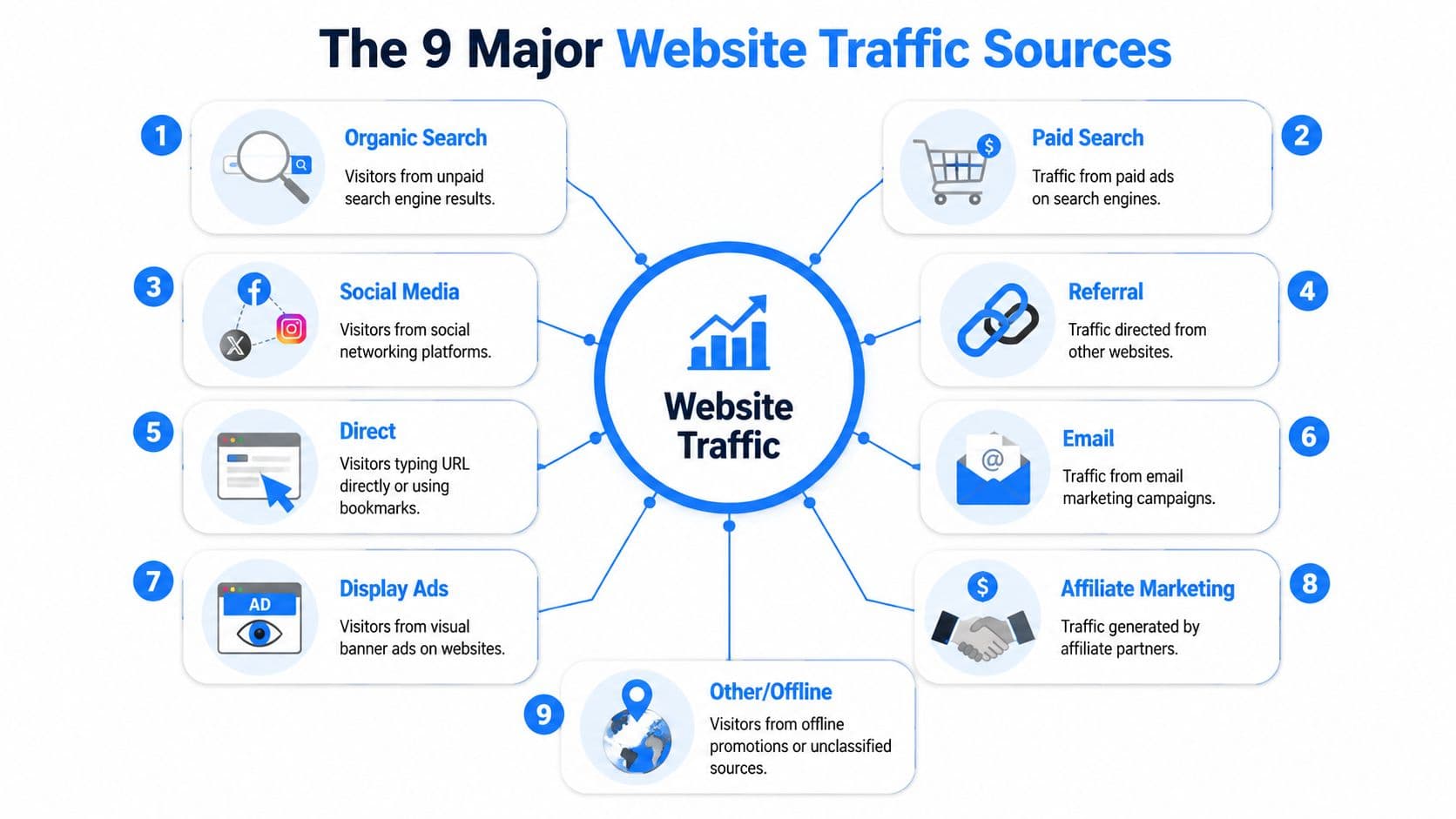
Here's how I'd break down the nine major sources most Shopify merchants deal with:
-
Organic search
Visitors arrive from unpaid search results. They often have clear intent and specific questions. They respond well to strong product page copy, comparison content, FAQ clarity, and clean technical SEO. -
Paid search
This is the toll road. You buy visibility for high-intent queries, branded protection, or product-specific demand. It's fast, but every weak landing page costs money. -
Social media
Social brings discovery traffic from platforms like Instagram, TikTok, Facebook, Pinterest, or X. Some of it is organic, some paid. Either way, these visitors usually need faster education and stronger creative continuity between click and page. -
Referral
Referral traffic comes from links on other websites. Think publishers, blogs, review sites, partners, or communities. This audience often arrives with borrowed trust, which can convert well if the landing page continues the story. -
Direct
These are visitors who type in the URL, use bookmarks, or arrive without referrer data. Direct traffic can signal brand strength, but it can also hide poorly tagged campaigns. -
Email
Email traffic is usually your warmest audience. These visitors already know the brand, so the onsite experience should focus on reducing friction, not reintroducing the entire business. -
Display ads
Banner placements and visual placements across websites tend to create awareness first and purchase later. They can support retargeting, but cold display traffic rarely forgives weak creative or slow pages. -
Affiliate marketing
Affiliates, creators, and partners send traffic in exchange for commission. This can work well for niche categories because the recommendation carries context and trust. -
Other and offline
QR codes, podcasts, print inserts, events, packaging, SMS misclassification, app traffic, and anything else that doesn't fit neatly into a standard channel bucket lands here.
If you want a grounded local-business example of channel diversification outside major metros, Northpoint Web's guide on increasing website traffic in rural Utah is useful because it shows how traffic strategies have to adapt to context, not just platform trends.
Different roads bring different shoppers. Don't expect a social visitor, a Google visitor, and an email subscriber to buy for the same reason.
Comparing Traffic Channels Pros Cons and ROI
The fastest way to waste budget is to ask one channel to do every job. SEO won't give a new store instant volume. Paid search won't fix a weak offer. Social ads won't save a site that can't explain the product quickly. Email won't grow if you haven't built an audience worth emailing.
What merchants usually get wrong
Most stores don't have a traffic problem. They have a portfolio problem.
They lean too hard on one source because it's familiar. Founders who came from content backgrounds overvalue SEO. Performance marketers overvalue paid. Brands with strong retention teams keep squeezing email while underinvesting in discovery. The healthier approach is to compare channels by trade-offs: cost, speed, scale, and fit.
That's also why you need to track channel-level CAC instead of looking at blended acquisition in isolation. Blended numbers are useful for finance. They're terrible for deciding whether search, social, or email deserves the next dollar.
A lot of merchants also confuse speed with quality. Paid channels produce data quickly. That doesn't make them better. Organic channels take longer. That doesn't make them cheaper if your team never ships content or category page improvements consistently.
Website Traffic Source Comparison for Shopify Stores
| Traffic Source | Typical Cost | Speed to Results | Scalability | Best For |
|---|---|---|---|---|
| Organic SEO | Lower cash cost, higher time and execution cost | Slow to build | Strong once pages rank and content library grows | Sustainable acquisition, non-branded demand, evergreen product discovery |
| Paid Search | Medium to high | Fast | Scales with budget, margin, and query volume | Capturing existing intent, branded defense, product-specific demand |
| Social Ads | Medium to high | Fast | Strong if creative pipeline is healthy | Demand generation, new customer acquisition, visual products |
| Organic Social | Lower cash cost, high consistency cost | Uneven | Hard to predict, strong for brands with point of view | Awareness, community, creator-led brands |
| Email Marketing | Lower media cost, requires list growth and ops discipline | Fast with an existing list | Excellent within list size limits | Repeat purchase, launches, promotions, cart and browse follow-up |
| Referral | Usually moderate effort, sometimes relationship-driven | Medium | Selective rather than infinite | Trust transfer, niche audiences, PR, reviews |
| Affiliate | Variable commission-based cost | Medium | Good if partner quality stays high | Influencer-driven categories, reviews, creator ecosystems |
| Direct | No media line item, but built by brand investment elsewhere | Depends on brand strength | Strong if repeat behavior is healthy | Returning buyers, branded demand, loyal audience |
| Display Ads | Medium to high | Fast | Broad reach, weaker intent on cold traffic | Retargeting, awareness support, visual reminders |
Use this table for sequencing, not for picking a universal winner. If your store is young, organic SEO and paid search don't compete. They do different jobs on different timelines. If your repeat rate is strong, email should almost always be one of the highest-priority conversion channels because it works on an audience you already own.
For paid teams, channel comparison gets sharper when you combine platform cost with what happens after the click. That's where network-specific acquisition cost benchmarks and trade-offs become more useful than generic averages.
How to Measure Traffic and Attribute Sales
Attribution gets messy long before most merchants notice it. The dashboard says “Direct” is winning, social looks weak, and email performance seems inconsistent. Then you dig in and realize links weren't tagged, app traffic dropped referrers, and half the campaigns got lumped into the wrong bucket.
Why reports get messy fast
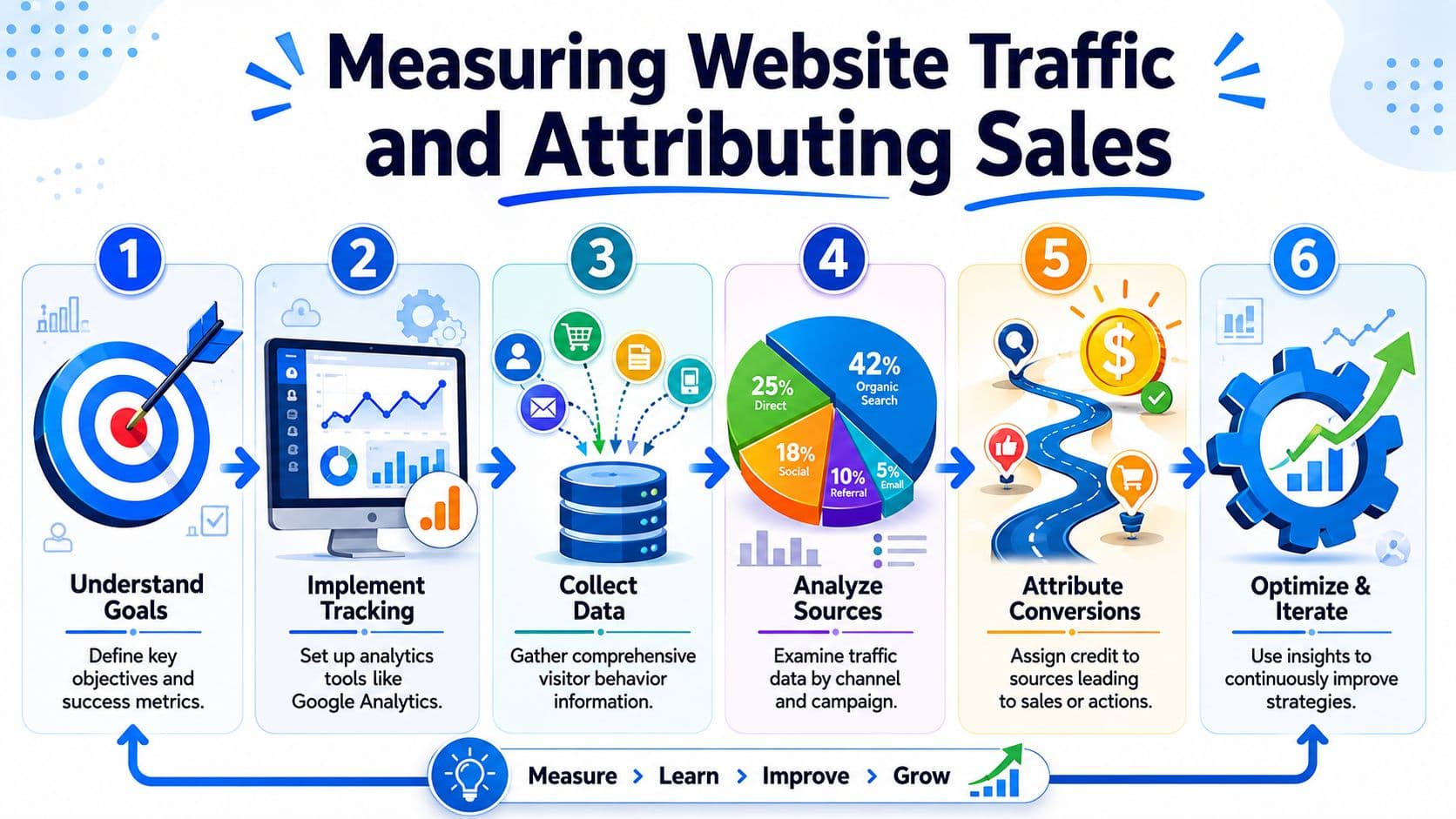
Analytics platforms usually group visits into channels like Direct, Referral, Social, Search/Organic, Search/Paid, Display Ads, Email, and Other, and Orbit Media's explanation of traffic source classification is one of the clearest summaries of that system. The practical takeaway is what matters for Shopify merchants: if UTM tagging is inconsistent, campaigns can be misbucketed into direct, which distorts CAC, ROI, and channel comparisons.
Squarespace's analytics documentation also highlights an important nuance in how traffic sources are classified and why direct can include unattributed visits. “Direct” doesn't always mean someone intentionally typed your URL. It can include private shares, app clicks, offline traffic, bookmarks, and visits that lost referrer data on the way in.
The channel report is only as trustworthy as your tagging discipline.
A clean attribution workflow
For most Shopify stores, attribution doesn't need to be complicated. It needs to be consistent.
-
Define the outcome first
Pick the business actions that matter. Usually that's purchase, but it can also include email signup, add to cart, or start checkout depending on the campaign. -
Tag every controlled link
Every email, paid ad, creator placement, and social promotion should use UTM parameters consistently. If your naming conventions drift, your reporting does too. -
Separate campaign purpose
Treat prospecting, retargeting, branded search, and promotional email as different motions. They may all drive revenue, but they do it in different ways. -
Compare source quality, not only session volume
The biggest traffic source isn't automatically the best one. Evaluate traffic based on what visitors do after landing. -
Use attribution models with common sense
Last-click is useful for seeing who closed the sale. First-click helps you understand who introduced the customer. Neither tells the full story alone. -
Review KPIs at the channel level
Tie source analysis back to business reporting. A solid e-commerce KPI framework helps stop vanity metrics from taking over the conversation.
A simple habit helps more than fancy tooling: audit your tagged links before launch, not after the report breaks.
A Prioritization Framework for Shopify Stores
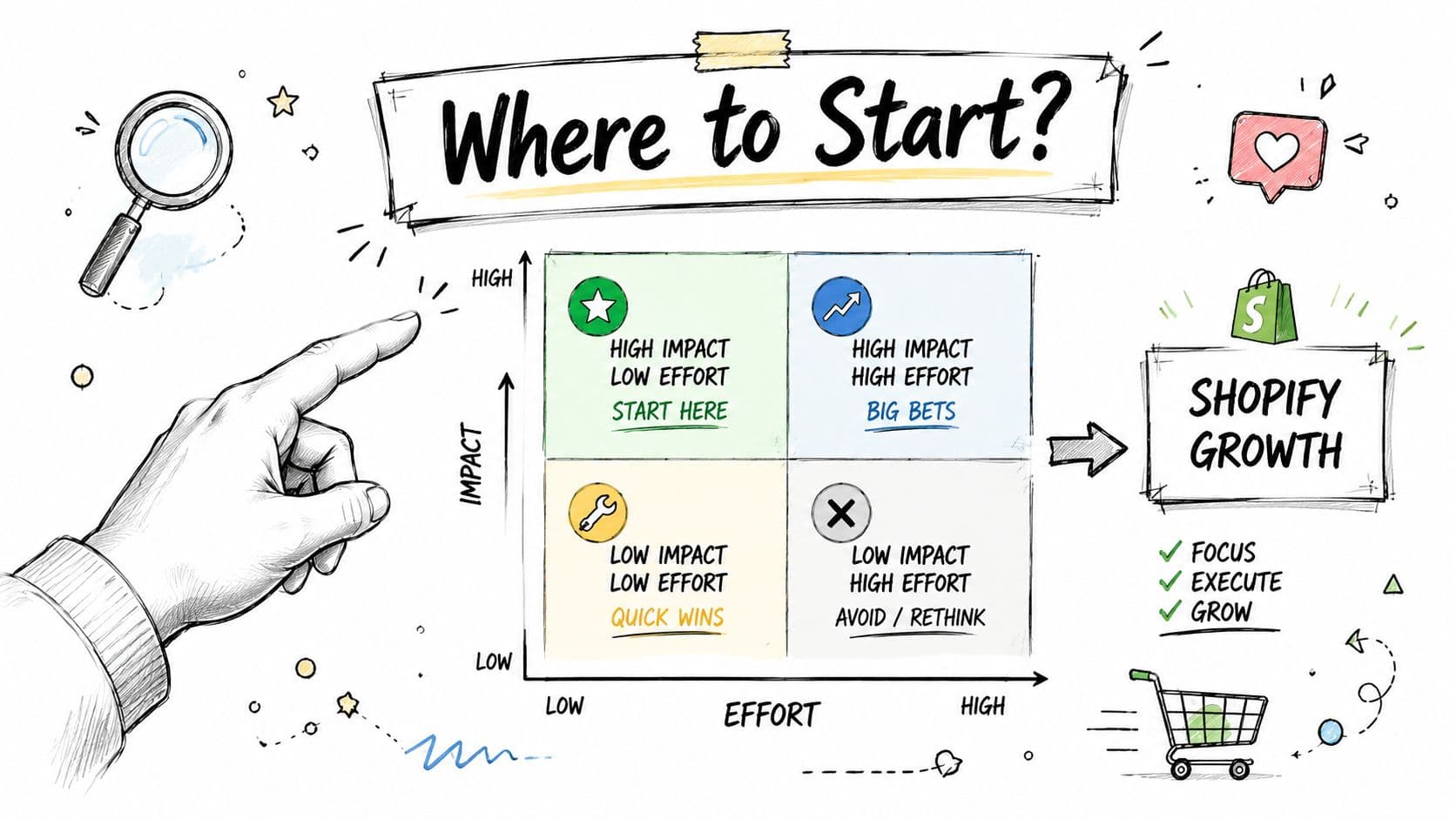
There isn't a best traffic source. There's only the best next source for your store, right now.
That answer changes based on stage, budget, and product type. A new brand selling a niche product shouldn't copy the channel mix of an established store with strong repeat purchase behavior. A commodity product with intense search demand needs a different plan than a premium product that has to be explained visually.
Start with store stage
If the store is new, build foundations before chasing channel complexity.
-
New store with limited proof
Focus on product page clarity, basic technical SEO, email capture, and one paid channel you can manage well. Don't spread thin across five platforms. -
Growing store with traction
Add structured search campaigns, stronger lifecycle email, and referral or affiliate tests. You want a mix of immediate demand capture and longer-term acquisition. -
Established store
Push harder on portfolio balance. Protect branded search, expand non-branded SEO, tighten retention, and use paid media for scale rather than survival.
Then pressure test budget and product type
Budget determines how much speed you can buy. Product type determines how much education you need before conversion.
A low-budget store usually wins by improving pages, building search visibility over time, growing email, and using organic social selectively. A larger-budget store can layer in paid search, paid social, retargeting, creator programs, and more aggressive landing page testing.
If your product needs explanation, prioritize channels that let you teach before you ask for the sale.
For search-heavy categories, put more weight on SEO and paid search. For visually driven categories like fashion, beauty, or home decor, social and creator traffic can do more of the discovery work. For replenishable products, email and direct traffic often become more valuable as the customer base matures.
The framework is simple. Start where your store can support the traffic you buy or earn. Then expand.
Your Tactical Playbook for Converting Each Traffic Type
Traffic source strategy matters. But revenue usually changes when the page, message, and merchandising line up with visitor intent.
Search is still too important to treat casually. Ahrefs' roundup of SEO data cites BrightEdge reporting that 68% of online experiences begin with a search engine, and it also notes GrowthBadger's finding that top blogs get 66.47% of traffic from search. For Shopify merchants, that means search visitors are too valuable to waste on generic pages.
Organic traffic conversion playbook
Organic visitors often arrive with a question. Sometimes it's product-specific. Sometimes it's comparative. Sometimes it's risk-related, like shipping, ingredients, sizing, compatibility, or returns.
What works:
- Match the query on the page
If someone lands from a specific search, the page should answer that exact need fast. - Front-load trust
Put product facts, policy clarity, and proof near the top. - Reduce research friction
FAQs, comparison modules, and collection filtering help search visitors self-qualify.
What usually fails is forcing search traffic onto broad pages that make them hunt for basics.
Paid traffic conversion playbook
Paid traffic is expensive attention. Treat it like that.
For paid search and paid social landers, the first screen should repeat the promise from the ad. If the ad says “sensitive skin safe,” the page can't open with vague brand language. If the ad pushes a bundle or seasonal offer, the page should show it immediately. Tight message match matters more than cleverness.
Use this checklist:
- Keep one primary action on the landing page.
- Remove competing exits where possible.
- Show price context clearly so visitors don't feel surprised late in the journey.
- Support the add-to-cart moment with shipping, returns, and delivery expectations.
Here's a useful demo of how onsite assistance can support that conversion layer without adding friction:
Social traffic conversion playbook
Social visitors are usually less linear. They clicked because the creative sparked curiosity, not because they were deep into checkout mode.
That means the page has to continue the story from the platform. Social conversion improves when the landing page feels like a natural next step, not a hard reset. Use creator assets, simple explanations, mobile-first imagery, and concise benefit-led copy.
Social traffic rarely rewards overbuilt pages. It rewards fast understanding.
A few practical moves help a lot:
- Use landing pages tied to the creative angle
Don't send every click to the homepage. - Lead with benefits before specifications
Social clicks are often emotion-first. - Add soft conversion paths
Email capture, bundles, quizzes, or browse-friendly collections can keep interested visitors moving.
Every source has its own rhythm. Conversion improves when you stop asking all visitors to behave the same way.
Turn Your Traffic into Your Biggest Asset
Traffic becomes an asset when you can trust where it came from, understand what the visitor wanted, and shape the onsite experience around that intent. That's the core job.
For Shopify merchants, the winning move usually isn't choosing one magical channel. It's building a balanced acquisition mix, measuring it cleanly, and treating conversion as a source-by-source discipline. Search visitors need answers. Paid visitors need message match. Social visitors need context. Email visitors need a fast path back to purchase.
Most stores spend too much energy on getting the click and not enough on earning the order. That's why traffic reports can look healthy while profit stays stuck.
If you get the foundations right, every channel gets stronger. Your SEO work turns into revenue faster. Your paid traffic wastes less spend. Your email list becomes more valuable. And your direct traffic starts to mean brand strength, not attribution errors.
If you want to turn more Shopify traffic into sales without adding headcount, Carti is worth a close look. It acts like a 24/7 sales associate on your store, answering shopper questions, guiding product discovery, and helping recover carts so more of the traffic you already paid for converts.

Written by
Daniel AndersonFounder of Carti. 10+ years building ecommerce brands in apparel and supplements. Still runs a Shopify store and built Carti to help merchants convert more browsers into buyers.
Ready to boost your store's sales?
Install Carti in 5 minutes and let AI handle customer questions, recommend products, and close sales 24/7.
Start Free Trial14-day free trial