
You're probably already selling through a mix of channels, and the tension is familiar. Retail brings reach, but it also means you're guessing at who bought, what they bought next, and why they didn't come back. Direct to customers changes that equation, because the brand owns the relationship, the data, and the experience from first click to repeat purchase.
The opportunity is large enough that it's no longer reasonable to treat direct selling as a side project. U.S. DTC ecommerce reached $239.75 billion in 2025, and Swell says that was 19.2% of total U.S. retail ecommerce. Swell also projects the global DTC ecommerce market to grow from $163 billion in 2024 to $595 billion by 2033 (Swell DTC ecommerce statistics). That scale is why merchants now treat DTC as a serious operating model, not just a branded web shop.
For a practical comparison of how direct models differ from traditional B2C retail, this B2C vs D2C breakdown is a useful companion read. If you're looking for a sharper channel plan, DTC ecommerce growth strategies is another relevant resource, especially if you're trying to decide where direct selling fits inside your broader growth mix.
What Selling Direct to Customers Really Means
A lot of brands start here because wholesale feels safe. A retailer takes inventory, your product gets shelf space, and the order flow looks clean on paper. Then the hard part shows up, because you don't really know who bought, what message moved them, or how to turn one sale into the next one.
Direct to customers, or DTC, changes the ownership structure of the business. When you sell through your own site, app, or store, you control pricing, customer data, and the end-to-end buying experience, which is what makes personalization and retention marketing possible without intermediary data loss (CDP DTC glossary).
The shift is strategic, not just channel-based
The best way to think about DTC is as a business philosophy built around owning the customer relationship. The site is important, but the primary value comes from the fact that the merchant becomes the system of record for browsing behavior, purchase history, and service interactions. That's why DTC merchants can improve recommendations, segmentation, and replenishment logic with direct evidence instead of retail sell-through guesses.
This is also why the model has become such a major part of ecommerce. U.S. DTC ecommerce reached $239.75 billion in 2025, and the global market is projected to keep expanding through 2033 (Swell DTC ecommerce statistics). Those figures matter because they show direct selling isn't a workaround anymore, it's a core route to market.
Practical rule: if you can't name the customer, you can't really build a durable DTC engine.
For merchants operating in Shopify, the storefront becomes more than a checkout page. It becomes the place where product discovery, messaging, and post-purchase behavior all connect. That's the fundamental shift, and it's why direct selling works best when the brand is ready to own both the commercial and customer experience.
The DTC Tradeoff: Benefits and Challenges
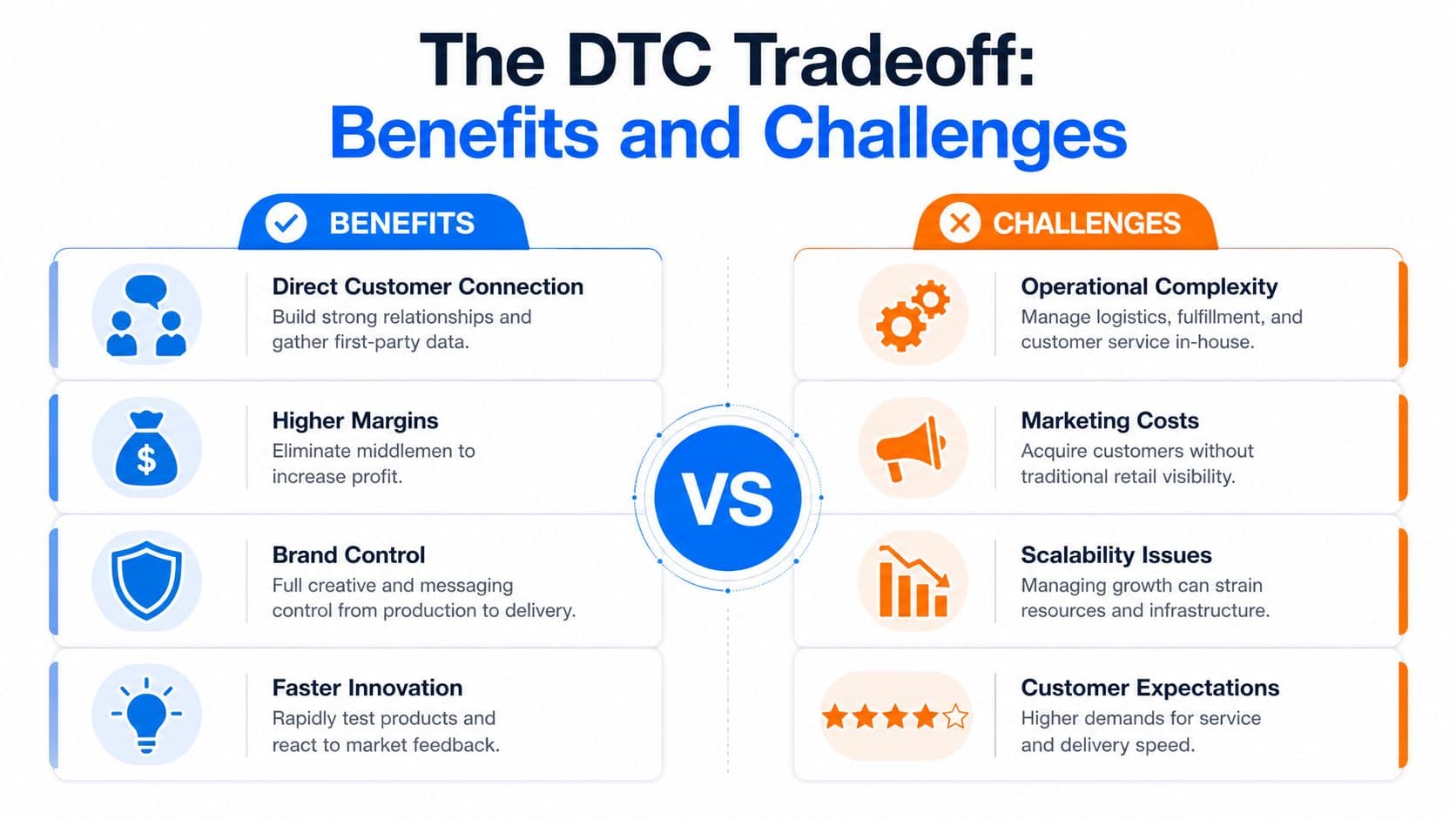
DTC gets sold as a clean win, but it's more honest to call it a tradeoff. You gain an advantage in some parts of the business and inherit more responsibility in others. If you make that choice deliberately, the model can be powerful. If you chase it because everyone else is doing it, the operational burden can eat the gains.
What you gain when you sell direct
The biggest benefit is first-party data ownership. When the brand owns the site, it controls the experience and can connect browsing, buying, and support activity in one place. That creates room for smarter personalization, better retention messaging, and more accurate merchandising decisions (CDP DTC glossary).
You also get more control over brand presentation. Retail channels usually compress your story into a product card, a shelf tag, or a marketplace listing. On your own storefront, you decide how products are framed, what bundles are offered, what policies are visible, and how the experience feels from landing page to confirmation email.
There's another upside that gets overlooked. DTC lets teams test product-market fit faster because the brand gets a direct signal loop. If a product page underperforms or a certain message converts better, the data lands with the merchant, not a reseller.
What gets harder the moment you own the relationship
The cost of that control is complexity. DTC brands manage stock levels, packaging, shipping, and direct customer communication themselves, and service reliability and inventory accuracy directly affect conversion and retention (Shopify enterprise guide). That means every missed shipment, stock mismatch, or unclear policy becomes the brand's problem immediately.
Customer acquisition also gets less forgiving. On a retailer's shelf, you borrow traffic. On your own site, you have to create it and pay for it. That's why many DTC brands feel the pressure first in marketing, then in support, then in fulfillment.
Operational reality: DTC is not just a marketing model. It's a service model with a storefront attached.
The best operators go in with a clear-eyed plan. They know the upside is richer data, stronger margin control, and closer customer relationships. They also know the model demands better systems, tighter fulfillment, and more disciplined retention work than a simple retail launch ever would.
Your Primary Channels for Selling Direct
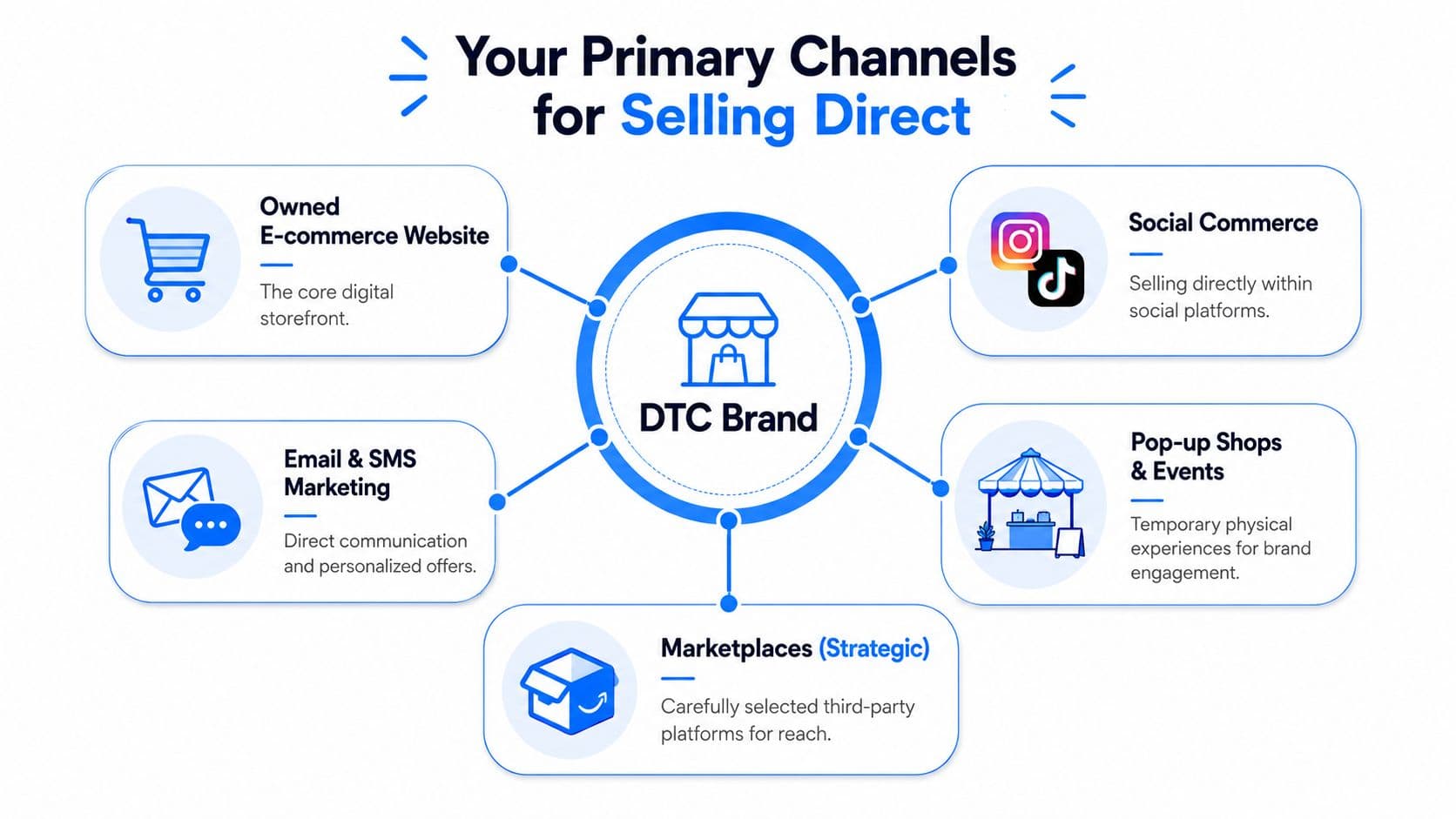
A strong DTC setup doesn't rely on one channel pretending to do everything. The owned website is the center, but each surrounding channel has a different job. If you make every channel chase the same goal, you blur the customer journey and waste spend.
Start with the owned store
Your Shopify store should act as the hub and system of record. It's where pricing lives, where the product catalog is controlled, and where customer behavior becomes usable data. If a channel can't ultimately point back to that owned environment, it shouldn't be treated as core infrastructure. Know what that hub costs before you scale it: our breakdown of how much Shopify Plus costs per month shows where the jump from Advanced actually pays off.
That's why social commerce and marketplaces should usually be viewed as acquisition surfaces, not the whole business. Social platforms are good for discovery and impulse buys. Marketplaces can add reach, but they also dilute control, which is exactly what DTC is trying to recover.
Use each spoke for a specific purpose
Email and SMS belong to retention and reactivation. They're the owned communication layer, which means they're useful for launches, replenishment nudges, and cart recovery without paying for a new ad impression every time.
Pop-up shops and events can support trust and brand recognition. They don't replace the digital engine, but they can help customers touch the product, especially when the category benefits from tactile experience.
Social commerce should be treated as a conversion extension of content. It works best when the product story is already strong and the path from post to purchase is short. When the conversation itself becomes the channel, a conversational commerce platform is the piece that ties chat, social messaging, and the store together.
Decision rule: if a channel gives you reach but strips away customer ownership, use it tactically, not structurally.
Each channel needs a role. Here is the full map:
| Channel | Job in the stack | Customer ownership | Use it for | Watch out for |
|---|---|---|---|---|
| Owned Shopify store | Hub and system of record | Full | Closing the sale, pricing, catalog, behavioral data | Everything must point back here |
| Email and SMS | Retention and reactivation | Full | Launches, replenishment nudges, cart recovery | Overuse burns the list |
| Social commerce | Conversion extension of content | Partial | Discovery and impulse buys with a short post-to-purchase path | Weak product stories convert nothing |
| Marketplaces | Tactical reach | None | Widening top of funnel when the economics work | Dilutes the control DTC exists to recover |
| Pop-ups and events | Trust and brand recognition | In person | Tactile categories where touch sells | Does not replace the digital engine |
Building Your Essential DTC Technology Stack
A DTC brand without the right stack usually ends up with a manual business disguised as a growth brand. The storefront matters, but so does the machinery behind it. If your tools don't help you acquire, convert, and support buyers efficiently, the model starts to leak margin.
The stack should map to the customer journey
At minimum, the stack needs four functions. The first is the ecommerce platform, which handles storefront control and checkout. The second is marketing automation, which covers email and SMS. The third is analytics, because you can't improve what you can't see. The fourth is customer support and engagement, because post-purchase questions don't stop when the order goes through.
That support layer matters more than many teams expect. Shopify's guidance says DTC brands should monitor support channels, offer multi-channel support, and build self-service resources, because support quality is tightly linked to loyalty and repeat purchases (Shopify DTC guide).
For merchants trying to reduce manual load, an AI chat layer can handle routine product questions, policy lookups, and checkout objections in-session. Tools like Carti fit that use case by answering catalog and FAQ questions automatically, which is useful when the same question gets asked repeatedly across product pages, carts, and account pages.
If you're evaluating broader automation options, this ecommerce automation tools guide is worth reviewing before you commit to a stack.
Don't treat support as a separate department
Support becomes part of the conversion path in DTC. A shopper asking about shipping, sizing, or returns is still deciding whether to buy. If your tools can't answer quickly, you create friction exactly when intent is highest.
The best stacks keep that friction low. They give the team a way to respond instantly, route edge cases to humans, and surface recurring questions that should be fixed in copy, policy, or merchandising. That's the practical difference between having tools and having a system.
The Hidden Workload: Staffing and Operations
DTC is frequently viewed primarily through the lens of acquisition. In reality, the hidden work is what determines whether the business can scale without burning out the team. Once the brand owns the order, it also owns the promise.
Fulfillment is part of the product
Stock levels, packaging, shipping, and direct customer communication are not background functions in DTC. Shopify notes that service reliability and inventory accuracy directly affect conversion and retention because the merchant manages the full interaction loop from order placement to delivery (Shopify enterprise guide). That means the warehouse and the support inbox are part of the customer experience, not separate from it.
If fulfillment slips, the damage isn't abstract. Customers notice late delivery, damaged packaging, and confusing status updates. Those problems usually come back as refund requests, chargebacks, and negative repeat-buy behavior.
Staffing needs to match the promise
The most common mistake is to staff for launch volume, then leave the same setup in place when order complexity rises. A brand that promises fast, personalized service but doesn't have enough people handling inventory exceptions, substitutions, or customer tickets will feel the strain fast.
That's where internal process design matters more than headcount alone. Clear handoffs, response rules, and escalation paths reduce unnecessary back-and-forth. If you need help building outbound sales or pipeline support around the DTC motion, Hire SDRs is a resource some teams use when they need dedicated prospecting support alongside ecommerce operations.
Support speed matters, but support clarity matters first. If the policy is muddy, every agent response gets slower.
The lesson is simple. DTC brands don't just sell more directly, they operate more directly. That's a strength only if fulfillment, service, and inventory discipline are built into the business from day one.
Measuring Success: Key Metrics for DTC Brands
DTC only gets useful when you can tell whether the economics work. A dashboard full of vanity metrics won't help if customer acquisition is too expensive or repeat purchase behavior is weak (here is what a good returning customer rate looks like). The right metrics tell you whether the model is compounding or leaking.
The core numbers to watch
| Metric | What it tells you | Why it matters in DTC |
|---|---|---|
| CAC | What it costs to win a customer | The brand pays for its audience instead of borrowing it from retail |
| LTV | Revenue a customer generates over time | Profitability usually depends on repeat purchases, not the first order |
| Conversion rate | How many visitors buy | Direct read on storefront effectiveness, offer clarity, and trust |
| AOV | Average spend per order | Evaluates bundles, upsells, and merchandising strategy |
| Retention rate | Whether people come back | Where the direct model either compounds or stalls |
What the metrics are really telling you
The best DTC teams don't look at these metrics in isolation. A strong conversion rate with poor retention can still leave the business weak. A high AOV doesn't help if support issues are driving refunds. And a low CAC doesn't matter if the customer never buys again.
For a more detailed breakdown of how to structure a performance dashboard, this ecommerce KPI guide is a useful reference. The main point is to measure the entire customer loop, not just the front end of the funnel.
Useful habit: review acquisition, conversion, and retention together, or you'll fix the wrong problem.
Your DTC Implementation Checklist and Next Steps
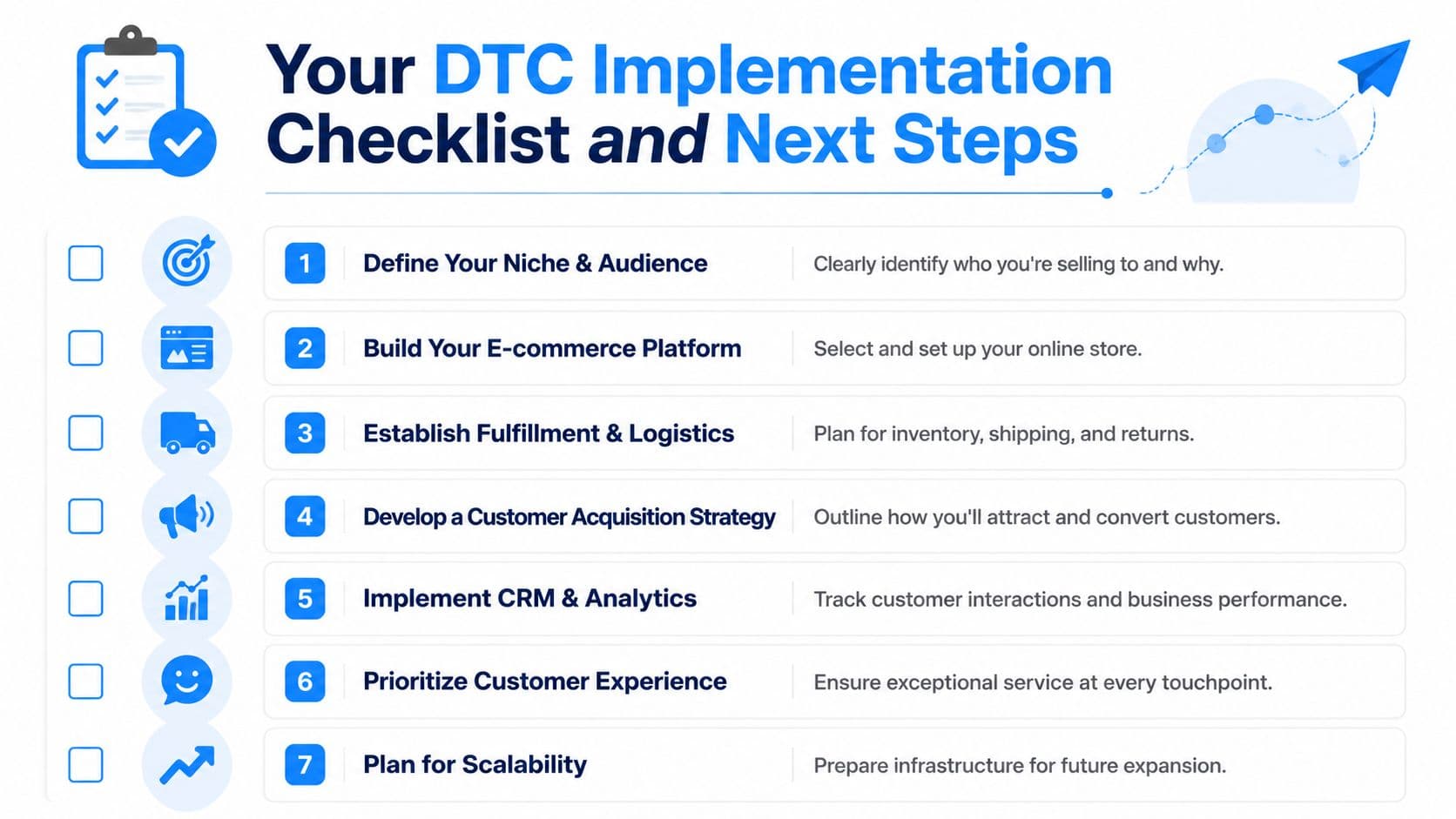
The cleanest way to launch DTC is to treat it like an operating model, not a campaign. That means deciding what the direct channel is supposed to do, what it is not supposed to do, and how it will coexist with the rest of the business.
A practical launch checklist
- Define your audience and value proposition. Be explicit about who the direct offer serves better than wholesale or retail does.
- Choose your storefront platform. For many merchants, that means Shopify and a clear theme architecture.
- Set up fulfillment and returns workflows. Inventory accuracy and shipping clarity need to be solved before traffic scales.
- Map your acquisition channels. Decide which channels drive discovery, which close, and which support repeat purchase.
- Install your core tech stack. You need analytics, messaging, and support tools that connect back to the same customer record.
- Design the customer experience. Policies, FAQs, and response times should feel intentional, not improvised.
- Build for scale early. If the process only works when someone is manually watching it, it isn't really built.
Advanced troubleshooting for established brands
Channel conflict is the issue most mature brands underestimate. McKinsey notes that a successful operating model has to apportion decision rights and budgets across D2C and store teams so the channels don't compete internally. That means DTC can't just be launched as a shadow business with its own incentives and no alignment.
The fix is governance. Decide who owns assortment, pricing, promotions, service rules, and budget allocation before the conflict starts. If retail and direct both chase the same customer without clear rules, the channel with the loudest internal sponsor usually wins, not the one that creates the best long-term value.
If you're building this on Shopify, start by tightening the customer experience and support workflow before you pour more money into acquisition. Then measure the model objectively, adjust the operating rules, and expand only when the economics and service quality hold together.
If you're ready to make direct selling more operationally sound, start by tightening your storefront, support, and fulfillment flow this week. For teams that want an AI chat layer that can handle product questions, policy responses, and cart recovery on Shopify, Carti is worth evaluating now rather than after support volume starts slowing conversion.
Frequently Asked Questions About DTC
Q: What does selling direct to customers mean?
Selling direct to customers (DTC) means the brand owns the storefront, the pricing, the customer relationship, and the data, instead of reaching buyers through retailers or marketplaces. The shift is strategic rather than channel-based. You take on acquisition, fulfillment, and support in exchange for margin and control.
Q: Is DTC more profitable than wholesale?
It can be, but not automatically. You keep retail margin, control pricing, and own customer data, while taking on acquisition costs, fulfillment, and support. Profitability usually hinges on repeat purchases, which is why retention metrics matter more in DTC than first-order economics.
Q: What tools does a DTC brand need to start?
Four functions at minimum: an ecommerce platform for storefront and checkout, marketing automation for email and SMS, analytics, and a customer support and engagement layer. The support layer is part of the conversion path, because a shopper asking about shipping or sizing is still deciding whether to buy.

Written by
Daniel AndersonFounder of Carti. 10+ years building ecommerce brands in apparel and supplements. Still runs a Shopify store and built Carti to help merchants convert more browsers into buyers.
Ready to boost your store's sales?
Install Carti in 5 minutes and let AI handle customer questions, recommend products, and close sales 24/7.
Start Free Trial14-day free trial