
A shopper lands on a product page at 11 p.m. with one question about sizing. If the answer isn't there, the sale often ends with the tab closed. Baymard's cart abandonment research, covering 50 ecommerce studies published between 2006 and 2025, puts the average documented abandonment rate at 70.22%. The same research found that 42% of US online shoppers abandoned a cart because they were only browsing or weren't ready to buy. That second number is the one worth sitting with. Plenty of those shoppers had a question they never got answered.
Founded in 2020 by Yoav Oz and Shauli Mizrahi, Rep AI built a business on that gap. It belongs to the conversational-commerce category that grew up around generative AI between 2020 and 2024, and it is often the first name merchants hear. Yet stores searching for a rep ai alternatives shortlist usually want the same thing: an assistant that answers real pre-purchase questions, recommends products, and fits a monthly budget.
The ten options below split into two distinct groups. Some are sales-focused storefront assistants that answer the first question, recommend a product, and place an add-to-cart button in the chat. Others are helpdesk suites with AI added on top, built to clear tickets rather than close sales. Each entry covers what the tool does after the first shopper question, which channels it covers, what its conversation limits allow, and where it falls short. Matching the category to your actual goal matters more than comparing feature checklists, because a tool built for support tickets will handle a sizing question very differently from one built to sell.
1. Carti
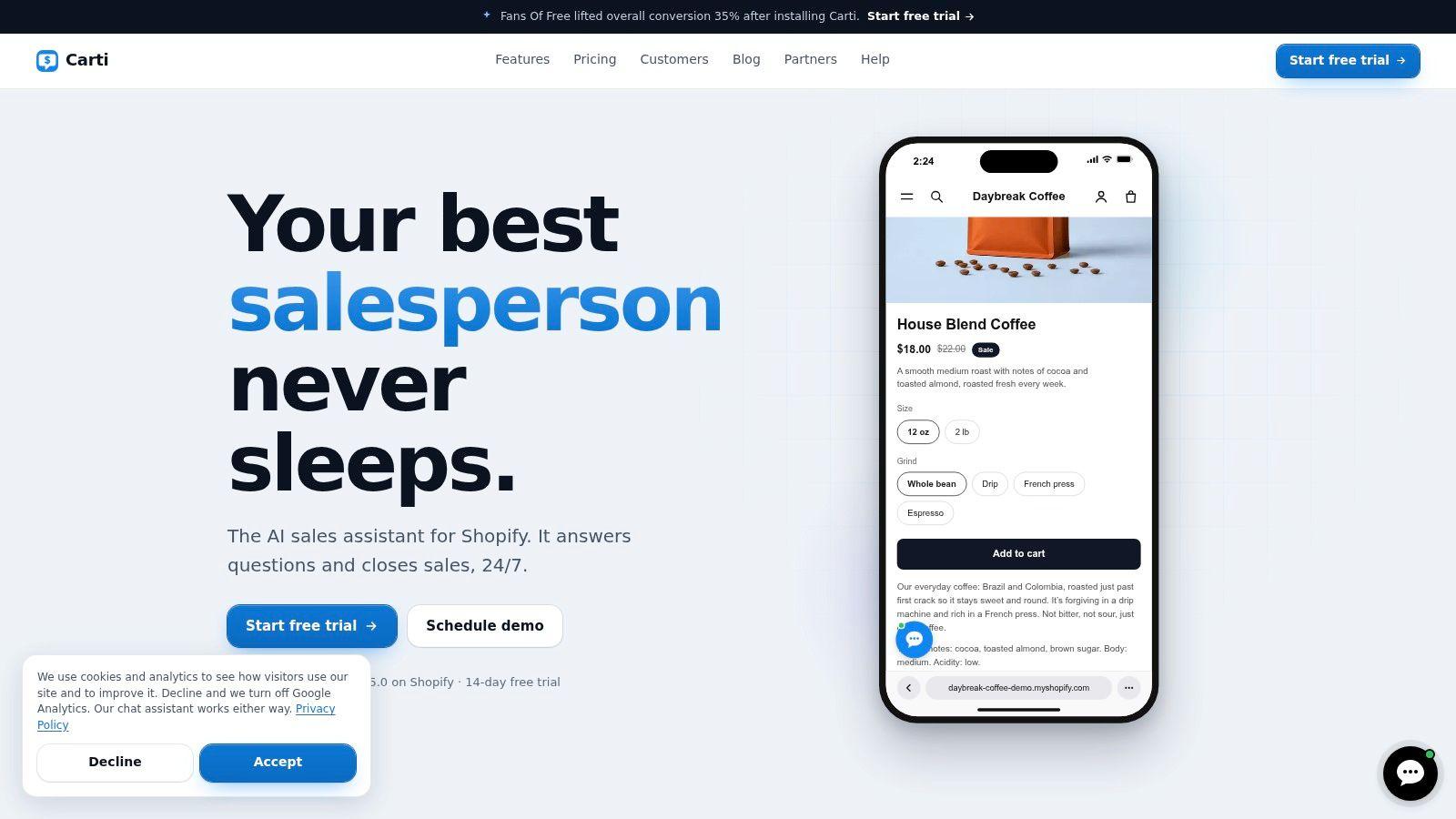
Carti is an AI sales assistant built only for Shopify stores. It learns the catalog, policies, and FAQs, then answers sizing, shipping, returns, and product comparison questions in storefront chat, on Instagram, and in Facebook Messenger. Setup takes a few minutes and needs no code.
What happens after the first question
The reply is not the end of the job. Carti can surface a product from the live catalog with its real price and stock shown inside the conversation, then place an add-to-cart button in the chat so the shopper doesn't have to hunt for the right variant. It also runs cart abandonment recovery in chat and six proactive triggers: rage click, inactivity, exit intent, scroll depth, time on page, and post add-to-cart. Human handoff and order tracking keep post-purchase questions out of the support inbox.
Answers draw on reviews from Judge.me, Loox, Yotpo, Okendo, and Fera, which helps with fit and quality questions that catalog data alone can't settle. Replies go out in 92 languages. An Insights Dashboard shows what shoppers ask, so gaps in product pages become visible instead of invisible.
Plans and limits
The Free plan includes 50 AI conversations a month. Starter is $49 a month for 250 conversations, Growth is $99 for 600, and Scale is $249 for 1,750. Paid plans add a 14-day free trial, advanced analytics, and removal of platform branding. Merchants using Carti report 7-10% more revenue from AI-assisted conversations.
-
Strong on pre-purchase selling: Product cards carry View Item, Add to Cart, or both buttons, so a question can end in a cart addition.
-
Multichannel coverage: Storefront, Instagram, and Facebook Messenger share one assistant and one knowledge base.
-
Fast start: No-code setup, a free tier, and a trial on paid plans make it cheap to test on a single product page.
-
Capped conversations: The allowance runs from 50 a month on Free to 1,750 on Scale, so high-traffic stores need to model volume before choosing a tier.
-
Data dependency: Answer quality tracks the completeness of product pages and policy copy. Thin pages produce thin answers.
Website: heycarti.com
2. Shopify Inbox
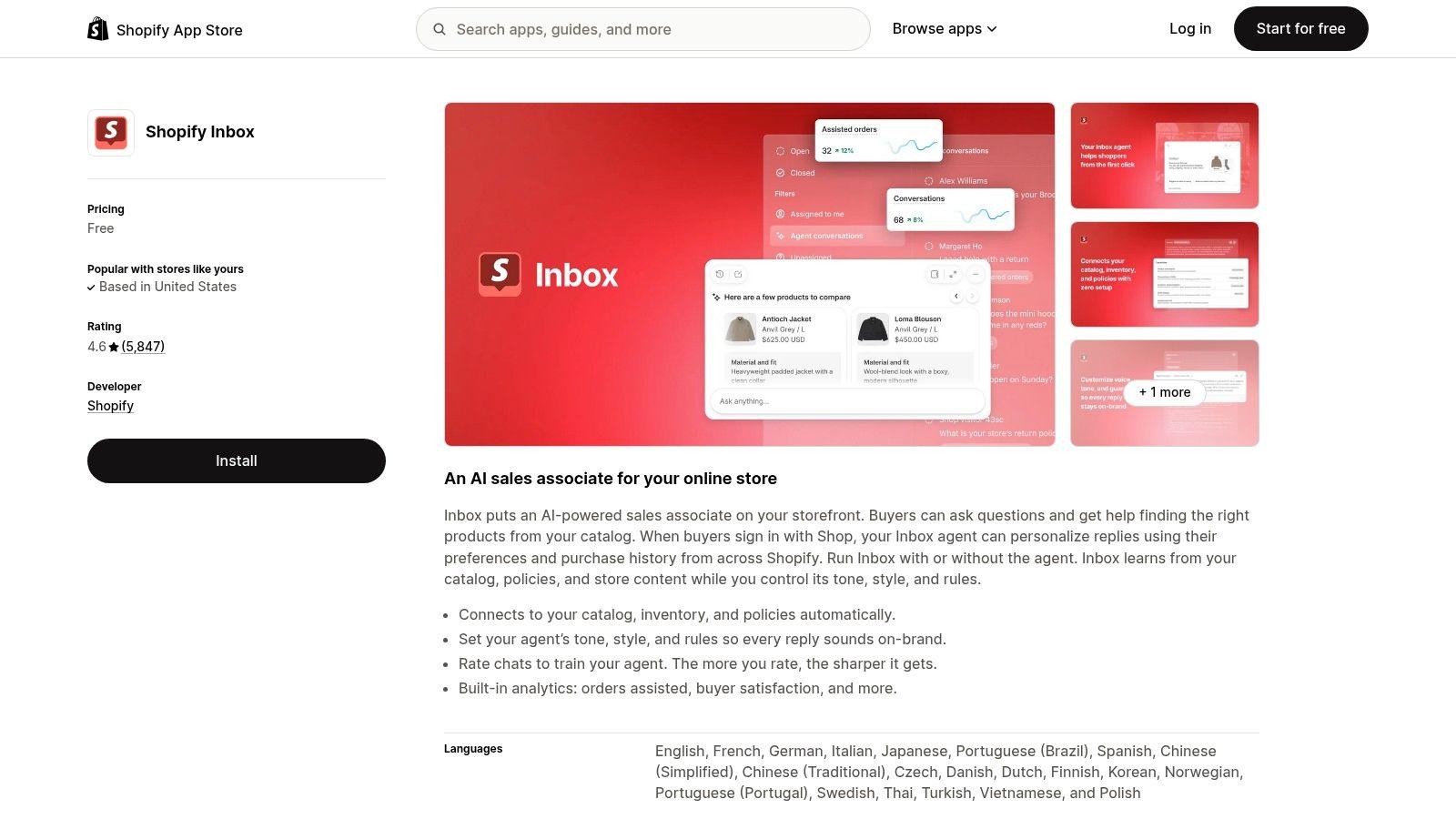
Shopify Inbox is a practical first test if you want storefront chat without adding an app bill. Its optional AI agent uses catalog and storefront information to answer questions about products, shipping, returns, sizing, and policies. It can recommend products, too.
The useful test is what happens after that first answer: does the recommendation help the shopper choose? Merchants can adjust tone, style, and rules, then use chat analytics to track assisted orders and buyer satisfaction.
A consumer study summarized by Axiobench found that 38% of U.S. consumers already used AI for online shopping in 2025, while 52% planned to. That makes shopping assistance worth evaluating, but your store's results matter more than adoption alone.
- Free and native: No app budget, data sync to maintain, or separate billing relationship.
- Reasonable starting point: The app listing has a large review base, though reviews alone won't establish whether it fits your sales workflow.
- Policy control: Rules help keep answers within approved topics.
- Narrow scope: Storefront chat is the focus, rather than multichannel support.
- Limited configuration: Deep workflows, routing logic, and broader channel coverage are reasons to consider another tool.
Choose it for a straightforward storefront trial. If your requirements extend beyond that, Shopify Inbox alternatives compared breaks down the trade-offs.
Website: shopify.com/inbox
3. Tidio with Lyro
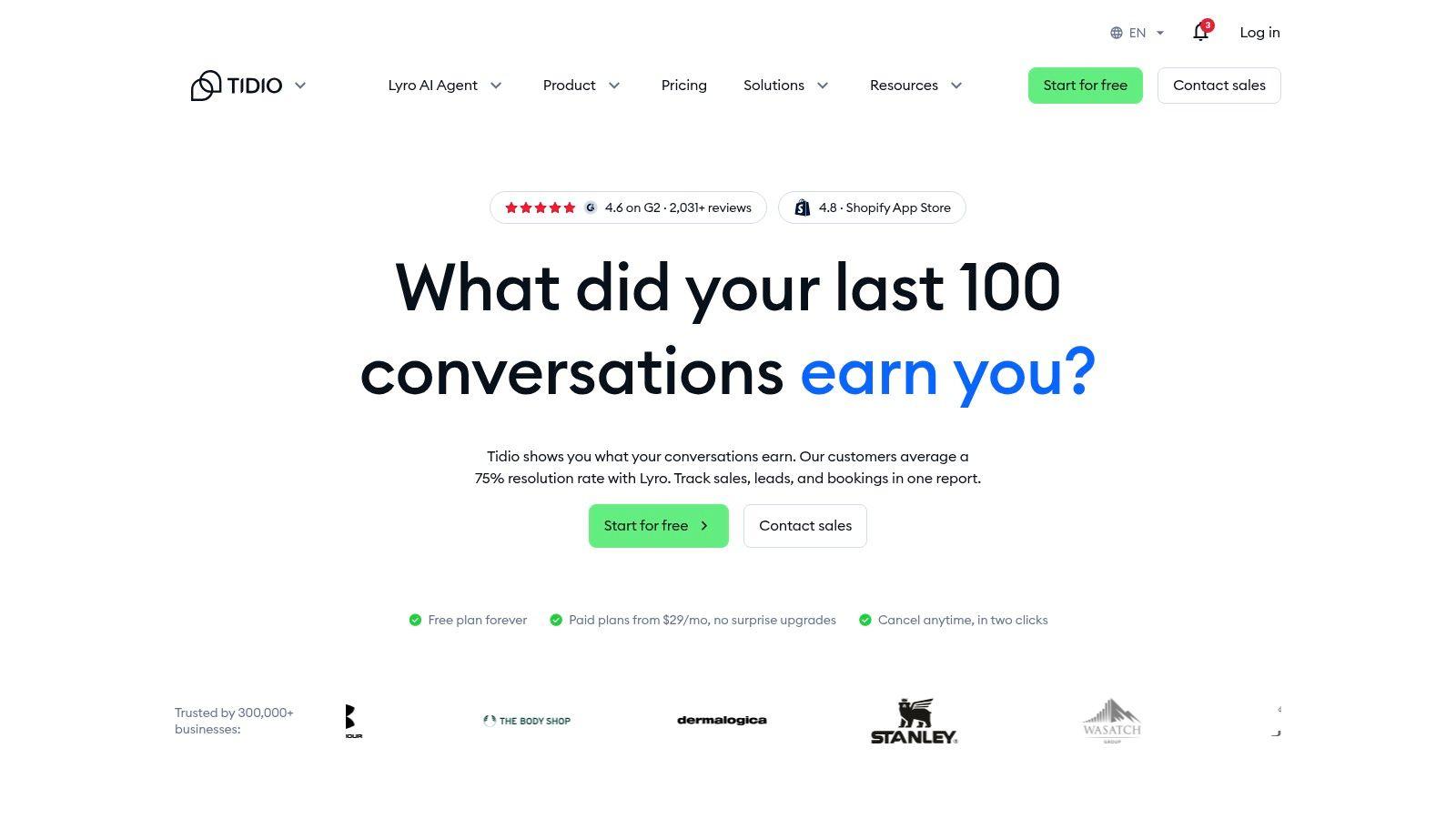
Tidio pairs live chat and helpdesk functions with Lyro, its AI agent. For Shopify stores, Lyro can use synced product data and show recommendations as product cards inside the conversation. The appeal is one system for automated answers and human support.
Speed is the argument for chat generally. Salesforce's connected customer research, based on responses from more than 8,000 consumers and business buyers, found that 83% expected to engage with someone immediately when contacting a company, up from 78% in 2019. The same report found that 52% described most service interactions as fragmented.
Check the free tier carefully: the free plan includes a one-time allowance of Lyro conversations rather than a monthly refresh. Confirm the current allowance on the vendor's pricing page before planning a launch around it.
-
Combined workflow: Automated answers and human agents share one inbox, so escalation doesn't require a second tool.
-
Shopify product cards: Recommendations can appear as cards with images and prices.
-
Low-risk trial: A free entry point exists, and paid plans can be tested before committing.
-
Volume-based costs: AI usage scales with conversation limits, so a busy month costs more.
-
Support-first design: It's customer-service software, not a product-discovery specialist.
Website: tidio.com
4. Zipchat AI
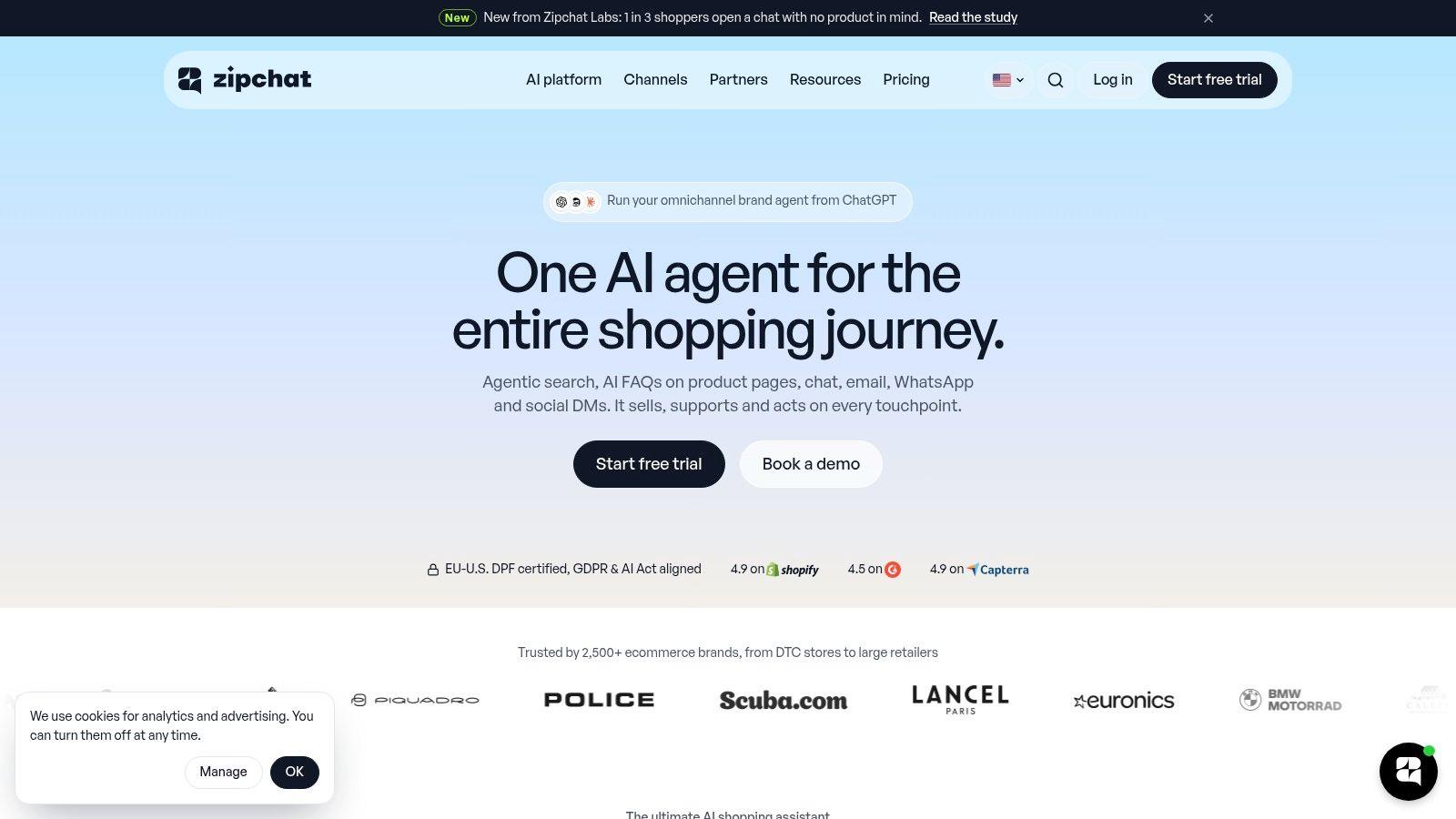
Zipchat is an ecommerce AI agent that runs on storefront chat, product pages, and messaging channels. Its Shopify integration handles catalog-based product search, order lookup, discount creation, and purchase tracking. Merchants who sell through DMs as much as through the store will find the channel list familiar: Instagram DMs, Facebook Messenger, WhatsApp, and email.
The willingness to buy inside a chat window is higher than most merchants assume. Valtech's survey of 1,003 consumers found that 71.5% across Europe, the United States, and Asia-Pacific said they would consider completing a purchase, including payment, inside an AI chat app.
Where it fits
Stores with a strong DM presence benefit most, because the same agent answers on the site and in the inbox. Discount creation inside chat is a practical touch for objection handling on price.
-
One agent, several channels: Consistency across storefront and messaging without duplicating knowledge.
-
Commerce actions: Order lookup and discount creation go beyond FAQ answering.
-
Published pricing: Costs can be estimated before a sales call.
-
Reply caps: Plans limit monthly AI replies, so spikes need extra packages or a higher tier.
-
Verify the Shopify specifics: Not every advertised capability is Shopify-specific, so confirm the ones that matter.
Website: zipchat.ai
5. Gorgias AI Agent and Shopping Assistant
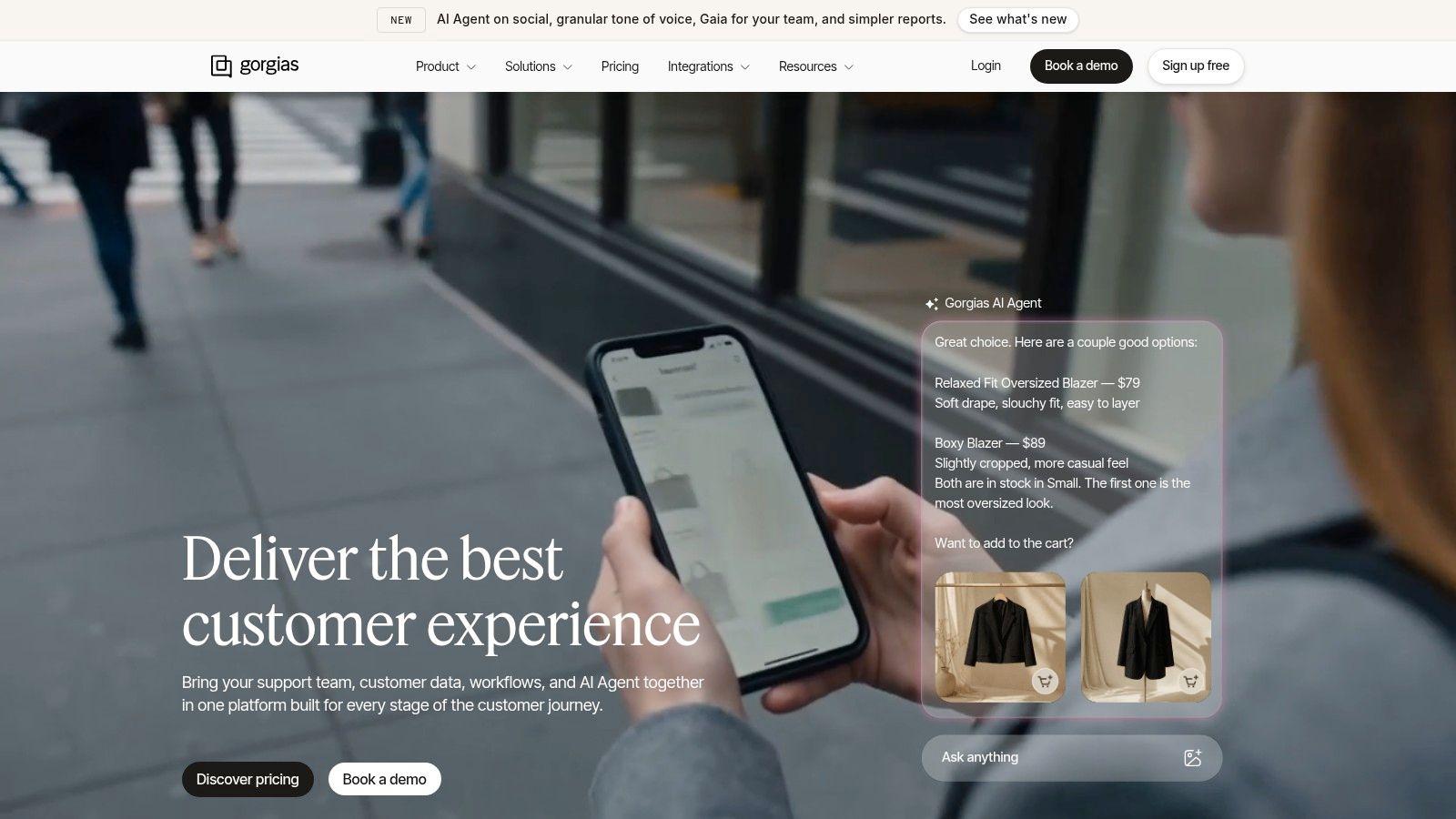
Gorgias is a Shopify-focused support inbox with AI layered across pre-purchase and post-purchase conversations. The Shopping Assistant answers product questions, recommends items using shopper context, and can share discounts. The AI Agent can perform configured Shopify actions, such as order changes, and hand off to staff.
Channel coverage is broad: chat, email, SMS, Instagram DMs, Facebook Messenger, and WhatsApp. For a store whose support load is already heavy, consolidating conversations and order context in one place is the main value.
Friction at checkout is expensive. Salesforce's state of connected customer report found that 74% of consumers were likely to switch brands if a company did not provide an easy checkout process, and 71% expected companies to communicate with them in real time.
The trade-off to price out: AI usage is charged on top of helpdesk plans. Run your monthly conversation volume through the vendor's calculator before assuming the entry plan covers it.
-
Deep Shopify workflows: Returns, order changes, and policy questions sit inside the same inbox.
-
Shared context: Agents see order history next to the conversation.
-
Tool consolidation: Support and shopping assistance come from one vendor.
-
More platform than some stores need: A merchant who only wants pre-purchase chat pays for a helpdesk.
-
Eligibility questions: AI Agent and Shopping Assistant availability varies by plan, so confirm it in the account.
A closer look at how the two differ sits in this Rep AI vs Gorgias comparison.
Website: gorgias.com
6. Re:amaze
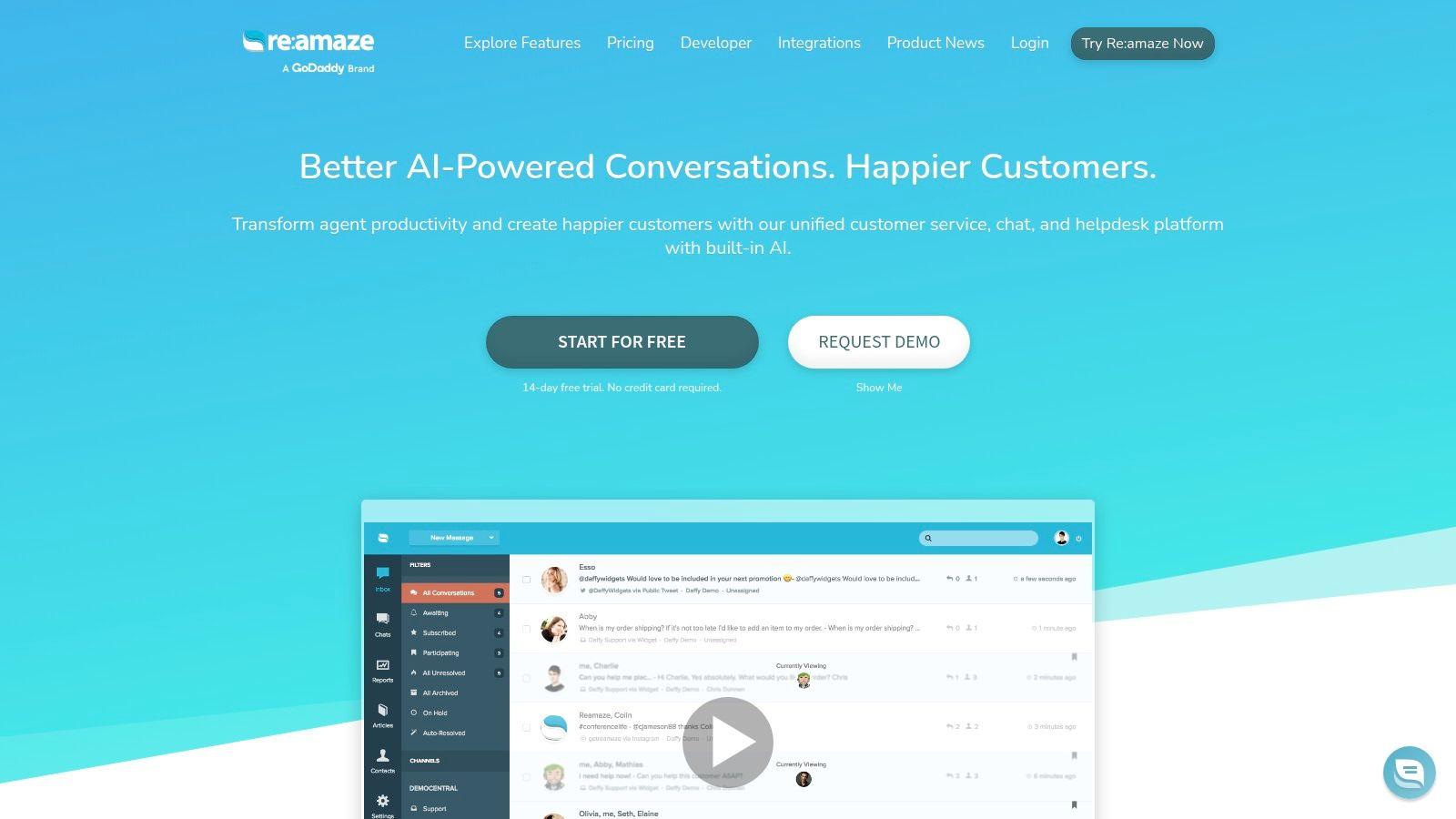
Re:amaze is a customer-support platform built around a shared inbox, with an AI Agent, chatbots, and Shopify order data visible alongside each conversation. It leans support rather than selling. That's not a flaw, it's a category.
Support quality is measurable, and the benchmark matters. An independent ecommerce AI customer service benchmark covering 15 ecommerce and direct-to-consumer deployments reported AI-handled support CSAT of approximately 4.2 to 4.8 out of 5, with selected deployments reaching 92% to 93% positive feedback against an ecommerce median near 82%. The spread is the point. Resolution quality, not deflection volume, drives those numbers.
-
One inbox across channels: Email, chat, social, SMS, and calls in a single queue.
-
Knowledge-grounded AI: The AI Agent responds from configured knowledge sources.
-
Order context: Shopify order data appears next to the conversation.
-
Support orientation: Product recommendations deserve a direct test against sales-first tools.
-
Plan variance: AI features and included resolutions differ by tier.
Website: reamaze.com
7. Octane AI
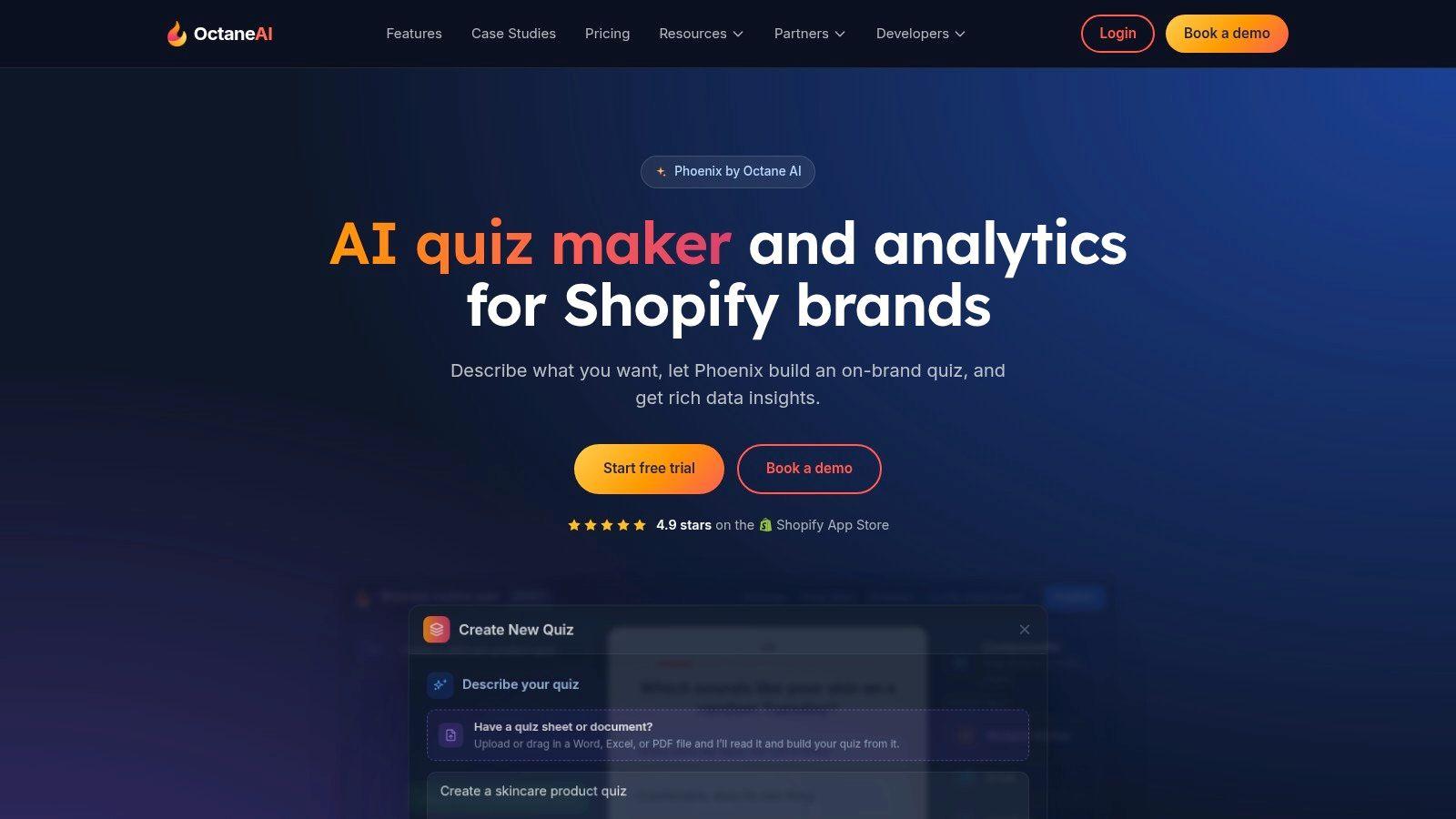
Octane AI is a quiz platform, not a chat widget replacement. Shoppers answer questions about preferences and get personalized recommendations. Its Phoenix AI assistant can build a quiz from a plain-language brief and the Shopify catalog, which cuts the setup time that used to make quizzes impractical for small teams.
That format suits catalogs where the shopper needs help narrowing down, not a single answer. Supplements, skincare, and apparel with dense variant trees are the obvious cases.
Salesforce's state of the connected customer, surveying more than 8,000 consumers and business buyers across 16 countries, found that 73% expected companies to understand their needs and expectations, while 52% described companies as generally impersonal. A short quiz is one way to act on that.
Where quizzes beat chat
A quiz collects structured preference data with every completion. That data feeds segmentation, email flows, and future recommendations. Open-ended chat rarely produces the same clean record.
-
Guided discovery: Strong when shoppers must choose among many products or configurations.
-
Zero-party data: Preferences are captured during shopping, not inferred later.
-
Track record: The Shopify App Store listing shows 4.7 out of 5 from 209 reviews.
-
Different experience: A quiz isn't a conversation, and some shoppers want to ask a question directly.
-
Tier limits: Entry plans cap quiz counts and include credit allowances, so heavier usage costs more.
Website: octaneai.com
8. Manifest AI
Manifest AI is the closest structural match to Rep AI on this list. It's a Shopify storefront chatbot for customer questions, product recommendations, and quiz-style discovery, positioned to handle buyer objections and reduce drop-off. Merchants who liked Rep AI's sales framing will recognize the shape of the product.
The category's pitch rests on conversion outcomes. An ecommerce support analysis of Rep AI alternatives reports that 79% of brands said they saw increased sales or conversions from AI-driven conversational commerce, and that 60% measured average order value as a key success metric. Those are brand-reported figures, so treat them as direction rather than a forecast for your store.
Free to install is not free to run. Shopify listings often show a zero-install price while usage is billed separately. Confirm the monthly charge at your conversation volume before building a launch plan around it.
-
Chat plus guided flows: Both open questions and structured discovery in one storefront experience.
-
Sales framing: Objection handling is part of the product's stated purpose.
-
Low entry barrier: The listing reviewed showed a free-to-install option.
-
Smaller evidence base: The listing reviewed showed 4.4 out of 5 from 61 reviews, well short of the large helpdesks.
-
Verify the details: Channel support, pricing thresholds, and catalog behavior need confirmation before scale.
For a direct feature comparison, see Manifest AI vs Rep AI.
Website: getmanifest.ai
9. BOBBI AI Shopping Assistant
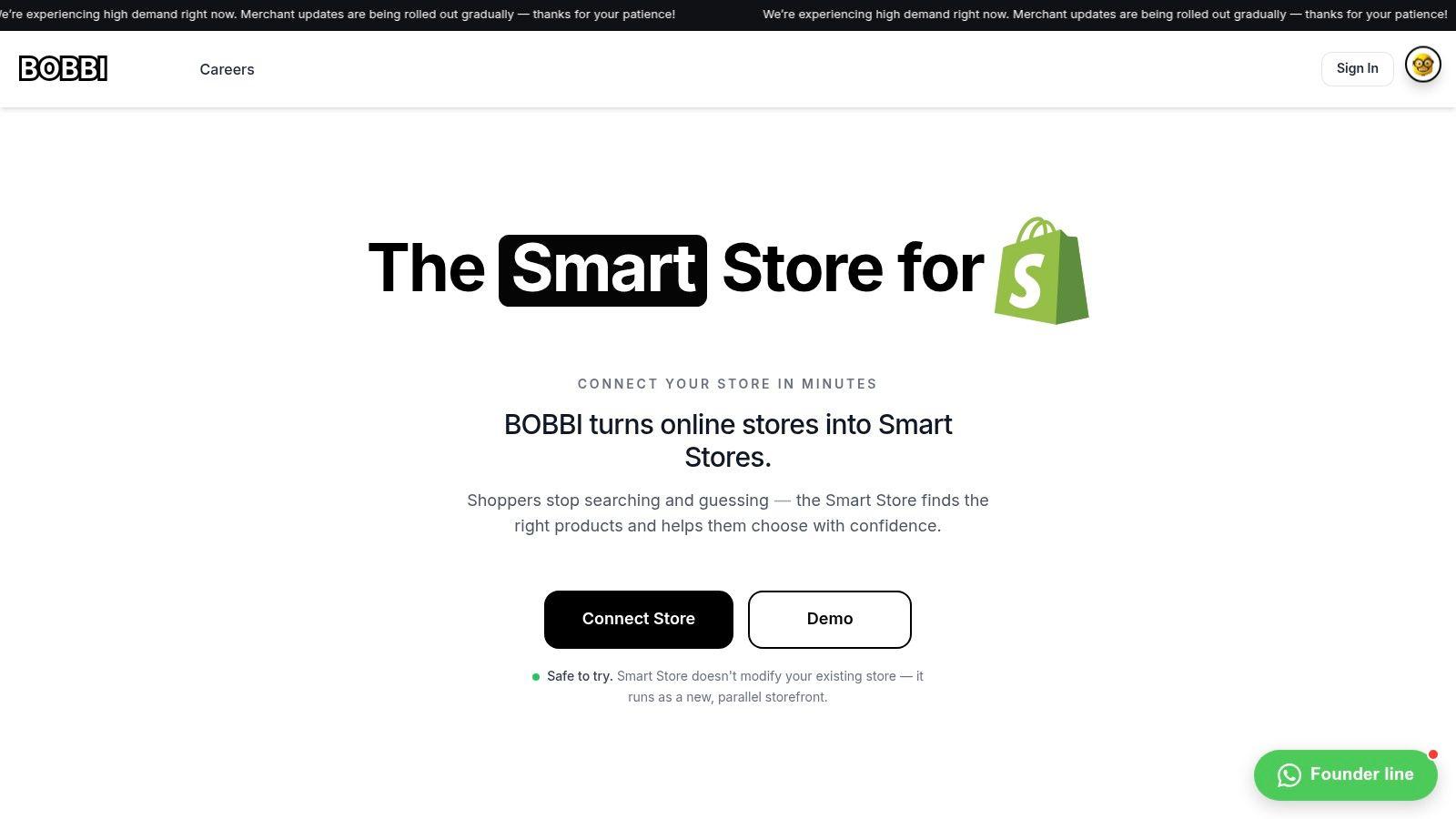
BOBBI takes a different interface approach. Shoppers describe what they need in natural language and matching products stay visible during the interaction, rather than disappearing behind a chat bubble. It uses the existing Shopify checkout, so nothing changes about payment or fulfillment.
Traffic routing is the feature worth noting. Merchants can decide what share of visitors sees the experience, which allows a controlled test against the current storefront. That's a more disciplined way to evaluate a newer tool than a full rollout.
Demand for this kind of shopping help is growing. Stord's state of AI report indicates that 51% of consumers had used generative AI for online shopping in 2025, up from 38% in 2024, while 17% used it regularly.
-
Distinct format: Product discovery that keeps results on screen beats a chat window for browsing behavior.
-
Testable: Traffic-split controls limit exposure while you measure.
-
Free plan: A free tier is shown on the Shopify App Store.
-
Thin reputation data: The listing reviewed had only four reviews.
-
Language coverage: The listing says English is supported, which may not fit multilingual stores.
-
Not a support inbox: No multichannel helpdesk role.
Website: bobbi.live
10. Inveon.ai AI Shopping Assistant
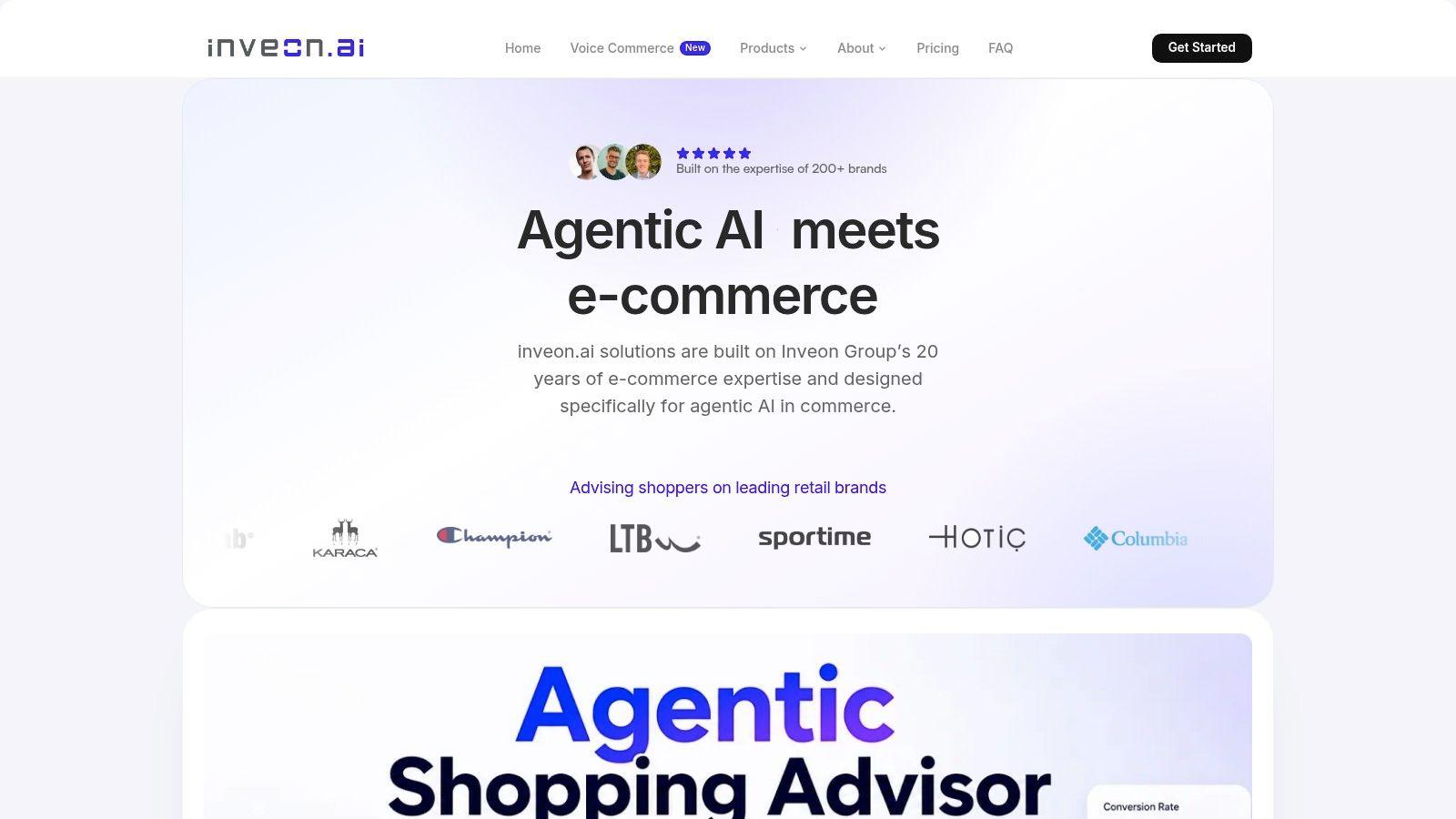
Inveon.ai's ASA is a sales-led Shopify assistant. It combines product and order questions with real-time recommendations, proactive chat for shoppers showing purchase intent, and upsell and bundle features. For a brand trying to lift basket size rather than cut ticket volume, that mix is relevant.
Price is the first thing to check. It sits well above free and low-cost alternatives, so the revenue case has to be clear before committing. The review count is small, which means the displayed rating is limited evidence of long-term reliability.
Published performance claims deserve scrutiny across the whole category. An investor profile of Rep AI reports that the platform helped Shopify stores increase conversions by 250%, reduce support tickets by 95%, and raise average order value by 40%. The same records don't identify sample size, baseline conversion rates, time period, or attribution method. Apply the same skepticism to any vendor number, including the ones on this list.
The test that settles it: run 20 real pre-purchase questions from your own product pages through the assistant. Count correct answers, unsupported claims, and clean handoffs. That tells you more than any published percentage.
-
Basket-building features: Upsells, bundles, and recommendation analytics go beyond FAQ answering.
-
Proactive engagement: Chat can trigger on purchase intent signals.
-
Trial available: The Shopify App Store listing includes a 15-day free trial.
-
Premium entry price: Confirm the current figure on the vendor's pricing page.
-
Limited review history: A very small number of reviews makes the rating weak evidence.
-
Verify channels and limits: Usage caps and channel coverage need checking before comparing it with omnichannel tools.
Website: inveon.ai
How the ten options differ on free access, primary focus and best-fit use
| Item | Free option | Primary focus | Best for |
|---|---|---|---|
| Carti | Free plan: 50 AI conversations per month | Shopify sales chat and product recommendations | Stores seeking a multilingual sales assistant across storefront and social channels |
| Shopify Inbox | Free | Shopify-native storefront messaging and AI answers | Merchants wanting a simple, integrated chat starting point |
| Tidio with Lyro | Free plan with a one-time AI conversation allowance | AI answers combined with live chat and helpdesk tools | Stores combining automation with human customer support |
| Zipchat AI | 7-day free trial | Ecommerce AI selling across chat and messaging channels | Merchants seeking cross-channel product recommendations and automated conversations |
| Gorgias AI Agent and Shopping Assistant | Free trial | Shopify customer support and shopping assistance | Teams managing pre- and post-purchase conversations in one inbox |
| Re:amaze | Free trial | Shared inbox, live chat, and AI-powered customer support | Merchants centralizing support conversations and Shopify order context |
| Octane AI | Free trial | Product quizzes and personalized discovery | Stores that want guided product selection and shopper preference data |
| Manifest AI | Free to install; ongoing usage costs may apply | Shopify chatbot and guided product discovery | Merchants seeking chat and recommendation features in one storefront experience |
| BOBBI: AI Shopping Assistant | Free plan | Conversational product discovery | Stores testing an alternative to standard chat with a portion of their traffic |
| Inveon.ai AI Shopping Assistant (ASA) | 15-day free trial | Sales chat, proactive recommendations, and upsells | Brands focused on increasing basket size with product suggestions and bundles |
The free access column deserves a close read, because the entries are not equivalent. A permanent free plan, like the ones from Carti, Shopify Inbox and BOBBI, renews every month and can carry a low-volume store indefinitely. Tidio's free tier works differently: its AI allowance is a one-time quota, so once those conversations are used, Lyro stops answering unless you pay. A time-limited trial, like the ones Zipchat and Inveon.ai offer, expires on the calendar no matter how few conversations you ran. That difference decides how long you can evaluate a tool with real shoppers before money is involved.
The focus column is the faster filter. Carti, Zipchat, Manifest AI, BOBBI and Inveon.ai are storefront sales assistants: their job starts at the pre-purchase question and ends at a recommended product or an add to cart. Gorgias and Re:amaze are helpdesk suites with AI layered on top, built for teams that already run a support queue and want order context in one inbox. Tidio sits between those groups, pairing automation with live chat. Octane AI is its own category, since the quiz is the product and chat is secondary.
Match the tool to the outcome you want before comparing prices. If the goal is converting browsers on product pages, a helpdesk suite will feel like the wrong purchase no matter how strong its ticket features are. If the goal is shrinking a support backlog, a sales-first assistant will leave the post-purchase queue untouched. Most stores comparing Rep AI alternatives are in the first group, which is why the sales assistants dominate this list.
Matching Each Store to the Right Assistant
Start with the channels your shoppers use and the number of conversations you expect in a normal month. A store that sells through Instagram DMs needs a different tool from one whose support queue is full of return requests. Write both numbers down before opening a single pricing page.
Then look at what each tool does after the first question. An assistant that answers but can't recommend, can't add to cart, and can't hand off cleanly is an FAQ widget with better copy. Test that sequence on a live product page, not in a demo.
Billing models are not interchangeable. G2's alternative listings for Rep AI sit alongside tools billed per conversation, per reply, by product count, by seat, and by resolution. Those lists also mix ecommerce sales tools with general customer-service platforms, which makes category-level comparison misleading unless you separate pre-purchase conversion assistants from post-purchase help desks.
The cheapest listed plan is often not the cheapest month. Usage caps and overage behavior decide the real bill, especially in a peak season. Model your cost at three traffic levels, a quiet month, a normal month, and your best month of the year, and see which plans hold up.
Timing matters too. Deloitte's 2025 Holiday Retail Survey found that 33% of U.S. consumers planned to use generative AI during their holiday shopping journeys. A tool that hasn't been tested before the peak is a liability during it. Run a two-week pilot in a quiet period and read the transcripts.
A shortlist worth building: Shopify Inbox to establish a baseline for free, one sales-focused assistant to test recommendation and add-to-cart behavior, and one helpdesk-led option if post-purchase volume is heavy. For Shopify stores that want a sales-focused storefront assistant with a free plan and a 14-day trial on paid plans, Carti is a strong option to evaluate first.
If a shopper's question is where your sales stall, Carti answers it on the storefront, recommends products from the live catalog, and can put an add-to-cart button inside the conversation. Plans start free with 50 AI conversations a month, then run $49, $99, and $249 a month for 250, 600, and 1,750 conversations, with a 14-day free trial on paid plans. Visit Carti to see how it handles sizing, shipping, and product comparison questions for your own catalog.

Written by
Daniel AndersonFounder of Carti. 10+ years building ecommerce brands in apparel and supplements. Still runs a Shopify store and built Carti to help merchants convert more browsers into buyers.