
You're three weeks from your biggest sale of the year, and the chat app you installed in January is still on the tier you picked when the store was quiet. The printed price looks small next to your ad spend. Then you open the invoice and find a line item you can't explain, because the plan counted conversations and your shoppers asked four questions each.
That gap between the advertised tier and the bill is what chatty pricing means in practice. Two things sit under the phrase. One is the conversation a shopper has about price itself. The other is how the vendor meters that conversation and charges you for it. Most pricing pages explain the second badly and the first not at all.
The fix is arithmetic, not intuition. Count the replies your shoppers really use, price the busiest month rather than the average one, and turn both into a single cost per conversation you can compare across vendors.
What Chatty Pricing Means and How Vendors Bill for It
Chatty pricing is the conversation around price itself. A shopper asks what an item costs delivered, how a discount stacks, or why two similar products sit at different prices, and the chat answers in the same terms the storefront uses. No new number, no invented bundle, no vague promise to check at checkout.
That job matters because price confusion is expensive at the last step. Baymard reports that 40% of shoppers abandon checkout because additional costs such as shipping charges and taxes are too high or appear unexpectedly, in its research on reducing cart abandonment. A chat that states shipping and tax before the payment page removes one specific reason to leave.
Complexity does damage even earlier. In a controlled market experiment run by the Consumer Financial Protection Bureau, buyers facing 16 sub-prices were 15 times more likely to choose a higher-priced offer than buyers seeing the same offer as one price, according to the CFPB report on price complexity in laboratory markets. Lead with the landed total, then break out components if the shopper asks.
The counted unit decides the bill
Every vendor counts something. A conversation, a reply, a visitor, a resolved ticket, a feature switch. That unit, not the headline fee, sets how fast your spend grows when traffic climbs.
Chatty pricing models compared
| Model | How it is billed | Advantage | Drawback | Best suited to |
|---|---|---|---|---|
| Flat monthly tier | Fixed fee with a conversation or visitor cap | Predictable spend and easy budgeting | A busy month can force a jump to the next tier | Steady, predictable traffic |
| Per conversation | Charged for each chat session | Easy to understand and easy to audit | A long shopping session costs the same as one quick question | Short, simple chats |
| Per AI reply | Charged for each answer the assistant sends | Tracks real usage closely | Hard to forecast because one question can trigger several replies | Low or very uneven usage |
| Metered overage with spending cap | Included allowance, then a fee per extra reply | Low entry price with protection from spikes | The cap can stop replies at peak demand | Stores that want a hard cost ceiling |
| Base fee plus add-ons | Platform fee plus paid features or flows | Pay only for the features you use | Each add-on raises the total and blurs comparisons | Narrow needs, one or two features |
A flat tier is the easiest line to forecast, and the hardest to fine-tune. Cross the cap by a handful of chats and you buy the whole next tier, not the difference. Per-conversation billing audits cleanly against your own logs, though it treats a twenty-message sizing debate and a one-line shipping question as the same event.
Per-reply billing follows real effort, which is fair until you notice that a single comparison question can generate several answers. Metered overage keeps the entry price low and the ceiling firm, but a cap that halts replies during a launch turns a billing safeguard into a sales problem. Add-on pricing suits a store that wants two flows and nothing else, and it makes vendor comparisons messy because no two bundles contain the same parts.
Practical rule: price the plan against your busiest week, then check what the tool does when the allowance runs out mid-conversation.
Two questions for every vendor
Ask what exactly is counted, in writing, with an example transcript attached. Then ask what happens on the busiest day of the year, including whether the assistant keeps answering, downgrades, or goes quiet.
Recurring app charges deserve the same scrutiny as any other subscription line. For tracking renewals, usage charges and invoice cycles across a stack of tools, renn's small business billing guide is useful when several apps bill your Shopify account on different schedules.
Why Price Clarity Changes What Shoppers Buy
A shopper builds a cart, likes the product, and reaches the payment step. The total is higher than the number on the product page. They close the tab because they cannot tell what changed.
Interest in getting those answers conversationally is already broad. In 2024, 55% of consumers surveyed across 26 countries said they wanted to use virtual assistants while shopping, according to IBM's Institute for Business Value consumer study cited in this conversational commerce statistics roundup. That measures stated interest, not proof that any particular chat widget lifts revenue.
Clear price presentation still matters because shoppers notice when an answer reduces uncertainty. A chat reply that names the product price, stock status, and any promotion gives the buyer something firmer than a general sales answer. On Shopify, Carti can recommend a product from the live catalog with its price and stock shown in the chat, and can place an add-to-cart button in the conversation. That keeps the answer close to the purchase decision instead of sending the shopper back to compare tabs.
The share of shoppers who name surprise costs as their reason for leaving is a different measure from the share of all carts left behind. Treat them separately when you set targets. One describes a stated reason. The other describes an outcome with many possible causes.
Price clarity also affects the bill. A vague answer creates follow-up questions, rephrasing, and repeat sessions. Each turn consumes capacity on a metered plan, or pushes a fixed plan closer to its next tier.
Three questions worth asking any chat tool about its price answers:
- Storefront parity. Does it quote the same price the product page shows, including the current promotion, or does it paraphrase from an old catalog sync?
- Assumptions stated. Does it say when shipping and tax depend on the shopper's location, rather than presenting a total it can't honor?
- Value explained. Can it explain why two products differ using materials, size, included accessories or warranty, instead of just repeating both numbers?
A tool that fails those questions wastes both shopper time and paid conversation volume. Better answers reduce the need for another chat before the buyer decides.
Sample Monthly Costs for Shopify Stores
Start with the formula, because it exposes what tier pricing hides. Monthly price divided by included AI conversations gives the best-case cost per conversation, and you only reach that figure when the store uses the entire allowance.
Unused capacity isn't free. It's the same fixed fee spread over fewer chats, which is why a quiet month can cost more per conversation than a busy one on the identical plan.
Sample monthly costs by store size on Carti plans
| Store scenario | Included conversations per month | Plan | Monthly price | Best-case cost per conversation |
|---|---|---|---|---|
| Small store testing chat | 50 | Free | $0 | $0 |
| Steady store | 250 | Starter | $49 | $49 divided by 250 |
| Growing store | 600 | Growth | $99 | $99 divided by 600 |
| High-traffic store | 1,750 | Scale | $249 | $249 divided by 1,750 |
The Free plan costs $0 per month and includes 50 AI conversations per month, which is enough to judge answer quality on real transcripts before spending anything. Starter runs $49 per month for 250 AI conversations. Growth is $99 per month for 600 AI conversations, plus everything in Starter.
What under-use does to the real number
Say a store on Growth handles 400 conversations in a slow month. The fee stays at $99, so the cost lands near $0.25 per conversation instead of the best-case figure in the table. Nothing broke. The store bought capacity it didn't use.
Run the same math in reverse during a sale month and the picture flips. A plan that looks expensive per conversation at half utilization becomes the cheapest option when the allowance is fully consumed, which is why the printed tier price is a poor ranking tool on its own.
These are monthly conversation caps, not unlimited use. When the count reaches the cap, the month's remaining chats need either a higher tier or an overage arrangement, and that decision should be made before the sale, not during it.
For a sense of how differently other Shopify chat tools structure their tiers and counted units, this breakdown of Tidio pricing is a useful cross-check against the conversation-cap model.
Divide the plan price by the conversations you actually expect, not the conversations the plan allows.
Take your own average monthly conversation count, divide the plan price by it, and hold that number next to the table. If your figure is more than double the best-case column, the plan is oversized for normal months and you're paying for headroom you only need twice a year.
How Reply Counts Change Your Real Bill
A conversation count tells you how many sessions started. It says nothing about how much work happened inside them, and that's where per-reply economics diverge from per-conversation economics.
Chatty's pricing page states that it charges $0.075 for each AI reply beyond the included allowance and that the average conversation contains 2.5 replies. Those two numbers together explain why a store can blow through an allowance while its session count looks modest.
Replies per conversation and total replies
| Session type | Replies per session | Total replies for 100 sessions |
|---|---|---|
| Single-question FAQ | 1 | 100 |
| Average session as stated on Chatty's pricing page | 2.5 | 250 |
| Product comparison or sizing chat | 4 | 400 |
The multiplication step
Subtract the included reply allowance from your total replies, then multiply the remainder by the per-reply fee. That's the whole calculation.
Work it with stated assumptions. If a plan's allowance covers 150 replies and the store sends 250 in a month, the extra 100 replies at $0.075 each add $7.50 to the bill. Small in isolation, and the same arithmetic on a launch month with several thousand extra replies is not small at all.
The pattern behind those numbers is predictable. A shipping question resolves in one answer. A sizing question pulls a follow-up about fit, then a comparison, then a returns question, and each turn is another billable reply. Stores selling apparel, beauty or anything with variants should expect the higher end of that range as their normal mix, not their exception.
Peaks and caps
Budget for the peak month, because a sale week that doubles traffic doubles the reply count for that period while your allowance stays flat. Then check what the spending cap does. A cap that stops extra charges but keeps answering is a different product from a cap that stops replies, and only one of them protects revenue during a launch.
Per-reply metering also changes how you write answers. Front-loading shipping, returns and sizing into the first reply reduces the number of turns needed, which lowers the bill directly. For a comparison of how seat-based and ticket-based helpdesk tools meter their AI usage instead, see this analysis of Gorgias pricing.
Work Out Your Own Monthly Conversation Volume
Measure before you compare. Three steps give you a number you can defend, and none of them require a spreadsheet model.
-
Pull the traffic baseline. Open Shopify analytics and write down sessions and orders for the last three months, including the busiest one. Keep the peak month visible rather than averaging it away, since the peak is what sets your plan.
-
Measure your chat rate. During a trial, count the chat sessions the store starts and divide by store sessions over those same days. Multiply that rate by monthly sessions to get an expected conversation count. A trial that runs only through a quiet week will understate the peak, so note which days you sampled.
-
Sort sessions by type. Tag transcripts as single-question FAQ chats at one reply, average chats at about 2.5 replies, and product comparison or sizing chats at four or more. Read twenty transcripts and the mix becomes obvious. That mix, not the session count, decides whether a reply-metered plan is cheap or expensive for your catalog.
Now apply it. Say the count lands at 800 conversations in a month. A plan capped at 600 won't cover it, so the choice is the next tier up or a written overage budget for the difference, and the cheaper of those two depends on how far past the cap you expect to go.
Repeat the count for the sale month separately. A week that doubles traffic doubles the conversation count for that week, and a monthly allowance doesn't stretch to accommodate it.
Write the peak-month figure at the top of the page and use it for every plan comparison that follows.
One caution on the chat rate itself. Proactive prompts raise it, sometimes sharply, because the store starts conversations that shoppers wouldn't have opened. If you switch triggers on after the trial, remeasure rather than reusing the old rate.
How to Evaluate, Negotiate and Trim the Bill
Check the counted unit first and the feature list last. Most regretted purchases in this category come from a merchant who compared capabilities and never compared metering.
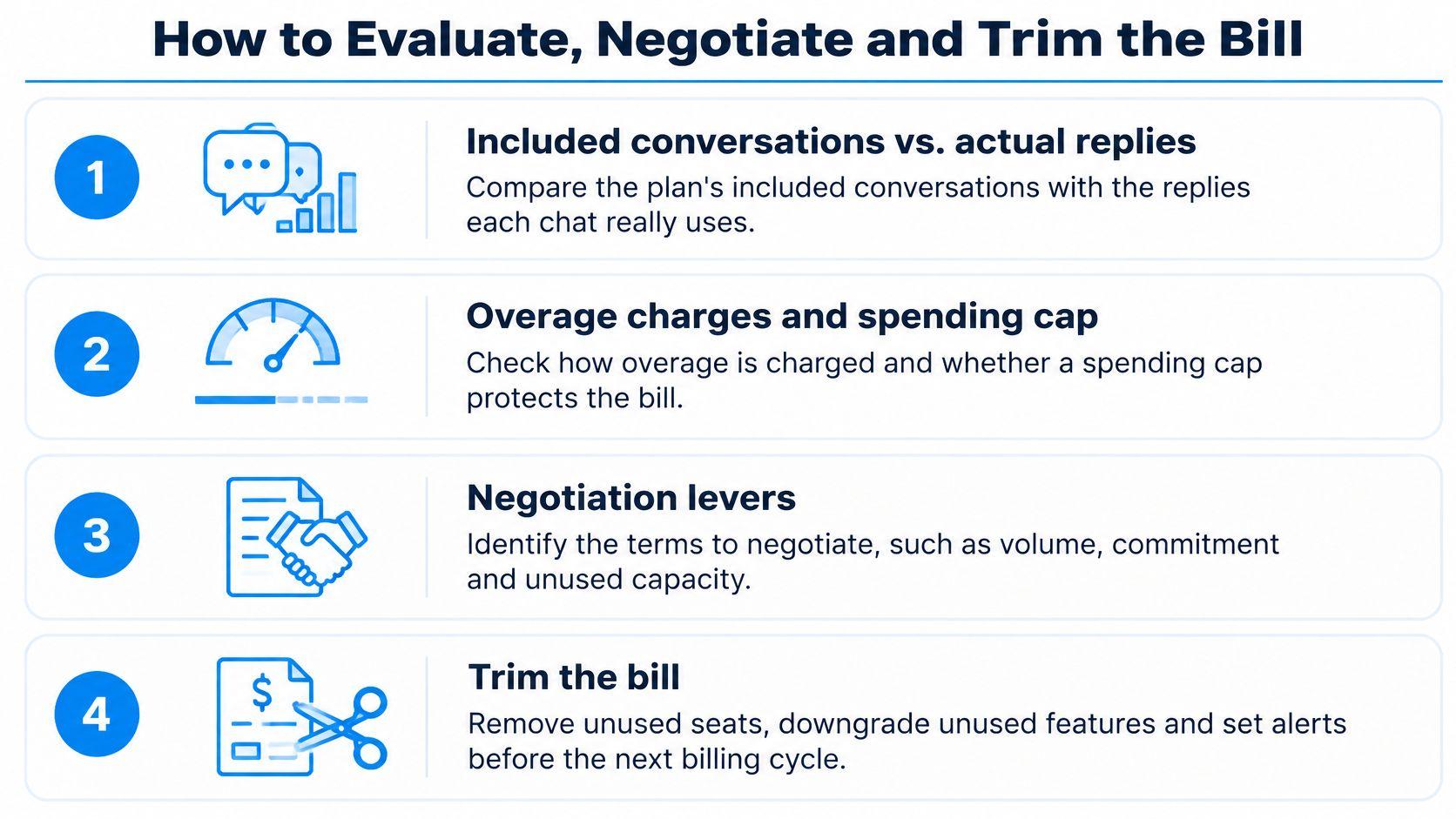
The evaluation order
- Included conversations against real replies. Compare the allowance with the replies your transcripts consume.
- Overage mechanics. How the extra is charged, and whether a spending cap exists.
- Reporting. What the dashboard shows about conversations, answers and outcomes.
- Languages and channels. Which markets and inboxes the tool covers.
- Catalog and policy reading. Whether it answers from your live products and policies.
- Trial length. Long enough to include a weekend and a promotion.
- Setup time. How much work stands between install and first useful answer.
Carti is an AI shopping assistant for Shopify with plans Free, Starter, Growth and Scale at monthly caps of 50, 250, 600 and 1,750 AI conversations, and a 14-day free trial on paid plans. Every limit there is a monthly cap. Current details sit on the Carti site.
On reporting, the dashboard shows orders and revenue from shoppers who chatted on every plan. Starter includes reports comparing chat and non-chat conversion rates and average order value, and every paid plan includes advanced conversion analytics covering conversion lift, revenue per conversation and engagement trends over time. Growth adds holdout sales-lift tests and a monthly sales report with recommendations.
Coverage matters for stores selling outside one market. Carti replies in 92 languages and answers Instagram and Facebook Messenger messages, and setup takes a few minutes with no code. Transcripts are reviewable at any time, which is what makes the reply-count audit possible in the first place.
Six things to settle before you commit
- Get the unit defined in writing. Ask what counts as an AI reply and whether a whole conversation counts as one unit. A vendor that can't answer precisely is a vendor whose invoice you can't audit.
- Confirm the reset and the exhaustion behavior. Does the allowance reset monthly, and what happens the moment it runs out? Silence, degraded answers and continued metering are three different outcomes.
- Put the overage rate and the cap in the contract. Confirm a spending cap can be set, and confirm whether it stops charges or stops replies.
- Ask about discounts rather than assuming them. Promotional and annual pricing may exist. Ask, get it in writing, and don't build a budget on a discount nobody confirmed.
- Read the cancellation terms and trial length. Check notice periods and whether an annual commitment locks in a tier you've outgrown. This look at Zipchat pricing shows how differently vendors in the same category package tiers and commitments.
- Run a two-week test on real transcripts. Then compute cost per conversation from the test, not from the pricing page.
Trimming the bill without hurting answers
Answer shipping, returns and sizing in the first reply. Every question resolved in one turn is a turn you don't pay for on a reply-metered plan, and it's a better shopper experience anyway.
Keep the knowledge base current. Stale policy pages produce wrong answers, wrong answers produce repeat questions, and repeat questions produce both overage and refunds. Review each invoice against the conversation count for that month, and investigate any month where the two move in different directions.
Then pick the plan whose allowance covers a typical busy month, not your quiet average and not your absolute record day. Downgrade unused features, remove seats nobody logs into, and set a billing alert before the next cycle rather than after it.
Carti answers pre-purchase questions from your live catalog and policies, shows orders and revenue from shoppers who chatted on every plan, and prices on monthly conversation caps of 50, 250, 600 and 1,750 so you can match a tier to the peak-month count you just calculated. Start on the free plan, read twenty transcripts to see how many replies your shoppers really use, then test a paid tier with the 14-day free trial. Visit Carti to compare the caps against your own numbers.

Written by
Daniel AndersonFounder of Carti. 10+ years building ecommerce brands in apparel and supplements. Still runs a Shopify store and built Carti to help merchants convert more browsers into buyers.