
Tidio's Free plan costs $0 per month for 50 conversations, Starter costs $29 monthly or $24.17 per month billed annually for 100, and Growth starts at $59 monthly or $49.17 per month billed annually for 250. Those are core-plan prices, not an all-in AI budget.
The common advice to choose a plan by its sticker price misses the buying decision that matters. A Shopify merchant needs to budget for human conversations and Lyro AI conversations separately, then choose capacity around whichever allowance runs out first.
Tidio Pricing at a Glance
Tidio core plans from the pricing page
Tidio's pricing page lists these public starting prices and included billable conversations.
| Plan | Monthly billing | Annual billing per month | Included conversations |
|---|---|---|---|
| Free | $0 | $0 | 50 |
| Starter | $29 | $24.17 | 100 |
| Growth | From $59 | From $49.17 | Starts at 250 |
| Plus | From $300 plus usage | Not listed publicly | Usage based |
| Premium | Custom | Custom | Custom |
Plus is priced from a usage-based quote, so the starting monthly price is the figure to budget from until checkout returns the actual quote.
The table covers the customer-service meter. Treat Lyro AI as a second meter with its own quota when you build the budget; a plan can look adequate for human chat and still be the wrong size if AI capacity is the first allowance to run dry.
Starter doubles Free's included conversation allowance, while entry-level Growth provides five times Free's allowance. That makes the table useful for a first budget, but the store still needs a demand estimate before choosing capacity.
Compare commitment before comparing savings
Annual billing is approximately 16.7% less than monthly billing for Starter and entry-level Growth. The page math is $29 times 12 equals $348 versus $24.17 times 12 at $290.04, and $59 times 12 equals $708 versus $49.17 times 12 at $590.04.
Those annual rates are monthly equivalents under annual billing, not interchangeable with month-to-month subscriptions. A merchant comparing quotes should keep the payment commitment visible rather than copying only the smallest displayed monthly number.
Monthly billing can be the more useful starting point when a store hasn't measured its support demand. An annual discount doesn't compensate for choosing the wrong allowance or committing before the team understands its workflow.
Budgeting rule: Compare plans using the same billing cadence, then evaluate whether the included capacity matches actual demand.
Build a usable subscription record
A practical subscription sheet should preserve more than the plan name. It should make the purchasing decision understandable to the person reviewing the next invoice.
- Record the selected allowance. Growth starts at 250 conversations and Plus is usage based, so the entry price shouldn't stand in for every configuration.
- Separate fixed and variable charges. A Plus starting price leaves the usage component unresolved until the quote is produced.
- Save the checkout confirmation. Keep the agreed billing cadence, selected capacity, and quoted total together.
- Name the subscription owner. Someone should review usage before renewal rather than discovering a mismatch through an invoice.
For merchants reviewing their wider software budget, the same habit applies outside customer service. Teams comparing an SEO subscription can explore RankEngine subscription options and record commitment and scope separately, without treating an unrelated tool as a substitute for chat capacity.
The useful comparison is whether the subscription covers the work the store intends to assign, at a commitment the owner can manage.
How Lyro AI Is Billed Apart
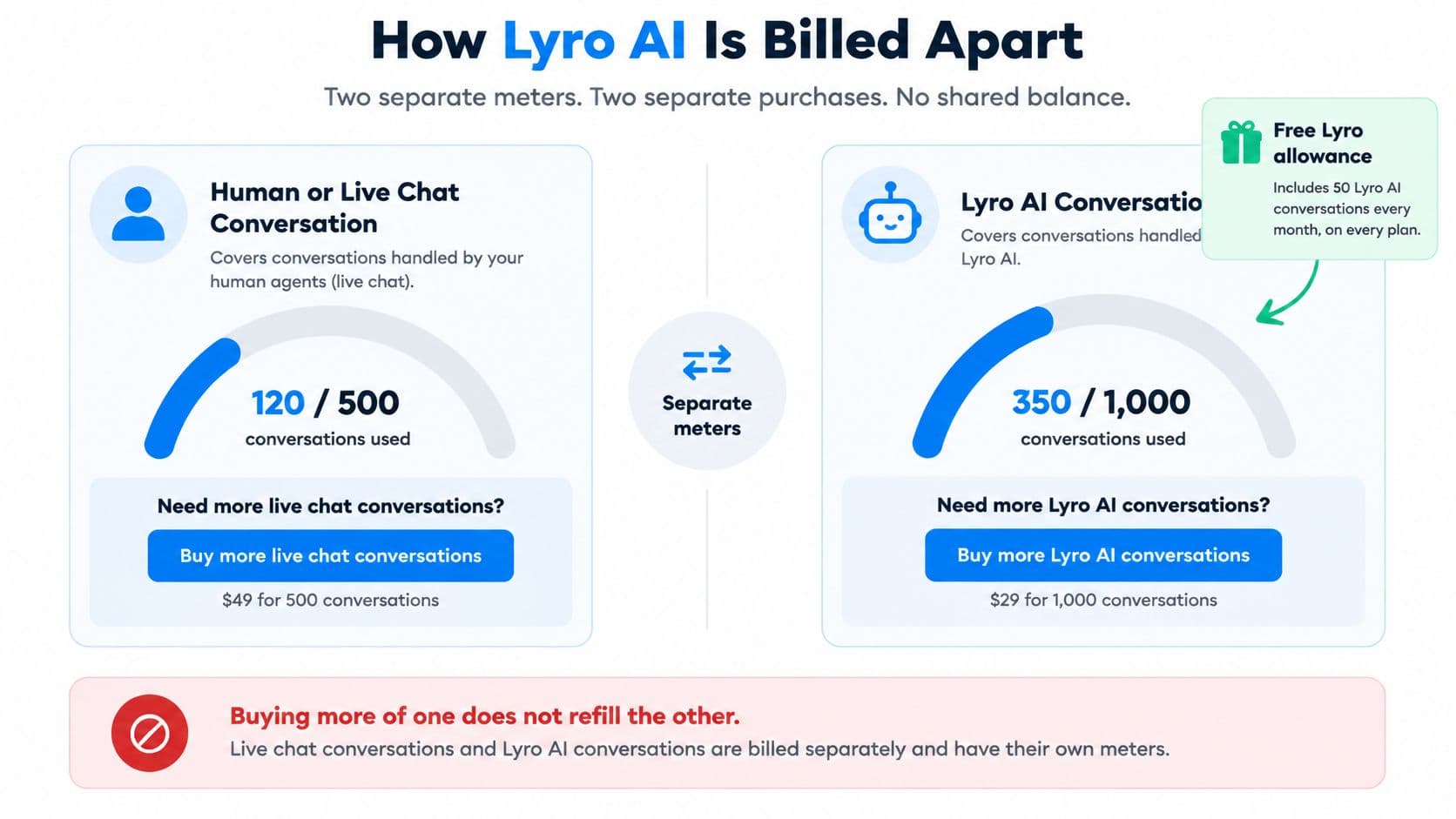
The easy-to-miss Lyro distinction is the lifetime free allowance. Tidio's upgrade guidance describes 50 free Lyro conversations that don't renew, alongside paid monthly quotas ranging from 50 to 1,000 AI conversations.
A store can therefore remain on a free customer-service plan after exhausting its free AI capacity. A recurring human-chat allowance doesn't make that AI allowance recurring.
Keep the meters separate
One meter tracks human or live-chat conversations. The other tracks Lyro AI conversations, and buying more capacity for one doesn't refill the other.
For a Shopify operator, that distinction changes the budget worksheet. Human-support capacity belongs on its own line, while AI capacity needs a separate quota, renewal rule, and recurring cost.
Lyro AI conversation packs on annual billing
The annual-billing rates and approximate full-utilization unit costs are:
| AI conversations per month | Annual rate per month | Approx cost per conversation |
|---|---|---|
| 50 lifetime free, does not reset | $0 | One time only |
| 50 | $32.50 | $0.65 |
| 200 | $116.67 | $0.58 |
| 500 | $291.67 | $0.58 |
| 1,000 | $583.33 | $0.58 |
The lifetime row is an exception, not a monthly pack. The paid rows represent renewable monthly AI capacity under annual billing.
Size AI capacity against shopper questions
Site traffic isn't an AI-conversation forecast. A visitor browsing a collection page may never ask anything, while a shopper comparing products may need substantial help before deciding.
A useful forecast starts with actual questions about sizing, shipping, returns, compatibility, and product differences. The merchant should identify which questions the AI is intended to handle and which require a person.
Follow-up questions and multi-message exchanges deserve attention, but messages shouldn't automatically be treated as separate billable conversations. The checkout review should establish how Tidio counts an interaction before message volume is used for budgeting.
The lower unit cost on larger packs also needs context. It assumes the merchant uses the included capacity, so a larger pack isn't automatically better value for a store with light demand.
Unused capacity still belongs in the cost calculation. A lower advertised cost per conversation doesn't help if the store buys substantially more conversations than shoppers need.
Limits That Sit Under the Price
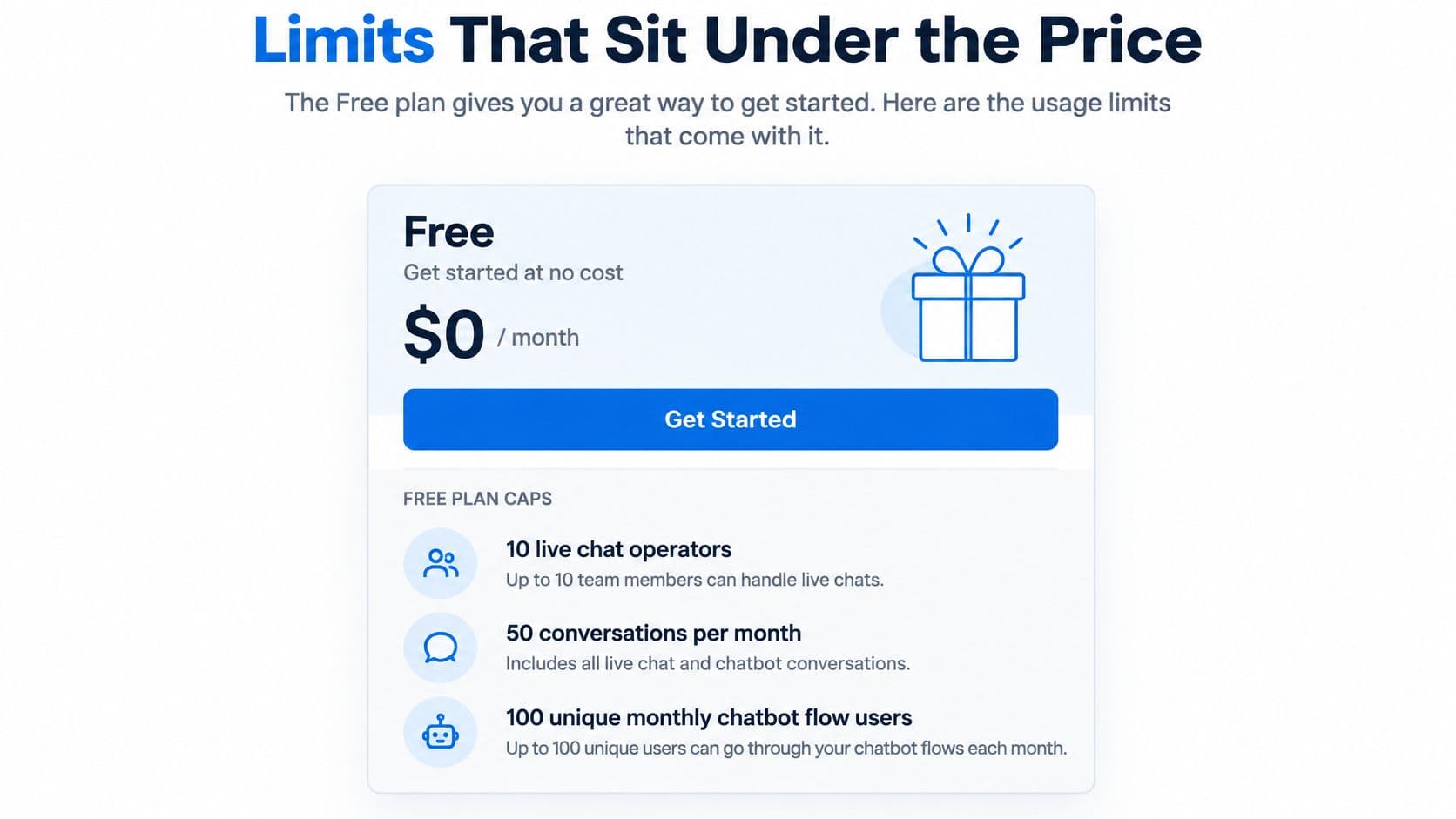
Tidio's FAQ lists Free-plan capacity of up to 10 live-chat operators, 50 conversations per month, and chatbot flows serving up to 100 unique monthly visitors. It also states that the conversation allowance is counted per project, not per agent, and resets monthly.
That distinction matters for a Shopify store with several staff members answering questions. Adding people to the account doesn't multiply the project's conversation allowance.
Separate capacity from staffing
An operator allowance answers who can use the account. A conversation allowance answers how much counted activity the project includes, and those aren't the same purchasing constraint.
Say a founder brings a colleague into customer service during a product launch. The extra person may improve coverage, but the merchant still needs enough conversation capacity for the launch's demand.
The same care applies to automation. A store can have room for human conversations while another part of its setup has exhausted its allowance.
- Human support. Live-chat conversation capacity governs the relevant human-support workload.
- AI responses. Lyro capacity governs AI-served conversations independently.
- Automated outreach. Flow visitor capacity needs its own check rather than being treated as interchangeable with chat volume.
These limits shouldn't be combined into a single total. They measure different activity, so spare capacity in one category doesn't establish available capacity in another.
Complete the checkout checklist
Before approving an upgrade, the merchant should open the selected configuration and make a short record.
- Confirm billing cadence. Record whether the selected rate requires annual billing or supports monthly payment.
- Capture the conversation definition. Save the wording that explains what Tidio counts as billable.
- Note the project scope. Make clear which store or project consumes the allowance.
- Record AI capacity separately. Include its renewal terms rather than assuming the core subscription covers it.
- Check Flow reach. Match the automation's intended audience to its visitor allowance.
This process is particularly useful when an agency configures the app and the merchant pays the invoice. Without a shared record, the agency may budget around a feature requirement while the store owner budgets around the headline subscription.
The agency should save a screenshot of the selected configuration with the quote. That gives both parties the same reference when usage changes or an upgrade becomes necessary.
Monthly Bills for Three Store Sizes
Example monthly list totals for Shopify volume
| Store pattern | Human plan | Lyro pack | Combined monthly list |
|---|---|---|---|
| Small, AI quota still unused | Free at $0 | 50 lifetime, then none | $0 |
| Steady questions | Starter at $29 monthly | 200 at $116.67 annual rate | $145.67 |
| Busier catalog questions | Growth at $59 monthly | 500 at $291.67 annual rate | $350.67 |
These are illustrative monthly-equivalent totals before tax, calculated from the published core-plan prices and Lyro annual rates. The paid examples mix a monthly core subscription with an annual-billing AI rate, so they aren't promises of a single monthly invoice or fully month-to-month offers.
Small store testing shopper demand
A small store can use the free human allowance while testing the unused lifetime AI allowance. That provides a way to examine the questions shoppers ask before committing to recurring AI capacity.
Once the lifetime AI quota is exhausted, the merchant needs a paid AI allowance to continue that use. The free test has no subscription cost per AI conversation, but it doesn't establish a renewable operating budget.
The useful output from this stage is a question log. The founder should learn whether shoppers mostly need help choosing products or need personal attention that the team intends to retain.
Steady store with repeat questions
The middle example suits a store with a modest human workload and a recurring stream of AI-appropriate questions. Its combined total includes both subscriptions rather than treating the core plan as the whole bill.
If human volume is stable, the annual Starter rate is a possible commitment lever. That decision should follow a usage review, not substitute for one.
The AI pack's approximate $0.58 per included conversation assumes full utilization. The merchant should also calculate cost per AI conversation used, particularly when demand varies between months.
Busier catalog with more comparison questions
The busier example assigns more capacity to AI without assuming that AI eliminates human work. Product comparisons may be suitable for automation, while exceptions and ambiguous questions can still require staff.
This is a starting-price illustration, not proof that the entry human allowance fits every busy store. The human configuration must still match the workload that reaches the team.
Here too, the pack's approximate $0.58 per included AI conversation is a capacity calculation, not a revenue forecast. No conversion lift belongs in the budget unless the merchant measures it.
Put checkout friction in context
Shopify reports that 40% of US online shoppers abandon carts because of extra costs such as shipping, taxes, or fees, while 18% cite a checkout that's too long or complicated.
Those figures explain why merchants might pay to answer shipping and fee questions before checkout. They don't demonstrate that any particular app raises conversion, and a chat tool doesn't replace fixing unnecessary checkout friction.
For a broader helpdesk budget comparison, the Gorgias pricing guide offers another framework to evaluate against the same store workload.
When Usage Pushes the Bill Up
A product launch or sale weekend can consume an allowance before the billing period ends. The merchant's next decision should depend on which workload increased, not just which upgrade appears next in the interface.
More human conversations call for a review of human capacity. More AI-served conversations call for a review of the AI pack, while broader automated outreach requires a separate Flow assessment.
Diagnose the increase before upgrading
The core-plan progression moves from a small free allowance to larger paid allowances, then toward usage-based or custom arrangements. A usage-based plan's starting subscription isn't the complete operating cost.
A practical volume test keeps the upgrade decision tied to real shopper activity:
- Count last month's shopper questions that needed an answer. Use conversation records rather than total website sessions.
- Split the workload into human and AI handling. Flag handoffs so the estimate doesn't assume every interaction belongs exclusively to one category.
- Estimate the AI budget using the nearest published pack. Use its per-conversation cost as a planning aid, not as an assumed pay-as-you-go rate.
- Compare the whole pack with the next tier. The merchant buys capacity, so the package price matters more than a theoretical unit-cost calculation.
- Allow for follow-ups and seasonal demand. Apply the vendor's conversation definition rather than counting every message as a new charge.
The count should also distinguish a temporary spike from sustained demand. A campaign that generates unusual questions doesn't necessarily justify the same commitment as a permanent increase in catalog complexity.
Upgrade checkpoint: Buy capacity for the workload that needs it. Don't increase the human plan to solve an AI-capacity problem.
Reduce avoidable demand without suppressing useful questions
Repeated questions can reveal missing information on product and policy pages. Publishing clearer sizing guidance or shipping explanations may help shoppers without requiring every answer to happen in chat.
That operational review belongs alongside the subscription review. The guide to reducing operational costs provides a wider context for examining recurring work before adding software spend.
The saved checkout quote should remain the purchasing reference. Any proposed change should identify the new allowance, billing commitment, and applicable usage charges before approval.
Which Plan Fits Your Store
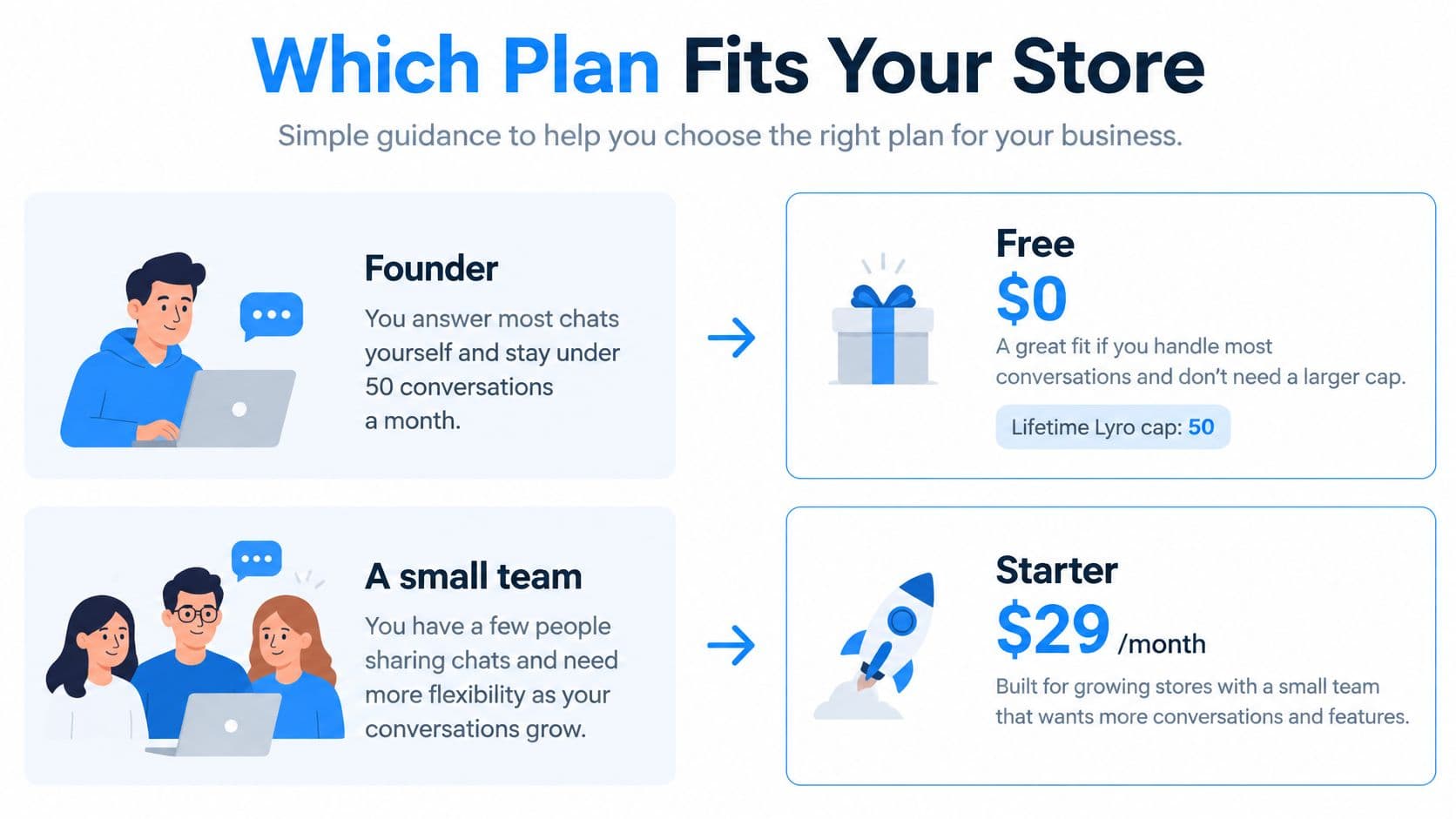
The right Tidio plan follows the store's service pattern, not its team size alone. A founder answering occasional questions has a different requirement from a catalog business assigning product guidance to AI.
The decision should also distinguish a customer-service subscription from an AI shopping budget. A merchant may need both, but that doesn't make their allowances interchangeable.
Match the plan to the work
Free fits a founder testing demand. It makes sense when the owner handles a light workload and wants to learn what shoppers ask before accepting a recurring subscription. The owner should treat free AI access as a test allowance, not assume an ongoing AI operation is funded.
Starter fits a small, predictable human workload. Its role is clearer when staff handle the conversations and AI is an optional addition justified by specific pre-purchase questions. A team that doesn't intend to delegate answers to AI shouldn't add AI capacity merely because it's available.
Growth fits a larger human-support requirement. A catalog with frequent sizing, shipping, and comparison questions should separate those that reach staff from those intended for AI. A busy catalog doesn't automatically determine the human tier because handling patterns matter as much as question volume.
Plus or Premium deserves a scoped quote. Several brands, an agency portfolio, or demand that doesn't fit a standard configuration calls for an explicit usage model. A larger base subscription shouldn't be mistaken for an all-in price.
Use decision criteria that survive a busy month
The merchant should evaluate:
- Monthly pre-purchase questions. Count answer-seeking interactions rather than assuming every visitor creates support demand.
- AI versus human handling. Identify which questions can follow a documented answer and which require judgement.
- Flow reach. Check the intended outreach audience against the selected visitor allowance.
- Seasonal spikes. Review launches and promotional periods separately from routine demand.
- Billing commitment. Decide whether stable usage justifies annual payment or whether flexibility is more useful.
This is also an ownership decision. A founder needs someone responsible for checking usage, maintaining answers, and approving upgrades, especially when an agency manages implementation.
Bragly's guide to choosing management tools for busy founders is useful context for assigning that responsibility rather than letting subscription reviews become an unowned task.
Compare an AI shopping allowance fairly
Carti is an AI shopping assistant for Shopify with Free at $0 for 50 AI conversations a month, Starter at $49 for 250, Growth at $99 for 600, and Scale at $249 for 1,750, with a 14-day free trial on paid plans. Its AI conversation allowances should be compared with Tidio's AI budget, not presented as equivalent to a human-support subscription.
For another focused comparison, the Tidio versus Zipchat guide can help frame the evaluation around intended shopping-assistant use.
The governing rule is the scarcer allowance determines the next capacity decision. A cheaper core subscription doesn't solve an exhausted AI quota, and spare AI capacity doesn't establish that the human plan is sufficient.
Before choosing, the merchant should recheck live pricing, count last month's shopper questions, and place that workload against Tidio's separate human and AI allowances. Only then does comparing a single AI allowance become meaningful.
Tidio Pricing Questions Shopify Owners Ask
Is Tidio free?
Yes. Free is a no-cost entry plan with limits on conversations, operators, and Flow reach. It's suitable for evaluating a light workload, but free access shouldn't be interpreted as unrestricted customer service or indefinitely renewable AI capacity.
Does the free Lyro allowance reset?
No. The free allowance is a lifetime quota rather than a recurring monthly allocation. Paid Lyro packages provide renewable monthly capacity, so a merchant planning ongoing AI use needs to budget differently from a merchant running an initial test.
Do extra team members add conversations?
No. Adding operators doesn't multiply a project's conversation allowance. Staffing and conversation capacity solve different problems, so a merchant bringing colleagues into the account should check available usage separately.
Is annual billing worth it?
It can be, when usage is stable and the merchant is comfortable with the commitment. A discount is less useful when the selected allowance doesn't fit the store, so annual billing should follow a workload review rather than lead the purchase decision.
What is the hidden cost?
The main risk is mistaking a base subscription for the complete budget. AI capacity, human usage, and automation limits need separate attention, particularly in usage-based configurations. The merchant should confirm the selected allowances and full checkout quote before paying.
Carti offers an AI shopping assistant for Shopify that answers pre-purchase questions about products and store policies. Merchants comparing Tidio's separate usage allowances can visit Carti to evaluate an AI conversation plan against their actual shopper-question volume.

Written by
Daniel AndersonFounder of Carti. 10+ years building ecommerce brands in apparel and supplements. Still runs a Shopify store and built Carti to help merchants convert more browsers into buyers.