
The usual advice is to install the highest-rated chat app and treat the star score as a sales forecast. That advice skips the only question that matters for a store: did the assistant create orders that would not have happened anyway?
ZipChat is an AI assistant for Shopify storefronts that answers pre-purchase questions. Its reviews are strong, and most of the performance numbers attached to them are self-reported. This ZipChat review is for a merchant deciding whether to add a chat assistant, a CX lead writing escalation rules, or an agency choosing an app for a client.
The reading draws on Shopify App Store listings, G2 and AppSumo reviewer comments, and a ZipChat operational study. Each source is kept in its lane. No independent controlled test has been published, so every figure below is a claim to check on your own traffic.
Three terms keep the tables honest. Conversion rate means orders divided by the conversations or sessions in the stated scope, not by all store sessions. Escalation rate is the share of chats handed to a person. Assisted conversion counts purchases among shoppers who used the assistant, which is not the same as lift versus a group that never saw it.
You should leave with a feature checklist, a setup path, a routing rule set, a way to read the reported results, a plan comparison, and a two-week test.
What ZipChat Does and Who Should Read This Review
Read the verdict before the feature list. ZipChat aims at shoppers who have not ordered yet. The public record shows enthusiastic merchants and company-reported usage, not an audited profit study. If your decision is "which app has the friendliest listing," you can stop early. If your decision is whether the subscription is covered by extra gross profit, keep going.
ZipChat Features and What Reviewers Report
| Feature area | What reviewers report | Source | What to verify |
|---|---|---|---|
| Catalog learning | Crawls the catalog and becomes usable within minutes without coding | G2 reviews | Accuracy on your own product variants |
| Channels | Integrations with a CMS, Instagram, Messenger and WhatsApp | G2 reviews | Which channels your orders really come through |
| Dashboards | KPIs for conversion and customer satisfaction | G2 reviews | Whether the dashboard matches your own analytics |
| Onboarding time | Several weeks to a few months for merchants moving from tools such as Tidio | Shopify App Store reviews | Your own setup timeline |
| Shopify rating | 4.9 out of 5 across roughly 209 to 210 reviews | Shopify App Store listing | Recent reviews, since listings vary |
| Multilingual replies | No language count in the listings and comments reviewed | Shopify, G2 and AppSumo material reviewed for this article | Language coverage for your customer base |
Catalog learning is the row that sounds fastest. Reviewers say the crawl can make the assistant usable within minutes, with no code. Minutes to a first reply is not the same as correct sizes, bundles, or variant names. Run ten awkward SKUs before you trust that row.
Channels, dashboards, and time
Channel coverage is described as a CMS plus Instagram, Messenger, and WhatsApp. That list only pays off if those surfaces already produce orders. A dashboard that shows conversion and satisfaction still has to be reconciled with Shopify analytics, or you will argue about two different denominators.
Onboarding is the row that punctures the "minutes" story. Merchants who moved from tools such as Tidio describe uploading training data, setting catalogs and business rules, and going live over several weeks to a few months, according to the Shopify App Store listing for ZipChat. Budget the longer clock if your policies are messy.
The same listing shows about 209 to 210 published reviews and an overall 4.9 out of 5. One view of the distribution puts 199 ratings at five stars, 95% of reviews, and another puts 193 at five stars, or 96%. About 19 in 20 published reviewers gave the top score. Those reviewers chose to post. A self-selected score is not an audited conversion test, and localized listings have shown small count differences, so read the newest comments.
Multilingual replies stay unresolved. None of the material reviewed here states a language count. Cart recovery is also unconfirmed. No reviewed source describes a cart-recovery feature, so open the current feature list before you buy for that job.
Use the last column as the pre-purchase checklist, starting with the channels your orders use.
Which Answers to Automate and Which to Route to Staff
The oversight limit should shape the launch, not the post-mortem. An AppSumo reviewer reports that suggested replies cannot be edited before they are sent, and that human escalation is limited to email notifications. Email can be too slow while a shopper is still in the thread. G2 reviews of ZipChat are the public trail for that limit. Write approval rules before the first complaint.
| Request type | Automate or route | Reason |
|---|---|---|
| Sizing and shipping questions | Automate | Repetitive and low risk, answered from catalog and policy |
| Product discovery and comparisons | Automate | Low risk and tied to recommendations |
| Refunds and return exceptions | Route to staff | Involves money and policy exceptions |
| Complaints | Route to staff | Emotional and time-sensitive, where escalation delay hurts |
| Medical or safety claims | Route to staff | Carries liability a chatbot should not carry alone |
| Unusual order exceptions | Route to staff | Needs inventory and order details the assistant may not see |
Sizing, shipping, and product discovery can stay automated when the answer lives on a policy page or a product record. Refunds, complaints, medical or safety claims, and odd order exceptions go to a named person. Those threads involve money, emotion, liability, or an order state the assistant may not see. A wrong refund answer will not show up if you only watch total sales. The split between a bot and a person is the same decision covered in a chatbot versus live chat comparison, and the email-only handoff makes the staff side slower than a live queue.
What to watch after launch
Track four numbers, not a single happiness score.
- Answer accuracy: Sample replies against the policy page, not against the tone of the chat.
- Escalation latency: Measure minutes from the handoff trigger to a human reply, because email delay is the risk.
- Unresolved-conversation rate: Count threads that end without an answer or a handoff.
- Conversion by intent: Separate sizing chats from complaint chats so one good sales day cannot hide a bad refund answer.
First-week rule: Review every automated answer about refunds and sizing, sample the rest each day, and widen automation only when that sample stays clean.
How to Set Up ZipChat on Your Shopify Store
Finish the routing rules before you install anything. Step 6 below is useless if nobody owns the inbox.
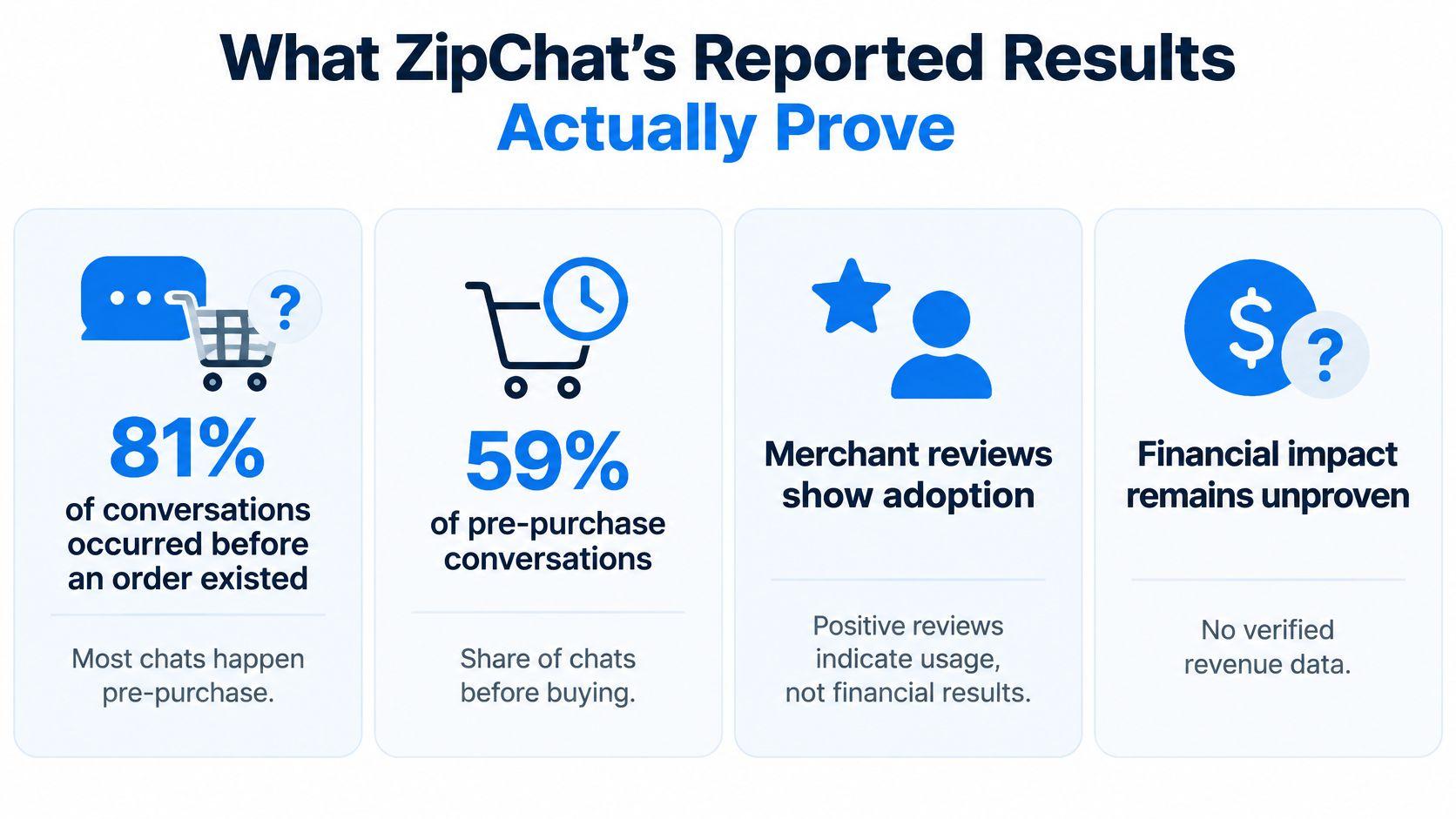
The graphic is a claim sheet for later measurement. It is not a setup result.
- Install ZipChat from its Shopify App Store listing. That listing is where the store connection starts, and skipping it leaves the theme and the app out of sync.
- Let the catalog crawl finish before anyone tests answers. Variant names, prices, and stock are what sizing and comparison replies depend on.
- Upload policies, shipping rules, return windows, and FAQ documents. The assistant can only promise what those files contain.
- Set business rules for discount limits and when a product may be recommended. Without those rules, a helpful tone can become an unauthorized offer.
- Connect only the channels that already produce orders, such as Instagram, Messenger, or WhatsApp. Extra channels create queues your team will not watch.
- Load escalation routes and approval rules from the routing table before launch. Name the person who receives the email, and name a backup.
- Test 40 real questions from past tickets, covering sizing, delivery, returns, and one policy exception. Log every wrong answer with the question that caused it.
- Launch on product pages first. Move to checkout only after the wrong-answer count is falling, because checkout errors hit shoppers who are closest to paying.
A done setup
A finished setup is a tested question log, named escalation owners, and a dated review on the calendar. If any of those three is missing, you have an install, not a launch. Adding the widget itself is the easy part of how to add a chatbot to Shopify. The hard part is the question log.
What ZipChat's Reported Results Actually Prove
| Reported result | Who reports it | What it covers | What is missing |
|---|---|---|---|
| 81% of conversations before an order existed | ZipChat operational study, Nov 2025 to Oct 2026 | Pre-purchase share of conversations | Traffic mix and denominator |
| 59% of pre-purchase conversations outside office hours | ZipChat operational study | Before 9 a.m., after 6 p.m., or weekends, shopper local time | Store time zones and order share |
| Escalated conversations convert at 11.4% vs 8.2% | ZipChat operational study | Company-reported comparison | Control group and selection effect |
| Below 3% of conversations escalated to a human | ZipChat operational study | Share handed to a human agent | Edge-case and error handling |
| 17%+ average conversion for AI-handled conversations | ZipChat public claim | Conversation-scoped figure | Attribution window and denominator |
| 600+ replies, 20% conversion, £130 average spend | Single Shopify merchant review, 2025 | Four weeks of one store | Baseline and traffic volume |
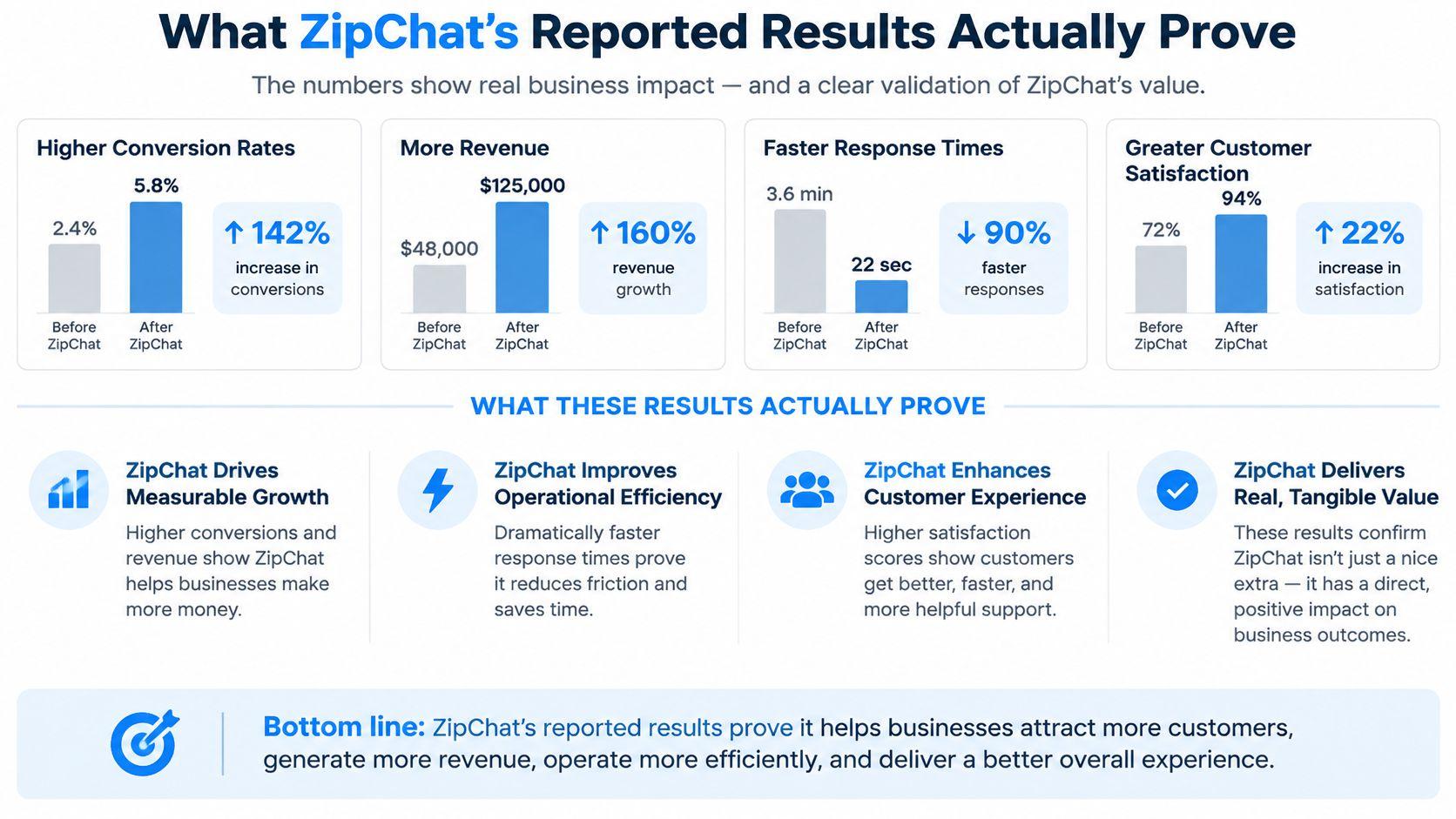
Read the rows as a filter, not a forecast.
The operational study says 81% of conversations happened before an order existed. That supports a pre-purchase job. It does not say which traffic sources, or how many sessions sit under that share.
59% of pre-purchase conversations arrived outside office hours, defined as before 9 a.m., after 6 p.m., or on weekends in the shopper's local time. Useful if your buyers are spread across time zones. Useless until you know whether those chats become orders.
Escalated conversations converted at 11.4%, against 8.2% for other conversations, a gap of 3.2 percentage points. Shoppers who ask for a person may already be closer to buying. The gap does not prove the handoff caused the sale.
Fewer than 3% of conversations were escalated. The AppSumo listing for ZipChat pairs a claimed 17%+ average conversion on AI-handled conversations with an escalation rate below 3%, which implies more than 97% of those conversations stayed automated. That 17%+ figure is conversation-scoped. The public write-up does not disclose the denominator, attribution window, traffic mix, category, or control group. It is not your store conversion rate. How to assign credit without double-counting is the point of revenue attribution.
One 2025 merchant review on the Shopify App Store reports more than 600 replies in four weeks, a 20% conversion rate, and £130 average spend. One store, four weeks, no published baseline, no traffic volume.
Treat every row as a reason to run a test on your catalog. None of them is a forecast for your store.
Use Cases Where ZipChat Earns Its Place
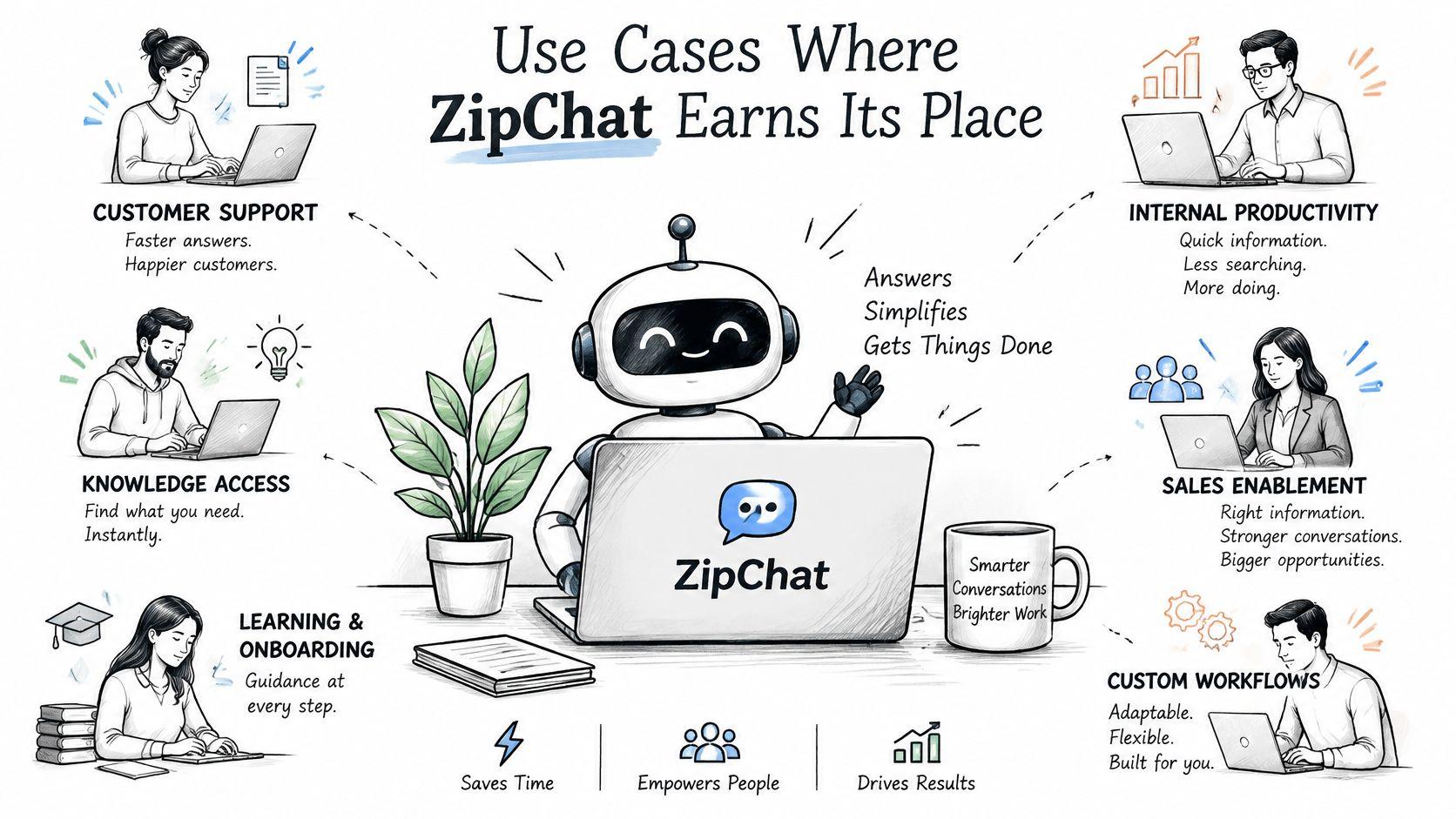
ZipChat's operational study from November 2025 through October 2026 is company-reported, not a controlled experiment. It is still the right lens for the four stores below, because it centers pre-purchase chats, after-hours demand, and a small human handoff. The study's escalated chats converted about 39% higher relative to the comparison rate. That relative gap can be shoppers who were already decided.
Four stores, four metrics
Fashion, high traffic, repetitive sizing. The assistant can take size and shipping questions from the catalog and the policy page. Return exceptions still go to staff. Watch tickets handled without escalation. If that share stays high and wrong sizes stay rare, the app is doing the job this evidence describes.
Direct-to-consumer, several time zones. The study's after-hours share is the reason to look here, not a promise that night chats pay. Track assisted conversion by time of day. A busy night shift with no orders is coverage, not revenue.
Beauty or home, sold in Instagram and Messenger DMs. Channel fit decides the bill. Confirm which inboxes create orders before you pay to connect them. Track time to first reply on each channel. A correct answer that lands after the shopper has left does not count.
Complex refunds or wholesale. Most threads need a person who can see the order, the contract, or the exception. The assistant adds little. Watch time to escalation. If that clock is slow, the email handoff is a cost, not a feature.
ZipChat fits stores whose questions repeat and whose buyers arrive outside office hours. It fits poorly where most conversations need a decision from staff.
ZipChat Pros and Cons for Shopify Merchants
Strengths the sources actually support
Reviewers describe a catalog crawl that can be usable within minutes, without code, plus links to a CMS, Instagram, Messenger, and WhatsApp. The App Store footprint is large for this category and heavily weighted to five stars. The company's own study puts a majority of pre-purchase chats outside office hours, so after-hours coverage is a real use, not a slogan.
Limits you should price in
Suggested replies that cannot be edited before send, plus escalation by email, are a poor fit for live complaints. No independent controlled test is public, and the conversion figures lack a baseline. Plan prices and conversation limits were not confirmed from ZipChat's own pricing page for this review, so open that page before any cost comparison. Cart recovery and a language count are unconfirmed in the sources used here.
The strongest case is fast setup and channel coverage for repetitive pre-purchase questions. The weakest point is oversight while a chat is still live.
ZipChat Versus Carti on Plans and Channels
A comparison here comes down to three questions: does the monthly conversation cap cover your traffic, does the language coverage match your buyers, and is the escalation path one your staff will use? The table answers the second and third directly. The cap question is arithmetic, and it is worked through below.
| Criteria | ZipChat | Carti |
|---|---|---|
| Languages | Multilingual replies, no count stated | Detects the shopper's language and replies in 92 languages, with no translation setup |
| Human escalation | Email notifications, per an AppSumo reviewer | Zendesk and Gorgias, with a test connection for API credentials |
| Channels | Instagram, Messenger and WhatsApp, per G2 reviewers | Instagram and Facebook Messenger |
Plan limits. Carti's tiers are Free at 50 AI conversations a month, Starter at $49 for 250, Growth at $99 for 600, and Scale at $249 for 1,750, with a 14-day trial on paid plans. No cap is unlimited, so the tier that fits is the one whose ceiling clears last month's chat volume with headroom for a campaign week. Run the same arithmetic on any ZipChat tier you price: the conversation allowance measured against your monthly chats. A cheaper plan that forces a mid-month upgrade costs more than the tier above it.
Languages. Carti detects the customer's language and replies natively in 92 languages, with no translation setup. ZipChat offers multilingual replies without a stated count. Whether that gap matters depends on your order book: a single-market store gains nothing from the number, while a store shipping across regions needs it in writing before committing. A count that is never used is not a feature.
Escalation and channels. ZipChat's reviewed path runs through email notification, and its reviewers place it on Instagram, Messenger and WhatsApp. Carti escalates into Zendesk and Gorgias and replies on Instagram and Facebook Messenger. Each product wins a different store. If complaints already live in a helpdesk, Carti's routing keeps one queue instead of two. If buyers reach the store through WhatsApp, ZipChat covers a channel Carti does not. Pick the path your team already answers inside a few minutes. A second inbox that nobody owns is not coverage.
Run a Two-Week Test Before You Commit
Start with one segment and two weeks. Positive merchant reviews show adoption and perceived usefulness, not financial return. Shopify App Store reviews of ZipChat often claim higher sales, cart recovery, and time saved, without a baseline, a control, an attribution method, traffic volume, or retention. A chat on a high-intent product page can be credited for a sale that was already going to happen. Shoppers also tend to expect quick automated answers that many stores never deliver. That expectation gap is real, and it does not prove this app closes it for your catalog.

- Pick the segment with the most repeated questions, usually sizing or delivery.
- Split visitors into a group that sees the assistant and a group that does not, or compare the same period before launch.
- Each day, log assisted conversion, revenue per conversation, average order value, escalation rate, and wrong-answer count. If your chat tool keeps a session log, filter it to unread sessions each morning and mark each conversation reviewed as you check it, so the wrong-answer count stays honest.
- Check reply speed on every connected channel. If you use Carti's engagement view, it already tracks total conversations, response rate, average reply speed, and messages per session. Slow replies cancel a correct answer.
- Compare the subscription with incremental gross profit from the test, after discounts, repeat buyers, and seasonality. Ignore the headline conversion claim.
- On day fourteen, continue only if the gain covers the cost and wrong answers are falling. Pause if refund or sizing answers stay unreliable.
Extend the view to 30 or 90 days for a before-and-after check, and add the staff cost of correcting wrong answers. Workload saved on policy questions and revenue from recommendations are different wins, and they need different metrics.
Carti is an AI shopping assistant for Shopify that answers pre-purchase questions from your catalog, policies, and FAQs, on the plans and conversation caps compared above. If this ZipChat review left the profit question open, run the same two-week split on your store before you sign a longer term. Visit Carti to see the plans and start the trial on a paid tier if the 50-conversation free cap is too small for the test.

Written by
Daniel AndersonFounder of Carti. 10+ years building ecommerce brands in apparel and supplements. Still runs a Shopify store and built Carti to help merchants convert more browsers into buyers.