
What happens when a shopper's sizing question turns into a refund request in the same conversation?
Most Zipchat vs Gorgias comparisons stop at feature lists. They don't map where a pre-sale answer ends and a post-sale service problem begins. That boundary decides whether a Shopify store needs a sales assistant, a helpdesk, or both running together without giving conflicting answers.
Zipchat vs Gorgias at a Glance
Zipchat is built to answer and sell before purchase in storefront and social chat. Gorgias is a Shopify native helpdesk built to run support after purchase across email, live chat, SMS, social and voice.
The age gap is real. Gorgias states on the Gorgias about page that it was founded in Paris in 2015 and reported serving more than 4,500 online stores by December 2020.
TechCrunch reported in August 2022 that Gorgias supported more than 10,000 online stores. Zipchat was founded in 2024, and its company profile claims more than 2,500 brands, a self-reported figure merchants should verify before relying on it.
That history matters less than the job each tool was built for. A longer record doesn't prove better product recommendations, and a newer launch doesn't prove weaker answers.
One question decides the choice. Is the bottleneck questions before purchase, or problems after it?
Chat, Automation and AI Features Side by Side
| Feature | Zipchat | Gorgias |
|---|---|---|
| Storefront chat | AI chat on the storefront | Live chat inside the unified inbox |
| Social and messaging channels | WhatsApp, Instagram and Messenger | Social channels inside the unified inbox |
| Automated AI replies | AI agent answers chat | AI Agent, priced per interaction |
| Product recommendations | Yes | Shopify data can support recommendations |
| Upsells and cart recovery | Yes | Not confirmed |
| Human handoff | Not confirmed | Contextual handoff to staff |
| Multilingual replies | Not confirmed | Not confirmed |
| Proactive engagement | Not confirmed | Not confirmed |
Where the Difference Is in Kind
The dividing line sits at the moment of purchase. Zipchat's documented actions, product recommendations, upsells and cart recovery, all serve a shopper who has not decided yet. Gorgias works on the other side of that line: rules, macros, auto-tagging and contextual handoff help staff sort, assign and answer tickets once a customer already has a problem.
That split shows in the table itself. Zipchat confirms selling features and leaves handoff, languages and proactive contact unconfirmed. Gorgias confirms workspace features and leaves the selling side thin. Each tool is strongest on its own side of the purchase.
What a Feature List Cannot Show
A table shows capability. A trial shows accuracy. Broad channel coverage says nothing about whether a sizing answer is correct, and a fast wrong answer costs more than a slow correct one.
A feature only counts once it works in a merchant's own trial, on that store's catalog and policies.
A simple test cuts through the claims. Pull the five most common pre-sale questions from last month's chats, run each through both tools, and score the answers for accuracy against the store's real catalog and policies. Record whether each reply ends in a sale, a clean handoff or a dead end. Teams that write up results often borrow structured drafting methods from resources on ChatGPT publishing workflows so every scorer fills in the same scorecard.
Merchants planning to run both tools should add one more check. Send a pre-sale chat that turns into a post-sale problem and confirm the conversation moves across without the shopper repeating details or receiving conflicting answers.
Unconfirmed cells deserve direct questions before purchase. Ask each vendor in writing about multilingual replies and proactive engagement, then keep the reply with the contract paperwork.
How Deep Each Shopify Integration Goes
Integration depth has three layers. There's data the tool can read, actions it can take, and systems it connects to. Merchants should test all three, because reading an order isn't the same as changing it.
Actions Inside the Ticket
Gorgias documents a deep order connection. The Gorgias Shopify integration documentation lists the ability to duplicate, cancel, refund and edit Shopify orders through the ticket interface or macros.
That same documentation covers fulfillment status, order notes, customer profiles and transaction history inside the ticket. Agents don't need to open Shopify in another tab to check what happened.
Zipchat takes a different route. The Zipchat Shopify App Store listing lists order tracking, discount creation, stock checks, returns and refunds among its actions, so a shopper can ask about an order inside chat.
That listing also advertises integrations with Gorgias, Zendesk, Intercom, Freshdesk, Salesforce, Klaviyo, HubSpot, Judge.me, Loop Returns, Recharge and Zapier. Zipchat can therefore run beside an existing helpdesk instead of replacing it.
Reading order data helps an assistant answer. Controlling orders lets a helpdesk resolve. Merchants should confirm which one each tool actually does.
Whether Zipchat can edit orders isn't confirmed in the cited material, and merchants shouldn't assume it can. A practical test settles the point.
Install both tools on a development store. Run one order lookup, one refund request and one stock question, then record which system was allowed to act and which one only answered.
Pricing Models and the Real Cost per AI Reply
The two vendors meter different units, so the sticker price is only the start.
| Pricing element | Zipchat | Gorgias |
|---|---|---|
| Entry plan | Starter at $64 per month billed annually or $80 billed monthly | Helpdesk priced by monthly tickets, 50 to 5,000 per month |
| Included AI volume | 750 AI replies and about 300 conversations per month on annual Starter | 30 to 530 automated AI interactions per month by plan |
| Extra AI usage | $49 for 250 extra replies on Starter, Pro and Scale | $1.50 per extra automated interaction |
| AI Agent rate | Plan replies and $49 top-ups | $1.00 per automated interaction billed monthly, $0.90 billed annually |
| Human takeover | No AI interaction counted once a human agent takes over | |
| Trial or guarantee | 30-day money-back guarantee |
What Each Vendor Publishes
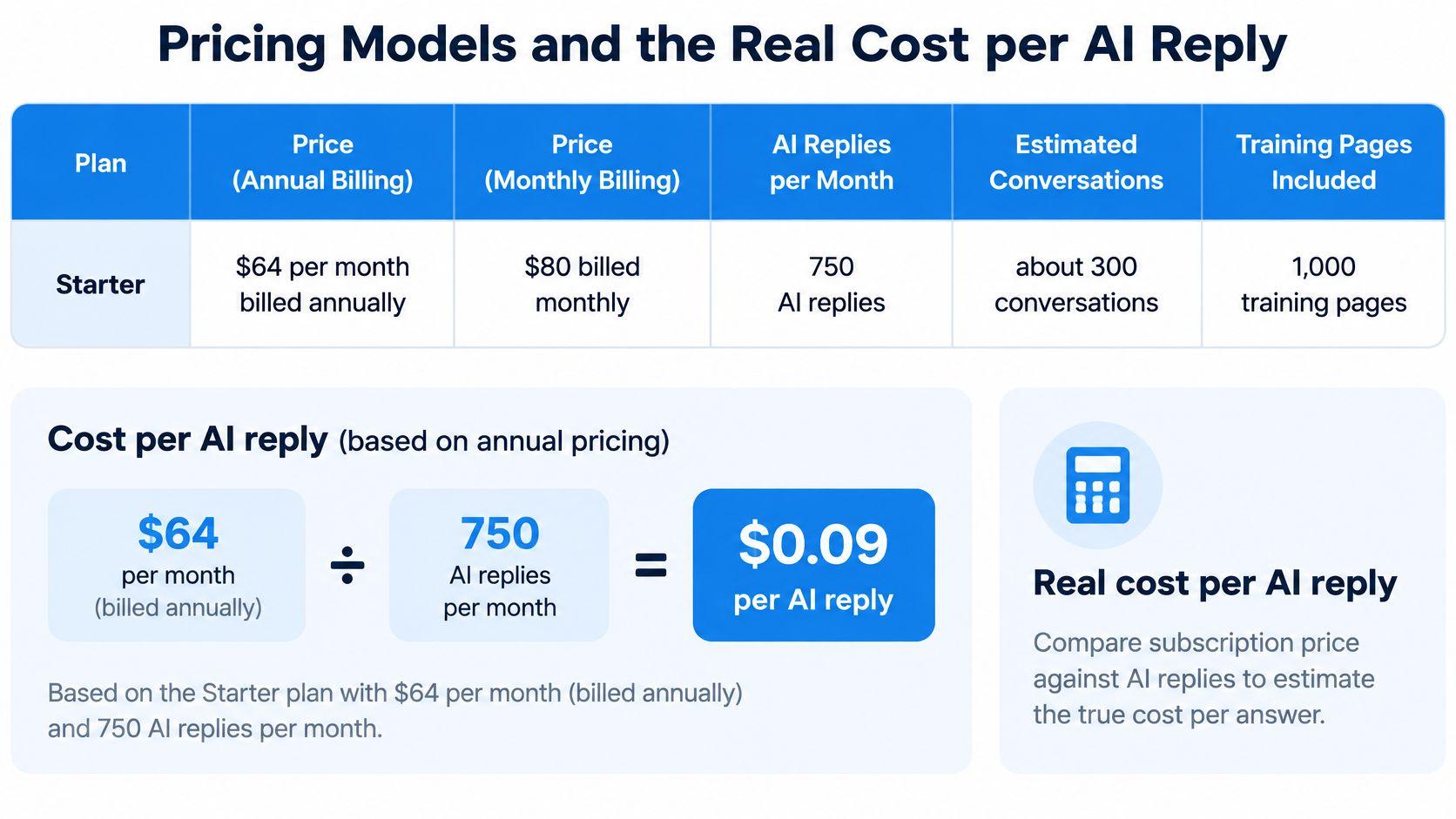
The Zipchat pricing page lists Starter at $64 per month billed annually or $80 billed monthly, with 750 AI replies, about 300 conversations, 1,000 training pages and one AI agent. It also lists a 30-day money-back guarantee and extra replies at $49 for 250.
The Gorgias pricing information page states that Helpdesk plans range from 50 to 5,000 tickets per month and include 30 to 530 automated AI interactions per month. Additional automated interactions cost $1.50 each, while AI Agent costs $1.00 per automated interaction billed monthly or $0.90 billed annually.
A Worked Example at 300 Conversations
At 300 automated conversations a month, Zipchat annual Starter works out to about $0.21 per conversation. Gorgias AI Agent alone costs $270 to $300 at that volume, before the Helpdesk subscription priced by monthly tickets.
The units differ, and that limits the comparison. A pre-sale sizing question can sit inside a Zipchat conversation, while a post-sale refund can become a Gorgias ticket with an automated interaction attached. If both tools are installed, assign ownership for order actions early so one shopper request does not get answered as a chat reply and again as a helpdesk ticket.
Merchants need one shared volume count before comparing bills. A fuller breakdown of how Gorgias ticket pricing stacks up helps frame that count.
The formula stays simple. Add the base plan, overage and AI charges, then divide by orders or recovered carts. Cost per reply alone does not show value.
How to Test Response Quality in Your Own Store
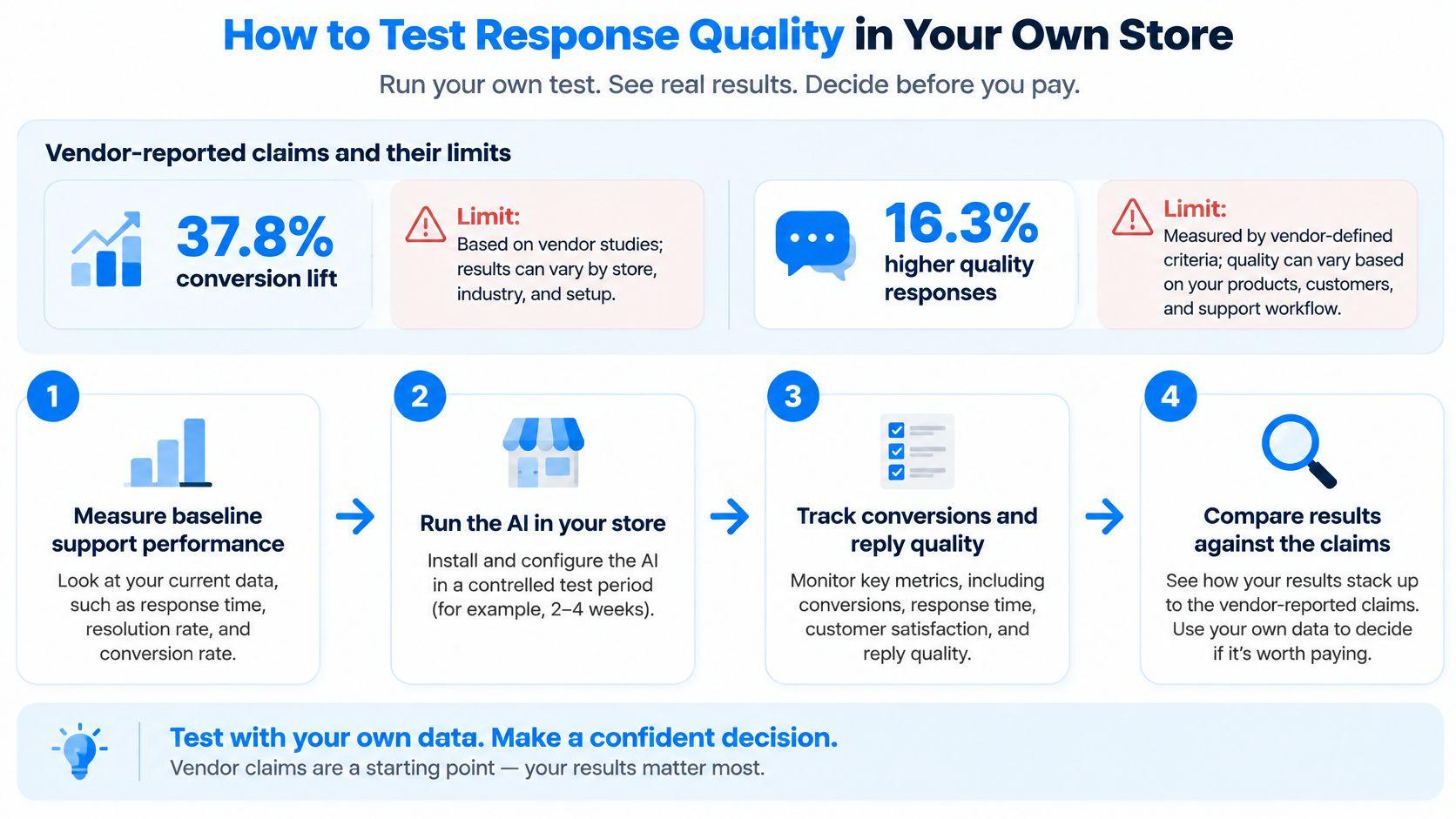
Vendor claims are a starting point, not proof. Each figure below comes from the vendor's own published material and should be treated as unaudited until a store reproduces it.
Zipchat claims a 37.8% conversion lift and a 16.3% chat-to-conversion rate in Zipchat's published performance material. That source doesn't disclose sample size, control design or whether the figures are incremental.
Gorgias describes an AI agent benchmark covering more than 200 live ecommerce stores and over 8,000 conversations, with blind scoring across 12 vendors over a rolling 90-day window. Its shopping score weights automation at 40%, response quality at 35% and speed at 25%.
Neither product's head-to-head score appears in the cited material. The benchmark therefore isn't proof that either tool beats the other.
A Six Step Store Test
- Export real questions. Pull 200 pre-sale and post-sale questions from the last 90 days and tag each one by intent.
- Install both trials safely. Use a development store or a low traffic store so errors don't reach paying customers.
- Randomize eligible sessions. Split comparable traffic between the tools instead of testing them in different weeks.
- Score every intent separately. Track median response time, escalation rate, factual accuracy and resolution rate for sizing, shipping, returns and comparisons.
- Separate assisted from incremental. Report assisted add-to-cart and purchase lift apart from lift the test can attribute to the tool.
- Choose on the scorecard. Don't select a system on attribution alone when accuracy or escalation results point the other way.
Merchants who need a measurement framework can adapt the approach in a guide to chat bot analytics to this scorecard. The point isn't more dashboards. It's one shared definition of a resolved conversation.
Pros and Cons of Zipchat and Gorgias
Zipchat Strengths and Limits
- Storefront coverage. An AI agent spanning chat, WhatsApp, Instagram, Messenger and email.
- Documented commerce actions. Cart recovery, order tracking, discount creation, stock checks, returns and refunds.
- Helpdesk coexistence. A listed Gorgias integration and a 30-day money-back guarantee on its pricing page.
- Newer company. Founded in 2024, with a self-reported brand count.
- Unconfirmed areas. Order editing, human handoff and multilingual replies aren't confirmed, and conversion figures are vendor reported without a disclosed method.
Gorgias Strengths and Limits
- Longer operating record. A unified inbox across email, live chat, SMS, social and voice.
- Order control in tickets. Refunds, cancellations and order edits from inside the ticket, with Shopify order data in view.
- Usage based AI cost. AI interactions cost $1.00 or $0.90 each under AI Agent pricing, and extra automated interactions cost $1.50 each.
- Volume exposure. Costs rise with ticket volume, so busy months cost more.
Neither vendor's uptime, SLA or support response commitments were confirmed in the cited material.
Privacy, Security and Onboarding Checks Before You Install
Pre-install checks prevent surprises after launch. Each item below can be verified against the vendor's own privacy policy or Shopify App Store listing.
Data and Access Checks
- Shopify permissions. List every scope the app requests at install and check that each one matches the job.
- Transcript storage. Ask where chat transcripts are stored and how long they're kept.
- Model training. Confirm whether shopper messages are used to train models, and get the answer in writing.
- Data processing agreement. Confirm whether one is offered and what it covers for customers under strict privacy law.
- Personal data controls. Look for controls on personal data inside transcripts, plus redaction or deletion options.
- Staff access. Check role based access so seasonal staff can't export full conversation history.
- Audit trail. Confirm that escalations and refunds leave a record an owner can review later.
Onboarding Checks
Setup effort varies more than feature lists suggest. Merchants should list the setup steps in order and note whether a developer is needed for any of them.
Time to the first live answer matters during a trial. So does the material the merchant must supply, such as policies, size charts and FAQs. Missing source material usually shows up later as wrong answers.
Plain limit: No uptime or SLA claim for either product was confirmed, so merchants should request those commitments in writing before relying on either tool during peak trading.
Support response commitments deserve the same treatment. If a vendor won't state them in writing, the store carries the risk when chat fails on a busy weekend.
How to Switch or Run Zipchat and Gorgias Together
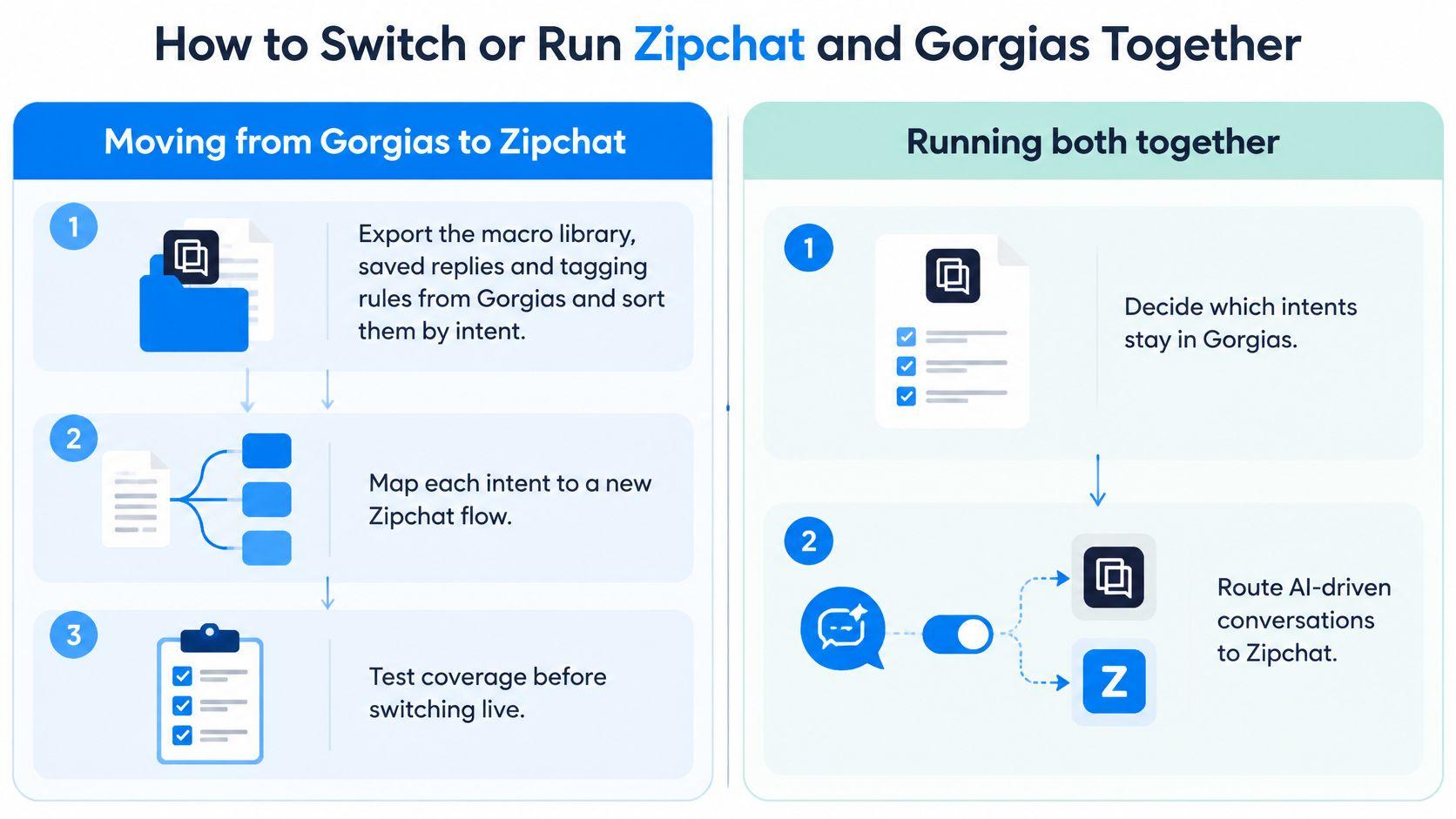
Two paths work. A store can move from Gorgias to Zipchat, or it can run both with a clear split of intents. The second option only holds if each side knows where pre-sale questions end and post-sale work begins.
Migration and Coexistence Steps
- Export the current library. Pull the macro library, saved replies and tagging rules from Gorgias and sort them by intent.
- Split intents by stage. Questions about sizing, shipping and product comparisons usually move to the AI layer, while order edits, refunds and cancellations stay with agents. Some threads cross that line mid-conversation, so decide upfront which side owns the moment a sizing chat turns into a return request.
- Load source material. Add policies, FAQs and product information to Zipchat's training pages.
- Connect both systems. Use the listed Gorgias integration, then test that escalated conversations arrive in Gorgias with their context intact. A step by step Zipchat switching outline covers the sequencing.
- Name one policy owner. One person owns each policy, whether it's returns, exchanges or shipping promises, so the AI and agents don't give conflicting answers.
- Run in parallel. Keep both live for two weeks and run the same real tickets through each setup, comparing escalation rates and answer accuracy on identical intents.
- Retire the old widget last. Turn it off only after the test scorecard passes.
Context is the expensive part to lose. An independent Gorgias company review describes Gorgias consolidating email, social, SMS, order history and Shopify data in a single ticket workspace, which makes a dropped thread costly when a second tool enters the conversation.
Duplicate answers, lost context and conflicting return policies are the main coexistence problems, and the parallel run is where each one surfaces. A money-back guarantee is a limited safety net, not a substitute for that test.
Choose the Tool That Matches Your Ticket Mix
| Store profile | Stronger starting point | Reason |
|---|---|---|
| Revenue leaks through unanswered pre-sale questions on sizing, shipping and comparisons | Storefront sales assistant such as Zipchat | Pre-sale uncertainty is the bottleneck |
| Heavy queue of order edits, refunds, cancellations and subscriptions | Gorgias helpdesk | Ticket workspace consolidates order data and agent actions |
| Heavy Instagram and WhatsApp direct message traffic | Zipchat, after testing channel coverage | Covers WhatsApp, Instagram and Messenger in one assistant |
| Existing helpdesk the team already trusts | Keep the helpdesk and add an AI layer | Zipchat lists a Gorgias integration |
| Low ticket or chat volume | Start with the smallest trial | Compare volume against plan limits before committing |
Reading the Verdict by Situation
There's no single winner in Zipchat vs Gorgias, because the tools solve different bottlenecks. A store losing sales to unanswered sizing questions doesn't have the same problem as a store buried in refund tickets.
Stores with an existing helpdesk shouldn't assume replacement is required. Adding an AI layer for discovery and product evaluation can leave order tracking, returns and escalation with the team that already handles them well.
Merchants widening the shortlist can compare broader customer service AI agent options against the same ticket mix. The comparison only helps if every candidate faces the same intents and the same scorecard.
A Third Option for Storefront Questions
Carti is another option for storefront product questions. It's an AI shopping assistant for Shopify with a Free plan at 50 AI conversations a month, Starter at $49 for 250, Growth at $99 for 600 and Scale at $249 for 1,750, plus a 14-day free trial on paid plans.
That option fits the same test as the others. It earns a place only if it answers a store's real pre-sale questions accurately and hands off cleanly when an order problem appears.
The next step is concrete. Pull last quarter's tickets, tag them by intent, and use the table to pick a trial. Stores that skip the tagging step usually buy the tool that demos best, not the one that fits.
If pre-purchase questions on sizing, shipping, returns and product comparisons are where sales stall, Carti offers an AI shopping assistant built for Shopify storefronts, starting with a free plan and a 14-day free trial on paid plans. Merchants can test it against the same tagged ticket set used for Zipchat and Gorgias, then keep whichever tool scores best on accuracy, escalation and incremental sales.

Written by
Daniel AndersonFounder of Carti. 10+ years building ecommerce brands in apparel and supplements. Still runs a Shopify store and built Carti to help merchants convert more browsers into buyers.