
A shopper asks whether a jacket runs small at 11 pm, finds an offline chat window, and leaves without buying. The Shopify merchant sees an abandoned session the next morning, but the unanswered fit question never becomes a support ticket.
That's the practical reason to compare LiveChat alternatives by the questions they can resolve, not just their widget design or response speed. A replacement should help shoppers make sound purchase decisions while giving the team a reliable route for questions automation shouldn't answer.
Why Shopify Stores Look Beyond LiveChat
The jacket shopper doesn't necessarily need a live agent. A clear size chart and relevant fit reviews might settle the question, provided the tool can distinguish product evidence from a guess.
A staffed widget works differently. Someone must be available, understand the product, and reply before the shopper gives up. Adding another inbox won't fix that coverage gap unless the merchant also changes staffing or introduces useful self-service.
Channel preferences complicate the decision. In a 2025 survey of 1,500 U.S. customers, Webex by Cisco found that 83% preferred more than one way to contact a brand, while only 4% disagreed. In the same survey, 47% preferred calling during business hours, 35% preferred around-the-clock online messaging, and only 50% had been offered at least three digital messaging channels during their latest interaction.
Match the channel to the job
Those findings don't establish that every Shopify store needs every channel. They show why replacing human chat with messaging alone can still leave customers poorly served.
A merchant might need storefront answers for product discovery, Instagram and Messenger coverage for social shoppers, and human support for disputed returns. Sprints & Sneakers' customer experience optimization frameworks offer a useful resource for mapping those journeys before choosing software.
The practical shortlist contains different tools, not interchangeable versions of the same widget:
- Staffed live chat supports nuanced conversations when agents are available.
- Helpdesk inboxes organize ownership and follow-up.
- FAQ widgets expose approved, scripted answers.
- AI shopping assistants interpret questions against store information.
The starting task is straightforward: list the ten questions shoppers asked most during the last month, then sort them into product, shipping, returns, and order status. That list provides a better buying specification than a vendor's feature checklist.
LiveChat Alternatives Compared at a Glance
| Option type | Pre-purchase questions | Needs staff online | Pricing source |
|---|---|---|---|
| Staffed live chat | Answered while agents are available | Yes | The selected vendor's pricing page |
| Helpdesk inbox | Depends on agent replies or configured automation | For human answers | The selected vendor's pricing page |
| FAQ widget | Scripted answers to common questions | No | The selected vendor's pricing page |
| AI shopping assistant (Carti) | Can answer from store information and recommend products | No for automated answers; human escalation is optional | Carti's plan details |
The table compares operating models, not guaranteed features. A helpdesk may include automation, and a live-chat product may offer self-service tools. Check whether the plan you choose handles the questions shoppers ask without requiring another subscription or manual workaround.
Where each option earns its place
Staffed live chat suits stores where advice calls for judgment or a detailed conversation. The trade-off is coverage: subscription fees don't include the employee time required to keep agents available.
Helpdesk inboxes suit teams handling delivery problems, replacements, and cases that need an owner. A shared queue can help coordinate follow-up, but collecting a sizing question doesn't answer it before checkout.
FAQ widgets suit stable questions with approved answers, such as return windows or care instructions. They become harder to maintain when merchants try to script every product combination.
AI shopping assistants suit recurring product questions that require information from a store's catalog and policies. Carti is a Shopify chatbot with a free plan offering 50 AI conversations per month. Paid plans start at $49 per month for 250 conversations; Growth costs $99 for 600, and Scale costs $249 for 1,750. Paid plans include a 14-day free trial.
Buying rule: An attractive interface can't make up for missing product information or a handoff that doesn't work for your team.
Price verification matters
Check LiveChat's current subscription price on its official pricing page, since plan prices and included usage can change. For any vendor, compare the billing term, included usage, and overage conditions as well as the headline price.
Use this table to narrow the shortlist, then judge each tool by whether it answers pre-purchase questions accurately and fits your team's way of working.
Instant Answers, Suggestions and Cart Recovery
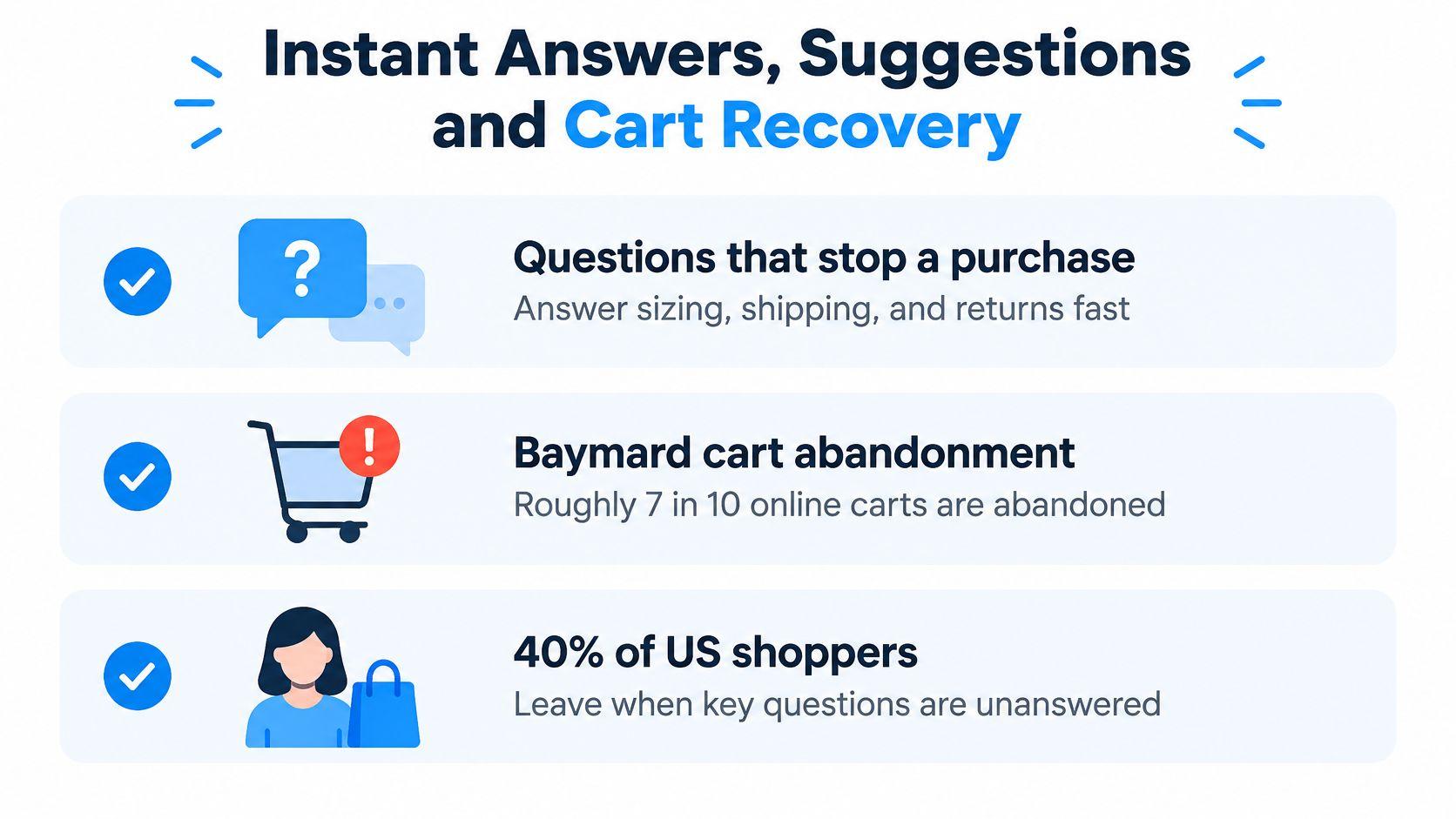
Questions that interrupt a purchase are often specific: whether a jacket fits broad shoulders, whether a replacement part matches an older model, or whether shipping charges apply to a particular destination. A fast generic answer doesn't resolve any of them.
Baymard's cart-abandonment analysis places abandonment at roughly 7 in 10 online carts, based on an unweighted average of 50 studies published from 2006 through 2025, and reports that 40% of U.S. online shoppers cited extra costs that were too high as a reason for abandonment. Those findings support clearer cost information, not a promise that chat can recover every abandoned purchase.
Judge answers by their evidence
For sizing, the tool should retrieve measurements and relevant fit information. For shipping, it should distinguish dispatch time from delivery estimates. For returns, it should identify product exclusions rather than repeat a general policy.
Product comparisons need similar discipline. Say a shopper wants a washable alternative to a dry-clean-only garment. A useful recommendation identifies a suitable product and explains the relevant care difference, rather than suggesting another popular item.
The publisher's assistant can recommend products from the live catalog, display their real price and stock, and place an add-to-cart button inside the conversation. Those functions shorten the path from an answer to an action, but the recommendation still needs to match the shopper's requirements.
Proactive Triggers can initiate a conversation, while the Insights Dashboard shows what shoppers ask. A trigger should address likely uncertainty without covering product information or repeatedly interrupting browsing.
Recovery needs a reason to return
The assistant also offers cart abandonment recovery in chat. Useful recovery addresses a remaining obstacle, such as uncertainty about a product, rather than treating another message as sufficient persuasion.
Button-click analytics record product views, add-to-cart actions, collection browsing, and suggested replies. These events help separate a conversation that attracted attention from one that helped a shopper move forward. The publisher's chatbot best-practices guide provides additional implementation guidance.
- Use real questions. Run the same ten pre-purchase questions through every trial.
- Check the evidence. Record whether each answer matches the catalog, policy, or approved FAQ.
- Test uncertainty. Include missing measurements and unclear delivery information to see whether the tool admits the gap.
- Inspect the purchase path. Confirm that shoppers can continue to Shopify checkout without unnecessary fields.
An assistant should clarify the purchase, not introduce another required transaction. Baymard's checkout-flow guidance reports that 18% of shoppers abandon when forced account creation or a hidden guest-checkout option becomes an obstacle, while 17% leave because checkout is too long or complicated.
Languages, Channels and Integrations to Check
Language coverage changes who can evaluate a product confidently. In a survey of 8,709 consumers across 29 countries, CSA Research found that 76% preferred buying products when information was available in their native language, while 40% would never buy from websites in other languages.
A language count alone isn't an acceptance test. Merchants should check whether translated answers preserve measurements, product names, exclusions, and the distinction between a recommendation and a guarantee.
Test language and channel continuity
The publisher's assistant automatically detects the customer's language and replies natively in 92 languages, without translation setup or extra configuration. A practical trial should include the store's leading non-English markets and questions containing local product terminology.
The multilingual AI assistant guide offers a starting point for that evaluation. A fluent-looking answer still needs review by someone who understands both the language and the product.
The assistant also replies to Instagram and Facebook Messenger messages. For a store selling through direct messages, the useful test is whether the answer remains consistent with the storefront's catalog and policies.
Reviews add another source of product evidence. Supported review applications include Judge.me, Loox, Yotpo, Okendo, and Fera, allowing the assistant to use reviews for fit and quality questions. Reviews should inform an answer, not turn an individual shopper's experience into a universal product claim.
Confirm the route after the answer
The Klaviyo integration adds shoppers to the merchant's chosen list when they sign up in chat and agree to receive communications, with the chat identified as the source. That consent requirement matters more than just collecting an email address.
Escalation deserves equal scrutiny. Re:amaze, Help Scout, and Freshdesk escalation integrations are coming soon and aren't yet available. Stores depending on one of those connections need another working route before switching.
A promised integration isn't an operational handoff. The acceptance test is whether the right person receives the unresolved question with enough context to act.
- Languages: Confirm accurate answers in the store's priority markets.
- Channels: Test storefront and social messages against the same approved information.
- Escalation path: Verify a currently available route, ownership, and shopper expectations.
Pricing and ROI Compared Without Guesswork
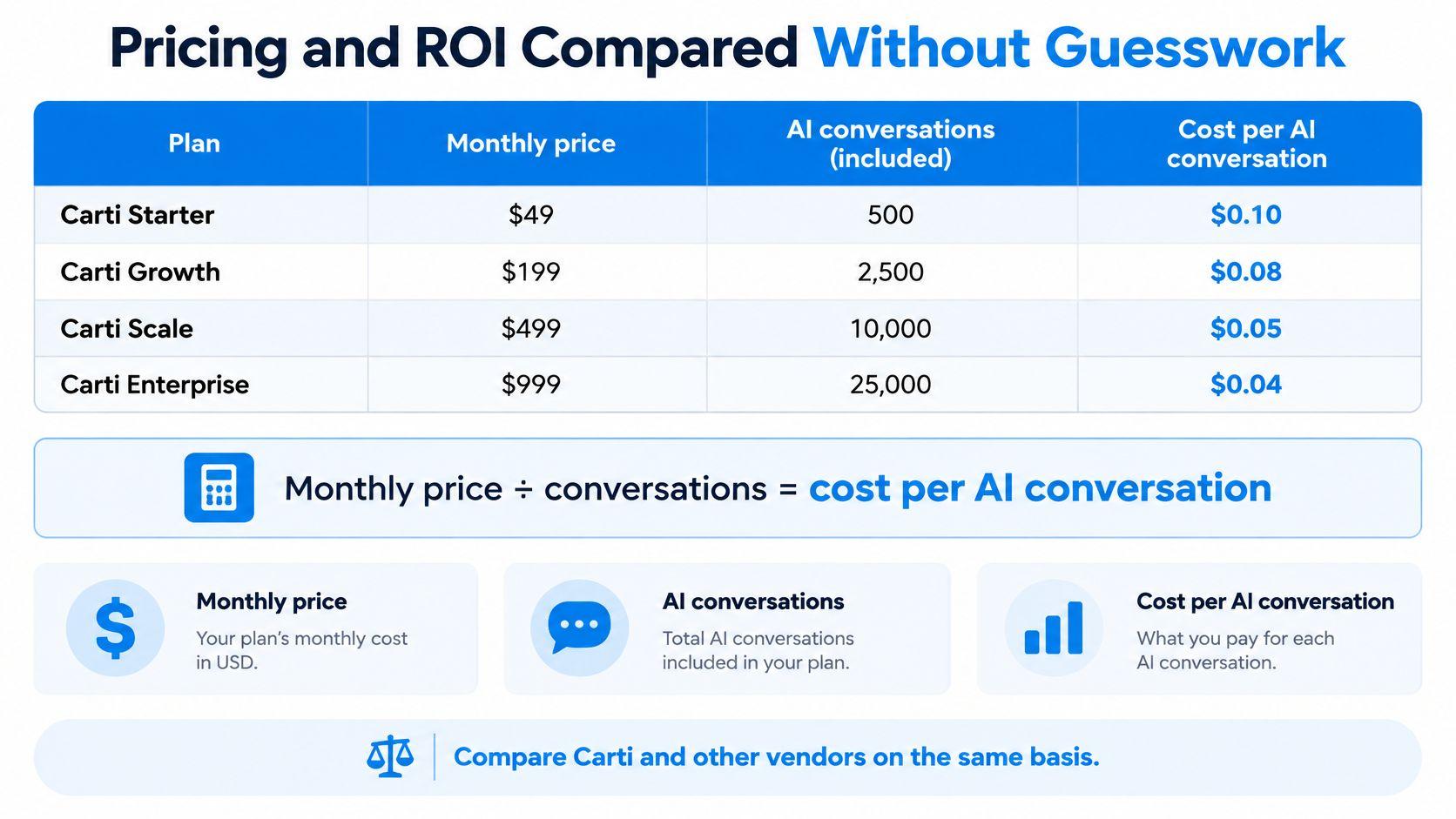
| Carti plan | Monthly price | AI conversations a month | Cost per conversation |
|---|---|---|---|
| Free | $0 | 50 | $0 |
| Starter | $49 | 250 | $0.20 |
| Growth | $99 | 600 | $0.17 |
| Scale | $249 | 1,750 | $0.14 |
Monthly price ÷ included conversations = cost per included AI conversation, rounded to the nearest cent. That calculation assumes the full allowance is used, so it isn't the effective cost of each conversation when usage is lower.
Compare the billable unit
Every paid plan includes advanced conversion analytics, covering conversion lift, revenue per conversation, and engagement trends over time. Starter, Growth, and Scale also include priority chat support.
For another vendor, the comparison worksheet should record the monthly charge, billing commitment, included seats or conversations, and any overage rule. A ticket, message, conversation, and automated resolution aren't interchangeable units.
The publisher's Tidio pricing breakdown can help identify comparison questions, but current competitor figures should still come from that competitor's official pricing page. An unconfirmed price shouldn't enter the budget.
Operational costs belong in the worksheet too. Staff time spent correcting policies, checking answers, and handling escalations can outweigh a small subscription difference. Recepta.ai's live chat support guide provides useful context for evaluating the human-service workflow alongside automation.
Calculate payback from margin
The useful payback formula is:
Break-even incremental orders = monthly tool cost ÷ contribution margin per incremental order.
An illustrative calculation can use the Starter subscription and a hypothetical contribution margin of $25 per additional order. The calculation is $49 ÷ $25 = 1.96, meaning the merchant would need two additional orders to cover the subscription alone.
Those hypothetical order economics aren't a benchmark. Each merchant should substitute actual margin after discounts, payment costs, fulfillment, and other variable expenses.
Assisted revenue requires a separate interpretation. A shopper may chat and purchase despite already intending to buy, so an attributed order doesn't automatically represent an incremental sale.
- Cost per used conversation shows whether the allowance matches demand.
- Assisted revenue shows which orders followed conversations under the attribution rules.
- Incremental contribution estimates whether the assistant produced enough additional margin to justify its total cost.
A cheap plan that leaves important questions unresolved isn't automatically economical. A larger allowance also isn't a saving when the store doesn't use it.
Which Alternative Fits Your Industry
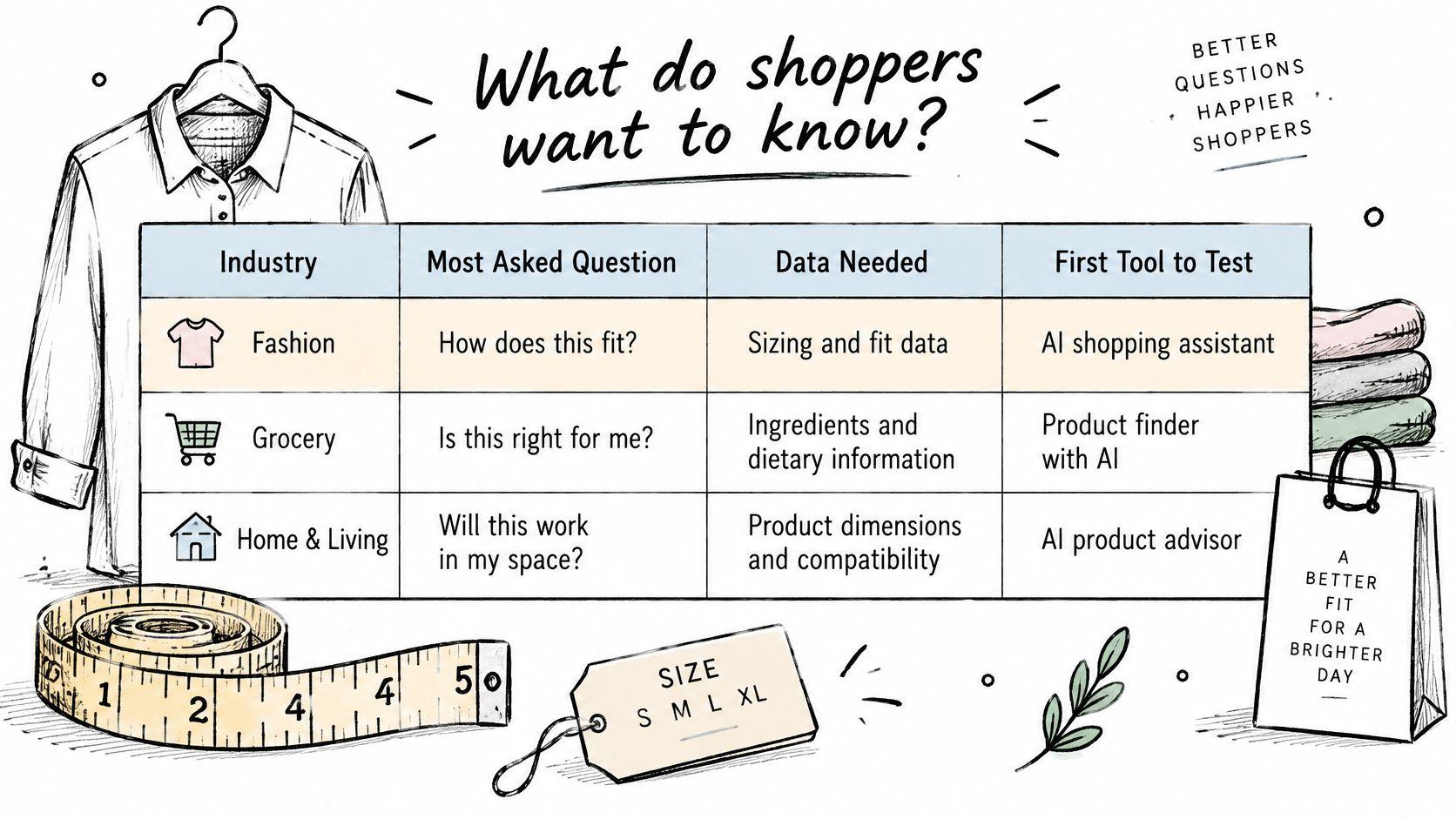
| Category | Typical pre-purchase question | Data the answer needs | Tool to test first |
|---|---|---|---|
| Fashion | Does this run small? | Size chart and fit reviews | AI assistant connected to review apps |
| Beauty | Is this safe for sensitive skin? | Ingredient list and product policy | AI assistant with a human route |
| Home | Will it fit my space or model? | Dimensions, compatibility, and stock dates | AI assistant with live catalog data |
| Wellness | Is this right for my condition? | Approved claims and regulated guidance | Human chat for claims, AI for shipping |
Product risk should determine the automation boundary. The same assistant can perform well on garment measurements and still be unsuitable for answering a health-related suitability question.
Fashion and beauty need different safeguards
For fashion, start with measurement accuracy. A size label alone doesn't establish fit, and an assistant shouldn't convert a few reviews into a guarantee. The strongest answer combines the size chart with carefully qualified review evidence.
For beauty, ingredient retrieval is useful, but a list of ingredients doesn't establish that a product is safe for a particular person. Sensitive-skin and allergy questions need a human route rather than confident reassurance.
A well-configured assistant can still explain shades, application instructions, and published product policies. The boundary is between describing documented product information and assessing individual health risk.
Home and wellness expose missing information
For home products, dimensions must include units and relevant clearances. Compatibility should come from an explicit specification, not a similar-looking model name.
Stock information and delivery information also need separate checks. A product being available doesn't establish an arrival date, so merchants should test whether the tool has actual shipping evidence before allowing date-specific answers.
For wellness, claim-based questions belong with a qualified person. Automation can handle documented shipping policies and routine order questions while avoiding individualized guidance.
Agencies should evaluate each client's categories independently. Reusing a widget configuration is convenient, but reusing answer permissions across unrelated product risks isn't sound implementation.
- Choose the closest category. Start with the row that reflects the store's actual purchase uncertainty.
- Test the top five questions. Include realistic product details rather than generic prompts.
- Mark human-only answers. Record which questions require judgment, missing evidence, or a qualified response.
The right tool is the one that answers within its evidence and stops where that evidence ends.
Run a Two-Week Trial Before You Cancel LiveChat
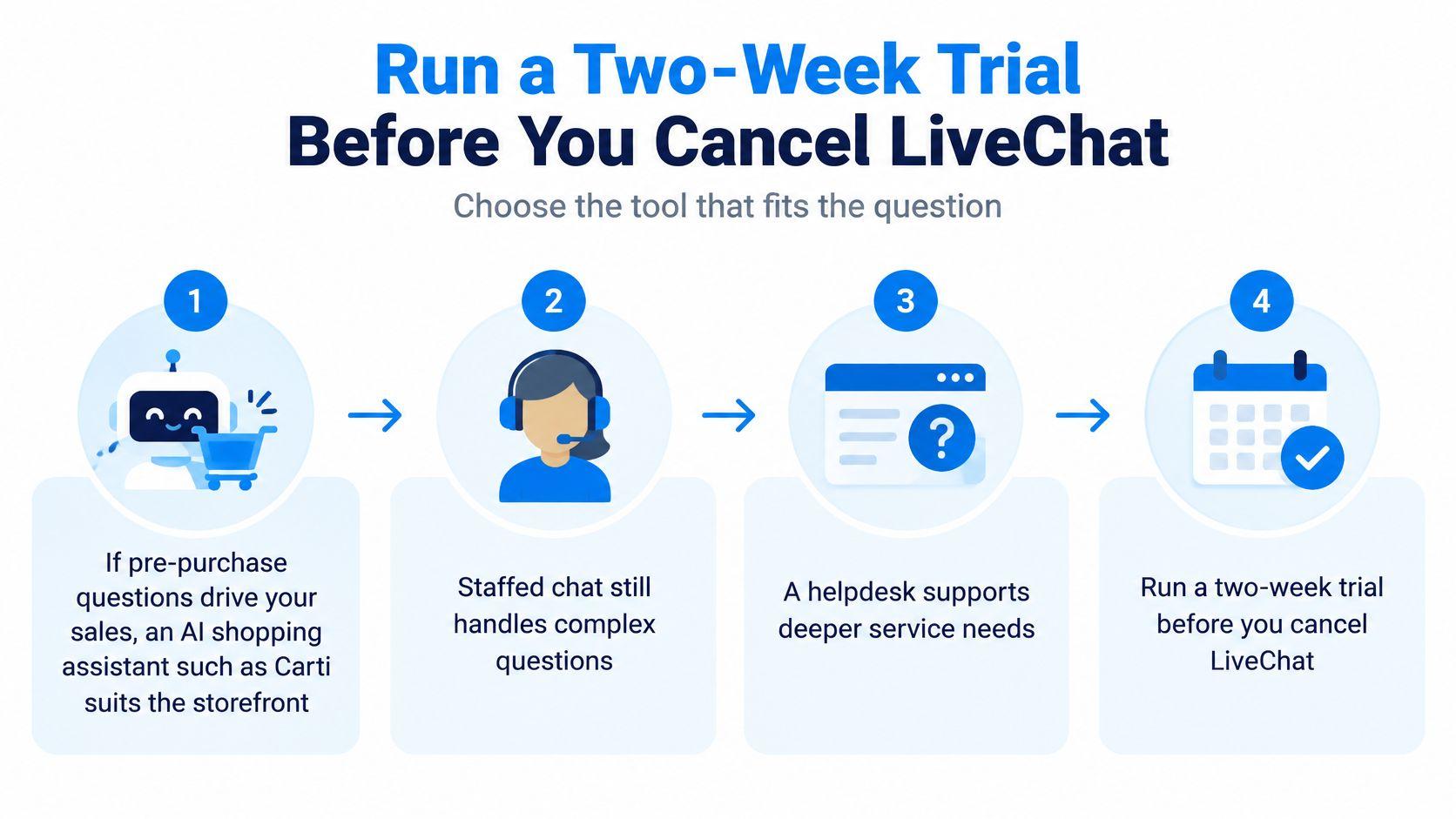
If pre-purchase questions drive sales, an AI shopping assistant such as Carti suits the storefront, while staffed chat or a helpdesk remains appropriate for complex post-purchase cases.
A controlled transition protects the service customers already receive. The trial should test answer quality, shopper behavior, and the team's ability to handle exceptions, rather than treating installation as proof that the replacement works.
Switch with an acceptance checklist
-
Preserve the existing record. Save or export recent LiveChat transcripts if the current tool allows it. Keep unresolved cases identifiable so a software change doesn't erase responsibility for follow-up.
-
Connect approved store information. Sync the catalog, policies, and FAQs after removing contradictory or outdated wording. The new assistant's widget goes live in the Shopify theme without code once the sync finishes.
-
Run the prepared question set. Enter the ten questions collected during the initial review and compare every answer with the underlying store information. Record incorrect claims, unsupported assumptions, and appropriate admissions that information is missing.
-
Keep the existing service available during the two-week trial. Operate the new tool alongside the old service, but avoid displaying competing launchers to the same shopper. Use separate test conditions or controlled exposure where the installation allows it, and keep a clear rollback route.
-
Review conversations and commercial outcomes. Chat Logs support keyword search and date-range filtering, and transcripts can be reviewed anytime. The dashboard reports conversations, escalations, orders, and attributed revenue, giving the merchant a basis for inspecting both successful interactions and unresolved cases.
-
Retire the old chat only after acceptance. Verify correct answers, working escalation rules, and a named owner for exceptions. If a critical question still receives an invented answer, fix the knowledge or restrict the workflow before expanding exposure.
Separate attribution from impact
A conversation can influence a purchase without creating it. It can also prevent a poor product choice, reveal a missing specification, or expose a confusing policy without producing an immediate order.
Use distinct outcome labels when reviewing transcripts:
- Purchase assistance: The shopper received relevant information and proceeded toward an order.
- Risk reduction: The answer clarified a limitation or prevented an unsuitable recommendation.
- Knowledge gap: The conversation revealed information the merchant needs to add or correct.
- Service escalation: A person needed to resolve the case, with ownership preserved.
A trial succeeds when the merchant can explain both what the assistant resolved and what still requires staff. Cancellation should follow that evidence, not precede it.
For merchants comparing LiveChat alternatives, Carti offers Shopify product answers, catalog recommendations, and conversation analytics. Start with the Free plan's 50 AI conversations a month or a paid plan's 14-day free trial, then decide using two weeks of answer checks, escalation reviews, and purchase outcomes.

Written by
Daniel AndersonFounder of Carti. 10+ years building ecommerce brands in apparel and supplements. Still runs a Shopify store and built Carti to help merchants convert more browsers into buyers.