
A one-second delay can reduce conversions by 7%, according to performance research summarized by site-speed benchmarks. That loss often starts before checkout. A shopper wants to know whether a jacket fits, whether a serum contains a particular ingredient, when an order will arrive, or what happens if the product doesn't work. If the answer isn't available at the moment of hesitation, the shopper may leave without adding to cart.
Shopify CRO works best when merchants fix the specific point where intent breaks down, rather than treating conversion as a single homepage metric. The playbook below moves from questions and product discovery to checkout clarity, inventory, recovery, testing, trust, and retention. It also maps Carti's Instant Answers, Smart Suggestions, Cart Recovery, and Insights Dashboard to the moments where conversational assistance can remove friction.
1. Conversational AI and Instant Response Optimization
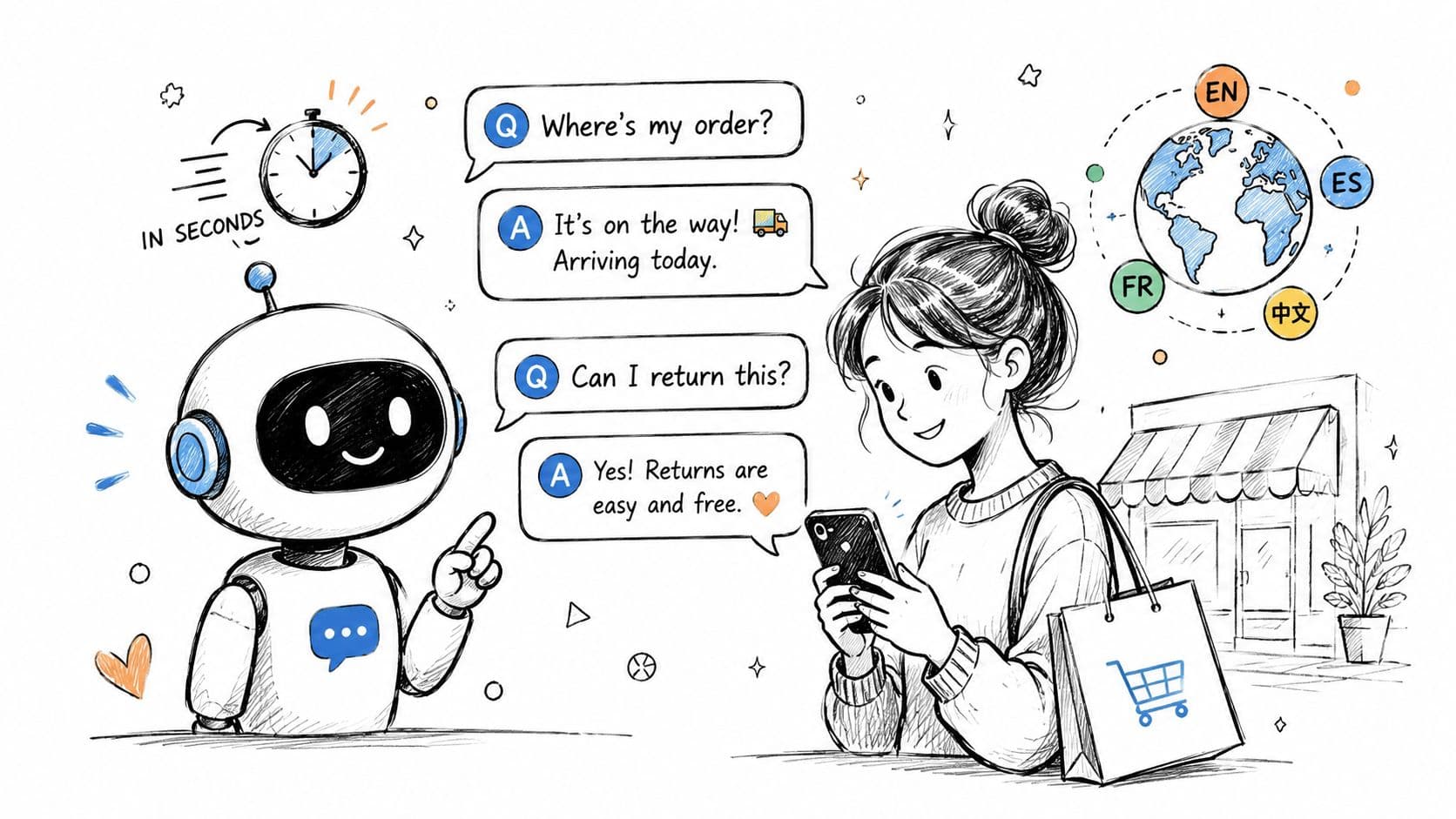
Shoppers rarely abandon because they dislike every part of a product. More often, they pause over one unresolved question. A conversational assistant can answer questions about sizing, ingredients, compatibility, shipping, returns, or availability while the shopper is still deciding.
That response needs to be accurate and contextual. A generic bot that sends visitors to a broad FAQ page adds another task. A useful assistant identifies the product in view, draws from the store's catalog and policies, and gives a direct answer. Carti's conversational commerce guidance is relevant here because the strongest use case is not support deflection alone. It's helping a shopper take the next sensible step.
Build the knowledge before the interface
Start with product titles, variants, descriptions, shipping rules, return terms, and FAQs. If those sources conflict, the assistant can create uncertainty faster than a human agent. Review conversation logs and use the Insights Dashboard to find questions that remain unanswered or receive weak answers.
Set an escalation path for exceptions. A shopper asking whether a dress runs small may need a catalog-backed answer. A complaint about a damaged delivery or an unusual order change may need a human. The trade-off is simple: automation should handle repeatable decisions, while people handle ambiguity, emotion, and policy exceptions.
Practical rule: A fast wrong answer is still purchase friction. Keep catalog and policy accuracy ahead of conversational polish.
A Shopify fashion store might place Instant Answers beside size and material details, while a beauty store could surface ingredient or routine guidance on product pages. Measure assisted conversion, response time, unanswered questions, and downstream orders, not chat engagement by itself. Merchants evaluating a broader AI shopping agent should apply the same standard.
2. Smart Product Recommendations Based on Behavior
Recommendation quality depends on timing and relevance, not on showing more products. A shopper viewing a dress may need shoes, a matching bag, or care instructions. A returning customer may be ready for a replenishment or a complementary item, while a first-time visitor may still need help choosing the original product.
Start with high-confidence relationships. Frequently bought together, compatible accessories, and complete-the-look suggestions are easier to explain and less likely to feel intrusive than broad algorithmic guesses. Carti's personalized product recommendations can support this workflow by connecting browsing signals and cart context to a more useful next suggestion.
Match the recommendation to intent
A recommendation should answer a shopper's likely next question. For example, “Need a layer for this dress?” is more helpful than “You may also like.” In beauty, a conversational prompt might ask what finish or skin concern the shopper wants before suggesting a product. In home and wellness, it might recommend an accessory only after confirming compatibility.
Keep inventory synchronized. Recommending an unavailable shade or size damages confidence and forces the shopper to restart the search. Segment recommendations by new versus returning visitors, product category, and cart contents, then compare click-through, assisted conversion, order value, and returns.
There's also a restraint problem. Too many suggestions compete with the primary decision. On a product page, keep the main product's value proposition and purchase action dominant. On the cart page, recommend only items that make the order more complete or easier to use.
Use the Insights Dashboard to identify combinations shoppers ask about repeatedly. Those questions can reveal merchandising opportunities that raw purchase data misses. If customers frequently ask which cleanser pairs with a moisturizer, the answer can become a structured bundle, a product-page module, or a Smart Suggestion.
3. Abandoned Cart Recovery Campaigns
Global cart abandonment is reported at 70.22% across more than 50 studies, according to Baymard's cart abandonment benchmark. That figure signals a funnel problem rather than a simple recovery opportunity. A cart may reflect price resistance, shipping uncertainty, payment failure, distraction, or a question the storefront left unanswered.
Start with diagnosis. Track cart creation, checkout starts, payment-step exits, and completed orders as separate events. Shopify merchants can then see whether shoppers leave after shipping costs appear, during address entry, or when a payment method fails. Each cause requires a different recovery path.
Recover intent without creating pressure
Carti's cart abandonment recovery workflow can trigger a context-aware onsite prompt while the shopper is still present. “Need help with anything?” gives someone a chance to ask about sizing or delivery before an incentive changes the economics of the order. Preserve cart contents in the return path so the shopper does not rebuild the order.
Email adds a second touchpoint. Klaviyo's benchmark summary reports a 3.33% conversion rate and approximately $3.65 in revenue per recipient for abandoned-cart email, as cited by cart-abandonment email benchmarks. Treat those figures as operating context, not a forecast for every Shopify store.
Segment messages by likely friction:
- Shipping uncertainty: Clarify delivery terms and total cost.
- Product hesitation: Return shoppers to the exact item and address the relevant question.
- Payment failure: Provide a direct retry path or support option.
- High-consideration purchase: Offer reassurance before testing an incentive.
Measure recovered orders and incremental revenue per recipient alongside opens and clicks. Engagement without completed orders often means the campaign returns shoppers to the same checkout problem. Use the result to refine the storefront, checkout, or Carti prompt, rather than sending more reminders.
4. Comprehensive FAQ and Knowledge Base Optimization
The best FAQ content answers objections before they become support tickets. Product pages should explain the details that affect purchase confidence, while checkout and policy pages should remove uncertainty about delivery, returns, payments, and order changes.
Create answers from real customer language. Review support conversations, emails, and Carti chats for recurring questions. “Does this run true to size?” is a different content need from “What are the garment measurements?” The first asks for guidance. The second requires structured product data.
Organize answers around the buying journey
A useful knowledge base might group information into:
- Before purchase: Fit, materials, ingredients, compatibility, and use cases.
- During checkout: Shipping costs, delivery timing, payment options, and taxes.
- After purchase: Tracking, care instructions, exchanges, returns, and refunds.
Write the reason behind a policy, not only the policy itself. “Returns accepted within the stated window” is less reassuring than a clear explanation of eligibility, process, and expected next step. Keep language plain, especially for international shoppers and mobile screens.
Carti's Insights Dashboard can turn unanswered questions into a content roadmap. A question asked repeatedly on a specific product page may belong directly beside the purchase action. A question that appears after checkout may indicate a confirmation-page or order-status gap.
Avoid hiding important answers behind an overloaded accordion or a generic support link. The trade-off is between page length and decision support. Put high-intent information near the relevant decision, then link to deeper detail for shoppers who need it.
5. Transparent Checkout Experience Design
Checkout deserves focused investigation because shoppers can lose confidence at several points between cart and payment. Review each stage separately. Identify where Shopify shoppers leave, then inspect what they encountered there, such as an unexpected fee, unclear delivery timing, a form error, or missing policy information.
Show costs as early as the experience allows. Shipping surprises, uncertain arrival dates, difficult forms, and unclear returns can turn purchase intent into delay. Make the order total, payment methods, delivery expectations, and return path easy to verify before the final submission.
Design for confidence and completion
Keep checkout focused without removing information shoppers need. A shorter layout may reduce distraction, but hiding shipping details or the returns link can create hesitation. Test both the amount of information and its placement instead of assuming minimal design will perform best.
Carti can provide targeted assistance during checkout. A prompt such as “Questions about shipping or returns?” gives hesitant shoppers a way to resolve uncertainty without leaving the page. Where possible, configure answers around the current cart, product, and destination. Route payment or account problems to human support when automation cannot safely resolve them.
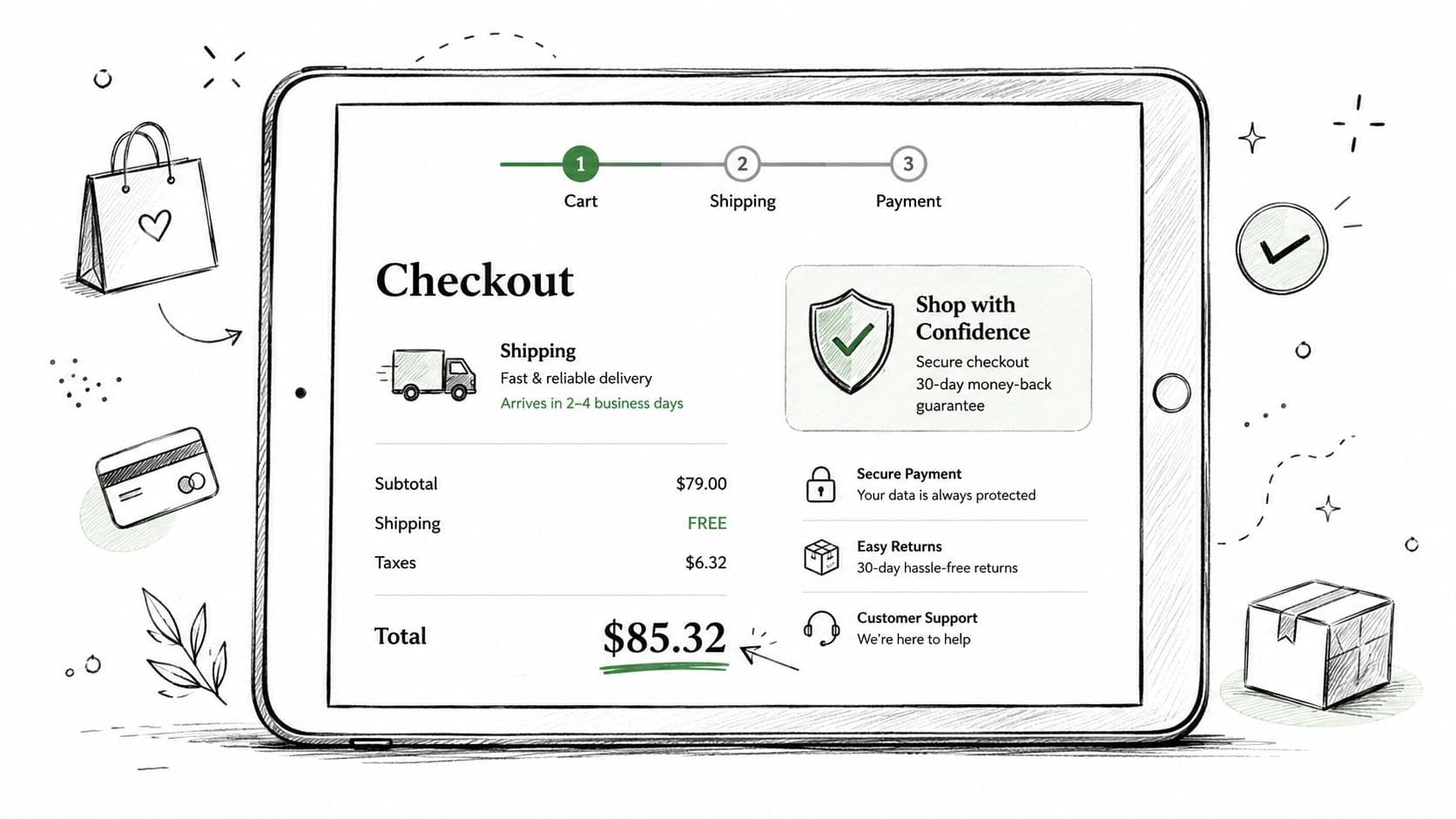
Review mobile taps, autofill behavior, error messages, discount-code handling, and payment recovery. Compare analytics exits with support conversations and Carti chats. An abandonment event may reflect a technical failure rather than a change of mind.
Use the following visual to assess how checkout clarity supports purchase completion.
6. Real-Time Inventory and Availability Communication
Availability information helps shoppers decide, but only when it's trustworthy. “Only one left” should reflect actual variant inventory, not a generic urgency script. False scarcity may create a short-term click while damaging confidence, support workload, and future purchases.
Connect availability messaging to the same inventory source that controls Shopify variants. Include the specific size, shade, color, or configuration. “Available” is often too vague. “Medium is available, large is unavailable” gives the shopper a usable answer.
Use honest urgency and useful alternatives
A fashion shopper asking about a nearly sold-out size may benefit from a direct availability answer and a fit alternative. A beauty shopper whose preferred shade is unavailable may need a similar tone, a restock notification, or a waitlist. These responses preserve intent without pretending that the original item is still purchasable.
Carti can support this conversational layer when inventory data is current. The assistant should:
- Confirm the exact variant: Avoid broad product-level availability claims.
- Explain restock information: Share a known timeline only when the store has one.
- Offer a relevant substitute: Match function, shade, fit, or price position.
- Capture demand: Use waitlists to inform replenishment and merchandising.
Urgency language also needs restraint. Specific availability is credible. Repeated exclamation marks and vague “selling fast” claims feel promotional rather than helpful. Measure cancellations, support contacts, substitute-product acceptance, and waitlist demand to see whether availability messaging improves the whole experience.
7. Multi-Language and Localization Strategy
Translation does not create a localized buying experience by itself. Shopify shoppers also need familiar payment methods, clear delivery terms, regionally appropriate returns information, and product guidance suited to local context.
Start with markets already producing meaningful store activity. Use traffic and customer conversations to identify priority languages, then audit catalog fields, size guides, ingredient details, and policy content before enabling automated responses. An error in a return condition or measurement can weaken trust at the point of purchase.
Prioritize the buying decision
Carti's publisher information describes support in 92 languages. That can help a Shopify merchant serve multilingual shoppers without maintaining a separate conversational workflow for every language. Accuracy still depends on the source content. Ambiguous measurements, incomplete duties information, or regional exceptions will remain confusing after translation.
Run a controlled rollout in one high-opportunity market. Review conversations by language for misunderstood terms, unanswered questions, and escalation frequency. A French-speaking shopper may need product guidance, while shoppers in another market may ask first about payment or delivery.
Localization should match the shopper's buying context:
- Currency and totals: Show costs in a format the shopper can understand before checkout.
- Payment preferences: Offer relevant regional methods only when the store can fulfill orders through them reliably.
- Policy language: Explain shipping, duties, returns, and refunds with local clarity.
- Merchandising: Recommend products that are available and suitable for that market.
Connect Carti's answers to the same Shopify catalog, inventory, and policy information used elsewhere in the storefront. This reduces contradictions between a translated conversation and the product page. Review unanswered questions and escalations weekly, then update source content before expanding to another market.
A smaller, accurate rollout is better than broad automation that creates avoidable confusion. Measure conversion by market, support demand, checkout completion, and return reasons to decide whether localization is improving the full customer journey.
8. Data-Driven Insights and Continuous Testing
Industry benchmarks report an average website conversion rate of 2.35%, with desktop ecommerce at 4.14% and mobile at 1.53%, according to conversion-rate optimization benchmarks. Use these figures as context, not targets. A store-wide average can conceal a mobile checkout issue, a product-page question, or a weak recovery flow.
Build the measurement plan around Shopify's funnel: product views, add-to-cart actions, checkout starts, payment progression, completed orders, and post-purchase outcomes. Add Carti events, including questions asked, answers delivered, escalations, recommendation clicks, and returns from recovery messages. This connects storefront friction with revenue and retention instead of treating engagement as the outcome.
Turn shopper behavior into testable decisions
Start with the largest stage-specific drop-off, then identify the shopper question closest to that decision. A useful hypothesis might be: “If we place the most common fit answer beside the size selector, more qualified shoppers will add the product to cart.” Test that change against the existing product page while keeping unrelated elements stable.
Carti's Insights Dashboard can reveal unanswered questions and recommendation performance. Its testing and reporting features can help merchants compare variants. Keep the primary measure tied to completed orders or revenue. Clicks, conversation starts, and engagement can explain a result, but they do not establish business value on their own.
Review results weekly:
- Funnel stage: Where did shoppers leave, and was the pattern different on mobile?
- Shopper segment: Did new, returning, or high-intent visitors respond differently?
- Customer quality: Did returns, support volume, or order value shift unfavorably?
- Next action: Should the team revise the answer, change the page, or run another controlled test?
Industry guidance also associates landing-page A/B testing with a 12% conversion increase. Treat that finding as support for disciplined experimentation, not a forecast for a particular Shopify store. Roll out changes only after the primary metric and unwanted effects have been reviewed.
9. Trust Building and Social Proof Integration
Trust signals reduce uncertainty only when they answer the question in front of the shopper. Put a fabric-quality review beside material details, fit feedback near the size guide, and the returns policy close to the purchase decision. A footer link rarely helps someone deciding whether to buy.
Collect review prompts around real objections. Ask customers about fit, quality, shipping, setup, ingredients, or use results, then group the responses by product and concern. A beauty store can surface comments about texture and scent. A home-goods store may need feedback on assembly, dimensions, and durability.
Carti can identify recurring shopper questions and surface relevant proof during a conversation. If a shopper asks whether an item runs small, the assistant can provide fit guidance or link to authentic reviews. The response should reflect the evidence available, rather than present customer feedback as a guarantee.
Use a trust system that supports the decision:
- Specific customer reviews: Favor details, context, and product relevance over generic praise.
- Clear guarantees: State coverage and limits in plain language. A badge cannot replace the terms.
- Visible support: Let shoppers ask questions before they enter payment details.
- Transparent policies: Explain returns, exchanges, delivery, and refunds where uncertainty appears.
- Public responses: Address negative reviews with empathy, facts, and a clear resolution path.
Placement matters more than volume. A page crowded with badges, logos, and testimonials can make the product decision harder. Match each proof element to the objection, then monitor completed orders, support questions, and returns to see whether it helps or creates new confusion. Review the evidence regularly, and remove signals that attract attention without resolving a concern.
For payment-related disputes, merchants may review tools such as a dispute refund window tool. Keep any customer-facing promise accurate, specific, and consistent with the store's actual policy.
10. Personalized Post-Purchase Communication and Retention
A completed order is not the end of conversion work. The post-purchase experience determines whether the customer understands the product, trusts the delivery process, and feels confident returning to the store.
Send confirmation information immediately and set clear expectations for processing, shipping, tracking, returns, and exchanges. Proactive updates reduce the need for customers to ask where an order is. Product-specific guidance can prevent avoidable disappointment, such as care instructions for apparel or usage guidance for beauty products.
Support the customer's next decision
Carti's post-purchase role should be practical before it becomes promotional. A customer asking about tracking needs a status answer. Someone asking how to use a product needs precise guidance. A return request needs a clear process, eligibility information, and escalation when the case falls outside standard rules.
After the customer has had enough time to use the product, a relevant replenishment or complementary recommendation may make sense. The timing should follow product behavior, not an arbitrary campaign calendar. A consumable, a seasonal item, and a durable product each require different follow-up logic.
Segment communication by product category and order history. Gather feedback after delivery or after the customer has had a meaningful use experience, rather than sending repeated surveys that create fatigue. Track repeat purchases, return reasons, support resolution, and customer value together. Optimizing repeat orders while making returns difficult may improve a narrow metric and damage the relationship.
Comparison of 10 CRO Best Practices
| Strategy | Implementation complexity | Resource requirements | Expected outcomes | Ideal use cases | Key advantages |
|---|---|---|---|---|---|
| Conversational AI & Instant Response Optimization | High, NLP models, multi-turn dialog and catalog/policy integration | AI/chat platform, training data, catalog/CRM integration, monitoring/ops | Faster responses (seconds), lower abandonment, measurable conversion uplift | High-volume support, international storefronts, real-time sales assistance | Immediate scalable support, 24/7 multilingual coverage, consistent answers |
| Smart Product Recommendations Based on Behavior | Medium, behavior tracking and recommendation model tuning | User behavior data, recommendation engine, inventory/pricing sync | AOV lift (15–35%), higher engagement and conversion | Large catalogs, upsell/cross-sell opportunities, personalized shopping journeys | Contextual personalization, higher basket value, reduced decision paralysis |
| Abandoned Cart Recovery Campaigns | Medium, multi-channel sequences and timely triggers | Cart tracking, chat/email/SMS tools, segmentation and incentive rules | Cart recovery 10–30%, high ROI (often 10x+), quick wins within hours | Stores with high cart abandonment, time-sensitive promotions | Targets intent-ready shoppers, high ROI, multi-touch re-engagement |
| Comprehensive FAQ & Knowledge Base Optimization | Medium, content audit, structure and ongoing maintenance | Content creators, KB platform, analytics for gaps and updates | Reduced support volume, fewer checkout objections, self-service lift | Complex products, high repeat questions, support-constrained teams | Scales self-service, consistent messaging, SEO and discovery benefits |
| Transparent Checkout Experience Design | Medium, UI/UX changes and backend coordination | Checkout platform changes, inventory/pricing coordination, UX testing | Checkout abandonment reduced 15–35%, improved trust and fewer support tickets | Sites with checkout drop-offs, price-sensitive shoppers, high AOV orders | Clear costs and guarantees, fewer surprises, higher completion rates |
| Real-Time Inventory & Availability Communication | High, live inventory sync and accurate availability logic | Inventory API sync, SKU mapping, chatbot/UX integration, monitoring | Fewer post-purchase cancellations, increased urgency and confidence | Limited-stock launches, high-SKU apparel/beauty catalogs | Accurate availability, trustworthy scarcity, alternative recommendations |
| Multi-Language & Localization Strategy | High, translation, cultural adaptation, regional compliance | Localization tools/teams, regional pricing/payment integrations, legal review | International conversion uplift (20–40%), expanded market reach | Global DTC brands, emerging market expansion, multilingual traffic | Native-language support, lower multilingual support costs, better regional fit |
| Data-Driven Insights & Continuous Testing | Medium, analytics instrumentation and experiment frameworks | Analytics/dashboard, A/B testing tools, analyst capacity | Incremental conversion gains, prioritized high-impact fixes, proven ROI | Data-rich sites pursuing continuous CRO, iterative optimization | Evidence-based decisions, rapid experimentation, measurable improvements |
| Trust Building & Social Proof Integration | Low–Medium, review/testimonial capture and display | Review platforms, moderation workflows, creative assets | Conversion uplift (25–40%), reduced hesitation and returns | Higher-price items, new-customer acquisition, quality-sensitive products | Social validation, credibility signals, objection handling with real evidence |
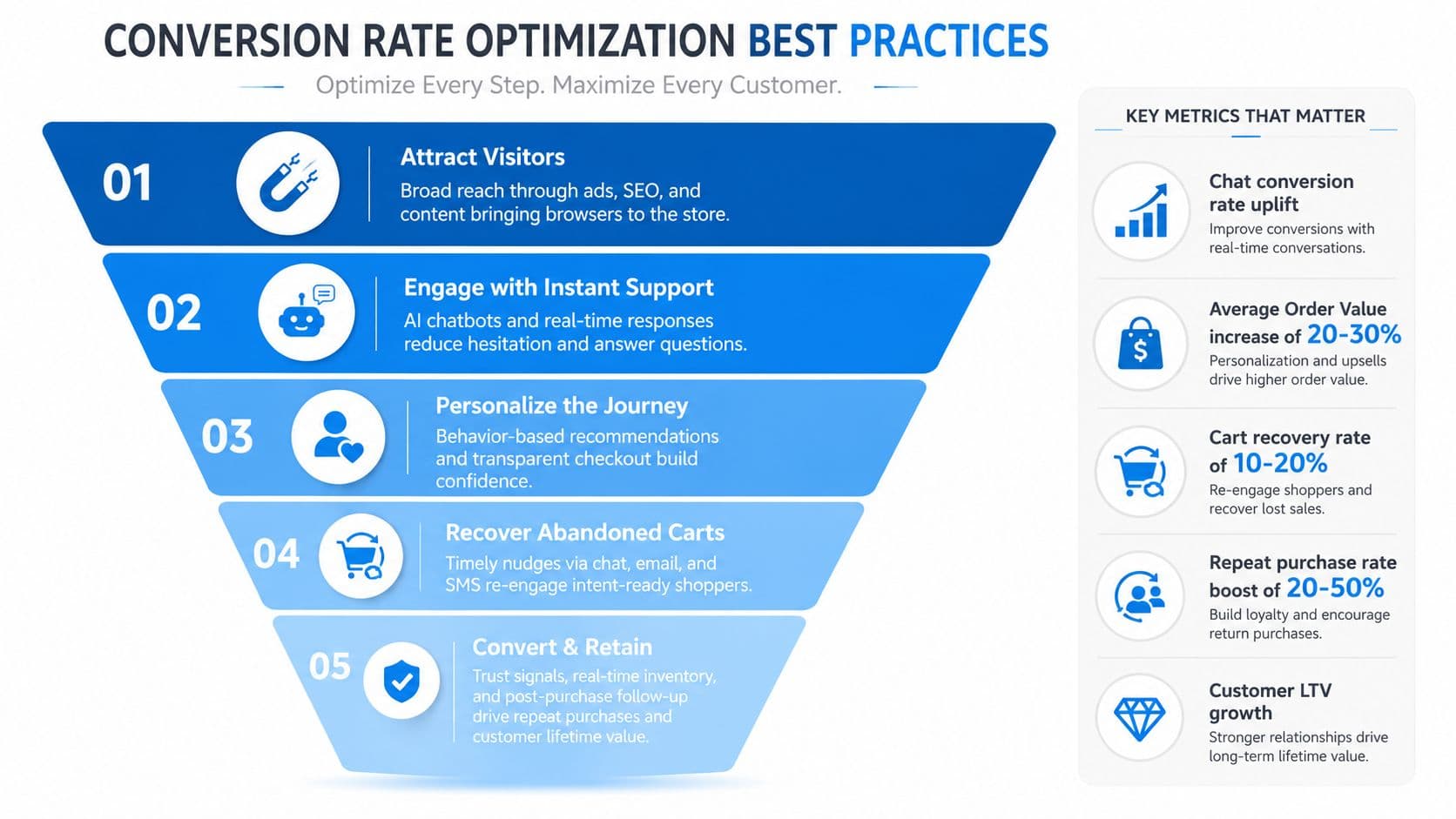
| Personalized Post-Purchase Communication & Retention | Medium, CRM automation and segmentation workflows | CRM/automation platform, content for flows, returns and tracking integration | Repeat purchase increase (20–50%), higher LTV, lower returns | Subscription/DTC brands, retention-focused strategies | Boosts lifetime value, improves satisfaction, drives repeat purchases |
Turn CRO Improvements Into a Weekly Operating System
Conversion rate optimization best practices become useful when they form an operating rhythm. Start with the friction closest to a purchase decision. Review unanswered questions, product-page hesitation, shipping clarity, payment errors, and checkout-stage losses before redesigning the homepage.
A practical sequence is:
- Fix unanswered questions and checkout transparency. Make fit, ingredients, compatibility, shipping, returns, delivery expectations, and total cost easy to understand.
- Improve discovery and availability. Use behavior-informed recommendations, accurate variant inventory, and relevant alternatives.
- Launch recovery carefully. Connect Cart Recovery to the exact cart, likely abandonment reason, and a low-friction return path.
- Run structured tests. Write a hypothesis, change a focused element, define the primary outcome, and record what the result teaches.
- Close the loop after purchase. Use tracking, product guidance, returns support, and relevant follow-up to protect the next conversion.
Track the business as a system. Core measures should include conversion rate, average order value, chat conversion rate, cart recovery rate, response time, unanswered questions, repeat purchase rate, and lifetime value. These metrics explain different parts of the customer journey. A higher chat click rate means little if orders don't increase. A stronger first-order conversion rate may conceal more returns or weaker repeat behavior.
Speed deserves a baseline check because a one-second page-load delay can reduce conversions by 7%, according to the site-speed research summary. Test mobile and desktop separately, and connect performance findings to funnel stages rather than treating page speed as an isolated technical score.
Carti can serve as an implementation layer for Instant Answers, Smart Suggestions, Cart Recovery, and the Insights Dashboard. It can't replace accurate catalog data, clear policies, reliable inventory, or disciplined experimentation. Merchants still need to decide which customer problem matters most and verify whether the fix improves completed orders and customer quality. A useful external perspective is Wojo Media's CRO framework, especially its emphasis on treating optimization as a repeatable process rather than a one-time redesign.
Review the dashboard weekly, assign an owner to the highest-impact issue, and keep a record of every test. Over time, the store builds more than a collection of winning changes. It builds an evidence base for merchandising, support, checkout design, and retention.
Carti gives Shopify merchants Instant Answers, Smart Suggestions, Cart Recovery, and Insights Dashboard tools for resolving shopper questions and improving the buying journey. Visit Carti to connect conversational assistance with a practical CRO workflow and start turning unresolved hesitation into measurable learning.

Written by
Daniel AndersonFounder of Carti. 10+ years building ecommerce brands in apparel and supplements. Still runs a Shopify store and built Carti to help merchants convert more browsers into buyers.
Ready to boost your store's sales?
Install Carti in 5 minutes and let AI handle customer questions, recommend products, and close sales 24/7.
Start Free Trial14-day free trial