
Nearly a third of customers expect a response within one hour, while 38% expect support immediately. Yet the average first response time for e-commerce support remains 4–6 hours, according to e-commerce customer service statistics from eDesk. For a Shopify merchant, that gap isn't an inbox problem. It's a sales problem.
A shopper asking about sizing, delivery, ingredients, compatibility, or returns is often close to making a decision. If your store can't answer quickly and accurately, the customer doesn't always open a ticket. They leave, compare another product, or postpone the purchase until the intent disappears. Effective ecommerce customer service closes that gap by combining fast answers, useful product guidance, proactive engagement, and human judgment where automation reaches its limits.
Why Ecommerce Customer Service Is Your Silent Revenue Driver
A typical Shopify store converts only a small share of its visitors, so most browsing sessions end without an order. That audience is not automatically lost. Visitors often leave because they cannot resolve a practical doubt before checkout, such as whether a product fits, when it will arrive, whether a promotion applies, or how easy a return will be.
Customer service can answer those questions while buying intent is still active. A support conversation can function as product discovery, objection handling, and checkout assistance in one interaction. Industry benchmarks report that 95% of e-commerce professionals say customer service drives revenue and that live chat can lift average order value by 10%, as reported in Salesforce's e-commerce statistics.
The cost-center mindset creates the wrong workflow
Merchants often judge support by ticket volume, labor cost, and queue size. Those measures matter for operations, but they miss conversations that prevent abandonment or help a shopper choose a higher-value product.
A reply sent after the customer has left may resolve the question without recovering the sale. On-site assistance has a different job. It should use the product catalog, inventory context, store policies, and the customer's own language to reduce uncertainty before the shopper exits.
Practical rule: Treat every pre-purchase question as a potential conversion event, not merely a support request.
That shift changes staffing and technology decisions. Ask which repeated questions block purchases, which answers require live data, and which conversations should move to a person immediately. AI can handle clear, repetitive requests, but it needs accurate Shopify data and defined escalation rules. Poor automation does not reduce workload. It sends customers through another obstacle.
Shopify friction is specific and measurable
Shopify merchants manage a connected buying journey that can still feel fragmented to shoppers. Product data sits in the catalog, fulfillment information comes from order and carrier systems, discounts follow campaign rules, and conversations may spread across storefront chat, email, social platforms, and phone.
A useful e-commerce customer service CXO guide can help leadership teams treat support as a customer-experience function rather than an isolated helpdesk. The highest-value improvements usually begin with three actions:
- Map buying objections: Identify questions that appear before product views, add-to-cart events, and checkout.
- Connect answers to action: Let shoppers compare products, understand policies, and move toward purchase without restarting the conversation.
- Measure commercial outcomes: Track assisted conversions and order value alongside resolution time and satisfaction.
The objective is not aggressive selling. It is timely guidance that removes friction, gives automation a clear boundary, and turns support into a practical sales channel.
Understanding the Modern Support Ecosystem
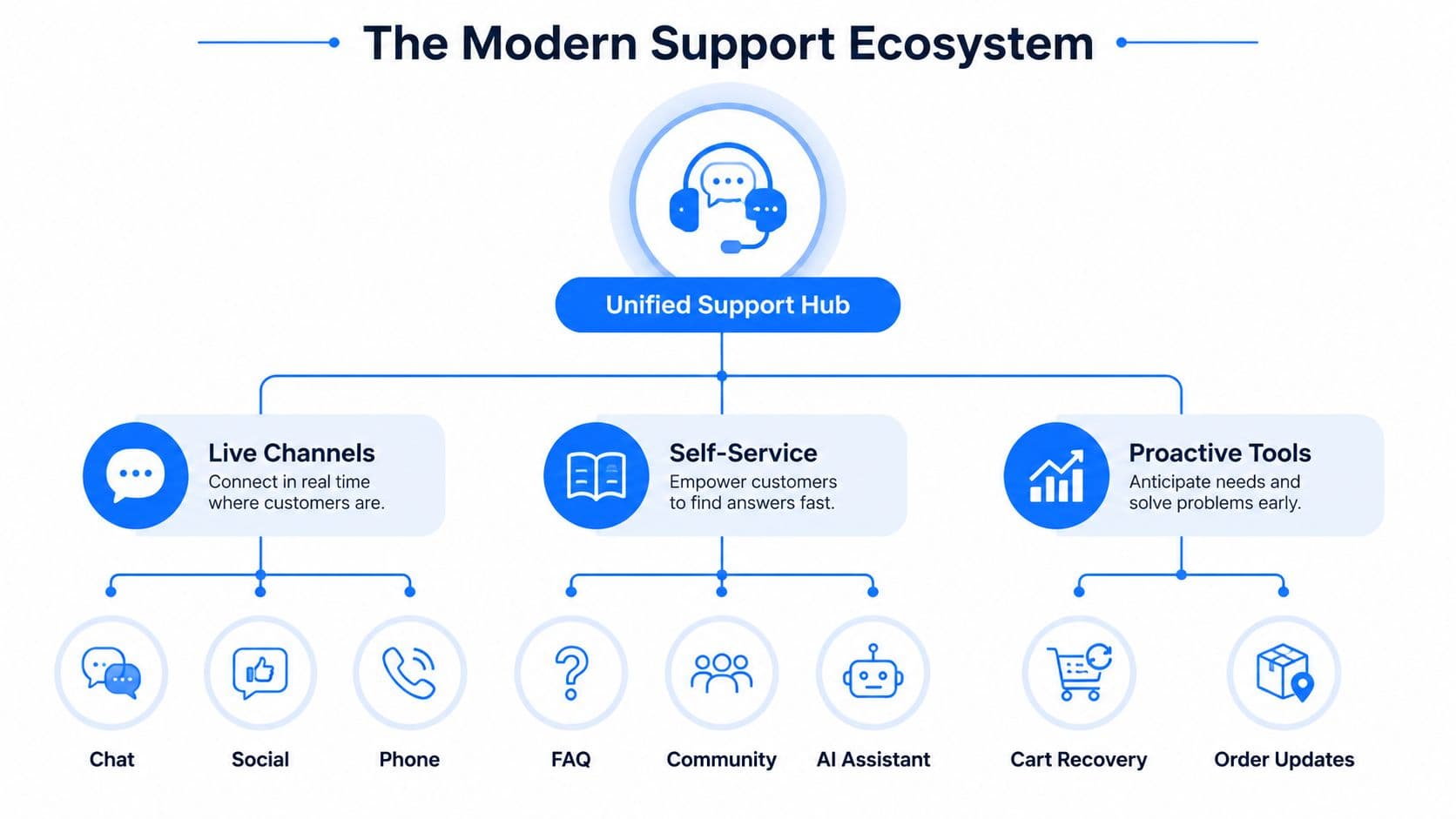
Modern ecommerce customer service isn't a single inbox with a larger FAQ attached. It's a coordinated system that gives customers a consistent path from question to answer, regardless of where the conversation starts.
Build around a unified customer record
A multichannel store offers several ways to contact the brand. An omnichannel store carries the customer's context between those channels. If someone asks about a delayed order in live chat and follows up by email, the agent should see the conversation history, order details, and previous actions instead of asking the customer to repeat everything.
The operating model needs four connected layers:
- Live channels: Storefront chat, social messaging, phone, and email handle direct conversations. Chat is especially useful before purchase because it can answer objections while the product page is still open.
- Self-service: FAQs, searchable help content, order tracking, return instructions, and an AI assistant handle questions customers prefer to solve independently.
- Proactive tools: Cart recovery, order updates, replenishment reminders, and product recommendations reach customers before they need to initiate contact.
- Unified support hub: Agents need shared conversation history, customer details, order status, policy rules, and escalation controls in one working view.
Separate reactive service from proactive assistance
Reactive support starts after the customer asks for help. It handles issues such as a missing order, a refund request, or a product defect. Those interactions still matter, but they occur after friction has already affected the experience.
Proactive assistance identifies a likely obstacle and offers relevant help before abandonment. A shopper repeatedly checking a size guide might need fit guidance. A visitor comparing two similar products might need a concise difference between them. A customer who leaves checkout may need clarification, not an indiscriminate discount.
The distinction matters because automation should follow intent. A store that sends the same message to every visitor creates noise, while a store that uses behavior and catalog context can make support feel timely rather than intrusive.
Keep the handoff visible
Customers shouldn't encounter a dead end when a bot can't complete a request. The system should explain what it can do, collect the information an agent needs, and pass the conversation forward without losing context.
That requires clear ownership. Merchandising teams maintain product facts, operations teams maintain shipping and return rules, and support leaders define escalation boundaries. When those teams update the same knowledge source, customers receive fewer conflicting answers and agents spend less time correcting outdated information.
The Critical Role of Speed and Accessibility
Fast support is part of the buying experience, not a back-office extra. Nearly a third of customers expect a response within one hour, 38% expect immediate support, and 52% of global shoppers expect support availability around the clock, according to eDesk's e-commerce customer service benchmark. For Shopify merchants, those expectations affect whether a shopper keeps comparing products, completes checkout, or leaves for a competitor.
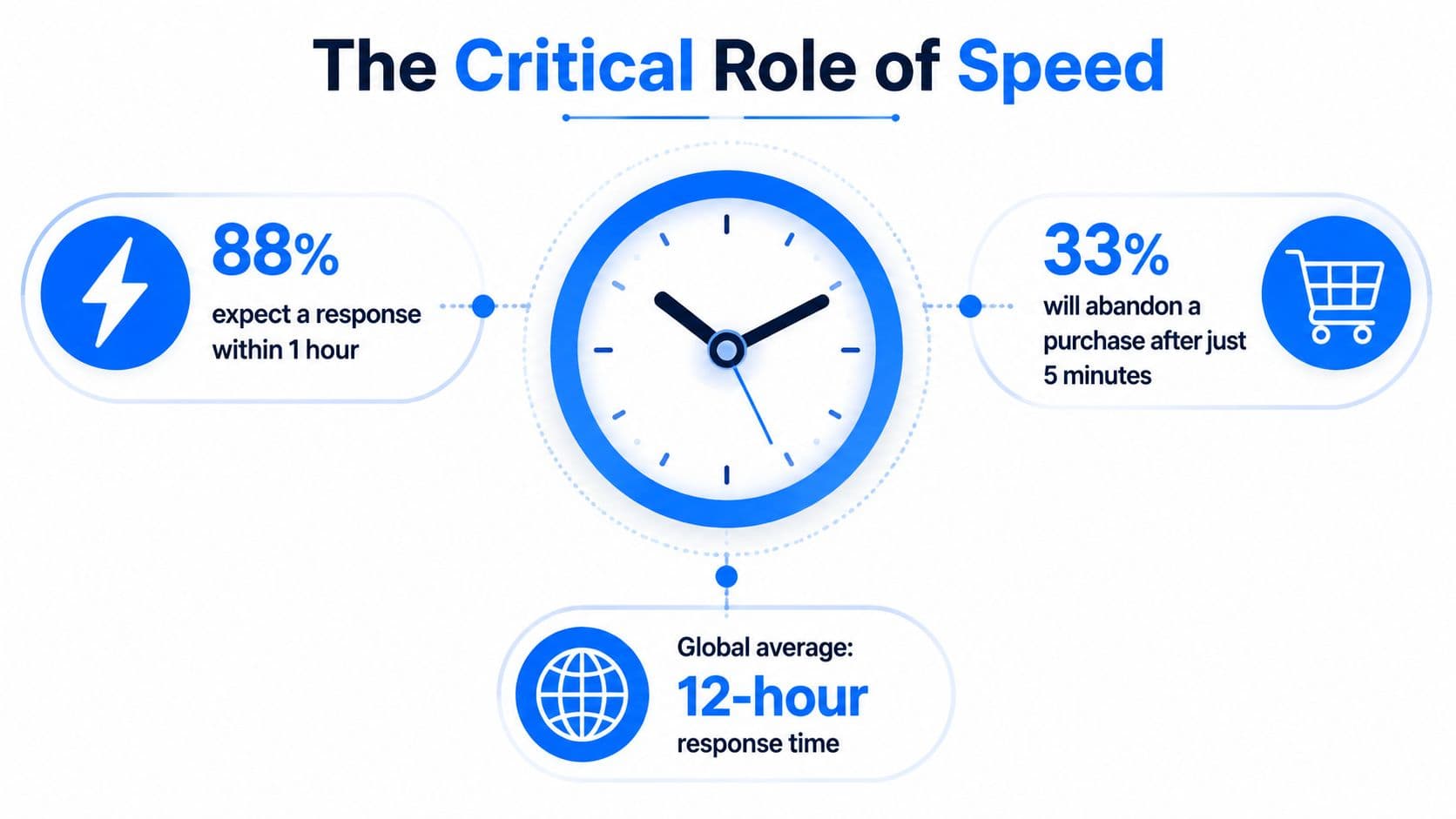
Slow replies are only part of the problem. Stores also lose sales when shoppers cannot get help outside staffed hours, must work through a single language, or cannot find a human for an urgent issue. An acceptable average response time can hide failures across time zones and shopping sessions. Track coverage by hour and market, not only the overall average.
Seconds matter most in live chat
Live chat allows less waiting than email. Benchmark data reports that satisfaction peaks at 84.7% when the first response arrives within 5–10 seconds, while the average live chat first response time is about 1 minute 35 seconds. The figures appear in Ringly's live chat statistics.
That gap gives AI a specific operational job. A bot can answer a product, shipping, or order question within seconds, then pass a higher-risk conversation to an agent with the customer's context intact. A message that only says “please wait” preserves no momentum and makes the customer wait twice.
Set an explicit target for first response, resolution, and handoff. Use this practical guide to customer service response time to set expectations and review where delays occur.
Accessibility is part of speed
Fast service has no value if customers cannot reach it. Research covering five global markets found that 43% of Australian respondents identified difficulty reaching customer service as a major frustration, while 42% cited data privacy concerns, as reported by Mediaweek's coverage of online shopping barriers in Australia.
For Shopify stores selling internationally, accessibility includes:
- After-hours coverage: Provide accurate answers while human teams are offline.
- Language support: Serve shoppers in their preferred language instead of sending them through a translated policy page.
- Privacy-safe workflows: Request only the information needed to identify an order or resolve the issue.
- Human access: Make escalation clear for sensitive, expensive, or emotionally difficult cases.
Speed starts the conversation. Accurate answers and a clear human route help turn that conversation into an order and a repeat purchase.
Balancing AI Automation with Human Empathy
AI and human service aren't opposing choices. They handle different classes of work.
Customers often choose bots when they need an immediate answer to a simple question. Industry coverage of a 2025 U.S. survey reports that 51% of shoppers choose bots for instant answers on simple questions. The same coverage reports that 93% prefer a live agent when an issue feels high-stakes, while only 12% prefer an AI-only route for that situation. The findings are summarized in Askful's ecommerce AI customer support guidance.
Give AI the repeatable work
AI performs well when the store can define the rules, provide reliable source data, and verify the result. Suitable workflows include product specifications, size and compatibility questions, shipping policy explanations, order-status lookups, promotion rules, and basic return eligibility.
The important distinction is between answering and acting. An AI assistant that links to a return form may reduce some effort, but an integrated system can check eligibility, collect the required details, and prepare a clean handoff when the policy doesn't cover the situation.
Use automation to:
- Answer routine questions: Product attributes, care instructions, delivery regions, and policy basics.
- Recommend relevant options: Suggest products or variants based on stated needs and catalog data.
- Collect context: Capture order details, the customer's goal, and previous troubleshooting before escalation.
- Protect response speed: Provide immediate assistance during traffic spikes and outside staffed hours.
Reserve human judgment for trust-sensitive moments
Refund disputes, damaged goods, payment concerns, privacy questions, accessibility needs, and high-value order problems require more than policy retrieval. A customer may need discretion, reassurance, or an exception that a rigid automated rule can't evaluate safely.
The handoff should happen early when the customer signals urgency, repeats the question, expresses distrust, or asks for an action outside the assistant's authority. Don't force the customer through a maze of buttons before offering a person.
Automation should remove repetition from human work, not remove humanity from difficult conversations.
If volume exceeds internal capacity, merchants can evaluate services that hire remote customer service reps, provided those teams have clear permissions, brand guidelines, escalation rules, and access to the same customer context. A remote team without integrated information spreads fragmentation across more people.
The most useful AI for customer service supports agents instead of hiding them. It drafts accurate replies, retrieves relevant information, recommends next actions, and leaves the final decision with a trained person.
Key Performance Indicators for Shopify Stores
Ticket volume tells you how busy the team is. It doesn't tell you whether support protects revenue, resolves problems, or creates additional work.
A Shopify merchant should build a measurement system that connects operational performance with customer and commercial outcomes. Start with a consistent reporting window and segment results by channel, intent, product, customer type, and whether AI or a human handled the conversation.
Track the service experience
First Response Time shows how long a customer waits before receiving a meaningful reply. A bot acknowledgment shouldn't count if it only says the conversation is queued. Measure the time to a useful answer or a properly informed handoff.
Resolution Time measures how long the issue remains open. Read it alongside repeat contacts. A short interaction that fails to solve the problem can produce more work later than a longer conversation that resolves it correctly.
Customer Satisfaction Score gives a direct reaction to the interaction. Segment CSAT by issue type because a strong overall score can hide poor performance in refunds, delivery failures, or product defects.
Net Promoter Score reflects broader loyalty rather than a single support exchange. Use it for directional, longer-term decisions, not as the only way to judge today's queue.
Add revenue-aware measures
Support becomes a sales channel only when the dashboard can show commercial influence. Useful measures include:
- Chat-to-sale ratio: Compare conversations that lead to orders with the total number of qualified shopping conversations. Define the attribution window before reporting results.
- Assisted average order value: Compare orders with meaningful chat interaction against a clearly defined baseline. Segment by product category so a premium assortment doesn't distort the result.
- Pre-purchase resolution rate: Count whether shoppers received a complete answer without leaving the buying journey.
- Cart recovery contribution: Attribute recovered orders only when the workflow can connect the nudge, interaction, and purchase reliably.
- Escalation quality: Review whether human handoffs contain enough context for the agent to act without restarting discovery.
Measurement principle: A rising deflection rate isn't success if customers still reopen the issue through another channel.
Review transcripts, not only dashboards. Look for missing catalog data, confusing product pages, recurring policy objections, and moments where an automated answer sounded confident but wasn't sufficiently precise. Those findings belong in merchandising, operations, and content planning, not just in the support queue.
Implementing Proactive Cart Recovery Workflows
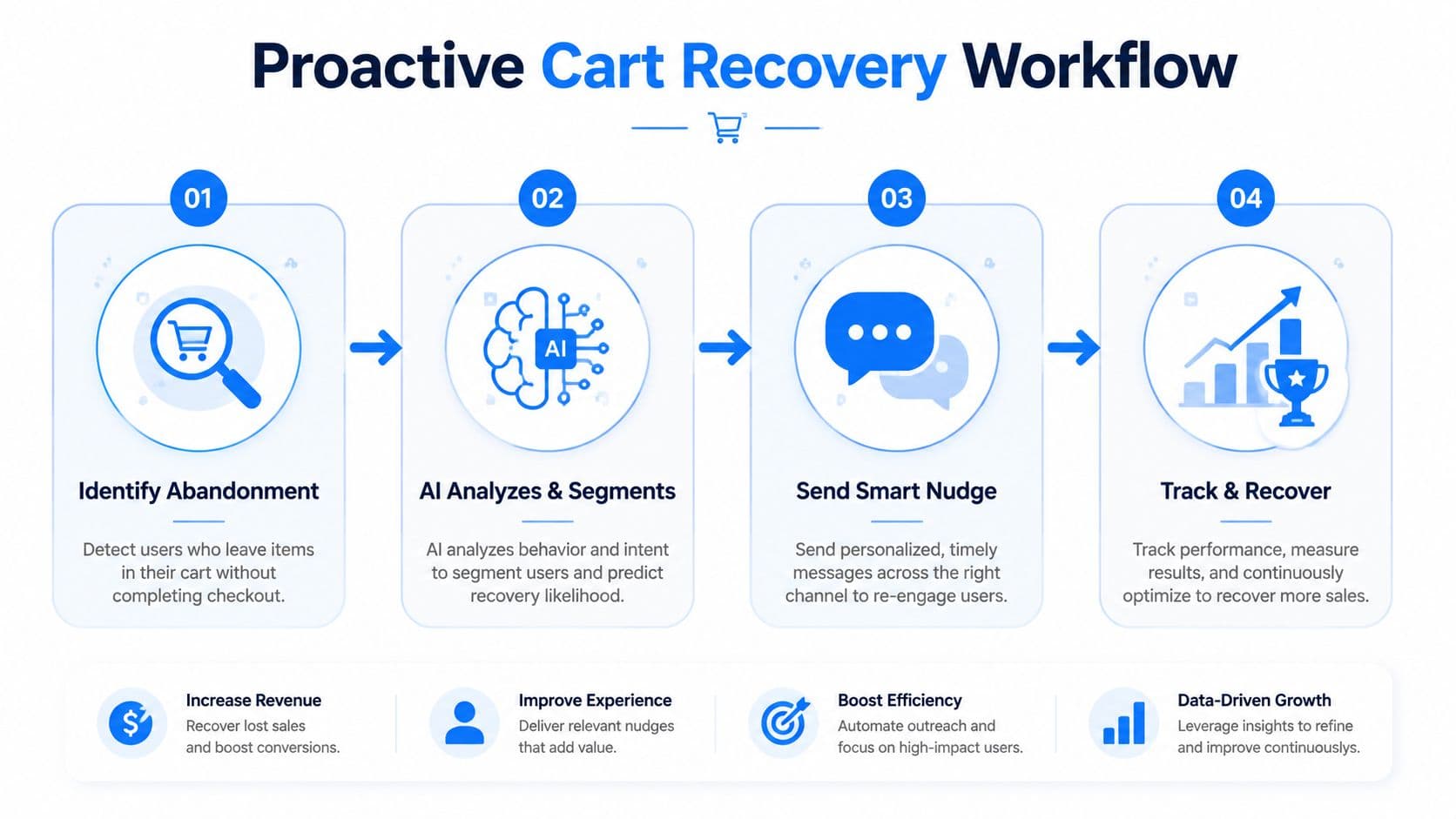
Cart recovery works best when it behaves like assistance, not pressure. A shopper may abandon because of uncertainty about shipping, a product choice, a promotion, payment, or timing. The workflow should identify the likely friction and offer a useful next step rather than immediately sending a generic discount.
Consider a shopper who adds a skincare product and leaves after opening the shipping policy. A helpful assistant can answer delivery questions, explain the return policy, and suggest a compatible product only if the customer asks for alternatives. It shouldn't invent urgency, claim limited stock without verified inventory, or offer a discount that conflicts with the store's promotion rules.
A practical conversation sequence
- Detect the signal: The store identifies an abandoned cart or a shopper returning to the same product.
- Interpret the context: The assistant checks cart contents, product information, available variants, relevant policies, and the customer's conversation history.
- Offer a focused nudge: The message addresses a likely question and gives the shopper a clear way to continue.
- Escalate or follow up: A human receives conversations involving payment issues, unusual requests, policy exceptions, or frustration.
A message might read: “Need help choosing between the two sizes in your cart? I can explain the fit guidance and delivery options.” That is more useful than “You left something behind.” If the shopper asks about a return, answer the policy question first. Don't lead with an incentive when confidence is the actual barrier.
For a deeper operational walkthrough, see this guide to cart abandonment recovery.
| Trigger | Action | Outcome |
|---|---|---|
| Shopper leaves with products in the cart | Send a contextual question about product choice, delivery, or policy | The shopper gets help tied to the likely obstacle |
| Shopper returns to the same product | Offer comparison, sizing, compatibility, or usage guidance | The customer can make a decision without searching elsewhere |
| Shopper asks about a promotion | Check the applicable campaign rules before responding | The store avoids inaccurate discount promises |
| Shopper raises a payment or high-stakes concern | Route the conversation to a human with context attached | The customer receives accountable assistance |
Test the workflow like a support process
Review every message for accuracy, timing, frequency, and tone. Suppress nudges after purchase, after a customer opts out, or when the cart contains an issue that automation can't safely address. Compare recovered conversations with non-recovered conversations, but don't treat every purchase after a message as proof that the message caused the order.
The strongest workflow feeds its failed conversations back into the store. If shoppers repeatedly ask about delivery regions, update the product page and shipping content. If they ask which variant suits a specific use case, improve comparison copy and catalog metadata.
Strategic Implementation and Tool Selection
Technology selection should follow the workflow, not the other way around. A Shopify merchant needs a system that can access current catalog information, policies, and order context without creating a second maintenance burden.
Use a controlled rollout
Start with a focused set of high-volume, low-risk questions. Connect the assistant to approved product and policy content, then test responses against real customer conversations. Check whether the system handles variants, unavailable items, policy exceptions, and unclear wording without making unsupported promises.
Look for these capabilities:
- Shopify integration: Product, inventory, cart, and order context should remain connected to the storefront experience.
- Catalog learning: The tool should use current product data instead of relying on a manually copied FAQ that quickly becomes outdated.
- No-code administration: Support and merchandising teams should be able to update approved answers without waiting for a development cycle.
- Multilingual coverage: International shoppers should receive consistent assistance in their preferred language.
- Actionable reporting: Dashboards should show recurring questions, failed answers, escalation patterns, and commercial signals.
- Human escalation: Agents need conversation history and a clear transfer path.
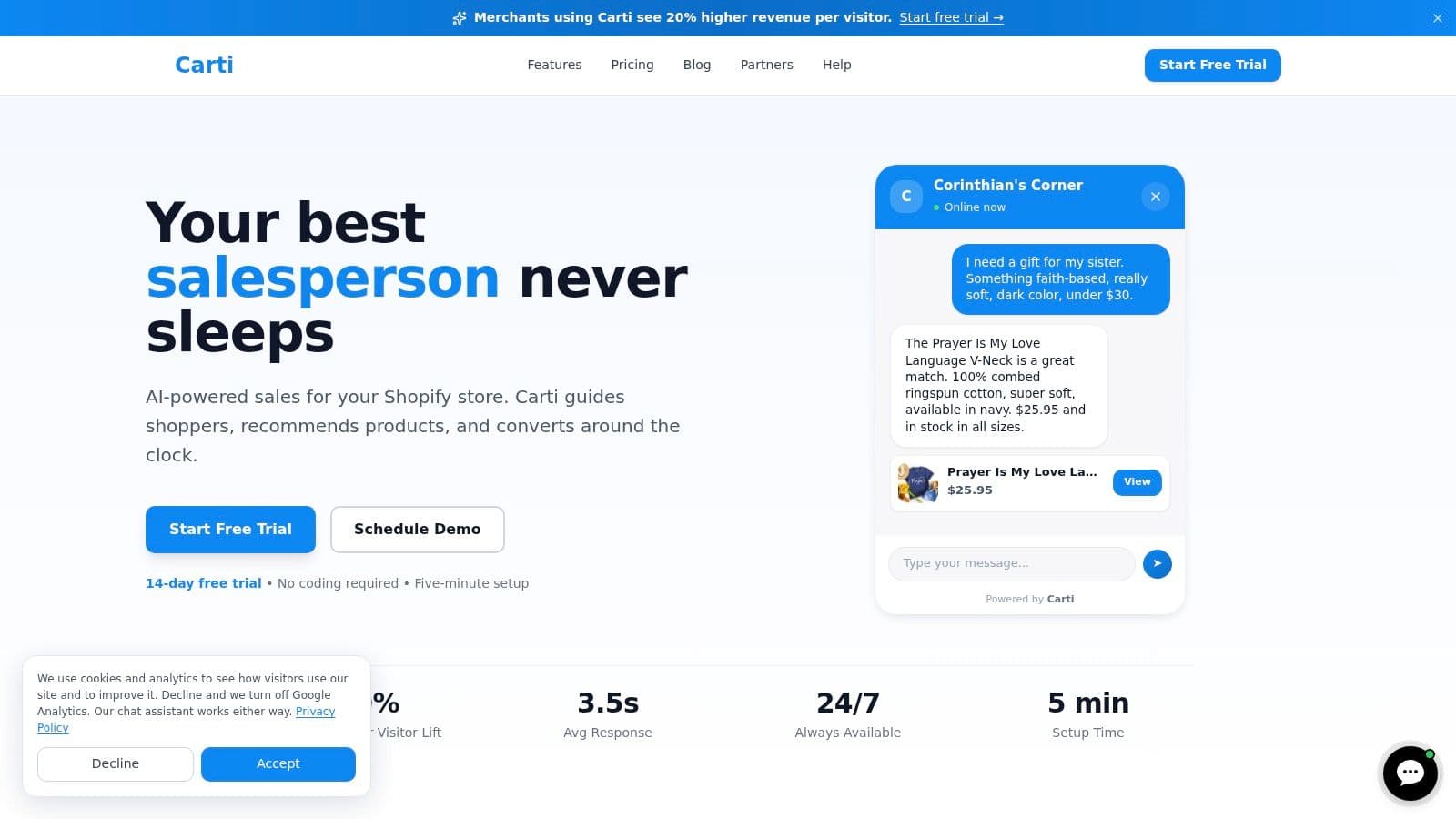
Carti is one Shopify-focused option that provides storefront chat, catalog and policy-based answers, product suggestions, cart recovery prompts, and an insights dashboard. Evaluate it alongside helpdesk, live-chat, and AI-agent alternatives against your own data, escalation needs, brand controls, and reporting requirements.
Launch narrowly, inspect transcripts, correct weak source content, and expand only after the assistant gives reliable answers. The fastest setup isn't the one that goes live first. It's the one that avoids creating a new layer of customer confusion.
The Future of Support-Driven Growth
AI support is creating a new operating constraint for Shopify stores: scale responses without losing accuracy, disclosure, or human judgment. Customers need to know when they are interacting with automation, what information it uses, and how to reach a person when the issue exceeds its limits.
Support should therefore function across discovery, checkout, delivery, returns, and repurchase. Each stage needs a different balance. A product question may suit an instant answer or recommendation, while a damaged order, unusual return, or payment concern needs a clear handoff with full context.
The commercial opportunity extends beyond reducing ticket volume. Helpful answers can remove hesitation before checkout, explain policies before disputes arise, and bring customers back after a problem. Stores that measure only service cost will miss those outcomes.
The strategic shift: Build support as a sales and retention layer, then use automation to make it available without exhausting the team.
Review unanswered pre-purchase questions, response delays, after-hours gaps, and failed handoffs. Fix the workflow with the highest friction first. Track service quality alongside assisted conversions, recovered carts, repeat purchases, and escalation outcomes. Keep humans close to conversations where trust matters most.
Carti helps Shopify stores answer product and policy questions, recommend relevant products, and prompt cart recovery. Visit Carti to evaluate a no-code AI chat workflow for your storefront. Salesforce's commerce benchmarks also provide broader context for connecting service performance with commerce results.

Written by
Daniel AndersonFounder of Carti. 10+ years building ecommerce brands in apparel and supplements. Still runs a Shopify store and built Carti to help merchants convert more browsers into buyers.
Ready to boost your store's sales?
Install Carti in 5 minutes and let AI handle customer questions, recommend products, and close sales 24/7.
Start Free Trial14-day free trial