
The usual advice in a Tidio vs Intercom comparison is to choose Tidio for a smaller budget and Intercom for a larger support team. That's a useful starting point, but it skips the question that matters at checkout: can the tool answer a shopper's actual question correctly, with the right product context, at a cost the store can sustain?
For Shopify merchants, the stronger choice isn't necessarily the platform with more features or the lower subscription. It's the one that helps shoppers make informed purchases, passes difficult questions to a person cleanly, and produces a bill that still makes sense during a busy sales period.
Tidio vs Intercom at a Glance
| Factor | Tidio | Intercom |
|---|---|---|
| Founded | 2013, Szczecin, Poland, according to Tidio's company disclosures | August 2011, according to CNBC's funding coverage |
| Reported scale | More than 300,000 companies, self-reported in its company disclosures | More than 25,000 customers in 2018, Intercom-reported in CNBC's coverage |
| Core positioning | Commerce-focused chat with a Shopify app, documented in its Shopify migration guidance | Broader customer-messaging and help desk platform, described in Tidio's comparison guidance |
| Pricing model | Conversation allowances, with AI capacity metered separately on its pricing page | Seats plus usage, including Fin outcomes, on its pricing page |
| Shopify-specific depth | Dedicated Shopify app with documented order and catalog workflows | Supports ecommerce, but the required Shopify workflows need direct verification |
| Best fit pattern | Storefront support and catalog-assisted chat | Complex ticketing, routing, and enterprise administration |
The company histories indicate different starting points, not a product ranking. Tidio's disclosures also report more than 180 employees and $25 million in Series B funding, alongside its broader company footprint.
Intercom was founded by Eoghan McCabe, Des Traynor, David Barrett, and Ciaran Lee. CNBC's coverage of its March 2018 funding announcement reported $125 million raised at a $1.275 billion valuation, with customers across 117 countries.
What the differences mean for a merchant
These are company-reported figures from different periods, with potentially different definitions of a customer. They show direction rather than a defensible head-to-head score: Tidio addresses a broad small and mid-sized business audience, while Intercom established substantial adoption among software companies and larger support organizations.
The operational distinction is more useful than company size. A merchant comparing the products should separate the work of answering purchase questions from the work of organizing a support department.
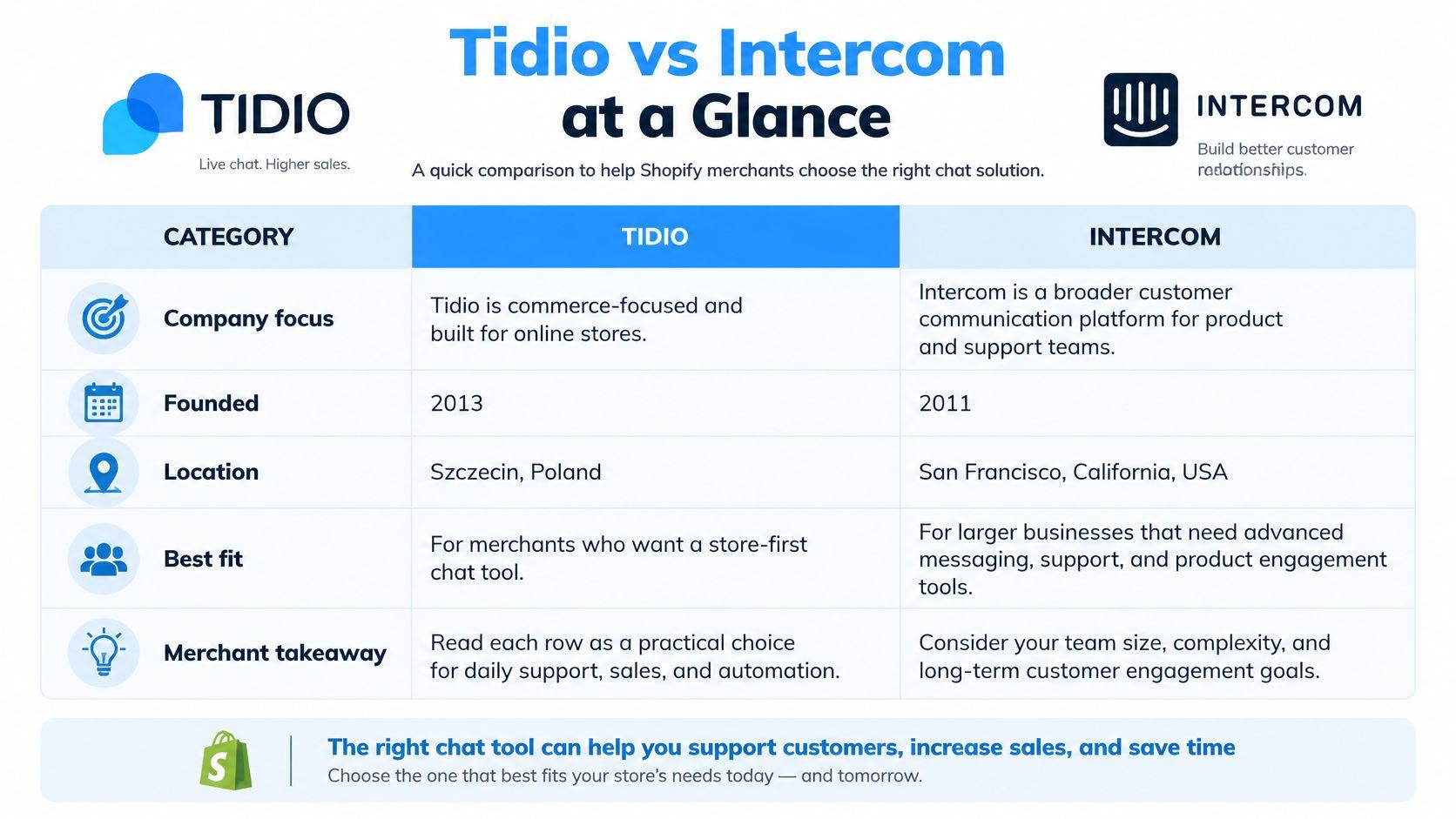
Company focus indicates which workflows deserve closer inspection. Pricing architecture indicates which usage records the merchant needs before choosing a subscription. Shopify depth indicates how much configuration or integration testing may sit between installation and a useful answer.
The first decision should therefore be whether the store needs a storefront sales assistant or a full customer-messaging platform. That choice determines whether catalog access and purchase assistance deserve the greatest weight, or whether routing, administration, and team coordination should dominate the evaluation.
How Each Bot Answers Shoppers and Hands Off
A useful test starts with ordinary purchase questions, not a polished vendor demonstration. Each candidate should receive a sizing question, a shipping cutoff question, a return-window question, and a product comparison question taken from the store's actual support history.
The expected answer should be written before either bot responds. Otherwise, a fluent reply can look convincing even when it misses an important exclusion, such as final-sale merchandise or different delivery rules for personalized products.
Accuracy means more than a plausible answer
A strong response should use the store's own catalog, policies, and FAQs. When a policy determines the answer, the response should identify that policy rather than present an unsupported promise.
For a sizing question, the reviewer should distinguish a supported recommendation from an invented fit claim. For a shipping question, the reviewer should check whether the assistant separates dispatch timing from delivery timing.
- Sizing: Does the answer use the relevant product's measurements rather than generic advice?
- Shipping: Does it account for the destination and the store's actual cutoff conditions?
- Returns: Does it preserve exclusions and distinguish refunds from exchanges?
- Comparisons: Does it explain meaningful differences without inventing product attributes?
Tidio calls its AI assistant Lyro AI, while Intercom calls its agent Fin. Their billing units differ, so a successful answer and a billable event shouldn't automatically be treated as equivalent measures of performance.
Handoff is part of the answer
A shopper who asks for a person shouldn't need to argue with the assistant. The receiving agent should get the question, the relevant context, and a clear indication of what remains unresolved.
A Gartner survey summarized by RetentionEdge covered 3,566 customers and found that customers were about three times more likely to use general-purpose AI assistants than a company's own chatbot for customer-service issues, while company-chatbot usage had remained flat since 2022. That finding doesn't establish which of these platforms performs better, but it does challenge the assumption that shoppers will tolerate an unhelpful branded widget.
Practical rule: A correct admission of uncertainty, followed by a useful handoff, is better than an immediate answer that creates a promise the store can't honor.
A fair pilot should use the same ten real shopper questions for each tool. Each answer can be marked correct, incomplete, or wrong, with separate notes for tone and handoff quality.
The reviewer should also include an unavailable answer, a contradictory policy, and an explicit request for human help. Those cases reveal how the system behaves when the knowledge base isn't enough.
Shopify Data, Cart Recovery and Languages Compared
| Capability | Tidio | How to test it |
|---|---|---|
| Order history inside the conversation | Yes, through the Shopify app | Ask about a recent test order during a chat |
| Import chat contacts as Shopify customers | Yes, through the Shopify app | Start a chat and inspect the Shopify customer record |
| Recommend live catalog products in chat | Yes, agents can recommend specific products | Ask for a product by use case and inspect the product link |
| Cart recovery | Not confirmed by the available documentation | Abandon a test cart and inspect any message received |
| Language coverage | Exact coverage not confirmed | Send the same question in different non-English languages |
| Helpdesk and channel integrations | Required connections need verification | List existing tools and test the necessary connections |
| Automated flows and triggers | Flows has a separate visitor allowance | Attempt an exit-intent flow and verify trigger availability and timing |
Tidio's migration guidance documents Shopify order history inside conversations, importing new Tidio contacts as Shopify customers, and agent recommendations of specific catalog products. Those are concrete capabilities, but they don't prove that an AI assistant autonomously performs every related action.
That distinction matters. Data visible to an agent isn't automatically data available to the bot, and a product recommendation feature isn't automatically a verified inventory-aware shopping workflow.
Test access at the moment it matters
For Intercom, the merchant should demonstrate the required Shopify workflow inside the proposed configuration. A broad ecommerce positioning doesn't establish that a specific order field, product variant, or customer attribute appears where the agent needs it.
For either platform, the trial should establish:
- Availability: Can the relevant person or automation access the information?
- Freshness: Does a changed product or policy produce an updated answer?
- Permissions: Is customer information protected from unauthenticated requests?
- Continuity: Does the information remain available after escalation?
The available documentation describes capabilities, not controlled benchmarks of conversion lift or response time. Claims that either tool necessarily sells more or answers faster would go beyond that evidence.
Keep unconfirmed workflows open
Cart recovery needs a practical demonstration covering the trigger, channel, consent requirements, destination link, and suppression after purchase. If email forms part of that workflow, MailAdept's SPF, DKIM and DMARC explained provides useful background for checking sending-domain authentication before interpreting delivery failures as a chat-platform problem.
Language testing should include product terminology, return exclusions, and handoff text, not just greetings. A multilingual AI assistant evaluation can help merchants structure that assessment around shopper intent rather than a language-count headline.
The final workflow check should involve a real test order. The merchant should ask about it in chat, inspect the transcript, and verify the resulting customer record for missing information, duplicate contacts, and inappropriate data exposure.
Pricing, Seats and Cost at Your Volume
A low seat price does not prove a chat tool is cheap at the moment of purchase. The cost that matters is what the store pays for the answers a shopper receives, measured against resolved chats and attributed orders, not against a feature list.
| Store profile | Tidio cost driver | Intercom cost driver | What to measure |
|---|---|---|---|
| Solo DTC store with one inbox | Published conversation capacity before custom pricing | An Essential seat plus usage | Conversations per month |
| Three-person support team | Separate conversation and Lyro allowances | Three paid seats plus usage | Peak seats needed |
| Growth brand with heavy AI volume | Lyro capacity and any custom-plan requirement | Fin outcomes plus staffed seats | Cost per resolved chat |
Tidio's pricing page lists capacity of up to 2,000 billable conversations, 1,000 Lyro AI conversations, or 100,000 visitors reached with Flows before contacting the company about a custom plan. Those are separate usage dimensions, not one pool a merchant can spend however the month goes. A store that stays under the conversation cap can still hit the Lyro or Flows limit first.
The same page describes the first 50 conversations as free for the lifetime of the account and says the monthly conversation limit can be upgraded from 50 to 1,000. That is not a recurring free AI allowance. Before forecasting, map each counter to human support, AI assistance, or automated visitor engagement. Mixing them produces a budget that will not match the invoice.
Calculate the staffed baseline first
Intercom's pricing page lists Essential at $29, Advanced at $85, and Expert at $132 per seat per month when billed annually, with usage charges on top, including Fin at $0.99 per outcome. On that published basis, a hypothetical team with three Essential seats costs $87 per month before usage.
Three seats. $87 before a single Fin outcome.
Confirm the billing term, currency, seat types, and variable charges at checkout before approving an Intercom plan, since annual and monthly prices can differ. The comparison that holds up is the full stack:
Platform subscription + paid seats + AI usage + messaging usage + implementation effort.
Tidio's conversation-based structure needs a forecast of shopper demand. Intercom's structure also needs a staffing forecast, because an unused seat still bills and a missing seat blocks a handoff at peak. A seasonal store should price an ordinary month and a promotion-driven peak. An average month hides the week when both AI usage and staffed seats spike together.
A dedicated Tidio pricing breakdown can organize those counters without treating the headline plan as the complete bill.
Measure the commercial result
Published prices do not show whether the cheaper option raises ecommerce revenue or only cuts support expense. In a hypothetical fashion store, one prevented return can outweigh the subscription gap, but only if the item's margin and shipping cost make that return more expensive than the extra chat spend. That is a store calculation, not a claim the pricing pages prove.
Run a pilot and track:
- AI conversations: Total demand and the billing counter that increments.
- Escalation rate: Questions that still need a person.
- Human-handled conversations: Workload left after automation.
- Assisted purchases: Orders tied to chat under one attribution rule.
- Cost per assisted purchase: Relevant tool costs divided by those purchases.
Assisted revenue is not incremental revenue. A shopper may have bought without the chat. Treat attribution as an operational signal, then compare cost per assisted purchase across both tools before calling either one the better buy.
Pros and Cons for Shopify Merchants
Tidio offers a more direct storefront starting point
Tidio's strongest documented Shopify advantages are practical: order context within conversations, customer-record creation, and catalog-assisted recommendations. Its conversation-oriented billing also gives merchants a recognizable budgeting unit when they already know how many shoppers contact support.
The main limitation is the need to distinguish the inbox, AI, and automation allowances. A store can have adequate human-support capacity while lacking enough AI capacity or visitor-trigger coverage for its intended deployment.
- Strength: The documented Shopify workflows align with everyday product and order questions.
- Trade-off: Forecasting requires separate usage estimates rather than a single chat total.
- Open checks: Cart recovery, required languages, and existing helpdesk connections still need demonstration.
A free entry point can reduce the commitment needed for initial exploration. It doesn't replace a realistic trial using the specific paid configuration the merchant expects to operate.
Intercom offers a broader organizational framework
Intercom's stronger fit is a support operation that needs structured routing, administration, and coordinated customer messaging. A merchant buying that capability should judge the product by how well agents manage ownership, transfers, permissions, and follow-up.
Its limitation for this comparison is the distance between a broad support platform and a verified Shopify purchase-assistance workflow. The merchant still needs to establish that the relevant product and order context reaches the right person or automation.
Intercom's plan documentation distinguishes Lite seats from paid full seats and explains that Lite seats don't provide the same full access. Staffing decisions should therefore follow the work each teammate performs, not merely the existence of an included seat category.
A capability deserves weight only when the store needs it and the proposed configuration delivers it.
Neither list is a score. A merchant with straightforward storefront questions may place greater value on catalog context than administrative depth, while a support manager coordinating multiple agents may make the opposite trade-off.
The useful comparison is the cost of completing the store's required workflows, including the work that remains manual.
How to Set Up and Migrate Your Chat Tool
Migration should preserve service continuity before it pursues automation. A store with a simple inbox can make a relatively contained change, while a team handling multiple channels needs explicit ownership of imports, routing, permissions, and launch checks.
-
Preserve the required records before cancellation. Export the contacts, conversation history, and saved replies the business needs, subject to the source tool's available export options. Compare the export with the destination's supported import formats, and record anything that won't transfer.
-
Connect Shopify and inspect a test conversation. The reviewer should confirm that the expected customer and order information appears in the intended workspace, without assuming that installing the app completes every permission or mapping step.
-
Prepare the knowledge base against live policies. Load shipping information, returns terms, sizing guidance, and common questions, then compare generated answers with the current storefront pages. An outdated return policy can create incorrect promises even when the assistant follows its source material faithfully.
-
Assign handoffs to named people or queues. Each escalation category needs an owner, an expected reply window, and a fallback when the intended recipient is unavailable, so a technically successful transfer doesn't become an unanswered message.
-
Retire the old storefront widget before public cutover. Remove or hide its theme embed and inspect the mobile storefront for duplicate chat bubbles. Account cancellation and widget removal are separate tasks, so both need confirmation.
-
Test the replacement on a preview or staging theme before switching traffic. The merchant should replay the agreed question set, inspect channel routing, and begin recording conversation usage, agent workload, and assisted purchases.
Launch checks that prevent avoidable disruption
The exact import sequence should follow each vendor's current documentation. A migration checklist should never be mistaken for a promise that every conversation, attachment, tag, or saved reply transfers automatically.
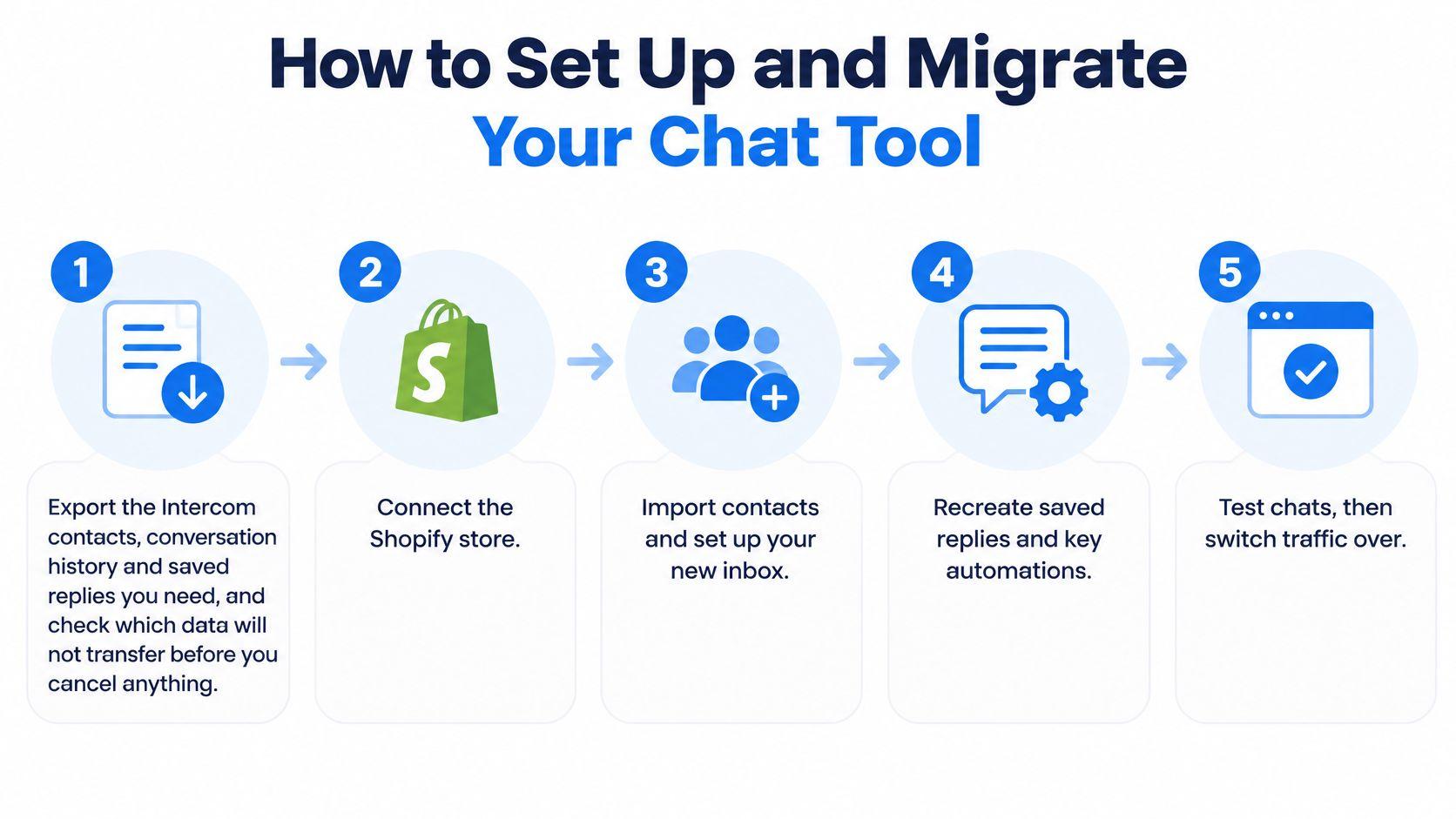
Mobile testing should include opening the widget, typing a question, following a product link, and returning to checkout. If the widget appears slow or obstructs a purchase control, the launch owner should investigate before expanding exposure.
Direct-message routing also needs an actual incoming-message test. A connected account doesn't prove that the right inbox receives the message or that a human can continue the conversation.
For stores evaluating a different destination, a Shopify chatbot migration checklist can help structure the cutover. The safest launch is the one with an explicit rollback plan and retained access to records needed for unresolved customer issues.
Which Tool Fits Your Store
A small direct-to-consumer store
A small store primarily handling sizing, shipping, returns, and product-selection questions should shortlist Tidio. Its documented Shopify workflows make it a sensible candidate when the immediate need is better storefront support rather than a wider reorganization of customer service.
The deciding demonstration should involve the catalog the store sells. A useful answer about a dress, skincare product, or sofa must preserve the relevant differences in fit, ingredients, dimensions, and policy conditions.
A growing support operation
A brand coordinating multiple agents, markets, and messaging workflows should shortlist Intercom when routing and team administration have become the primary problem. The value lies in managing the support operation, provided the proposed configuration also passes the Shopify workflow checks.
Instagram or Messenger traffic shouldn't automatically settle the choice. The merchant needs to confirm the exact channel connection, routing behavior, conversation continuity, and associated charges in the configuration being purchased.
The storefront-first tool answers the shopper, while the messaging platform manages the team.
That contrast is a decision lens, not an absolute product boundary. Either candidate still has to demonstrate the other side of the workflow well enough for the store's requirements.
Edge cases deserve their own acceptance criteria
Direct-message sellers should prioritize verified channel support. Stores with substantial non-English traffic should have fluent reviewers assess policy accuracy and product terminology in the languages customers use.
A team already operating Zendesk should establish whether the proposed tool complements or duplicates the existing workflow. Agencies should compare cost per store, including account administration and maintenance, rather than assume that a configuration suited to a single merchant scales neatly across clients.
- Storefront priority: Favor demonstrated product context and useful purchase answers.
- Operational priority: Favor clear ownership, routing, and suitable agent access.
- Budget priority: Compare expected and peak usage, not the entry subscription alone.
The next step is a controlled shortlist, not an immediate annual commitment. The merchant should run the same ten shopper questions through both candidates, verify Shopify data access, and calculate the expected bill at realistic volume.
The stronger choice is the tool that answers the required questions correctly and hands off cleanly, while leaving the store with an acceptable operating cost. Published feature lists can narrow the candidates, but they can't establish that result for an individual catalog.
Carti is an AI shopping assistant for Shopify that answers from a store's catalog, policies, and FAQs, recommends products, supports Instagram and Messenger, and integrates with Zendesk and Gorgias for escalations. Its plans are Free with 50 AI conversations a month, Starter at $49/month with 250, Growth at $99/month with 600, and Scale at $249/month with 1,750, with a 14-day free trial on paid plans. Merchants comparing purchase assistance rather than a full messaging platform can visit Carti and test the same shopper questions against their own store information.

Written by
Daniel AndersonFounder of Carti. 10+ years building ecommerce brands in apparel and supplements. Still runs a Shopify store and built Carti to help merchants convert more browsers into buyers.