
The usual Tidio vs Zendesk advice is too simple: small stores should choose Tidio, and larger businesses should choose Zendesk. That framing skips the more important distinction. A shopper deciding which product to buy needs a different workflow from a customer disputing a refund.
For Shopify merchants, the better starting point is the problem that needs solving. Is the store losing sales because shoppers can't get product answers, or is the support team losing control of ownership, follow-ups and escalations? Those problems can coexist, but buying a stronger helpdesk won't automatically solve both.
Tidio vs Zendesk Feature Matrix at a Glance
A side-by-side grid only helps when both columns name a real capability. Tidio's materials describe a conversational front line: a website chat widget, a shared inbox for social messages, and connections into commerce and marketing tools. Zendesk's customer-experience software overview describes organized service work: omnichannel ticketing, an agent workspace, knowledge management, workflow automation, analytics, quality assurance and customer context.
Tidio and Zendesk feature matrix
| Feature | Tidio | Zendesk |
|---|---|---|
| Live chat | Website chat widget in a shared inbox | Omnichannel conversations in an agent workspace |
| Ticketing | Creates Zendesk tickets from Tidio conversations | Omnichannel ticketing with an agent workspace |
| Automation | Conversational flows | Workflow automation |
| AI and measurement | Vendor-reported resolution average, not a neutral benchmark | Analytics and quality assurance tied to service work |
| What the agent can see | Shopify plus other documented integrations | Knowledge management and customer context |
| Channels in the inbox | Instagram, WhatsApp and Messenger | Omnichannel ticketing across service channels |
| Connected tools | Shopify, HubSpot, Klaviyo, Zapier, Zendesk and other tools | Ticketing, knowledge, automation, analytics and quality assurance |
| Pricing unit | Monthly conversation quotas | Per agent per month |
| Best fit | Storefront and social sales conversations | Multi-agent service operations |
Tidio's shared inbox pulls website and social conversations into one place. Shopify, HubSpot, Klaviyo, Zapier and Zendesk sit on that list, which fits questions that are still sales conversations: product, policy, or a handoff into tickets.
Zendesk's listed set supports work after a case exists. The agent workspace, customer context, workflow automation and quality assurance help a team assign ownership, follow a dispute and review how it was handled. On this evidence, that set does not show catalog recommendations or checkout conversion.
Judge each row by the job. Conversational flows have to supply catalog facts, accurate policy answers and a clear handoff while the shopper is still deciding. Workflow automation has to route, record and report once the issue is a ticket. With a helpdesk already acting as the system of record, the open question is whether another conversational layer covers a storefront gap. The matrix can show that split. It cannot show which tool recommends the right product, or which team closes a hard case faster.
What Each Platform Costs as Your Store Grows
A Shopify store with two agents and 250 conversations a month will not get a useful total from the cheapest headline plan. The bill depends on what the vendor counts: conversations, or agent seats.
Tidio's official pricing page lists Starter at 100 conversations per month and Growth with selectable quotas from 250 to 2,000 conversations per month. Compare those published allowances with demand, then recheck the live price at checkout beside the quota you select.
Plan limits and pricing units
| Plan or model | Limit or pricing unit | What it means for the store |
|---|---|---|
| Tidio Free | Conversation usage counted separately from automated-flow reach | A flow that touches visitors is not the same meter as a billable conversation |
| Tidio Starter | 100 conversations per month | The quota sits below this store's 250-conversation month, so Starter only fits if volume stays lower |
| Tidio Growth | Selectable quotas from 250 to 2,000 conversations per month | Pick the quota that covers a normal month, then see what a promotion month would require |
| Zendesk plans | Per agent per month | Count every support user who needs a seat before estimating the base subscription |
For that two-agent store, the Tidio check is whether both people can work inside the selected plan and whether the conversation allowance covers ordinary demand. If volume runs past the allowance, read what happens at the limit. Do not assume an overage fee or an automatic upgrade.
Zendesk's math starts with seats. Two agents means two monthly units on the chosen plan, plus any add-on the ticket workflow requires. A store that mostly answers pre-purchase questions may be paying for agent capacity it barely uses. A store that lives in refunds and case ownership will underbuy if it prices only a chat quota and ignores seats.
Tidio's monthly conversation-limit documentation separates conversation usage from the unique visitors reached by automated flows. A conversation allowance is not a website visitor cap. Substituting one number for the other misstates the budget.
A closer examination of Tidio pricing separates those allowances before a tier is chosen.
Budget rule: Compare the cost of the required workflow, not the price of the smallest available subscription.
The smallest plan becomes the expensive one when staffing or conversation demand moves. Budget the ordinary month, a promotion-driven month, and the capabilities the team intends to keep on.
Where Tidio Leads on Storefront Chat
Tidio is the more directly commerce-oriented candidate when the main task is helping shoppers inside conversations. The distinction isn't that a chat widget appears on a Shopify storefront. The important question is whether an agent can use store information without repeatedly asking the shopper to explain the situation.

Tidio's published Shopify capability description documents product cards and access to customers' carts or order history. These mechanics can make a conversation store-aware rather than leaving the agent with only the shopper's latest message.
Match each action to a shopper question
Consider a fashion store. A shopper asks whether a jacket suits layering over a thick sweater. A product card can bring the relevant item into the conversation, but the answer still needs reliable sizing and fit information.
Another shopper asks about an item already purchased. Order history can help the agent distinguish a new buying question from a post-purchase case. A cart check alone shouldn't be treated as proof that an order has shipped.
- Product selection: Check whether the conversation can present the right item, not just a general collection.
- Purchase context: Confirm that cart and order information refer to the correct customer.
- Policy questions: Verify that shipping and returns answers reflect the store's current policies.
- Exceptions: Establish when the conversation must move to a person.
The shared inbox also matters for stores receiving questions through website chat, email, Instagram, WhatsApp and Messenger. A sizing question arriving through Instagram can enter the same working environment as a question from a product-page visitor.
Verify the workflow before buying
Integration breadth and integration depth aren't interchangeable. A listed Shopify connection doesn't establish that every desired action is available on the selected subscription, and a CRM connection doesn't establish which fields synchronize.
Product cards and cart checks should therefore be confirmed for the intended tier before the store builds an operating process around them. Merchants should also check permissions, customer identification and what happens when store information is missing.
A practical evaluation starts with the store's most common shopper questions. Each should be tested against the actual catalog, policies and available order context, with particular attention to answers that sound plausible but lack supporting product information.
Where Zendesk Leads on Ticket Operations
Zendesk becomes the stronger candidate when the hard part is coordinating service work rather than starting conversations. A refund dispute might involve an agent, a warehouse check and a decision from a manager. A chat transcript alone doesn't define who must act next.
The operational value lies in ownership and continuity. A team needs to distinguish an unanswered customer message from a case awaiting internal investigation, and it needs a way to see which cases have stalled.
Evaluate the queue, not the widget
Consider a hypothetical store with several support agents handling refund disputes against internal response deadlines. The manager's priority isn't necessarily a more engaging storefront experience. It's knowing who owns each dispute, what evidence has been collected and which action remains outstanding.
Zendesk's workspace, ticketing and workflow capabilities align with that kind of work. Knowledge management can support consistent explanations, while analytics and quality assurance give managers a basis for reviewing how the team handles cases.
- Ownership: Assign responsibility for the next action rather than leaving a case in a general inbox.
- Routing: Send the case to the person or team equipped to handle it.
- Context: Preserve the customer's explanation and the team's investigation.
- Review: Identify repeated process failures instead of treating every complaint as unrelated.
Zendesk's customer milestone announcement provides evidence of a broad organizational customer base. It doesn't establish superior shopping-assistant performance, response speed or answer accuracy against Tidio.
Recognize the real decision point
The trigger for a more structured helpdesk isn't chat volume alone. It's the point at which agents can no longer reliably track responsibility, internal dependencies and follow-through.
A useful customer-service automation plan should distinguish administrative routing from customer-facing answers. Automating assignment won't fix an inaccurate returns policy, and generating a quick reply won't resolve a warehouse investigation.
Before selecting Zendesk, a merchant should count the cases that need a named owner and an explicit response deadline. If those cases routinely require coordination, structured ticket operations deserve more weight than storefront convenience.
Automation, AI Replies and How to Measure Them
Tidio publishes a vendor-reported AI resolution average. That figure is not a neutral benchmark, and it does not guarantee results on a Shopify store's sizing, returns, or product-comparison questions.
The missing detail is the question mix. Order-status requests are a narrow task. Explaining ingredient suitability, or telling apart products with similar names, is a different one. A high rate on the first says little about the second.
Separate automation from successful answers
Tidio's conversational flows and AI replies handle customer interactions on the storefront. Zendesk's workflow automation moves and assigns cases after a request exists. Both cut manual work. They do not do the same job, so one score cannot rank them.
A completed automated action is not the same as a useful answer. A chat that ends on a wrong sizing note is not a resolution. A ticket closed after the wrong team is assigned is not one either.
| Pilot measure | What the merchant should record |
|---|---|
| First-response time | Time until the initial customer-facing response, distinguishing acknowledgment from a useful answer |
| Answer accuracy | Whether the answer matches current catalog and policy information |
| Escalation rate | Which questions require human intervention and why |
| Assisted conversion | Purchases associated with eligible pre-purchase conversations |
| Cost per resolved pre-purchase conversation | Relevant tool and handling costs divided by satisfactorily resolved buying questions |
Use a controlled question set
Tag each conversation in a two-week pilot as pre-purchase, order status, returns, or another category the store sees. That window is an evaluation recommendation. It is not a claim about either vendor's performance.
Send the same questions through both candidates. Fit, shipping time, ingredients, and compatibility are useful categories when they match the catalog. Score storefront answers on whether the shopper can choose. Score ticket automation on whether a named owner gets the case and a deadline.
A high resolution rate on order-status requests says little about whether an assistant helps shoppers choose the right product.
Define revenue attribution before reading assisted purchases. Shoppers who open chat may already intend to buy, so a purchase after a conversation does not by itself prove incremental sales.
No neutral head-to-head benchmark covers support quality, response speed, or conversion for these two tools. The store's own tagged question set, with human review of accuracy and a written definition of resolution, is the evidence that can support a choice.
Which Platform Fits Your Store Situation
Which tool to start with, by store situation
| Store situation | Better starting point | Why it fits |
|---|---|---|
| Single-owner DTC store with frequent pre-purchase questions | Storefront chat tool | Fit and shipping answers address uncertainty before checkout |
| Growing team with several agents and response deadlines | Zendesk | Routing, queues and reporting suit coordinated service work |
| Store selling heavily through Instagram and Messenger DMs | Tidio | Its shared inbox covers those channels |
| Store where shopper uncertainty blocks sales | Pre-purchase AI shopping assistant for Shopify | Catalog answers and product recommendations address buying decisions |
A single-owner store should avoid treating a full service operation as the default purchase. If the owner's main problem is repeatedly explaining product differences, the evaluation should focus on how well a tool handles those explanations.
A growing support team faces a different constraint. Even accurate answers can leave customers frustrated when nobody owns the next action. In that situation, queue discipline can matter more than conversational presentation.
Match the starting point to the constraint
For a store receiving substantial social-message traffic, channel coverage affects daily work. A merchant should test whether agents can identify the customer, understand the question and complete the required action without losing context between systems.
For a store with unresolved buying questions, an AI shopping assistant deserves a separate evaluation from the helpdesk. Carti is one option for Shopify, with Free offering 50 AI conversations a month, Starter at $49/month for 250, Growth at $99/month for 600 and Scale at $249/month for 1,750, plus a 14-day free trial on paid plans. It answers product questions, recommends catalog items and supports escalations to Zendesk and Gorgias, with a Test Connection button in Settings for checking API credentials.
Selection principle: The strongest service desk and the most suitable shopping assistant don't have to be the same product.
A hybrid architecture can make sense when both problems are material. The storefront layer handles shopping questions, while the helpdesk handles cases that require investigation and accountable follow-up.
That isn't a reason to buy extra software automatically. The additional layer should have a defined purpose, a tested handoff and measurable value that outweighs the complexity of maintaining another system.
How to Move Between Tidio and Zendesk Safely
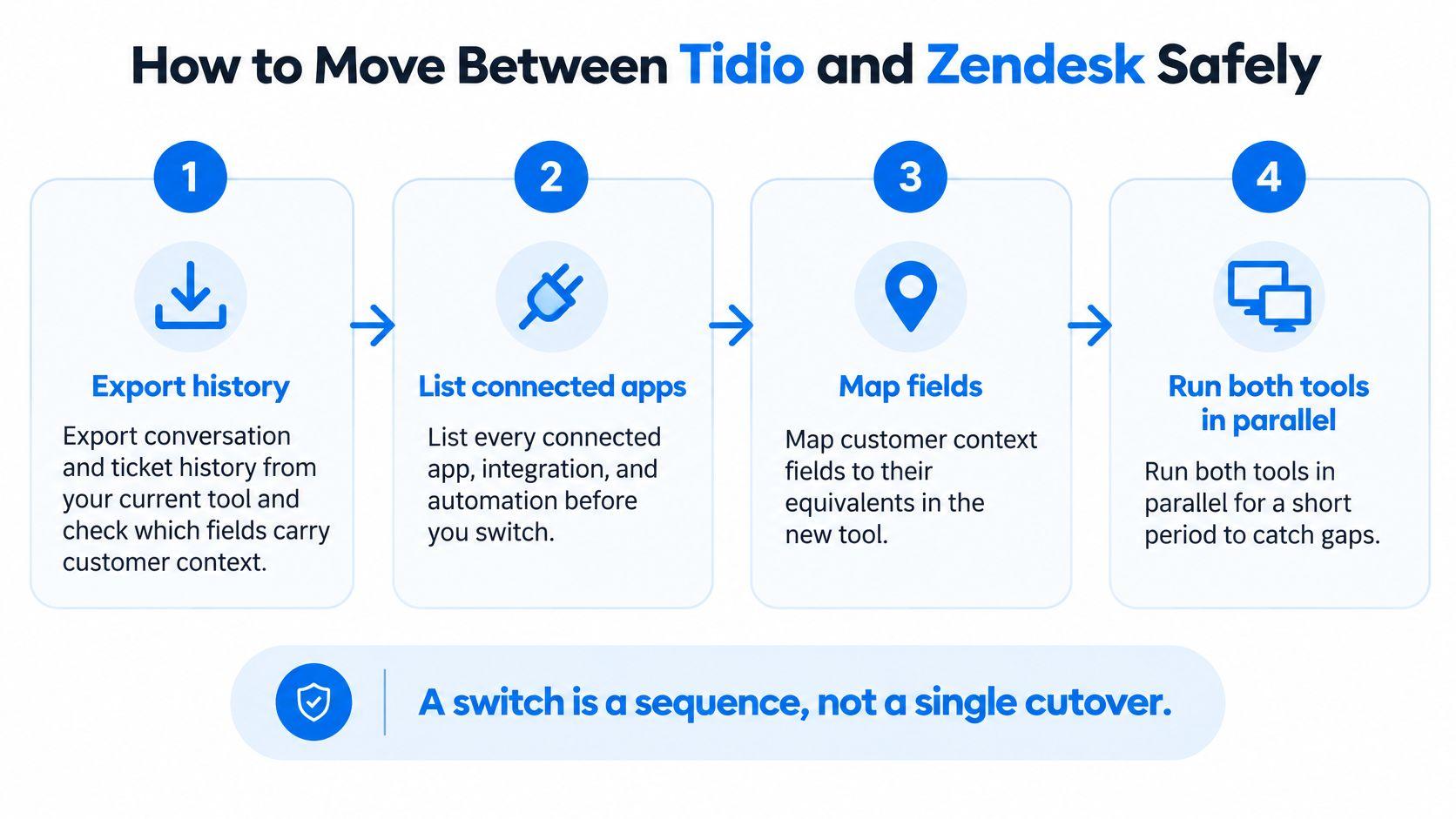
A switch is a sequence, not a single cutover. The safest migration plan separates historical records, connected channels, automation and escalation so that a failure in one area doesn't go unnoticed.
Preserve context before changing traffic
-
Export the available history. Confirm which conversation and ticket exports the current account supports, then inspect a sample before relying on it. Check customer identifiers, timestamps, attachments and internal notes, since an exported transcript may not preserve every field.
-
Inventory connected channels. List Shopify, Instagram, WhatsApp, Messenger, email and every connected app in use. Record permissions and account ownership so the migration doesn't depend on credentials held by an unavailable employee.
-
Map fields and rebuild rules. Match customer-context fields to their target equivalents, then rebuild the automations associated with refunds and escalations first. Rules should be reviewed rather than copied blindly, especially where the new tool represents case status differently.
These checks protect more than record completeness. A returning customer may reasonably expect an agent to understand an earlier discussion, even when the store has changed software.
Reconnect and prove the handoff
-
Test each connected channel. Reconnect the supported Shopify and social integrations, then send and receive a message through every active channel. An enabled connection isn't enough evidence that customer messages reach the intended workspace.
-
Use a controlled parallel period. A suggested two-week transition can keep the old tool available for reference while new conversations enter the target system. Prevent duplicate automated replies and make the team's handling destination explicit.
-
Move escalations only after a successful test. Create a test case and inspect the destination ticket for customer identity, conversation context and ownership. The common avoidable mistake is changing the live escalation route before confirming what the receiving agent sees.
Consider a hybrid instead of a replacement
Tidio can create Zendesk tickets from its conversations. That supports a design in which Tidio captures storefront and social intent while Zendesk remains the destination for escalated cases.
The merchant should still inspect what transfers rather than assuming every attachment, field or internal note will appear automatically. The handoff is complete only when the receiving agent can continue without asking the customer to repeat the problem.
A finished migration has observable acceptance criteria: escalated tickets contain usable context, every active channel passes a message test and the team knows which system owns each stage of the conversation.
Confirm Your Choice With a Two-Week Pilot
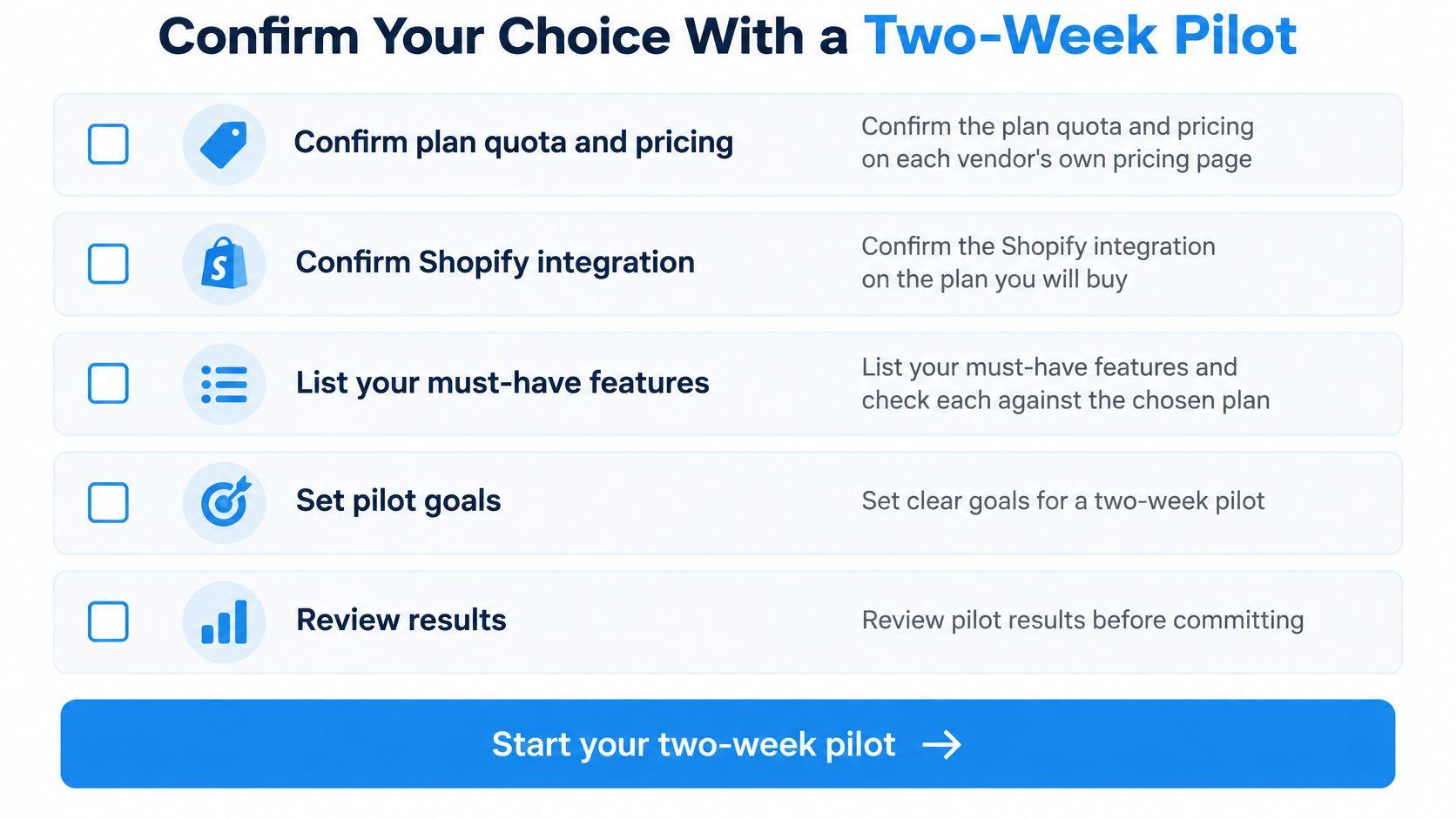
A pilot should test the paid workflow under consideration, not merely demonstrate that a widget can answer a sample question. The store needs enough evidence to distinguish useful automation from fast but incomplete replies.
Buying checklist
- Confirm the commercial terms: Check the quota, billing unit and current price on each vendor's own pricing page.
- Verify Shopify access: Confirm that the intended subscription supports the required store actions.
- Build the question set: List the store's most common pre-purchase questions and prepare correct reference answers.
- Check channel coverage: Include website chat, Instagram, WhatsApp and Messenger wherever the store uses them.
- Define ownership needs: Specify routing responsibilities and internal response deadlines.
- Test escalation: Inspect the receiving ticket rather than accepting a successful connection message.
- Preserve history: Establish what can be exported and what must remain accessible elsewhere.
- Run the evaluation: Apply the pilot measures with consistent conversation categories.
- Decide from observed results: Review failed answers and handoffs alongside the aggregate figures.
Make the choice operational
Choose a storefront chat tool when unanswered buying questions are the primary constraint. Choose a helpdesk when the team's bottleneck is accountable case handling. Consider a hybrid when both needs justify separate tools.
A trial should reproduce the plan and workflow the merchant intends to buy wherever possible. Before committing, the store should run its own questions, verify the available trial terms and confirm that the team can handle exceptions without losing customer context.
For merchants evaluating the shopping-assistance side of Tidio vs Zendesk, Carti offers an AI shopping assistant for Shopify that answers product questions and recommends items from the store's catalog. Merchants can explore its paid-plan trial using their own catalog and shopper questions, then assess whether it complements their helpdesk or addresses a different need.

Written by
Daniel AndersonFounder of Carti. 10+ years building ecommerce brands in apparel and supplements. Still runs a Shopify store and built Carti to help merchants convert more browsers into buyers.