
About 70.19% of online shopping carts are abandoned, according to Baymard Institute's aggregation of 49 studies, as reported in this ecommerce cart-abandonment benchmark. That means most retention problems begin before a customer becomes a customer. A brand that waits for a manual follow-up, a weekly campaign, or a support agent to notice the signal is already late.
Customer retention automation turns those signals into coordinated action. Shopify events, lifecycle email, onsite AI chat, SMS, push notifications, loyalty activity, and subscription behavior can feed workflows that respond while intent is still visible. The important shift is architectural: retention isn't an email calendar with a few discounts attached. It's a layered operating system that helps a DTC brand recognize hesitation, deliver value after purchase, encourage the next order, and suppress irrelevant messages when the customer has already acted.
What Customer Retention Automation Actually Means
Customer retention automation is the use of pre-built rules, behavioral triggers, and AI agents to re-engage existing customers and high-intent shoppers without requiring someone on the team to launch every interaction manually. A checkout abandonment event can start an email sequence. A product question can open an onsite conversation. A replenishment window can trigger a reminder. A loyalty milestone can grant a reward.
That makes automation the execution layer of retention marketing. Retention marketing decides who the brand wants to keep, why customers might leave, and what value should bring them back. Automation turns those decisions into repeatable workflows across email, onsite chat, SMS, push, loyalty, and subscriptions.
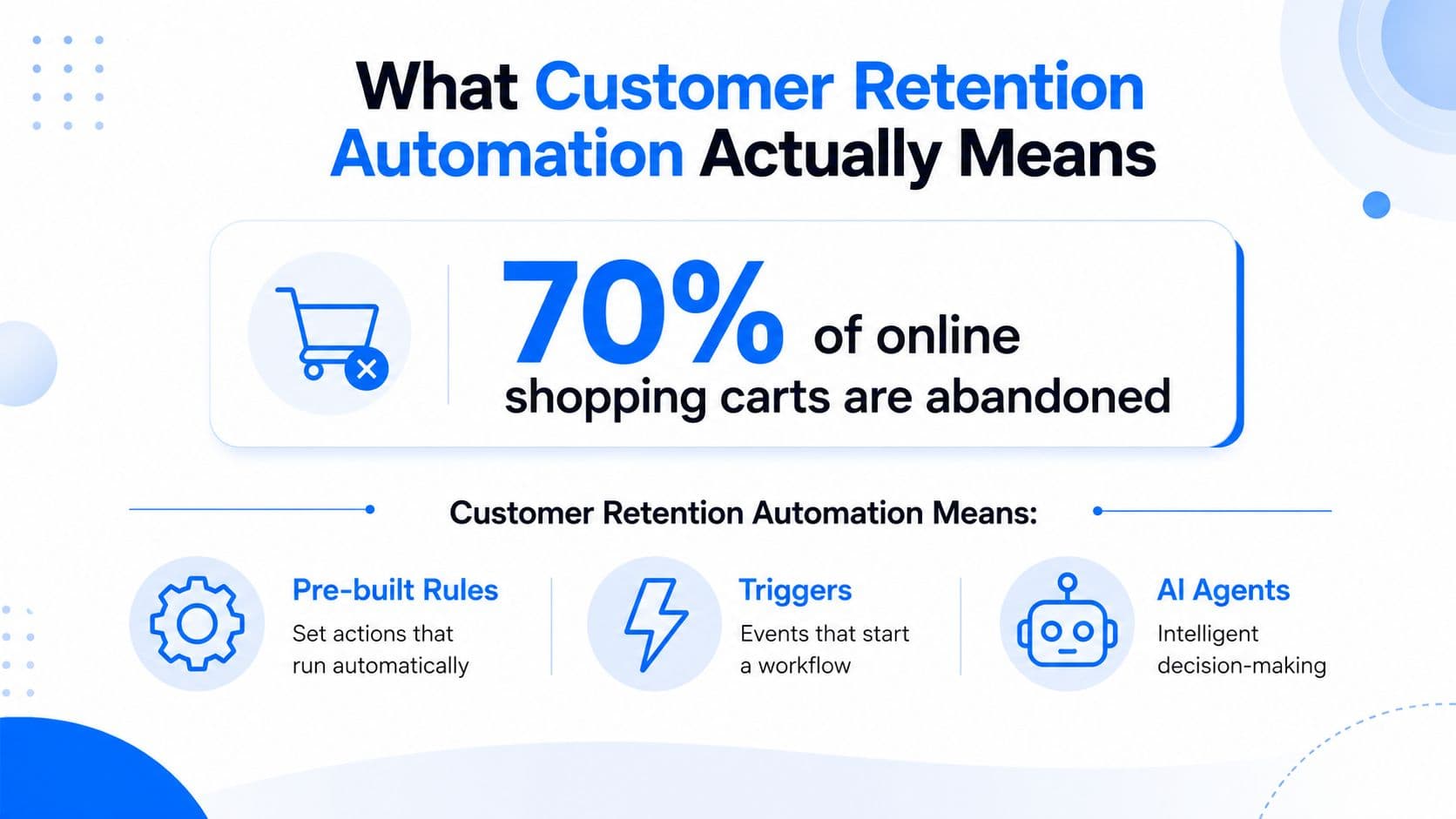
A useful implementation starts by separating three components:
- Rules: Define what action should happen, such as sending an email, showing a chat prompt, or adding points.
- Triggers: Identify the event that starts the workflow, such as checkout abandonment, inactivity, delivery, or a repeat-purchase window.
- Decision-making: Use customer data and AI to choose the relevant response, product recommendation, answer, or offer.
Automation isn't a single app, a collection of discount codes, or a chatbot operating in isolation. A discount-heavy setup may create activity without creating profitable loyalty. A chatbot that doesn't know order status or product policies can create more support work. An email platform with no suppression logic can message a buyer about an abandoned cart after the order has already shipped.
Build around shared signals
The practical model is a connected system. Shopify remains the transaction and event source, while the email platform, onsite experience, loyalty program, and reporting layer consume the same customer state. The workflow should know whether someone is a first-time visitor, a recent buyer, an active subscriber, or an at-risk customer before it chooses a channel.
Small retention gains can have outsized financial effects. A widely cited benchmark says that a 5% increase in retention can drive 25% to 95% profit growth, as summarized in this overview of churn-prevention automation and customer retention. The exact outcome depends on margin, purchase frequency, acquisition cost, and category, but the strategic point holds: retention is often a profit lever, not just a communications function.
For a broader framework on diagnosing churn, improving customer experience, and building repeatable retention processes, review this guide to how to improve customer retention. Then design your automation around the specific moments where your customers hesitate, purchase, consume, and return.
The Four Layers of a Retention Stack
A retention stack works best when each layer owns a distinct customer moment. Naming vendors first usually leads teams to buy overlapping functionality. Start with the job each layer must perform, then choose the smallest toolset that can execute it reliably.
Layer ownership
Lifecycle email handles asynchronous communication after the shopper leaves the store. Klaviyo and Omnisend can react to Shopify events, segment customers by purchase history, and coordinate welcome, cart, browse, post-purchase, and win-back journeys. Emailwish enables Shopify email marketing with prebuilt flows for abandoned carts, welcome, and post-purchase. Email usually carries the largest share of automated retention communication because it supports longer explanations, education, recommendations, and structured sequences.
Onsite messaging and AI chat works while intent is still present. It can answer product questions, clarify shipping or returns, recommend a size or bundle, and address hesitation before the visitor exits. Many brands underinvest here because email reporting is familiar, while onsite conversations require better product data and more careful event design.
SMS and push are urgency channels. Use them for events where speed matters, such as shipping updates, back-in-stock alerts, time-sensitive cart reminders, or permission-based replenishment prompts. They shouldn't become a louder copy of the email program.
Loyalty and subscription mechanics create structural reasons to return. Points, tiers, referrals, subscriptions, and reorder reminders can make the second purchase easier to understand and more valuable. These mechanics work best when rewards reflect margin and customer behavior rather than operating as unrestricted discounts.
| Layer | Primary Trigger | Core Use Case | Example Tools |
|---|---|---|---|
| Lifecycle email | Shopify customer and order events | Nurture, recovery, education, win-back | Klaviyo, Omnisend, Emailwish |
| Onsite messaging and AI chat | Product intent, hesitation, exit behavior | Answers, recommendations, conversion assistance | Carti, onsite chat tools |
| SMS and push | Permission-based urgent events | Alerts, recovery, shipping, replenishment | SMS and push platforms |
| Loyalty and subscriptions | Purchases, referrals, reorder behavior | Repeat purchase and recurring revenue | Smile, LoyaltyLion, Yotpo |
Prevent the layers from competing
Shopify can provide the commerce events, but a larger operation may need a customer data platform to unify identity, consent, order history, and engagement state. The key isn't owning a CDP for its own sake. The key is ensuring that one purchase suppresses every relevant recovery sequence, one unsubscribe stops the correct channel, and one active subscription doesn't trigger a lapsed-buyer offer.
Use this ecommerce automation tools guide when evaluating the tool layer. Keep the architecture simple enough that the team can explain which system owns each trigger and where the KPI is recorded.
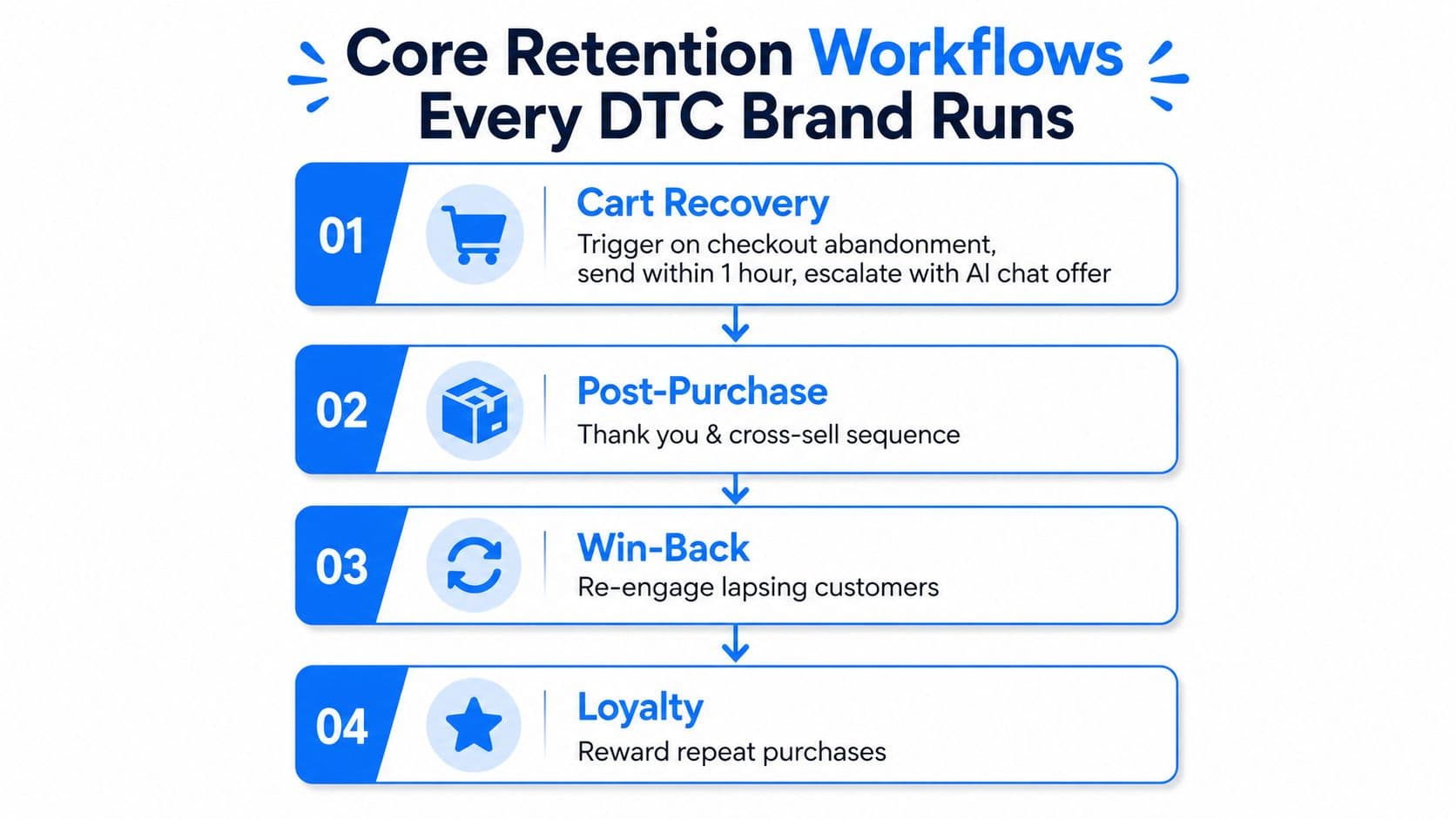
Core Retention Workflows Every DTC Brand Runs
The most reliable flows begin with a clear event, a defined timing window, and a suppression rule. Without all three, automation becomes a sequence of messages rather than a retention system.
Cart recovery
The trigger is checkout or cart abandonment in Shopify. Send the first recovery touchpoint within the first hour, because independent ecommerce guidance identifies the first 30 to 60 minutes as the highest-intent window, while delaying to 24 hours reduces the relevance of the buying context, as detailed in these abandoned-cart email benchmarks. Use email for the first reminder, SMS or push only where the customer has granted permission, and an onsite conversation when the shopper returns.
At the 24-hour mark, an AI chat experience can answer the objection that stopped the purchase, such as sizing, delivery, ingredients, compatibility, or returns. Suppress the entire sequence immediately after purchase. Also suppress duplicate recovery messages from other apps, or the shopper may receive several versions of the same reminder.
For implementation patterns and message sequencing, use this guide to cart abandonment recovery.
Browse abandonment
Trigger this flow when a known visitor views a product or collection without adding to cart or buying. Personalize by category and recent behavior, then keep the sequence short. Two useful messages may be enough: one that helps the shopper evaluate the product and another that addresses a likely objection.
Suppress browse messages when the visitor adds the item to cart, starts checkout, purchases, or enters a higher-priority customer flow. Don't send a generic product blast just because someone viewed a page. The value comes from matching the message to the observed intent. A product recommendation quiz is a useful capture point here, because it turns an anonymous browser into a known visitor with stated preferences.
Post-purchase nurture
Start the sequence from fulfillment or delivery state, not from the order confirmation alone. Before the customer receives the product, send useful order and preparation information. After delivery, provide usage guidance, care instructions, complementary product education, and a review request. Set the reorder reminder according to the category's consumption cycle rather than an arbitrary calendar date. Food and drink brands live on that cycle, which is why our food and beverage chatbot guide leans on subscriptions and reorder prompts.
A consumable may need a replenishment prompt sooner than a durable home product. Industry benchmark data puts 90-day repeat purchase rates at roughly 30% to 45% for consumables, 25% to 40% for beauty, 20% to 32% for apparel, and under 18% for home and durable goods, as outlined in this 90-day ecommerce retention guide. Treat those figures as category context, not as a target that every store should copy.
Win-back and lapsed buyers
Use inactivity thresholds such as 60, 90, and 180 days only when they match the product cycle and customer history. Start with value, education, or a relevant product update. As the gap widens, test a stronger incentive, but exclude active subscribers, recent purchasers, open support cases, and customers already receiving a replenishment sequence.
Flow order matters. A buyer shouldn't receive a win-back offer before receiving the product, understanding how to use it, and reaching a realistic repeat-purchase window.
Where an AI Chatbot Fits Alongside Email and Loyalty
Email, loyalty, and onsite AI chat don't compete for the same moment. They solve different forms of friction.
Email reaches the customer after the session ends. It owns asynchronous education, post-purchase nurturing, and lapsed-buyer reactivation. Klaviyo-style platforms are effective when the message needs context, a product grid, or a sequence that unfolds over time. Onsite personalization is where email data and the live session meet, and our ecommerce personalization examples show what that looks like on the storefront.
A loyalty program works after trust has been established. Points, tiers, referrals, and member benefits give existing buyers a reason to choose the same store again. Loyalty shouldn't be the first answer to a product-page problem. It can't compensate for unclear sizing, weak product information, or a confusing delivery policy.
Onsite AI chat owns the live session. Carti is one option in this layer, designed to answer catalog and policy questions, recommend products, and engage shoppers around buying intent. Setup speed is measured rather than promised: across every production install to date, the median time from install to Carti having the full catalog ingested and answerable is 4.4 minutes, measured from our own sync pipeline as of August 2026. For brands producing specialized landing experiences, resources that help create advertorial pages for DTC brands can complement the onsite conversation by giving shoppers a more focused path into the catalog.
| Lifecycle Stage | Loyalty Program | AI Chat (Carti) | |
|---|---|---|---|
| First visit | Captures permission when appropriate | Usually not active yet | Answers questions and guides discovery |
| Product evaluation | Sends browse follow-up after the session | May explain future rewards | Handles objections, fit, bundles, and comparisons |
| Cart hesitation | Sends recovery sequence | Can remind shoppers of available benefits | Intervenes when intent remains onsite |
| First purchase | Confirms, educates, and cross-sells | Starts earning and membership logic | Answers immediate product or order questions |
| Repeat purchase window | Sends replenishment or recommendation | Rewards the purchase and encourages the next one | Helps select the next relevant product |
| Lapsed state | Runs win-back and reactivation | Offers re-entry incentives where appropriate | Re-engages returning visitors during the session |
The channels can share behavioral events without sending duplicate messages. A cart event may start email, flag a chat state, and make a loyalty balance visible. The purchase event should then clear the cart state, suppress recovery, award points, and move the customer into post-purchase nurture.
For a deeper look at the onsite role, see this guide to an AI chatbot for ecommerce, and our best Shopify chatbots comparison scores the tools in this layer side by side. The important design choice is ownership. One channel should answer the live objection, another should continue the relationship after the session, and the loyalty layer should reinforce profitable repeat behavior.
Measuring Retention Automation the Right Way
Last-click email revenue is not a retention strategy. It tells you which message received credit, not whether customers are buying again because the entire experience improved.
Start with cohorts. Group customers by the month of their first purchase and track subsequent purchase behavior at consistent intervals, including 30, 60, 90, and 180 days. Our returning customer rate guide covers the benchmark context for those curves. A category-adjusted view matters because repeat buying differs across consumables, beauty, apparel, and durable goods. The 90-day benchmarks referenced earlier are useful context, but your own cohort curve should drive decisions.
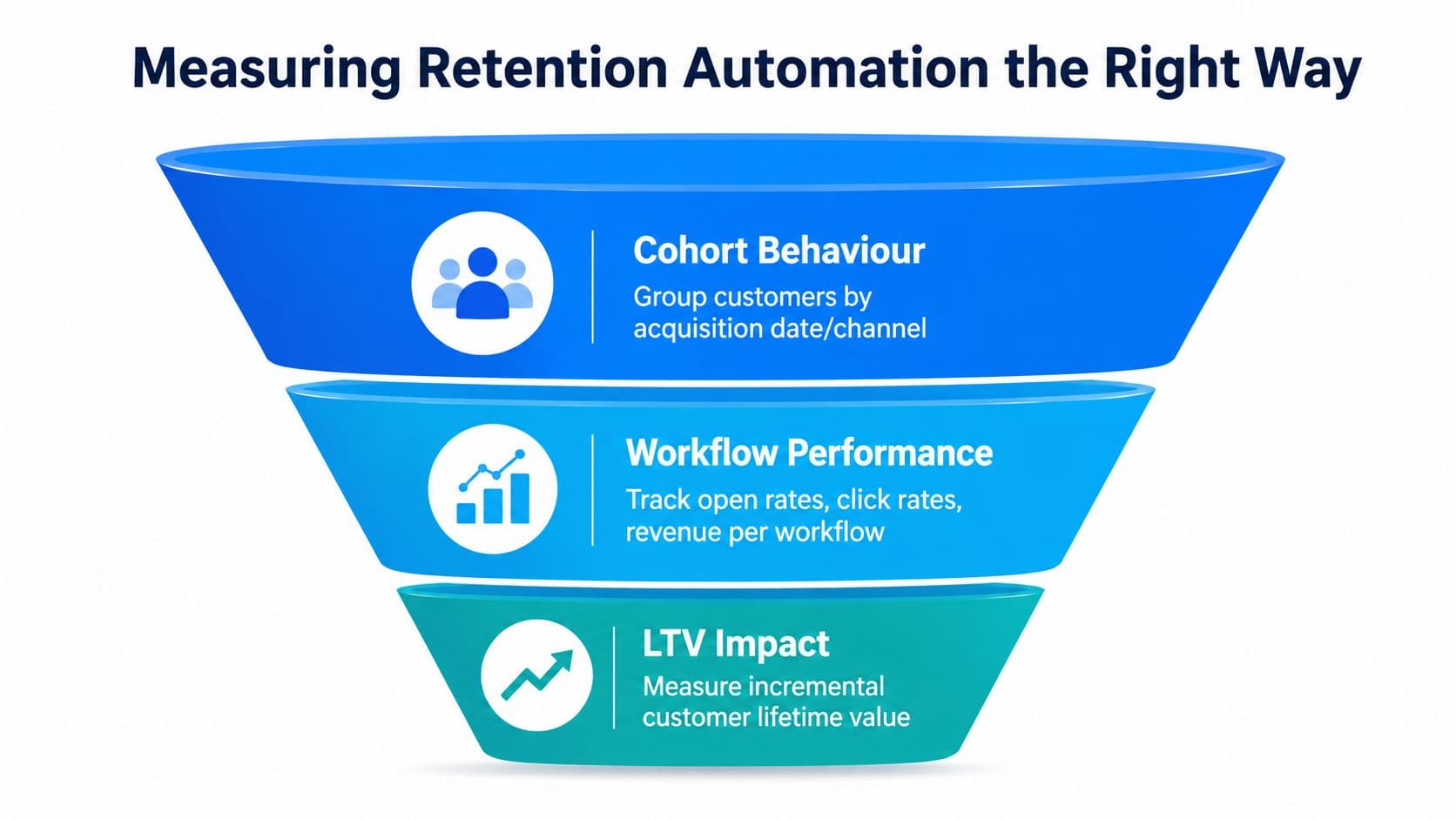
Measure three levels
Cohort behavior shows whether first-order customers become second-order customers. Separate cohorts by acquisition source, product category, discount exposure, and subscription status where the data supports it.
Workflow performance explains which automation is contributing to that curve. Track cart recovery, browse abandonment, post-purchase engagement, replenishment, loyalty participation, and win-back separately. Record delivered messages, clicks, assisted sessions, purchases, revenue, margin impact, and unsubscribes.
Lifetime-value impact is the business layer. Gainsight reports that 76% of companies use customer retention as a primary revenue metric and 55% prioritize gross revenue retention, according to its discussion cited by TSIA's 2025 customer growth and renewal outlook. The implication for ecommerce teams is straightforward: activity metrics matter only when they connect to profitable customer behavior.
Tag every automated message with a unique flow and campaign identifier. Store the originating trigger, customer state, channel, offer, and suppression outcome. If email claims a purchase while onsite chat and loyalty also influenced the customer, use a consistent attribution model rather than treating every channel's report as incremental revenue.
A flat cohort curve can indicate message fatigue, weak product value, poor timing, or a suppression gap. Don't replace the platform before checking those mechanics.
Your 30-Day Implementation Checklist
A retention system should be launched in an order that reduces collisions. Start with clean events and customer states, add the simplest asynchronous flows, then introduce onsite decision-making and loyalty logic.
Week one builds the foundation
Instrument the Shopify events your workflows will need: product view, add to cart, checkout started, checkout abandoned, purchase, fulfillment, delivery, subscription status, and customer consent. Audit existing Klaviyo, Omnisend, Emailwish, SMS, loyalty, and popup flows before adding anything. Duplicate automations are a common source of over-messaging.
Define the customer states the system must recognize:
- New visitor: Has no purchase history and needs product discovery.
- Known non-buyer: Has engaged but hasn't completed an order.
- First-time buyer: Needs confirmation, education, and a path to the next purchase.
- Repeat buyer: Can receive loyalty, cross-sell, and replenishment logic.
- At-risk customer: Shows inactivity relative to the category's buying cycle.
- Active subscriber: Must be excluded from inappropriate win-back and discount flows.
Week two launches core workflows
Set up cart recovery, browse abandonment, welcome, and post-purchase confirmation in the email platform. Keep the first version operational rather than clever. Every flow needs a trigger, entry criteria, timing, message purpose, and exit condition.
Run live test orders and abandoned sessions. Confirm that a completed purchase suppresses cart recovery, that a new order moves the customer out of browse abandonment, and that fulfillment state controls post-purchase timing.
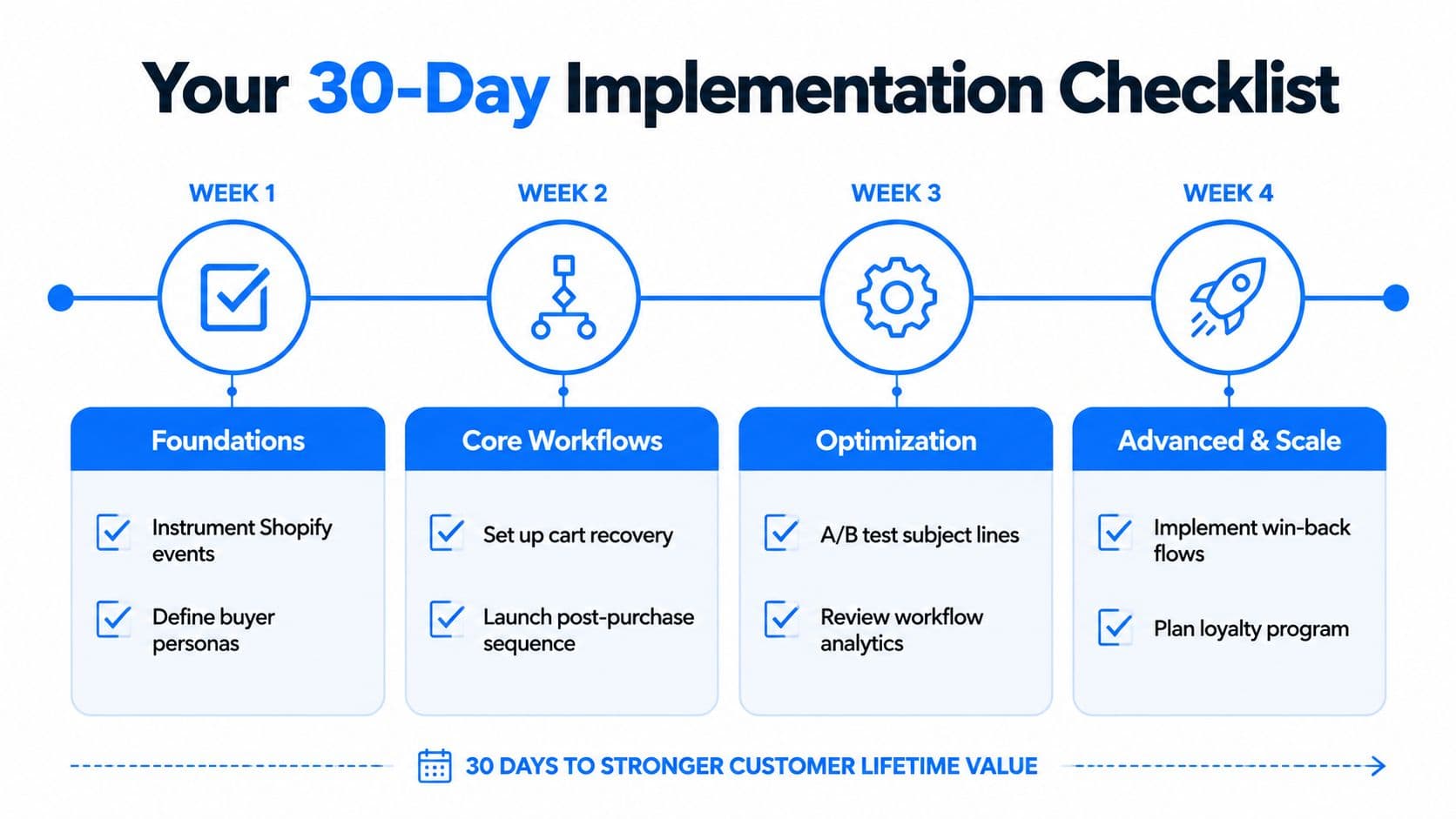
Week three adds onsite and loyalty
Install the onsite AI chatbot and connect it to the same product catalog, policies, and behavioral events used by email. Configure intent states so chat can assist an active shopper without restarting an email sequence or showing an irrelevant offer.
Add loyalty earning rules for actions that matter, such as purchases and referrals. Avoid rewarding every low-value interaction unless the margin model supports it. Loyalty should reinforce the behavior the broader retention system is already trying to create.
Week four measures and tunes
QA every workflow with live customer-state tests. Check consent, suppression, frequency limits, product availability, discount exclusions, and order-status accuracy. Create a cohort baseline and document which Shopify event feeds each channel.
Then review the first signals without overreacting to short-term noise. Fix broken triggers and conflicting messages before adding another app or another channel.
Best Practices, Pitfalls, and Common Questions
Profitable automation has less to do with the number of flows than with the quality of decisions behind them. Anchor each workflow to revenue, margin, repeat purchase, or customer experience. Prune flows that create clicks but no meaningful customer action, and don't add a new channel while the existing one still has unresolved suppression or attribution problems.
Practical rule: Every automated message should have a reason to exist, a customer state it serves, and a clear condition that stops it.
Common failures are predictable:
- Over-emailing recent buyers: Customers who just purchased need confidence and product value, not an immediate stream of unrelated promotions.
- Letting loyalty ignore margin: Points and rewards should support profitable behavior, with exclusions for products or orders that can't absorb the cost.
- Using chat to hide weak merchandising: A chatbot can answer questions, but it can't fully repair missing product details, poor photography, or confusing navigation.
- Treating every category alike: Replenishment logic must follow observed buying cycles, not a universal schedule.
- Counting platform-attributed revenue as incremental: A message can receive credit without changing what the customer would have done anyway.
Common questions
Q: Does an AI chatbot replace rule-based chat?
Not automatically. Rule-based chat is useful for predictable menus and routing, while AI chat can interpret natural-language questions and connect answers to catalog context. Use the approach that matches your data quality and support complexity.
Q: Does retention automation replace an email platform?
No. Email remains the asynchronous communication layer. Automation should coordinate email with onsite, SMS, push, loyalty, and subscription events rather than eliminate the tools that perform those jobs.
Q: What budget does a Shopify brand need for retention automation?
There isn't a responsible universal amount. Start with the lowest-complexity stack that can capture events, send core flows, support consent, and report on outcomes. Expand only when a measured bottleneck justifies the added cost.
Q: How soon will repeat-purchase lift appear?
Timing depends on category cycle, customer mix, offer strategy, and product experience. Watch cohorts over the relevant buying window instead of judging success from early opens or clicks.
Carti adds an onsite AI layer to customer retention automation by answering product and policy questions, recommending relevant products, and engaging shoppers around cart or browsing intent. Visit Carti to see how a Shopify store can add that conversational layer without turning retention into a stack of disconnected apps.

Written by
Daniel AndersonFounder of Carti. 10+ years building ecommerce brands in apparel and supplements. Still runs a Shopify store and built Carti to help merchants convert more browsers into buyers.
Ready to boost your store's sales?
Install Carti in 5 minutes and let AI handle customer questions, recommend products, and close sales 24/7.
Start Free Trial14-day free trial